Does your faith need strengthening? Are you confused and wondering if Jesus Christ is really "The Way, the Truth, and the Life?" "Fight for Your Faith" is a blog filled with interesting and thought provoking articles to help you find the answers you are seeking. Jesus said, "Seek and ye shall find." In Jeremiah we read, "Ye shall seek Me, and find Me, when ye shall seek for Me with all your heart." These articles and videos will help you in your search for the Truth.

Wednesday, March 21, 2018

The Unlearned Lesson of My Lai

By Conor Friedersdorf, The Atlantic, March 16, 2018

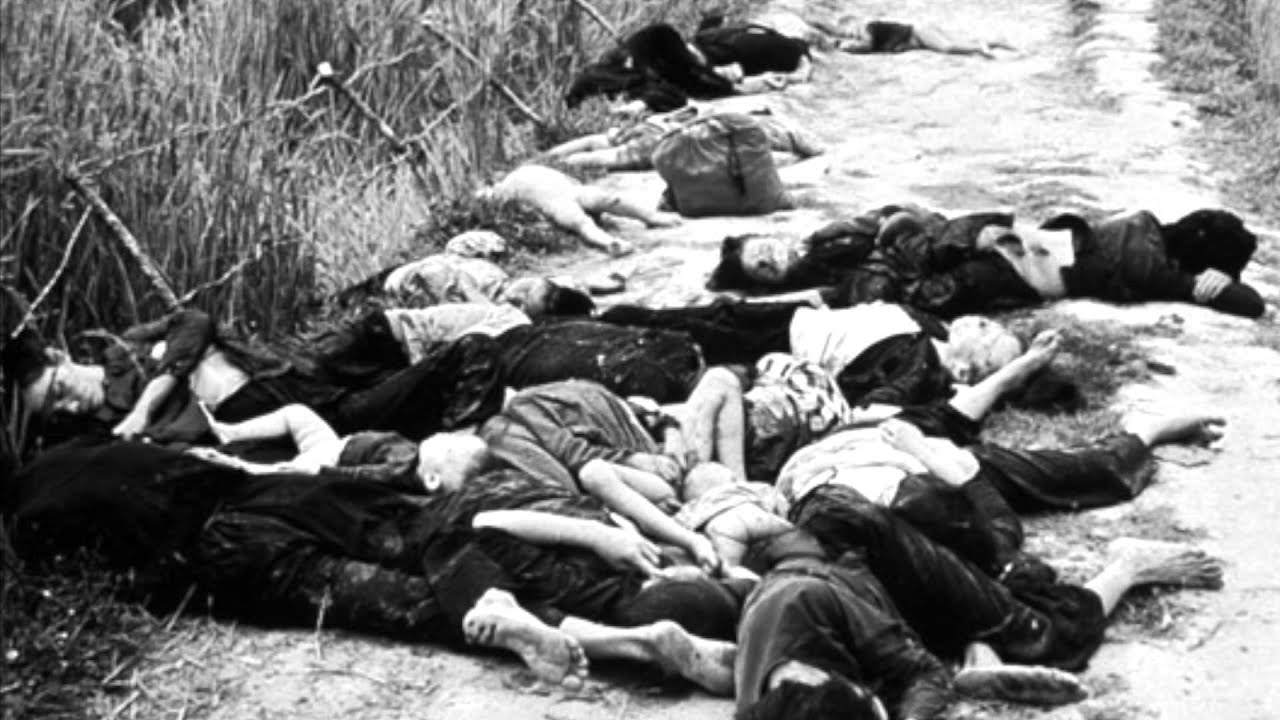
When U.S. Army soldiers ended their massacre of elderly men, women, and children in a South Vietnamese hamlet 50 years ago–on March 16, 1968–perhaps 500 civilians lay dead.

The green troops expected to meet Vietcong forces, but instead found unarmed families. “During the next few hours, the civilians were murdered,” Seymour Hersh later wrote. “Many were rounded up in small groups and shot, others were flung into a drainage ditch at one edge of the hamlet and shot, and many more were shot at random in or near their homes. Some of the younger women and girls were raped and then murdered. After the shootings, the G.I.s systematically burned each home, destroyed the livestock and food, and fouled the area’s drinking supplies.”
Image result for my lai massacreThe My Lai massacre still shocks the conscience.

It’s hard to fathom how a group of young American men, most of whom would never have killed anyone but for the Vietnam War, spiraled out of control together, perpetrating atrocities that rival any committed in the annals of human warfare.

And yet, whenever a country’s civilian leaders decide to send young men to fight any war of sustained length, it is almost certain that discipline will break down somewhere, that savagery will take hold sometime, and that shameful evil will be done, as had happened during the Civil War, World War I, World War II, and the Korean War.

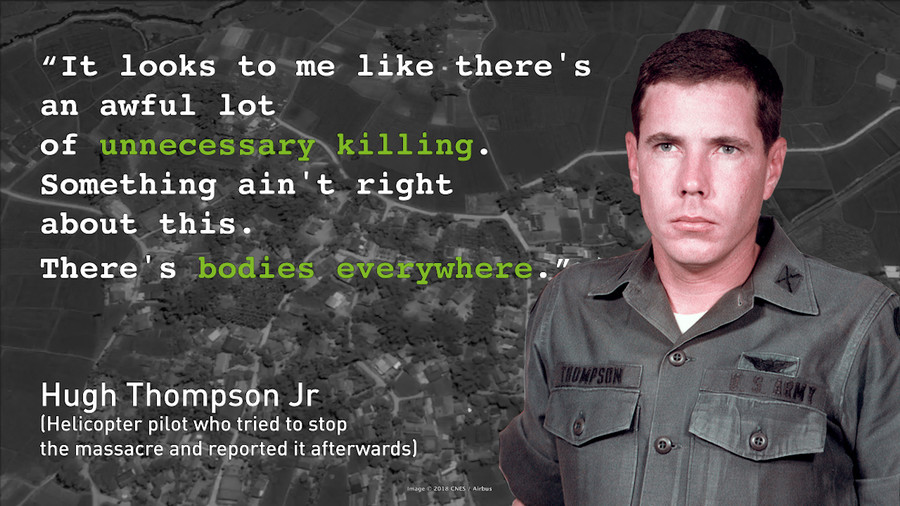
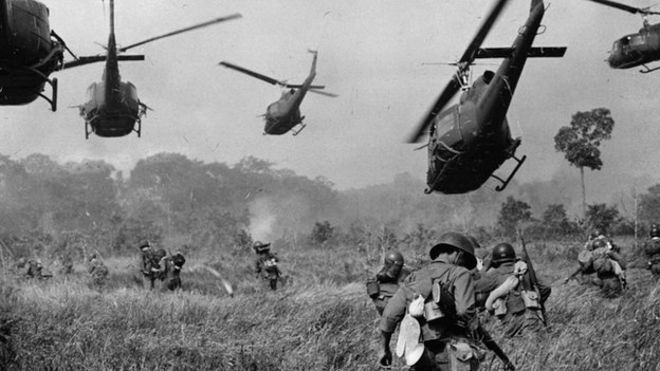
A country can minimize the evil perpetrated in its name, by its soldiers, by going to war only as a last resort; maintaining discipline as best as is humanly possible during armed conflict; holding war criminals responsible for their deeds; and treating those who stop or uncover crimes against humanity as heroes rather than villains. The hero of the My Lai massacre was helicopter pilot Hugh Thompson, Jr. Along with the members of his crew, Glenn Andreotta and Lawrence Colburn, he began observing the U.S. troops in Son M? Village from the air, believing them to be attacking enemy forces. It took time for him to realize that the soldiers of Company C were committing mass murder. At that moment, he could easily have just flown away.

Image result for my lai massacreInstead, he landed his helicopter, confronted heavily armed child killers and rapists amid their killing frenzy, and saved the lives of at least 11 civilians. As The New York Times described it decades later in his obituary:

He touched down near a bunker in which a group of about 10 civilians were being menaced by American troops. Using hand signals, Mr. Thompson persuaded the Vietnamese to come out while ordering his gunner and his crew chief to shoot any American soldiers who opened fire on the civilians. None did. Mr. Thompson radioed for a helicopter gunship to evacuate the group, and then his crew chief, Glenn Andreotta, pulled a boy from a nearby irrigation ditch, and their helicopter flew him to safety.

Image result for my lai massacreUpon returning to base he reported what he saw. And that likely saved many more innocents, for commanders ordered a halt to an operation that had been planned to include forays into other nearby hamlets where more killings could have taken place.

When I reflect on the My Lai massacre, I cannot put myself in the minds of the dozens of men who perpetrated it nor the three who risked their lives to intervene. I don’t know if anyone can fully explain either savagery or heroism in war.
Image result for my lai massacre

But a country needn’t solve any mystery to know how it ought to respond to mass murder. And that’s why, in my judgment, the U.S. should feel the most shame for the fact that just one man, Lieutenant William Calley, was ever punished for the mass killings. Found guilty of murdering no less than 20 people, he was sentenced to life in prison, but put on house arrest instead after President Nixon intervened. In the end, even he served just three-and-a-half years of house arrest. Then he went free.


He is now 74.

And Hugh Thompson? After news of the My Lai massacre reached the United States, this was his experience:

After it broke, I was not a good guy. I was sure not being invited to Annapolis or West Point or any other university that I’ve been to since, because I was a traitor. I was a communist. I was a sympathizer. I was neither one of those, I didn’t think. I was very confused about why I was being treated this way, because how wrong can it be helping a fellow human? And I’m no pacifist either. You know, I’m not one of these peacenik guys. So I was just very confused, and that went on for about 30 years.

Image result for my lai massacre calley

I became invisible. When it first broke, people thought everybody was picking on Lieutenant Calley. Believe me, Lieutenant Calley was very guilty. There is no way to get around it. But we, being Americans, we cheer for the underdog, so that’s what people were thinking. They thought the establishment was picking on this little guy. The turmoil the United States was in during this time was quite significant. We had demonstrations on every campus in the United States except about three, and I guarantee they were right outside your gate, because we had been there too long. We were [the demonstrators said] nothing but a bunch of baby killers, you know, and it was just a bad time for America.

And Congress came after me real hard. A very senior congressman made a public statement that if anybody goes to jail in this My Lai stuff, it will be the helicopter pilot.
Image result for my lai massacre calley
He later told 60 Minutes, “I’d received death threats over the phone. Dead animals on your porch, mutilated animals on your porch some mornings when you get up.” He and his crew did not receive the Soldier’s Metal until 1998. He lived to see the Army teach his behavior as a model of good soldiering. He died in 2006.

If the Armed Forces could train its members so that the murder of civilians would never again occur, and so that all soldiers possessed the moral rectitude and courage of Hugh Thompson, it would–and the moral risks inherent in wars of choice would shrink. Unfortunately, no army can totally eliminate war crimes perpetrated by its worst soldiers, nor can any Army simply replicate the best of its men.

Image result for my lai massacre
Meanwhile, the government’s unwillingness to prosecute torturers, despite its treaty obligations, shows that it sometimes remains willing to tolerate war criminals as it fights its enemies, and that the public is often oblivious to misbehavior by its soldiers.

That’s why, even though the Armed Forces have learned from My Lai, the surest way for the United States to avoid its next crime against humanity is for it to avoid wars of choice. Admittedly, the possibility of war crimes cannot by itself tell us whether it is prudent or imprudent to participate in a given conflict; but the next time that a war is being considered, rather than pretend that no American soldier would ever intentionally rape, maim, or murder, the near certainty that sustained war will include atrocities perpetrated by Americans should always at least weigh against waging it.

Tuesday, March 20, 2018

Friday, March 16, 2018

Wednesday, March 14, 2018

Sunday, February 18, 2018

Does Christianity Stand on Faith or Evidence?

By Dan Delzell, Christian Post, Oct. 23, 2011

I had an interesting e-mail exchange with an agnostic this week. He wrote: “If there were good evidence to corroborate the Bible, would you need faith? Correct me if I am mistaken, but faith lies at the core of the Christian worldview, not reliance on evidence.”

That is an excellent question and one that I suspect lies at the heart of why many agnostics and atheists have yet to seriously evaluate Christianity. If they only knew that the core of the Christian worldview is actually evidence rather than faith, many of them might finally look at the evidence with an open mind. It is only after one is presented solid evidence that he is invited to place his faith in the facts of the Gospel. Christian faith stands on something permanent and proven.

I am talking about mathematical and statistical evidence that any jury would hear about if the Bible was put on trial. The Bible can be judged as being either miraculous or man-made.

There are over 300 Old Testament prophecies fulfilled in the life, death, and resurrection of Jesus Christ. The statistical probability that Jesus of Nazareth could have fulfilled even 8 such prophecies would be 1 in 100,000,000,000,000,000.It is impossible that the Bible did not come from God. No scheme of man could have pulled it off over those many centuries. In order to reject the Bible, a person must have a strong predisposition against it from the outset. Otherwise, the evidence makes it a “slam-dunk case.”

To tell you the truth, I don’t think it takes very much faith to believe that “all Scripture is God-breathed.” (2 Timothy 3:16) How much faith does it take a jury to come back with a verdict in the midst of overwhelming evidence? What if a jury had 300 pieces of evidence that all pointed to the same person the way 300 biblical prophecies all point to Christ?

Skeptics will say, “You are using the Bible to validate the Bible.” True. But we are really dealing with 66 books written over hundreds of years. There is no dispute among scholars regarding the historical accuracy of the Bible. William Albright was a biblical and archeological scholar who mastered more than 26 ancient and modern languages. Albright wrote, “The excessive skepticism shown toward the Bible by important historical schools of the eighteenth and nineteenth centuries, certain phrases of which still appear periodically, has been progressively discredited. Discovery after discovery has established the accuracy of innumerable details, and has brought increased recognition to the value of the Bible as a source of history.”

I love the way Charlie Campbell lays out 10 solid reasons to completely trust the Bible. He goes into detail on each one, but here are the basic categories:

1. Fulfilled Prophecy

2. Archaeological Verification

3. The Bible’s Internal Consistency

4. External Verification

5. The Bible’s Amazing Scientific Accuracy and Foresight

6. The Manuscript Evidence

7. The Bible’s Forthrightness about Its Author’s and Hero’s Failures

8. The Willingness of Jesus’ Disciples to Suffer

9. The Bible’s Transforming Power for Good

10. The Testimony of Jesus, the Son of God

Christianity stands on facts. It stands on evidence. Christianity is entered into through faith. It is not a blind faith. It is faith in the facts. It is faith in something concrete. Christianity builds on past events and believes for the future fulfillment of all of God’s prophecies and promises. Without the Bible, we would only have mystical experiences to rely upon. How trustworthy would that be?

You will never find evidence like what we have in the Bible. Try to find one “holy” book of any other religion that has even ONE fulfilled prophecy. Where is the mathematical evidence in any of those religions? Where is the statistical and mathematical certainty to stand on when stepping out in faith for future events and for the eternal well-being of your immortal soul?

The order is for Christianity is: (1) Evidence; (2) Faith; and then (3) Assurance. Christianity stands upon evidence. It is personally received through faith that Jesus died for your sins on the cross. It brings comforting assurance to those who have stepped out in faith to trust Christ. You will never have the true assurance of salvation until you take a step of faith based on the evidence. Some non-Christians have a false sense of assurance without Christ, but in the end it tragically disappoints. Their assurance is not based on solid evidence, but only faith in someone or something other than the Jesus of the Bible.

God made you as a rational human being. God has given us rational reasons to know that He is trustworthy. Just look out into the universe. It is rational to believe that only God could have created such majesty. “The heavens declare the glory of God.” (Psalm 19:1) Are you listening to His voice in the heavens? Are you evaluating the evidence reasonably?

There was a once a man whose religion stood on faith rather than tons of evidence. His name was Abraham. The Bible tells us, “Abraham believed God, and it was credited to him as righteousness.” (James 2:23) What history did Abraham really have to go on before he was asked to trust God? What prophecies had been fulfilled? What evidence did he have to stand on? Very little compared to what you and I have been given over the past 6000 years of biblical history. Abraham was a man of tremendous faith.

If Abraham could believe God with little history to go on, you can certainly do it once you have studied the evidence for the Bible with your rational mind. God can be trusted. He always comes through and does what He says He will do.

Original article found here: https://www.christianpost.com/news/does-christianity-stand-on-faith-or-evidence.html

Copyright © Fight for Your Faith