Does your faith need strengthening? Are you confused and wondering if Jesus Christ is really "The Way, the Truth, and the Life?" "Fight for Your Faith" is a blog filled with interesting and thought provoking articles to help you find the answers you are seeking. Jesus said, "Seek and ye shall find." In Jeremiah we read, "Ye shall seek Me, and find Me, when ye shall seek for Me with all your heart." These articles and videos will help you in your search for the Truth.

Saturday, May 19, 2018

“On Faith vs Works”

Dennis Edwards

Thanks for writing. Don´t worry about running. If all you can do is walking, then that is all you can do. And that’s fine, so stop comparing what you can do with what I can do. We often push ourselves too hard by trying in our own strength. It is just like with Salvation. Paul writes, “Not by works of righteousness which we have done, but according to His mercy He saved us, by the washing of regeneration and renewing of the Holy Ghost.”[1] 

In Ephesians he says, “For by grace are you saved through faith; and that not of yourselves: it is a gift of God: not of works, lest any man should boast.”[2] In his letter to Timothy he proclaims, “Who has saved us, and called us with an holy calling, not according to our works, but according to his own purpose and grace, which was given us in Christ Jesus before the world began.”[3]

That´s why Jesus said, “Come unto Me all ye that labor and are heavy laden, and I will give you rest. Take My yoke upon you and learn of Me, for I am meek and lowly of heart: and you shall find rest unto your souls. For My yoke is easy and My burden is light.”[4] If the yoke is too hard and the burden is too heavy, maybe it is not His yoke but your own or someone else's that you have unwisely taken upon yourself or allowed others to place upon you. 

Maybe you are trying too hard in your own strength to save yourself, that you are not letting Him do it. You are not believing in His word like you should be, but are trying to earn your salvation with masses, and communions, and prayers, etc. Not that these things are necessarily wrong. But if you are trusting in them to save you, then you are working your way into God´s presence, when all He asks is that we call upon Him with all of our heart. 

In Jeremiah we read, “Call upon Me and I will answer you.”[5] “Ye shall seek Me and find Me when you shall search for Me with all you heart.”[6] Notice that He said with all your heart, not all your works. 

Later in Romans Paul says, “Whosoever shall call upon the name of the Lord shall be saved.”[7] This question of a second birth was even hard for Nicodemus to understand. He was the religious leader who came to Jesus in the cover of night to inquire more into Jesus’ teaching. But the truth is, we must be born again. That’s what Jesus said, “Except a man be born again he cannot see the kingdom of Heaven.”[8]

Dear one, we can never earn our salvation through our own works of righteousness. In Isaiah we read, “Our own righteousness is as filthy (menstrual) rags.”[9] But God in His mercy sent us His Son to die on the cross that we might have the free gift of eternal life. “For God so loved the world that He gave His only begotten Son that whosoever believes on Him shall not perish but have everlasting life.”[10] You see, salvation is a gift of God, but right from the beginning of time man has been trying to save himself through his own righteousness. 

Remember the story of Cain and Abel. Instead of offering a lamb as a sacrifice as God had requested, Cain offered the works of his own hands. God was displeased because He wanted obedience, not sacrifice. The lamb even there in the beginning of time typified the “Lamb of God which would take away the sins of the world.”[11]

Cain got so mad that he killed his brother Abel, whose simple faith and obedience had showed Cain up for the self-righteous religionist that he was. God does not want our religion, He wants our hearts. 

God has promised that if we open our hearts to Him and ask Him to come in, believe on Him by faith[12] that He was raised from the dead, He will come in and have fellowship with us and we shall be saved, or secured in His love and protection. 

In Romans Paul writes, “That if you shall confess with your mouth the Lord Jesus and shall believe in your heart that God has raised Him from the dead, you shall be saved. For with the heart man believes unto righteousness, and with the mouth confession is made unto salvation.”[13] Notice he says that righteousness comes by belief, not by works.
 
That’s why Augustine in his Homilies on the Gospel of John wrote, “Understanding is the reward of faith: therefore, do not seek to understand in order to believe, but believe that thou mayest understand.”[14] So we see that faith comes before a proper understanding. In other words, faith is the key to a proper understanding of things here and now and here after. Solomon wrote, “ Wisdom is the principal thing; therefore get wisdom: and with all thy getting get understanding.”[15] But in order to get that wisdom, we need faith. Not a blind faith, but faith built on reason and experience. That's why Peter tells us to give a reasoned defense of our faith, and Paul tells us to study that we might be approved unto God, rightly dividing the word of truth.

Paul also talks a lot about the importance of faith in both Roman’s chapter four and Hebrews’ chapter four. By believing in Jesus we enter into rest through faith. We no longer struggle to save ourselves or to keep ourselves saved but rest in Him, believing on His word and precious promises. Remember that Mary, the sister of Martha, chose the good part and sat at Jesus’ feet to be ministered to by Him, while her sister Martha continued to serve. And the Lord chided Martha when she requested that Jesus make her sister go back to work. He said, “But one thing is needful: and Mary has chosen that good part which shall not be taken away from her.”[16]

In the book of Revelation Jesus says, “Behold, I stand at the door (of your heart) and knock. If any man hears My voice and opens the door, I will come in to him and sup with him and he with Me.”[17] Pray this little prayer with me or something like it and have your sins washed away once and for all. 

“Dear Jesus, I believe you are the Son of God and died for me and have taken upon Yourself the sins of the world including mine. Thank You for dying for me. I now accept You into my heart for eternity. I believe You rose from the dead and I trust in You for eternal life. Please forgive me for my sins and self-righteousness. Help me to rest in You and in Your love and mercy and freedom. Grant me an infilling of Your Holy Spirit so I too may have the power to walk with You. In Jesus name, I pray.” 

If you have sincerely prayed this prayer or one similar from your own heart you are saved. The fight for your eternal soul is over and you can rest in Jesus knowing that you are His for eternity. Jesus said, “My sheep hear my voice, and I know them, and they follow me. And I give unto them eternal life, and they shall never perish, neither shall any man pluck them out of My hand. My Father which gave them Me, is greater than all; and no man is able to pluck them out of My Father´s hand. I and My Father are one.”[18]

I hope this helps. If you have any more questions please feel free to ask.

Notes:

[1] Titus 3;5
[2] Ephesians 2:8-9
[3] 2 Timothy 1:9
[4] Matthew 11:28-30
[5] Jeremiah 33:3
[6] Jeremiah 29:13
[7] Romans 10:13
[8] John 3:3
[9] Isaiah 64:6
[10] John 3:16
[11] John 1:29
[12] There are strong and reasonable arguments that support the claims of the disciples as the best inference from the evidence at hand, i.e., the empty tomb and the fact that neither the Jews nor the Romans produced a dead body to disprove the resurrection event, and that none of the disciples, who were eyewitnesses and knew the truth of the situation, recanted on their beliefs even in the face of severe persecution and martyrdom. Martyrdom does not prove truth, but it does prove sincerity. But the fact that the disciples were in a position to know the truth of the resurrection lends toward the conclusion that the resurrection was in fact true and not a myth developed later by them. 
[13] Romans 10:9-10
[14] Augustine, “Homilies on the Gospel of John” 29.6
[15] Proverbs 4:7
[16] Luke 10:42
[17] Revelation 3:20
[18] John 10:27-30
Friday, May 18, 2018

Israel Celebrates Birthday With Gaza Massacre


Monday, May 14, 2018

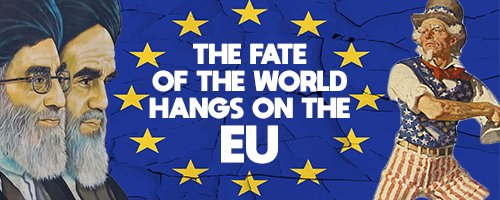
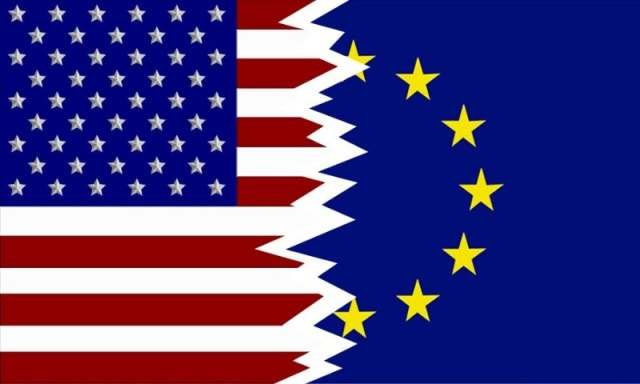
The Fate of the World Hangs on the EU?!?

by James Corbett corbettreport.com                                                                         May 12, 2018
So it's come to this. The fate of the world hangs in the balance...and it's the EU that's going to be
the deciding factor. The EU? Really? Sigh.

You may have heard that the US scrapped the Iranian nuclear deal this week, setting off a series of events that could very likely end up in a regional conflagration. But if that's what you heard, then you heard wrong. In actuality, Trump signed an Executive Memorandum on Tuesday that reaffirmed his October 13, 2017 decision to deny re-certification of the JCPOA and lifted sanction waivers promised under that agreement.

Confused? Don't worry, so is mostly everyone else. But here's the bottom line: the "Iran nuclear deal" was not some treaty between the US and Iran. It was a Joint Comprehensive Plan of Action signed by China, France, Russia the United Kingdom, the United States, the EU and Iran. In other words, only one player in this seven-member deal is walking away from the table.

This is not a trivial distinction. What it means is that it is still perfectly possible that the other signatories to the agreement could continue on with the agreement or hammer out some replacement for it. At the very least, Europe could stand up to Washington's sanctions regime...if they followed Mish Shedlock's advice and "Grow a Backbone on Something Important," that is. As Mish points out, billions of dollars of European business are on the line. That money will be lost if the Europeans just roll over and accept US demands to wind down all business in Iran in the next three to six months.

Deals that will be scuttled if Europe complies with the US sanctions include:
A $20 billion order of 100 Airbus jets from Iran Air.
A $1 billion natural gas extraction deal project led by France's Total SA.
An $800 million automotive joint venture between Iran and Renault.
Hundreds of millions of dollars of investments, development projects, licensing agreements and sales by Royal Dutch Shell and BP.Not that you should be crying in your beer over any of these corporate behemoths and their lost billions, of course, but the idea that European politicians would simply allow the US to walk away from a deal that the Iranians were in full compliance with and demand all the other parties do likewise is sheer insanity. Needless to say, this isn't about doing what is economically rational. It is about the US using its clout as the unquestioned unitary world superpower to force its "allies" to do its bidding.
And lest there be any confusion on the matter, let's be clear: These are not idle threats. When French banking group BNP Paribas SA dared to circumvent US sanctions on Iran, Cuba and Sudan between 2004 and 2012, a US judge forced them to forfeit a staggering $8.83 billion in profit and fined them a further $140 million to boot. This was a US judge, mind you, in US court upholding US sanctions, and ruling against a French bank. But when you are the self-appointed policeman of the world you get to throw anyone you want in jail. After all, who's going to stop you?

Bear in mind, this isn't some conspiratorial 3D chessboard political game going on. It's right there on the table. The US is telling Europe to jump and it's daring the Europeans to say anything other than "Sir, yes, sir!" This arrogance is so over the top, in fact, that France's ambassador to the UN has coined a whole new word to describe it: "unisolationism." It's a portmanteau of unilateralism and isolationism, and no one (least of all the Trump administration) would deny that it describes Washington's geopolitical philosophy.

And so it boils down to this: The EU and its leading nations have some soul searching to do. Are they going to roll over and do what they're told, like Uncle Sam's dependable lapdog, or are they going to defy their erstwhile master and refuse to comply with a new round of Iranian sanctions?

If this soul-searching at the heart of Europe sounds vaguely familiar to you, that's because it's nothing new. And this isn't just about Iran; it's about the shape of global geopolitics.

I wrote about this struggle last year in an editorial titled "US Battles Russia for Heart of the EU." Don't forget, it was less than a year ago that a similar sanctions scenario (this time involving Russia) likewise placed a fork-in-the-road in front of Europe: Go along with American sanctions at the expense of Europe's own business interests, or defy Uncle Sam and begin constructing a Eurasian alternative to the Pax Americana that has dominated the globe since the Second World War.
It may be said that no such radical realignment of Europe took place last year, but these types of world-historical changes generally do not take place all at once. They happen little by little over a period of years until the change can no longer be denied. So, is there any indication that Europe is inching out from under the American umbrella? Why, yes. Actually there are.

German Chancellor Angela Merkel has announced that "It’s no longer the case that the United States will simply just protect us. Rather, Europe needs to take its fate into its own hands, that's the task of the future."

EU President Jean-Claude Juncker has come out hard against the US withdrawal from the JCPOA, stating that Washington "no longer wants to cooperate with other parts in the world" and, as a result, "has lost vigor [as an international actor], and because of it, in the long term, influence."

And in a more concrete sense, the EUrocrats are reportedly rushing "to pull together legislation aimed at defending European companies from Washington's new crackdown on Iran."

Now the punditsphere is openly musing on the questions of whether or not Europe has rebelled and what kind of relationship will be possible between Brussels and Washington going forward.

It's a good question, and an important one. As I've pointed out many times before, we are being prepared for a transition away from the unipolar American-dominated world into a multi-polar BRICS-led "alternative" global system. As I've also pointed out many times before, this "alternative" is a false one, and those interested in human freedom should not be swept up in choosing sides in this false dialectic.
But make no mistake: a change is occurring, and with every passing year it is becoming more and more obvious that Europe's long-term economic interests revolve around forging new, deeper ties with its Eurasian neighbors. Whether or not the EU ultimately goes along with America's Iranian sanctions will be a bellwether of how quickly that change is taking place.

Dennis Edwards: The collaboration of Europe with Russia would seem to be what the Bible prophecies predict if we are understanding them correctly. Trump seems to be isolating America which is closely tied to Israel from the rest of the world. Again, Bible prophecy seems to indicate that America and Israel will be die-hard allies in the conflicts that lead up to Armageddon.
Dear Lord come quickly should be our prayer. But He will not come until we pass through these tumultuous times of terror on the way to Armageddon. "Immediately after the tribulation of those days shall sun be darkened and the moon shall not give its light... and then shall appear the sign of the Son of Man in the heavens and then shall all those that dwell upon the earth mourn when they see the Son of Man coming in the clouds of heavens with power and great glory. And He shall send forth His angels with a great sound of a trumpet and they shall gather together His elect from the four winds of the earth from one end of heaven to the other."

Evangelicals find like-minded Christians in unlikely place: Palestinian West Bank

By Dan Rabb, Religion News Service, May 11, 2018

BEIT SAHOUR, West Bank (RNS)–Smiling as he sings, Pastor Danny Awad faces his flock with eyes closed and palms turned skyward. The 30 or so worshippers scattered across two narrow rows of benches clap or sing along as the synthetic drone of an electric keyboard hums out a song of praise.

“Hallelujah!” Awad says, still smiling, as the song comes to an end. He rests his hands on the lectern, looking comfortable in front of the wooden cross that stretches floor-to-ceiling on the wall behind him. He motions for the others to be seated and prepares to deliver his sermon.

At first glance, this airy little church, modestly decorated with artificial flowers and faded posters of New Testament verses, could be any evangelical gathering from Topeka to Texas. Sunday morning hymns spill out its open windows into the small pasture outside. One detail sets this small community of believers apart, however, and has made it something of an apostate within the global evangelical community: the Palestinian flag that hangs prominently from the pulpit.

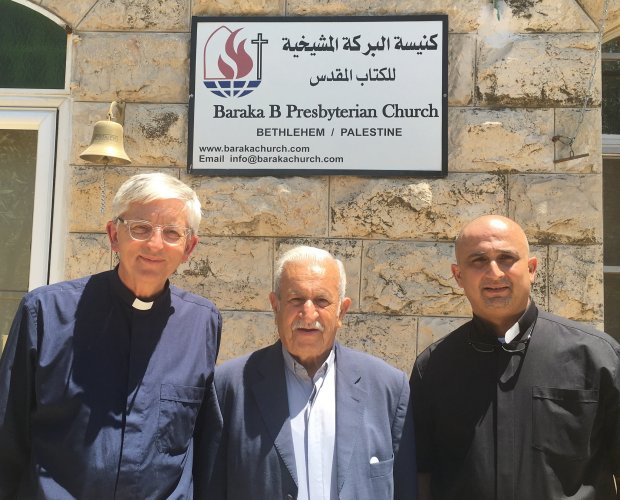
This is not the heartland, but the Holy Land. The Baraka Bible Presbyterian Church, led by Awad, sits off the main road in the West Bank village of Beit Sahour, near Bethlehem. It’s an evangelical church that is proudly, defiantly Palestinian.

In the context of the Middle East, where “evangelical” has become political shorthand for conservative Western Christians with a distinctly pro-Israel orientation, the idea of a Palestinian evangelical can seem like a contradiction in terms.

Image result for Pastor Danny AwadTime and again, the Baraka Church has found itself caught in the conflict inherent in that moniker. The congregation broke off from its parent organization, the Bible Presbyterian Church, after a dispute over what Awad and others saw as the American church’s pro-Israel leanings.

The subsequent dispute over the church’s land has been fought in courthouses in three different countries. It has also turned off the spigots of funding that normally flow freely to other evangelical congregations in the Holy Land.

“The other evangelicals have pretty much forsaken us, for the most part,” says Awad.

Yet even as his congregation dwindles from hundreds down to fewer than 50, Awad has begun using his unique pulpit to try to insert his voice into the global evangelical landscape. He is convinced the tide is turning, and that he’ll be able to engage American evangelicals as the unlikeliest allies for the Palestinian cause.

For now, though, the thousands of evangelical tourists who come to the Holy Land mostly stay on the other side of the separation wall that runs through the heart of downtown Bethlehem. Some are bused through the checkpoint to visit the site of Jesus’ birth, but the practicing evangelicals of the West Bank are, for the most part, kept out of sight and out of mind.

While the travel restrictions imposed on Palestinians keep Awad from traveling to Jerusalem himself, he says he is dismayed by pictures he sees of evangelical tourists praying at the Western Wall.

“They go there to worship at the dead stones of the Jews,” Awad says. “But they ignore us: the living stone, the living body of Christ.”

Awad has made it his mission to show American evangelicals that his community exists by engaging directly with American evangelical leaders. The best way to get Palestinian Christians on Americans’ radar is by entering into Christian fellowship with them, Awad says.

And at the Baraka Church’s Sunday morning service, evidence of these efforts abounds. Scattered among the Palestinian worshippers are members of evangelical congregations in Nashville, Tenn.; Toronto; and New Jersey–easily identifiable by the black earpieces through which Danny Awad’s father translates the Arabic prayers into English. Special prayer books provide both English translation and transliteration of the Arabic so the North American guests can sing along. The service includes a popular American worship song, led by Awad’s 11-year-old nephew. The Americans sing along while the locals mostly clap their hands with the music.

Many visitors are surprised to find Christians practicing this kind of worship in the West Bank. Pastor Marty Duren of Nashville came to the Baraka Church with another American pastor who had developed a relationship with Awad.

“Palestinian Christians are just totally absent from American evangelical thought,” he says. “I can’t speak for everyone, but in my experience I think most don’t think about or know that there are Christians in the West Bank at all.”

It is a sentiment familiar to Awad.

“I ask people: Do you think Jesus was born in Bethlehem, Pennsylvania?” he says with a laugh.

Of course, support for and pilgrimage to the state of Israel by American evangelicals have to do with more than just ignorance of their co-religionists in the West Bank or contemporary politics. It is rooted in theology. Interpretations of Scripture taught throughout the evangelical world, such as dispensationalism and replacement theology, hold that the repatriation of Jews to the Holy Land is a necessary precursor to Armageddon and the Second Coming of Christ. The creation of the Jewish state, and especially Israel’s seemingly miraculous victory in the Six-Day War, seemed to many evangelicals to be the fulfillment of prophesy. The Second Coming, surely, must be right around the corner. While not all evangelicals are focused on eschatological belief, support for Israel became an increasingly central aspect of church culture. Many of the American Christian tourists to the Holy Land come not only to see the sites where history took place, but where they believe the End of Days will begin in the future.

For the Palestinian congregation of the Baraka Church, this question of theology is not simply a spiritual matter. Not only do congregants see it as providing justification for their displacement and oppression, it almost cost them their church.

Missionaries from an American denomination called Bible Presbyterian established the church in the 1940s during the period of British Mandate. They had a fair amount of success attracting Arab Catholic and Orthodox Christians to their Bible-centric approach to faith.

But in the decades after the creation of Israel, the American church’s growing embrace of the Jewish state opened a gulf between the parent church and its Palestinian members. An agreement was reached in which the Baraka Church would be run entirely by its local members with no interference from missionaries, but would continue to receive funding from the parent church in America.

This tentative truce was shattered in 2012 when the Bible Presbyterians attempted to sell off a large plot of the church’s land to a group that Baraka members say planned to annex the property to the neighboring Israeli settlement. The deal sparked protests and riots throughout Bethlehem.

For Awad and the members of the Baraka Church, this was the ultimate betrayal. They attempted to block the sale though legal action that spanned Israel, the United States and Sweden and is still in process. In response, the Bible Presbyterians cut off all funding to the Palestinian church. For a church with declining membership and few outside supporters, the funding cut has left the Baraka Church financially on the brink.

Danny Awad says his church is engaged in a decades-long battle with dispensationalism. But for a man at war, Awad is frequently willing to embrace his enemy. He often opens his pulpit to visiting pastors whose pro-Israel theological leanings he finds infuriating and personally hurtful. If they are willing to come to his church, he will have them.

On this Sunday, the guest preacher exemplifies how that strategy has borne fruit. Pastor Kevin Brown of the Perfecting Church in Sewell, N.J., was drawn to the clergy by a fascination with eschatology and the final fate of mankind. Raised with dispensationalist belief, Brown acknowledges that he still subscribes to a literal translation of Scripture pertaining to the end of days. But, he says, coming to the West Bank and experiencing Christian fellowship at the Baraka Church for the first time five years ago helped him re-examine his beliefs.

“Jesus is returning,” he says. “Other than that, I let go of the speculative theology that was dictating to me how I saw this part of the world.”

Brown now brings other American pastors to the West Bank in the hopes that their theological and political beliefs will gain nuance through interaction with the reality, and the Christians, on the ground. He says that Awad doesn’t try to directly counter guests’ beliefs. By giving up his pulpit he creates a connection between place and preacher that can’t be done any other way.

“When they’re preparing to present at that pulpit, it forces them to look at that part of the world in ways they never have and to interact with the text of the Bible in ways that they never have,” Brown says. “There’s no way that does not become in some way paradigm-shifting for them.”

Awad knows he’s not going to change everyone’s mind. He’s OK with that. He recently invited a guest preacher from the Southern Baptist Convention–a famously conservative and literalist branch of American evangelicalism. He has no illusions that the preacher left an outspoken advocate for the Palestinian people. But at least that preacher now knows that they exist–that he has brothers and sisters in Christ–invisible behind the wall.

Friday, May 11, 2018

In Middle East Wars It Pays to be Skeptical

By Patrick Cockburn, Counterpunch, April 23, 2018

During the bombing of Baghdad in January 1991 I went with other journalists on a government-organized trip to what they claimed was the remains of a baby milk plant at Abu Ghraib which the US had just destroyed, saying that it was really a biological warfare facility. Walking around the wreckage, I found a smashed-up desk with letters showing that the plant had indeed been producing “infant formula” milk powder. It had not been very successful in doing so, since much of the correspondence was about its financial and production problems and how they might best be resolved. It did not seem likely that the Iraqi government could have fabricated this evidence, though it was conceivable that in some part of the plant, which I did see, they might have been manufacturing biological weapons (BW).

I was visiting a lot of bombed-out buildings at the beginning of the US-led air campaign and I did not at first realise that “the Abu Ghraib baby milk factory” would become such an issue. I was more impressed at the time by the sight of a Cruise missile passing quite slowly overhead looking like a large black torpedo. But, within hours of leaving Abu Ghraib, the true purpose of the plant there had become a topic of furious controversy. The CNN correspondent Peter Arnett, who was on the trip, had reported that “whatever else it did, it [the plant] produced infant formula”. He saw a lot of powdered milk and, contrary to the Pentagon claim that the place was guarded like a fortress, we could only see one guard at the gate. Arnett did not deny the US government version that the place was a BW plant, but he did not confirm it either. He simply reported that “it looked innocent enough from what we could see”.

Even such mild dissent from the official US version of the bombing turned out to be unacceptable, producing an explosion of rage in Washington. Colin Powell, the US chief of staff, expressed certainty that the Abu Ghraib plant had manufactured BW. The US air force claimed that it had multiple sources of information proving the same thing.

Arnett was vilified as an Iraqi government stooge by the US government. “This is not a case of taking on the media,” said the White House spokesman Marlin Fitzwater. “It’s a case of correcting a public disclosure that is erroneous, that is false, that hurts our government, and that plays into the hands of Saddam Hussein.” US news outlets, none of which had correspondents in Baghdad, vigorously toed the official line. Newsweek derided Iraq’s “ham-handed attempt to depict a bombed-out biological weapons plant near Baghdad as a baby-formula factory”.

It took years for the official version of the bombing to fall apart. Even though I had been in the plant soon after it was destroyed, I could not prove that it did not produce biological weapons, though it seemed to me highly unlikely. Media interest waned rapidly: the best study I could find about how the destruction of the milk factory was spun by official PR is a piece by Mark Crispin Miller, from which the quotes above are taken, published in 2003.

Proof came slowly, long after public interest had waned. A Congressional report in 1993 on US intelligence successes and failures in the Gulf War revealed the shaky reasoning behind the US Air Force decision to bomb the site. It turned out that “mottled camouflage” had been used on the roofs of two known BW facilities. The report said: “at the same time, the same camouflage scheme was applied to the roof of the milk plant”. This was enough for the US Air Force to list it as a target.

Confident official claims about multiple sources of intelligence turned out to be untrue. One has to burrow deep into an unclassified CIA paper on Iraq’s BW programme, to find a sentence admitting that another plant, which was the real centre of Saddam Hussein’s BW effort, was unknown to the US-led coalition and “therefore was not attacked during the war, unlike the Abu Ghurayb (sic) Infant Formula Plant (the Baby Milk Factory) that the Coalition destroyed by bombing in the mistaken belief that it was a key BW facility”.

The story of the Abu Ghraib baby milk factory is worth retelling because it underlines–in the wake of the US, British and French air strikes on alleged Syrian BW sites on 14 April–the need for permanent scepticism towards claims by governments that they know what is happening on the ground in Syria or anywhere else.

But government duplicity is scarcely new and denunciations of it may obscure an even greater danger. Look again at the attack on Peter Arnett’s story by the White House spokesman Marlin Fitzwater who was wrong–and Arnett was right–in saying that it contained “a disclosure that is erroneous, that is false”. But he adds correctly that it was a disclosure “that hurts our government and plays into the hands of Saddam Hussein”.

So it was in a minor way, and this brings us to a toxic attitude towards those who question the official version of events increasingly common in Britain and the US. It is overwhelming freedom of speech in Hungary and Poland and has already triumphed in Turkey and Egypt. In all cases, opinions diverging from those of the powers-that-be are branded as disloyal and unpatriotic and “false facts” are being spread by “useful idiots”, to use two ghastly clichés much in use. Marginalisation of dissenting is followed by its criminalisation: Turkey once had a flourishing free press but now any criticism of President Recep Tayyip Erdogan or words or actions of which he disapproves can be labelled as “terrorism” and punished accordingly.

There is much tut-tutting in Britain by the commentariat about the spread of authoritarianism in the Middle East and Eastern Europe, but less so about the growing limitation on what can be freely expressed at home. Increasingly, anything less than full endorsement of the government line about the poisoning of the Skripals in Salisbury or the suspected gas attack on civilians in Douma in Syria is characterised as support for Putin or Assad.

A telling instance of this new authoritarianism is the denunciations of a party of Christian clergy and peers who have been visiting Syria to meet church dignitaries and government officials. This is an understandable mission for concerned British Christians because Christians in Syria can do with all the solidarity they can get as they are forced to flee or are kidnapped or murdered by Isis, al-Qaeda or the Muslim Brotherhood. Like many Syrians, they see their choice as not being between good and bad but between bad and worse. They generally prefer survival under Assad to likely extinction under his enemies.

Visiting embattled members of the depleted Christian community in Syria is a good thing to do. And, yes, it could be said that the presence of British Christians in Damascus is very marginally helpful to Assad, in much the same way that Peter Arnett’s truthful report on the baby milk in Abu Ghraib must have pleased Saddam Hussein. The Foreign Office said the Christians’ visit was “not helpful” but then helping the British state should not be their prime concern.

None of the arguments currently being used in Britain and the US to smear those sceptical of the governmental and media consensus are new. The Bolsheviks used to denounce people who said or did things they did not like as “objectively” being fascists or counter-revolutionaries. When those being denounced, often only a preliminary to being shot, replied that they were no such thing, the Bolsheviks would reply: “tell us who supports you and we will tell you who you are”. In other words, the only thing that matters is what side you are on.

Thursday, May 10, 2018

New U.S. embassy in Jerusalem: A stone plaque and $400,000 in renovations, for now

By Loveday Morris and Ruth Eglash, Washington Post, May 8, 2018

JERUSALEM–Standing in the yard outside the soon-to-be U.S. Embassy in Jerusalem last week, U.S. Ambassador David Friedman watched as a worker positioned a newly chiseled stone plaque on the wall. Friedman held up his phone and snapped a picture.

For all the fanfare surrounding the opening of the new embassy this coming Monday, the hanging of the plaque on what is currently a consular services building is one of the few changes that will initially take place.

The first phase involves shifting just the ambassador and his core staff from Tel Aviv to Jerusalem–less than a half-dozen people–according to a U.S. official. That first move, including building modifications and additional security, cost under $400,000, another U.S. official said.

But the move is deeply symbolic, upending the decades-old U.S. policy of withholding recognition of Jerusalem as Israel’s capital until the final status of the contested city is worked out in a peace agreement between Israelis and Palestinians.

About 700 guests, mostly Americans, including members of Congress and representatives of organizations with close ties to Israel, are expected to attend alongside senior Israeli officials. Jared Kushner and Ivanka Trump will head the U.S. delegation, along with Treasury Secretary Steven Mnuchin and U.S. Middle East peace envoy Jason Greenblatt, the White House said.

Israel is bracing for demonstrations around the embassy opening, which comes just a day before Palestinians mark the anniversary of the Nakba, or “catastrophe,” in which they lost their land when the Israeli state was created in 1948.

Palestinian officials have called on diplomats, religious officials and civil-society organizations to boycott the opening ceremony, describing the move as illegal and a blow to peace efforts.

The site is the “newest and most secure U.S. facility in Jerusalem and Tel Aviv,” one of the U.S. officials said.

The Arnona neighborhood was on the front line during the 1948 Israeli-Arab war, and the building straddles the armistice lines drawn the following year between Israel and Jordan, with the property jutting into what was once no-man’s land.

Now, a new asphalt access road, paid for by a grant from the Israeli transportation ministry, snakes up to its side. It is one of the few modifications made during the first phase of the move. Construction of a planned 10- to 15-foot-high security wall has not yet started.

The embassy in Tel Aviv has 850 staff members, and it won’t be until the embassy is finished in seven to 10 years that a significant number of employees would move to the new location.

The arrival of the embassy has been met with mixed feelings in the Arnona neighborhood. A group of 20 residents, assisted by the left-wing Israeli group Ir Amim, petitioned the Supreme Court to block the embassy move, objecting to planned changes such as the security wall and an increase in closed-circuit television cameras. They challenged the state over the urgency of the move, but the petition was rejected May 1.

“My husband thinks it’s a potential security issue, that it will make the area more vulnerable,” said Shira Hasson, 38, as she sat outside a small bakery just up the hill from the new embassy site. “But it’s not the most worrisome thing on our minds.”

As she discussed the concerns, Bracha Meyer, listening nearby, felt compelled to interrupt.

“You should be thanking God that Jerusalem is being recognized as Israel’s capital and stop complaining,” said the 65-year-old, sporting a black beret.

She later explained that the security wall was no concern. “Blocking what view? Looking at the Arabs? There are so many vagabonds and Arabs lying around on the grass,” she said, gesturing toward the valley that separates Arnona from the nearest Arab neighborhood in East Jerusalem.

She later explained how she believed that the embassy move was part of divine prophecy, a view expressed by some Jews and evangelical Christians. “The messiah is on the doorstep,” she said.

Dennis Edwards: Here we see an Israeli woman believing that the recognition of Jerusalem as the capital of Israel would be a sign of the coming of the Jewish Messiah. Many Christians also believe the opening of the embassy in Jerusalem is a step towards the last seven years spoken of by Daniel the prophet.

Jesus Christ Himself, talking to His disciples about His return to earth in the last days, mentions Daniel's prophecy and the placing of the abomination of desolation in the Temple. Jesus indicates that the placing of the abomination of desolation in the Temple would be the sign of the beginning of the Great Tribulation. He would return "immediately after the tribulation of those days."

Christians believe the Orthodox Jews are misinterpreting the prophecies in the Old Testament. The Rabbis are understanding the prophecies as a fulfillment of their Jewish Messiah, whereas Christians see them as the fulfillment of Christ's own prediction of His return.

Rather than Messiah coming, the military and political leader of the last days commonly known as the Antichrist will appear instead and deceive the world and the Jewish people. However when he begins his persecution of religious peoples and demands the implementation of the "Mark of the Beast" technology or what many believe will be some type of bio-techno implant, many religious people turn against him.

Thus begins the horrendous period of persecutions of Christians, Jews, and Muslims and of anyone who will not accept the Mark of the Beast and the Antichrist global government.

It remains to be seen what actually develops in the Middle East as a result of the opening of the USA Embassy in Jerusalem. The event is scheduled to take place on the 70th anniversary of the Jewish people's victory over the Arabs on May 15, 1948.

With today's bombing by Israel of locations in Syria things do not seem to be cooling down. We could still be headed for an international agreement on the state of Jerusalem as called for by the King of Jordan and promised in the 1974 UN resolution 274 on the Palestinian/Israeli conflict.

That's why I'm prone to believe we are still headed towards the last seven years predicted by Daniel the prophet in the Old Testament some 700 years before Christ's birth. That's what I believe Bible prophecy indicates. That's what many Christians throughout history have believed.

Maybe we have it all wrong as some would contend. I guess we will have to wait and see if we are understanding the prophecies correctly. But God's word tells us not one thing will fail of all the things the Lord our God has promised concerning us. All prophecies unfulfilled will find their mates in their fulfillment, not one shall lack it's mate.

You might like to note here that Jared Kushner and Ivanka Trump will be heading up the delegation of Americans at the event. No doubt Trump won his victory over Hillary with a promise of greater support for Israel. He may have even cut a pre-election deal to make next week's move to secure the Jewish vote. Or the Jewish lobby may have presented to him the same proposition if he wanted their support.

One thing we remember is that both Bill Clinton and Obama were not keen on Israel not brokering an agreement with the Palestinians. Some Arab leaders believe that America's position today, by recognising Jerusalem as Israel's capital, undermines the UN resolution 274 which called for some type of agreement over Jerusalem.

Let's keep our eyes open to what develops.

Copyright © Fight for Your Faith