Does your faith need strengthening? Are you confused and wondering if Jesus Christ is really "The Way, the Truth, and the Life?" "Fight for Your Faith" is a blog filled with interesting and thought provoking articles to help you find the answers you are seeking. Jesus said, "Seek and ye shall find." In Jeremiah we read, "Ye shall seek Me, and find Me, when ye shall seek for Me with all your heart." These articles and videos will help you in your search for the Truth.

Saturday, June 6, 2015

Why Christian Education in Israel Could Vanish

Timothy C. Morgan, Christianity Today, June 3, 2015

Christian educators in Israel say their 48 high-achieving primary and secondary schools may be forced to close due to funding discrimination by the state’s Ministry of Education.

“For years, the ministry has been consistently cutting the budget of Christian schools–45 percent in the last 10 years,” Christian school administrators said in a joint statement. Those cuts caused Christian schools to raise the fees that parents pay. Previously, the ministry subsidized about two-thirds of the total budget for Christian schools.

“[But] last year, the ministry issued new regulations that even limited the ability of Christian schools to collect fees from the parents. The combination of these two things, substantial budget cuts and limiting allowable fees, is actually viewed as a death penalty for these schools,” the statement said.

Many of these Christian schools existed before the state of Israel was founded in 1948 and they have a superior academic track record. Christian Arabs have the highest rate of success in Israel’s matriculation exams (Bagrut), which largely determine who is admitted to a state university. Christian schools in total educate 33,000 students, about half of whom are Christian and half are Muslim, and they instruct students in traditional academic subjects, the Bible, and Christian doctrine. Israel has 1.4 million students in K-12 schools.

The ministry provides 100 percent funding for 200,000 ultra-Orthodox students in religious, nonpublic schools. Israeli Christians believe this is unfair treatment since Israeli national law prohibits discrimination in education. “In a challenging time like this for Christians in the whole Middle East, we expect Israel to deal with this identity matter of Christians in a sensitive way,” said Botrus Mansour, director of Nazareth Baptist, a K-12 school that is nationally recognized for excellent instruction. Christian school administrators want the ministry to fully fund recognized Christian schools.

“The [ministry] did exactly that [100 percent funding] with another distinctive group, two networks of the ultra-Orthodox Jewish community. There is surely inequality in the dealing with the mentioned different groups. Both of us are in the same category of ‘recognized but not public,’ Mansour said.

“We abide to the requirement of the ministry to teach the core subjects and submit to inspection of the ministry, but [the ultra-Orthodox] don’t. Result: We receive partial funding–and such that has been sliced year after year–while [others] get full funding.”

Last week in Jerusalem, more than 500 parents, students, teachers, and administrators gathered to protest in front of the ministry on behalf of these schools. Many held banners that read, “If you care, be fair.” Five Christian bishops and eight members of the Knesset (the Israeli parliament) attended the demonstration.

“Our situation is untenable, and we can’t go into the parents’ pockets because many parents come from a low socioeconomic class,” said Awni Bathish, the principal of the Salvatorian Sisters School in Nazareth at the protest. Many schools have difficulty collecting fees of $1,030 a year per student that parents are charged.

Several Israeli Catholic school leaders said they were calling on Pope Francis to intervene on their behalf with the Israeli government.

Oudeh Basharat, a liberal columnist for Haaretz, a major daily newspaper, wrote:

Arab MKs [members of the Knesset] Ayman Oudeh, Osama Saadia, Haneen Zoabi, Zouheir Bahloul, Yousef Jabareen, and Aida Touma-Suliman are all graduates of Christian community schools in Israel; more than 30 percent of Arab MKs are graduates of these schools. The alumni of these schools have similarly outstanding academic achievements, even though only 4 percent of all Arab pupils study in them. For some reason, the state’s leaders seem determined to crush these producers of Arab MKs and academics.

The next step for Christian schools is unclear. Nazareth Baptist’s Mansour said it is possible that come Sept. 1, the start of the new school year, all 48 schools would not reopen until the funding dispute is resolved. “[We want the ministry] to appreciate the work that the Christian schools have been doing in Israel for decades,” Mansour said.


The Bankster Suicides James Corbett


The building from which Thomas Hughes (reportedly) jumped to his death

by James Corbett
TheInternationalForecaster.com
June 3, 2015

29 year old investment banker Thomas Hughes died in the early morning hours last Thursday after apparently falling from the 24th floor of his Manhattan apartment building. The Daily Mail’s coverage of the incident is revealing, not because it sheds light on what actually happened to Hughes, but because it deftly buries the most interesting aspects of the case under a sea of speculation and hand-waving.

Exclusive: Father of investment banker, 29, fears son turned to drink and drugs to cope with stress and jumped to his death after a ‘Wolf of Wall Street cocaine party’!” blares the typically unwieldy tabloid title, and sadly the reporting does not rise above the level of that headline. After noting that Hughes is in fact the 12th person in high finance so far this year to take their own life (if that is indeed what he did), we are promptly informed that this has prompted a “renewed focus on the demands that Wall St places on young bankers.”

And his father’s “fear” that Thomas “jumped to his death after a ‘Wolf of Wall Street Cocaine party’?” If you can cover up the sidebar on the right-hand side of the DM’s clickbait-infested site long enough to actually read the article, you’ll find out that this is not what his father was actually saying. “I wish I would have crystal clear answers. If you met him you would say this is the opposite person who would seem like the kind of person who was considering taking this type of action,” the father was quoted as saying after asserting that his son was “enjoying his work.”

So what is happening here? Why are MSM outlets like the Daily Mail rushing to wrap this up as ‘just another suicide of an over-stressed banker’ before the police have even identified the body (which was unrecognizable after impact)?

The answer might just lie in Hughes’ resume. Although he worked for Park Avenue investment bank Moelis & Company at the time of his death, his Financial Industry Regulatory Authority (FINRA) profile indicates he interned at JPMorgan Chase before going on to stints at UBS and Citibank.

Although you could be forgiven for having blinked-and-missed-it in the midst of the wall-to-wall coverage of the earth-shatteringly important Caitlyn Jenner kerfuffle, those three banks were part of the sextet that were just found guilty of manipulating the $5 trillion a day foreign exchange market and collectively fined an impressive-sounding but ultimately trivial $6 billion for the crime.

While this connection in and of itself may not be the answer to the Hughes riddle, it takes on a new light when we look at some positively ghoulish information on “dead peasants insurance” in the banking industry. For those who don’t know, “dead peasants insurance” is known in the business world as “COLI” or “corporate-owned life insurance,” or on Wall Street as “BOLI,” i.e. “bank-owned life insurance.” These are life insurance policies that are taken out by corporations for their employees. In the event of the death of that employee, the corporation gets the pay out, often behind the back of the employee’s family.

Although it is traditionally painted in the media as little more than a tax deduction scheme, Ellen E. Schultz uncovered an altogether more sinister possibility. In her 2011 book Retirement Heist: How Companies Plunder and Profit from the Nest Eggs of American Workers, Schultz published a memo from an insurance agent to Mutual Benefit Life Insurance Co. discussing these types of insurance policies. The agent notes how firms like Procter & Gamble and Diebold were ‘suffering’ from low employee death rates (and thus low life insurance payoffs), but one firm had a significantly higher rate:


“A company the agent called NCC had a better death rate, he noted. People were dying at 78 percent expected mortality. ‘However, this includes three suicides within the first year which is highly unusual’— NCC had not had one suicide in twenty-five years until 1990. ‘Without these suicides, NCC would be running at 33% expected mortality. This fact highly concerns me.’”

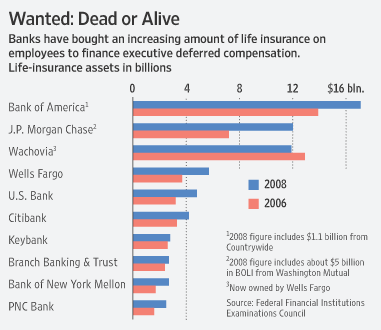
As Wall Street on Parade pointed out in an explosive report on the subject one year ago, Wall Street, too, is heavily invested in these types of insurance policies. That report detailed how Wall Street’s four largest banks hold as much as $681 billion in life insurance in force on their employees, past and present, and JPMorgan holds up to $179 billion of that total.

And now, coincidentally, JPMorgan has been experiencing an unusual number of ‘suicides’ and unusual deaths of young workers since the so-called “bankster suicide” phenomenon began in December of 2013.

This list includes the likes of Andrew Jarzyk, another former tech intern at JPMorgan who went missing and was found dead in the Hudson River in 2014 in circumstances that have still never been explained.

Or Gabriel Magee, the Vice-President of IT at JPMorgan who apparently threw himself from the 32nd floor of the bank’s London headquarters after sending his girlfriend a text that he would be home late that evening.

Or Kenneth Bellando, a former JPMorgan analyst whose JPMorgan-employed brother was mentioned in a senate investigation into Morgan’s $6.2 billion Whale derivatives disaster that slammed the bank for lying to regulators.

Although there has been a larger pattern of bankster deaths identified by others in the past year and a half, it’s the JPMorgan pattern that sticks out: young interns and analysts, many of them tech workers for the banking giant, are ending up dead in unusual circumstances.

Could this be, as the Daily Mail and its ilk are all too keen to suggest, simply a case of overworked young investment bankers choosing the easy way out? It’s a possibility. But could it be something much more sinister? A heartless scheme to help meet the company’s dead peasant mortality projections? Or an attempt to silence potential whistleblowers about the systems JPMorgan is using to game the markets? These, too, are possibilities, though ones that will never be broached by the lapdog media.

Friday, June 5, 2015

Four Ways to Find Your Place in This World

Author Dallas Willard

How do you find your place in this world? As a Christian, your transformation into His likeness is a lifelong process. Here are four things to remember as you make this journey.

1. Remember who you are.

That’s not as easy as it sounds. Remember who you are before God. You are an unceasing spiritual being with an eternal destiny in God’s great universe. Say it. 

I am an unceasing spiritual being with an eternal destiny in God’s great universe.

Memorize it. Say it to your friends. Tell it to people you meet. Strong currents in our society will attempt to keep you from realizing who you are before God.

Some months ago someone did a study of a certain type of chimpanzee. They discovered this chimpanzee possessed 99.4% of human DNA. What’s the conclusion you are supposed to draw? You know what it is. It’s certainly not that you are an unceasing spiritual being with an eternal destiny in God’s great universe. The conclusion you’re supposed to draw is that you’re very much like a chimp.

I’ve talked to some of my colleagues and suggested that we trying giving a chimp a Ph.D. Certainly if chimps have 99.4% of DNA and DNA is what we are, then some chimps should do better on tests than humans! But no one who thought about it would suggest that 99.4% of DNA translates into 99.4% of human experience. What conclusion should we draw? We humans are a great deal more than DNA. You are a spiritual being. I emphasize that and encourage you to stay connected to this truth because you will be continually challenged on this. Remember to say it to yourself, to your friends. Get them to say it to you. You may even want to write it on your bathroom mirror.

2. Remember to keep God before your mind.

You will keep in perfect peace
the mind that is dependent on You,
for it is trusting You (Is 26:3).


David says:

I keep the LORD in mind always.
Because He is at my right hand,
I will not be shaken (Ps 16:8).


Set the Lord before you. Keep Him in your mind. You can learn to do this. You can bring God before your mind constantly and train yourself to have Him there always. One simple approach is to train yourself to go through the morning repeating to yourself, every minute or so, "Hallowed be Your name" or some other phrase that’s meaningful to you.

3. Remember to live sacrificially.

On January 20, 1961, John F. Kennedy was inaugurated as the thirty-fifth president of the United States. During his inaugural address, this, the youngest man ever elected president said that "the torch has been passed to a new generation of Americans." In this context, President Kennedy issued the following challenge: "Ask not what your country can do for you, ask what you can do for your country."

This simple statement, delivered with great fervor, drew forth an amazing current of sacrificial giving from people. This is built into our hearts. We know it’s right. And as Christians we’re the ones who really know what it means and how it can be done.

Don’t strive to advance yourself. Let God advance you. This is a deep psychological and sociological truth as well as a profound theological teaching. If you try to save your life, you’ll lose it. Give it away. God will give it back to you. Don’t make it your aim to get what you want. Serve others. Remember, God gives grace to the humble. He calls us to submit ourselves to the mighty hand of God that, when the time is right, He will lift us up.

I need to add that it’s not safe to be a servant unless you know who you are and unless you stand before God. On the night of His betrayal, just before He shared the Passover with His disciples, ...

Jesus knew that the Father had given everything into His hands, that He had come from God, and that He was going back to God. So He got up from supper, laid aside His robe, took a towel, and tied it around Himself. Next, He poured water into a basin and began to wash His disciples’ feet and to dry them with the towel tied around Him (Jn 13:3-5).

Because Jesus knew who He was, because He was secure in His relationship with His Father, He was able to do the work of the most menial slave.

Remember who you are. Keep God before you. Then serve sacrificially. When you serve others, you’re really serving God. Because you are serving God, you give the best of service to other human beings.

4. Remember you need a plan of discipline.

Living the Christ life requires it. What’s normally thought of as church activities is not enough, even if you’re one of the leaders. Put together and follow a plan of solitude and silence, Scripture memorization, fasting, prayer, and worship.

If you regularly do these things, Christ will grow in you and His character will become your character. Then you will routinely and easily do the things He did and said to do out of love, joy, peace, and power.

The people who are in the world but not of the world are people who simply do the right thing routinely, easily with peace and joy. Their picture is drawn repeatedly in the Scriptures (Ephesians 4, Colossians 3, Philippians 2). What you see in these passages is true. It works. It’s accessible to everyone. And there’s nothing in this world that compares with it. People like this are the answer to Jesus’ prayer at the end of his commencement address.

I have given them the glory You have given Me.
May they be one as We are one.
I am in them and You are in Me.
May they be made completely one,
So the world may know You have sent Me
and have loved them as You have loved me.


This is what the world is waiting for. Paul says that all creation is groaning, waiting for the sons and daughters of God.

Now take your God-given place in this world. Be Christ to those around you.

Thursday, June 4, 2015

Can Forensic Scientists Prove Evolution?

By Ken Ham and the AIG Team.
Go to AIG here. -

Creationists and, as I pointed out during my debate with Bill Nye, TV’s “The Science Guy” last year, even some secular textbooks have highlighted the distinction between the two different kinds of science. One kind of science is observational science, which deals directly with the present. It’s directly testable, observable, and repeatable. It’s the kind of science that builds airplanes and cell phones, and put a rover on Mars. The other kind of science is historical science. Historical science deals with the past and is therefore not directly testable, observable, or repeatable. In historical science, the evidence must be interpreted on the basis of one’s worldview—the facts don’t “speak for themselves” (e.g., fossils don’t speak and don’t come with labels)—so what you believe about the past directly determines how you interpret the evidence.
What Are the Two Kinds of Science?

This distinction between the two types of science shows that it’s not ultimately a battle over the evidence (as we all have the same evidence), and it’s not a battle between science and faith. Rather, it’s a battle over two different views about the past that are used to interpret the evidence of the present. Biblical creationists start with God’s Word and interpret historical science through the lens of the history recorded in the Bible. Evolutionists start with man’s ideas about the past and interpret the evidence through that lens. It’s the same evidence, but we come to radically different conclusions because we have completely different starting points.

One branch of historical science is forensic science. It involves collecting clues and trying to piece together what happened in the past to solve a crime (or determine if indeed a crime even happened). This kind of science is often the subject of many popular detective and crime TV shows. Now, evolutionists will often say that evolution is just like forensic science. They say that we can examine the evidence at a crime scene and piece together what happened, often with reasonable assurance, so therefore can we look at the evidence around the world and see that evolution happened.
Forensic Science Must Be Interpreted

Now, there are many similarities between historical and forensic science. After all, forensic science is a branch of historical science. Just like in historical science, the facts don’t speak for themselves. They must be interpreted by the investigator. Sometimes the interpretation is pretty straightforward, but other times it’s not. The investigator must painstakingly collect all the data, find eyewitnesses, and compare the data with the eyewitnesses’ accounts of what happened. All of this is in an effort to reconstruct what happened in the past to produce the evidence left behind. But at times in this world, forensic scientists have come to the wrong conclusion and so the wrong person was charged with a crime.

Collecting the data is part of observational science. The forensic scientist looks around and finds things like fingerprints, DNA evidence, shell casings, eyewitness testimony, or other pieces of observational evidence. Of course, it should be noted that even data collection involves some historical science because the investigator was not there when the crime happened. The investigator does not know if the evidence was tampered with, planted to frame someone, or was contaminated, or perhaps the investigator purposely falsified the evidence. And sometimes evidence that would be very relevant is missed because the investigator did not know of its relevance! Now, after all of the observational evidence has been collected, the data must be interpreted. Reconstructing what happened is historical science.

When evolutionists say that the science that gives us forensics works the same as evolution and “proves” that evolution happened, they are neglecting to understand that forensics is a methodology, not a conclusion. We use forensic science to help us understand what happened, but the conclusion doesn’t come from the forensics—it comes from the interpretation of the evidence collected by the forensic scientists. This is obvious in the courtroom. Eventually, the evidence is brought before a jury or a judge. Both the prosecuting attorney and the defending attorney use the same evidence, but completely different interpretations of it, to try to convince the judge or jury of the defendant’s innocence or guilt. Perhaps the prosecuting attorney brings forth a gun, some fingerprints, and some shell casings as observational evidence. He interprets it to mean that the accused was there and he was the one who shot the victim. The defense attorney, however, will look at the same observational evidence and will perhaps argue that the fingerprints were from a previous visit and that the gun was stolen so the accused is innocent. He will argue that the prosecuting attorney is misinterpreting the evidence. It’s the same evidence, but different conclusions.

There are plenty of examples of where the evidence was interpreted wrongly and, later, new evidence shed light on what really happened. For example, in 2002 a woman was convicted of robbing and murdering her neighbor because her fingerprint was supposedly found on a pill container. Later it was found out that the fingerprint wasn’t actually hers—she had been wrongly imprisoned because of an incorrect interpretation of the observational evidence.
Evidence from Historical Science Must Be Interpreted

This is the same as evolution. The evidence from historical science must be interpreted. The assumptions of the researcher or scientist determine how the evidence is interpreted. An evolutionist interprets the evidence through the lens of man’s ideas about the past—millions of years and evolution. But a biblical creationist looks at exactly the same evidence and comes to a completely different conclusion because we have a completely different starting point.

Now, a big part of forensic science is reliable eyewitness testimony. In historical science, Christians have an eyewitness testimony from the Creator of the universe recorded for us in His Word. This testimony is the most reliable because it comes from the God who never lies (Titus 1:2). But evolutionists totally ignore this eyewitness testimony—something a forensic scientist would hopefully never do! They reach the wrong conclusions because they have the wrong starting point.

Evolutionists also ignore other interpretations of the data. Unlike a forensic scientist who tries to look at all different angles for how the crime may have been committed and by whom, evolutionists are committed to their interpretation of the evidence. Few stop to question the assumptions of millions of years or evolution. Biblical creation—even if it provides a far more consistent and better explanation of the evidence—is automatically rejected because it doesn’t match with the starting assumptions of secular scientists.

Forensics doesn’t prove evolution. Forensics merely provides a good illustration of a historical science system that uses observational science methodology. The evidence must be interpreted, and what you believe about the past determines how you interpret the evidence. We need to start with God’s unchanging, infallible Word and reach our conclusions from that firm foundation.

Thanks for stopping by and thanks for praying,
Ken

This item was written with the assistance of AiG’s research team.

Copyright © Fight for Your Faith