Does your faith need strengthening? Are you confused and wondering if Jesus Christ is really "The Way, the Truth, and the Life?" "Fight for Your Faith" is a blog filled with interesting and thought provoking articles to help you find the answers you are seeking. Jesus said, "Seek and ye shall find." In Jeremiah we read, "Ye shall seek Me, and find Me, when ye shall seek for Me with all your heart." These articles and videos will help you in your search for the Truth.

Friday, February 19, 2016

Archaeology and the Bible


by Phillip Climer on May 23, 2012:

Many archaeologists who excavate biblical lands reach conclusions that differ with the historical account of Scripture. How should a Christian respond?

The December 18, 1995, issue of Time magazine had as its cover story, “IS THE BIBLE FACT OR FICTION? Archaeologists in the Holy Land are shedding new light on what did—and did not—occur in the greatest stories ever told.” The article describes recent archaeological finds in Israel and surrounding areas, and then categorizes public and scholarly reaction to these finds into three main groupings: “Jewish and Christian Ultraconservatives,” who do not believe any part of the Bible is fiction; “Atheists,” who want to debunk the whole Bible; and “the moderate majority,” who want to be sure that the Bible is scientifically “grounded in truth.”

As Christians we fall into what Time calls the “Ultraconservative” group. We believe that the Bible is infallible not only in spiritual matters, but also in accounts with historical and geographical content.

WE BELIEVE THAT THE BIBLE IS INFALLIBLE NOT ONLY IN SPIRITUAL MATTERS, BUT ALSO IN ACCOUNTS WITH HISTORICAL AND GEOGRAPHICAL CONTENT.

When archaeologists excavate Biblical lands and based on their findings, reach conclusions that differ with the historical account of Scripture, how should a Christian respond? To say that we accept the Word of God by faith, whatever the claims of archaeology or any other branch of science, is the correct reply. However, making that statement without any further explanation may sound as though we are pitting blind irrational faith against rational scientific research. This essay is intended to demonstrate that while the science of archaeology may be reasonable, it is not truthful; and a faith that provides truth is much to be preferred over a research program that does not.

Of the other two groups mentioned in the magazine article, we can easily understand the “Atheists.” We accept the Bible as true; they reject it. As Time points out, even when archaeology supports a Biblical narrative, the atheists are likely to reject both Scripture and science. Their position is one of faith, as much as is ours; it is just that the object of their faith is their own ideas. But what is one to make of the third category, the “moderate majority”?

Many Evangelicals fall into this category, for they are delighted whenever an archaeological find supports a part of Scripture, or as Time says, “strengthens the Bible’s claim to historical accuracy.” But if a supportive archaeologist enhances Scripture’s claim to accuracy, does a scientific detractor weaken the Bible’s claim to truth? And if Christians accept only those archaeological findings that they agree with, can they not be justly accused of being childish in their refusal to face up to disagreeable facts?

The whole unfortunate enterprise of trying to verify the claims of Scripture with the findings of archaeology rests on a conflict between the science of archaeology and the Christian faith on the question, “What is truth?” To focus on this dispute, let us confront the claims of archaeology with the simple question, “How do you know?” The answer to this one question reveals the principles upon which are based all claims to knowledge and truth by any science, philosophy, or religion.

To begin with, we must know what the science of archaeology is, and the type of claims it makes. Secondly, we must compare and contrast archaeological information and Biblical truth. Finally, against this background, let us review the conflict that Time calls “fact vs. faith.”

Archaeological Information

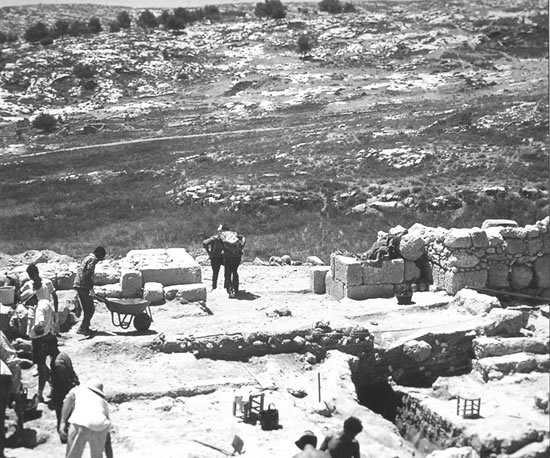
Archaeology is “the scientific study of extinct peoples through skeletal remains, fossils, and objects of human workmanship (as implements, artifacts, monuments, or inscriptions) found in the earth” (Webster’s Third International Dictionary of the English Language, 1981.) Archaeologists excavate and sift through the remains of ancient civilizations and then try to piece together their findings into a coherent picture of how the people of that society lived, and how its institutions functioned.

Perhaps the most important artifact that any civilization leaves behind is its body of literature. Many societies in the ancient Middle East left their writings in stone (the hieroglyphs of Egypt), or on soft clay tablets that hardened into stone over time (the Babylonians and Assyrians). The ancient Hebrews apparently used paper or possibly animal skins. Since these materials decompose, documents written on them had to be recopied time and again. Archaeologists generally accept hieroglyphs and clay tablets as being more accurate than paper manuscripts, since the former are more likely to be the original writings. There is obviously much less room for error or editing in a document carved on stone than on a manuscript copy several times removed from the original.

The Time article gives several examples of archaeologists rejecting Biblical manuscripts in favour of their own theories based on other artifacts. The book of Joshua, chapter 6, records the destruction of the walls of Jericho, allowing the Israelites under the leadership of Joshua to conquer the city. Time tells us that after extensive excavations at the site of ancient Jericho, archaeologists have determined that the location was abandoned between about 1500–1100 BC. According to them, no walled cities existed during this time in this area of Canaan. Conservative Biblical scholars and archaeologists also disagree on the date of the Israelite entrance into Canaan, but they both agree that it falls well within the time range mentioned above. Given this chronology, modern archaeology concludes that the Hebrews moved onto vacant or sparsely populated land. This thinking allows no walls to come tumbling down, and no city to conquer. The sceptics also doubt that Joshua even existed. Without a battle, who needs a general? Now let us ask the test question: How do they know that Jericho and its walls did not exist during this time period?

Just as our society paves over old streets and erects new buildings over the remains of old foundations, so ancient civilizations built towns and cities over the debris of earlier structures. When archaeologists excavate a site they divide it into different levels, each level or layer corresponding to a defined era of human habitation or abandonment. The methods by which a date for a particular level is determined are quite involved, and a detailed explanation of them is beyond the scope of this essay.

To gain some idea of what is involved, consider a future archaeologist excavating our civilization and finding only ceramic dishes up to a certain level. Above that level, he finds plastic and ceramic dishes. Suppose he also finds some sort of preserved calendar dated “1950” with the plastic dishes. He now has his dating “key”: the calendar and the plastic dishes. This key tells him that at his initial site plastic dishes were not in use before 1950. If he encounters plastic dishes at any other site, he assumes that the level in which he finds them was inhabited in 1950 or later. At Jericho, the scientists found some sort of artifacts (probably pottery) at a certain level that allowed them to date that level at 1500–1100 BC, based upon their “key” with similar artifacts at other excavations. This particular level did not contain the foundations or remains of any city walls, buildings, or other structures that would indicate a city. How to explain this discrepancy with the Biblical account? The earliest extant manuscript of the book of Joshua dates from a period hundreds of years after the events described in the book. Sceptics theorize that such a manuscript, in being recopied from a decaying original, could have been altered by a zealous scribe, seeking to glorify his God and the history of his nation by inventing a battle that never occurred and a leader who never existed.

The archaeologists who excavated Jericho published their theory. These findings were debated and ultimately accepted by most of the archaeological community. Unless and until some new evidence comes along, the modern science of archaeology has determined that the Israelite conquest of Canaan as described in the book of Joshua is not factual. Specifically, Joshua did not fight the battle of Jericho. This is an archaeological “truth,” or more accurately, a testing by archaeological research methods of a Biblical story, and the Bible fails the test.

Conservative Biblical scholars disagree, but their objections are tainted, because they are trying to prove the Bible, instead of looking at it objectively—or so the scientists say. Now if religious bias is the problem, perhaps we could demonstrate the objectivity of archaeology in the reconstruction of ancient civilizations by examining a site that has no religious significance today, but one that has been widely excavated by numerous scientists. In such a case, there would be no believers to muddy the waters for the clear-thinking scientists. There are many such sites; perhaps the most famous is Troy. 
Searching for Troy
In approximately 800 BC a blind Greek poet named Homer composed the first (and arguably the greatest) poem of European literature: The Iliad. This epic work tells of a great war fought approximately 400 years earlier, between a number of Greek city-states and the rich and powerful city of Troy, on the coast of Asia Minor (modern day Turkey). Perhaps the reader recalls some of the particulars of this story. Helen, queen of Sparta, was carried off to Troy by Paris, a prince of the Trojan royal family. Outraged, a number of Greek cities combined forces, sailed to Troy, and besieged the city for ten long years. They were not able to breach the massive walls of Troy, so finally they resorted to subterfuge. By means of a giant hollow wooden idol, the famed Trojan horse, the Greeks infiltrated Troy. The gates were thrown open, and the city was lost. Those Trojans not killed were enslaved, and Troy itself was burned and demolished. The victorious Greeks sailed home with the beautiful Helen, the cause of it all, “the face that launched a thousand ships.”

Since Roman times scholars have debated The Iliad: Does it describe a real war, or is it just a myth? If there was such a war, how accurate is Homer’s telling of it? In the 1850’s, modern archaeology took up the debate. For the last 140 years team after team of scientists has excavated a now deserted site on the coast of Turkey. Their very impressive and voluminous findings were reviewed by a recent documentary series on public television, In Search of the Trojan War. According to this program, the site suspected to contain the ruins of Troy was continuously occupied by humans for over 5,000 years. It contains 50 separate levels. Nine of these levels show the characteristics of true cities, that is, walls, palaces, etc. Nine of the levels also show signs of violent destruction, either by warfare or natural disaster, such as earthquakes.

EACH HIGHLY TRAINED ARCHAEOLOGIST LOOKED AT THOSE CATALOGUED FINDINGS...AND THEN CAME UP WITH A DIFFERENT INTERPRETATION TO EXPLAIN HOW ALL THOSE ARTIFACTS GOT THERE.What of Homer’s Troy? Which level, if any, matches the magnificent city of The Iliad? Did the Trojan War really happen? Almost a century and a half of modern scientific investigation, without any religious interference or bias, has yielded a new answer for each new investigator. The archaeological “truth” about Troy changes with each generation of archaeologists. The original excavator “proved” that The Iliad was as accurate as Christians believe the Bible to be. A later archaeological team threw out most of his conclusions and “proved” that Homer exaggerated greatly, if he told the truth at all. A subsequent generation of diggers “proved” that an earthquake largely destroyed Troy, and that pirates finished the job. And so on. The only points on which all the experts agree are that the site was inhabited for thousands of years, and it is now abandoned. But what of the sophisticated techniques for dating artifacts and levels of occupation? Each artifact was precisely catalogued by the team that found it. Each highly trained archaeologist looked at those catalogued findings, possibly made some excavations of his own, and then came up with a different interpretation to explain how all those artifacts got there.

The narrator of the documentary series takes us through these diverse theories in six hours of analysis. At the end, he makes this startling observation on the archaeological search for truth about the Trojan war: “There can never be a final word, only a new interpretation by each generation in terms of its own dreams and needs.” This is the “proof,” the “knowledge,” and the “truth” that modern archaeology gives us: “ . . . never a final word, only a new interpretation . . . ”
Ever Learning . . . Never Able . . . 

Returning to archaeological excavations in the lands of the Bible, let us review the case of Joshua and the battle of Jericho. The current secular view is that no battle took place there, and no walls existed. The proof is in the pottery, so to speak. But the final archaeological word is not in, and it never will come in. This is not the conclusion of a religious fanatic defending Scripture; this is a limitation of the method of the science of archaeology, as demonstrated in the search for Troy.

The sceptic may think that we are playing with words in reaching this conclusion. Perhaps he would say that the present theory of “no walls at Jericho” is substantially true, and that later excavations in the area will “fine tune” it. The sceptic would be wrong. In archaeology any theory, no matter how well established, can be turned on its head by the next shovelful of dirt at the next dig. The Time article provides us with just such an example.

Many secular archaeologists questioned the existence of King David, because there are no records of him dating from the time of his rule (traditional dates 1025–985 BC). As with Joshua and the conquest of Canaan, these scientists speculate that the legend of David may have been added by a scribe recopying documents at a much later date, trying to “improve” the history of Israel. But in modern Israel in 1993 an inscription in stone dating from about 900 BC was found containing the phrases “House of David,” and “King of Israel.” That one inscription was enough to turn sceptical opinion around: Now archaeologists generally accept that David really existed.

A monument and inscription from 1200 BC commemorating Joshua’s victory at the mighty walls of Jericho would similarly turn the archaeological world’s theory of the Hebrew conquest of Canaan on its head. Does such a monument exist? Who can say? But it is certainly true that the archaeological “truth” about Joshua and Jericho will not be the same fifty years from now as it is today, or as it was fifty years ago.

The reader may question the phrasing in saying that the truth of a past event is going to change every fifty years. How does the truth of the past change? Obviously, it never does. We have an account in writing of Joshua and the Israelites conquering the walled city of Jericho. Now that event either took place or it did not take place. The same can be said for any event for which we have record. The Greeks sailed to Troy to get Helen, or they did not. The theorizing of modern day archaeologists does not change a jot or tittle of history, because it is already past; it is out of their grasp; they can never re-live or recall those events. Even if an archaeologist constructed a hypothesis that was absolutely accurate in explaining the Trojan War or Joshua and the battle of Jericho, no one could ever know it was absolutely accurate, because no one can go back in time and test the hypothesis against reality.

This may all seem very basic, but it demonstrates that archaeological research fails to give us historical truth not just occasionally, but consistently. No hypothesis of history based upon archaeological research has ever or can ever be shown to be true. The theories will continue to pour out of the minds of archaeologists, but none of them will ever be proved either. Naturally this conclusion includes written records also. We do not know if those indestructible clay tablets of the Assyrians or Hittites are true or not, and we never will. The same can be said for the Egyptian hieroglyphs and even for our friend Homer. He tells a wonderful story, but we willknow if Achilles and Hector fought outside the walls of golden Troy only when we get a Word from God on the subject.
Biblical Truth

Scientifically, we do not know if the Bible is true, and we never will. That, of course, does not derogate from the truth or authority of Scripture, for two reasons: Scripture is self-authenticating; and science cannot prove anything true.

Scripture teaches that from eternity past God predetermined everything, everyone, every action, and every moment. By his Spirit and his Word he executed his eternal plan and brought the universe and time itself into existence. Since he is creator of all, including time, he stands outside of it and is therefore unchanging. When he inspired the prophets and apostles to write down that portion of his eternal plan which he chose to reveal to us, he directed them to write his unchanging Word describing his unchanging plan. When it comes to the past, how could anyone possibly imagine a more authoritative history than the Word of the one who determined that history and then brought it to pass?

HOW DO WE KNOW THAT THE SCRIPTURAL ACCOUNT OF THE BATTLE OF JERICHO IS TRUE? BECAUSE THE BIBLE SAYS SO.
Revisiting Joshua and Jericho one last time, let us pose the same question to the Biblical narrative that we did to the archaeological theory. How do we know that the Scriptural account of the battle of Jericho is true? Because the Bible says so. No hypotheses here, no guesses, just truth, from the God of truth, who not only infallibly knows the events at Jericho, but also predetermined them and brought them to pass. To doubt the veracity of any historical event in Scripture is to doubt the very nature of God Himself.

The “moderate majority” will discount the previous argument as an evasion, circular reasoning, irrationalism, and double-talk. It is simply wrong, say they, to believe that the Bible speaks truthfully on historical matters because it says it does. The Bible itself must be checked, or “verified.” But by what can Scripture be corrected? What is the standard the moderates use to judge the Bible? Archaeological methods of research can provide us with mountains of information about—or at least mountains of—pottery and spears used in ancient Israel, and we should respect that information, and the scientists who work so diligently to extract and study the artifacts they find. But any theory they devise concerning any part of Biblical history is by the nature of their own inductive method tentative and inconclusive. One cannot verify any narrative with a worse theory. The “moderate majority” cannot legitimately test Biblical history with scientific methodology, and since there currently are no other possibilities with which to verify it, they must either receive the Scriptural narrative in faith or reject it for no good reason.

The reader may wonder why this discussion of archaeology and the Bible has been limited to the Old Testament, and why the subject of miracles has not been considered more extensively. Aside from time and space constraints, there are two main reasons: The New Testament manuscripts are now generally accepted, even among sceptics. (A few generations ago they were not accepted as genuine, but someone came up with a new theory and now they are.) The sceptics do not believe what the manuscripts say, but they do, at least for the moment, accept them as dating from the apostolic age. Second, archaeological methods of research cannot give us a true theory of any event that is not a miracle. Given that failure, how can archaeologists even begin to comment with any credibility upon Bible history that contains many miracles, such as the Gospels?
”Fact vs. Faith”

The notion of “fact vs. faith,” as Time put it, now can be seen in all of its absurdity. To test any Scriptural historical account by means of any theory of archaeology is to test that which cannot be false by means of that which cannot be true. It is the height of absurdity.

The Bible is the only means by which God reveals his plan of redemption to his people. As such, it is primarily concerned with spiritual matters, and when we read it we should also be primarily concerned with the spiritual knowledge it contains. But the great drama of redemption is being played out upon the stage of the visible universe and history. We cannot fully appreciate the scope and grandeur of God’s plan of salvation if we neglect the platform upon which it is presented. We must not take lightly the denial of the accuracy of Biblical history by modern archaeology. If we do not proclaim the truth about Joshua and Jericho and King David or any other historical narrative in Scripture, we are guilty of not proclaiming “the whole counsel of God.” We are in a battle for truth, and we must look to God for patience and courage to see our way through it.

When the youthful David visited his brothers on the battlefield, he heard Goliath taunting Israel. He was outraged, asking, “who is this uncircumcised Philistine that he should defy the armies of the living God?” (1 Samuel 17:26) David immediately volunteered to face Goliath in combat, and he slew that blasphemer.

David had to battle the enemies of Israel militarily. Our war with the enemies of Christ is spiritual and intellectual in nature, but it is just as real, and even more deadly. As Christians our posture should be one of righteous indignation against the giant of sceptical archaeology that slurs the truth of the Word of Almighty God. Who are these archaeologists who think they can disprove Scripture with a piece of broken pottery dug out of the mud? Who are the “moderate majority” who dare tell us what parts of the Bible are “reasonable” to believe? Let us be as eager to confront the giant of archaeology as David was to confront the Philistine champion. In the struggle between the eternal Word of God and secular theories, we know by revelation that God will crush all anti-Christian arguments and imaginations under our feet. “Is not my word like fire?” says the Lord, “and like a hammer that breaks the rock in pieces?” (Jeremiah 23:29)

Phillip Climer is a free-lance writer living in California.

This article was first published by the Trinity Review, Number 170, April 1999. Used by permission. Copyright (c) 1999, John W. Robbins, P. O. Box 68, Unicoi, Tennessee, 37692. Tel: (423) 743-0199. 
This article is a reprint and, as such, may represent views outside the focus of Answers in Genesis.

Does Archaeology Support the Bible?

From The New Answers Book 1 Chapter 25:

by Clifford Wilson on January 24, 2008:

Original text found  at answersingenesis.org here:

In every area, the evidence has been forthcoming: God has vindicated His Word, and His Book is a genuine writing, with prophecies and revelation that must be taken seriously.
Follow the biblical record from Genesis to Revelation! This informative and beautiful book reveals discoveries that either confirm or illustrate the biblical narrative with over 200 full color images.

It is a biblical principle that matters of testimony should be established by the mouths of two or three witnesses. According to Hebrew law, no person could be found guilty of an offense without properly attested evidence from witnesses, even though this law was put aside at the trial of Jesus.

When it comes to the Word of God, a similar principle is demonstrated from the modern science of archaeology. We are told in Psalm 85:11, “Truth shall spring out of the earth,” and in Psalm 119:89, “Forever, O Lord, Your word is settled in heaven.” God’s Word is sure. It outlasts human generations, and in His own time God vindicates its truth. This puts God’s Word in a unique category: it is the “other side” of the two-way communication pattern between God and man. Man’s speech distinguishes him uniquely from all the animals, and God’s written Word distinguishes His special communication to man as immeasurably superior to all other supposed revelations.

According to that biblical principle of “two or three witnesses,” we shall now select evidences that support the truth and accuracy of God’s Word. In every area, the evidence has been forthcoming: God has vindicated His Word, and His Book is a genuine writing, with prophecies and revelation that must be taken seriously. His Book is unique because it is His Book.

Those inspired men of old wrote down God’s message, applicable to themselves in their own times, and also applicable to men and women across the centuries, right down to the present century. The Bible is the “other side” of the Christian’s study of the miracle of language. It is God’s chosen way of revealing His thoughts—the deep things which are unsearchable except by the revelation of the Holy Spirit.

In the following outline we suggest certain divisions of the Word of God. Then we list three significant evidences from archaeology to confirm that the witness is sufficient to cause the case to be accepted for each section—God’s Word is indeed Truth.

Major Evidences Regarding Genesis 1–11


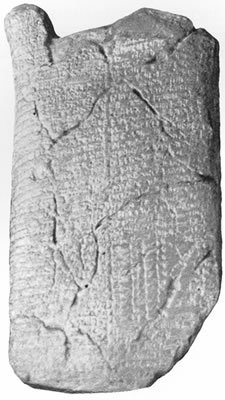
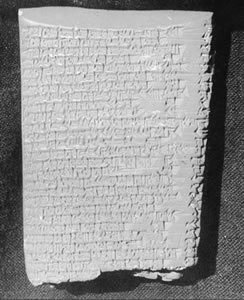
One of the Babylonian Creation Tablets, Enuma Elish

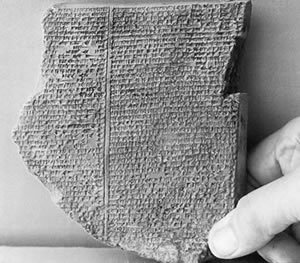
Part of the Gilgamesh Epic

Genesis 1–11 is the “seed-plot of the Bible,” an introduction to Abraham and great doctrines, such as God the Creator, Friend, Revealer, Judge, Redeemer, Restorer, and Sustainer. It is actual history, and it is a summary of beginnings.

Enuma Elish—This is the Babylonian Creation Record. We also have the Ebla Creation Tablet. The Bible record is clearly superior to this as the Enuma Elish has creation from pre-existing matter, which really isn’t creation at all. The Bible is the true account of this historical event.

The Epic of Gilgamesh includes the Babylonian Flood Story. Again, the biblical record is greatly superior. As Nozomi Osanai wrote in her master’s thesis on a comparison between Noah’s Flood and the Gilgamish Epic, “According to the specifics, scientific reliability, internal consistency, the correspondence to the secular records, and the existence of common elements among the flood traditions around the world, the Genesis account seems to be more acceptable as an accurate historical record.”1

Long-living Kings at Kish (Sumer)—These kings supposedly lived from 10,000 to 64,000 years ago. The Bible’s record is conservative and is the true account, while the Babylonian and other traditions have been embellished over time. It was later realized that the Babylonians had two bases for arithmetic calculations, based on either tens or sixties. When the records were retranslated using the system of tens rather than sixties, they came to a total within 200 years of the biblical record.

Major Evidences Regarding Genesis 11–36

This section contains Patriarchal records, with special reference to Abraham, the father of the Hebrews.

Abraham’s home city of Ur was excavated by Sir Leonard Woolley, with surprising evidence of near-luxury.2

The customs of Patriarchal times, as described in the Bible, are endorsed by archaeological finds at such places as Ur, Mari, Boghazkoi, and Nineveh. These were written records from that day—not just put down in writing many centuries later. They bear the marks of eyewitness reporting.


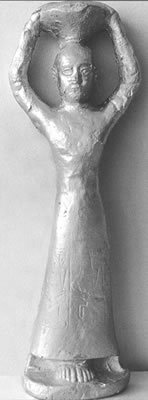
Ur Nammu, the king of Ur who claimed to build a famous tower

Thus, Abraham’s relationship with Hagar is seen in a different light by understanding that the woman who could not personally bear a child for her husband should provide him with one of her maidservants. In the Bible record we are told that it was Sarah who made the approach to Abraham, and her maid Hagar was a willing accomplice in having Abraham’s child. Thus, she gained economic security and personal prestige. We stress it was not Abraham who made the first approach to Hagar, but Abraham’s wife Sarah did in keeping with the customs of the day.

The records of the five kings who fought against four kings (Genesis 14) are interesting, in that the names of the people concerned fit the known words and names of the times.
Abraham’s negotiations with the Hittites (Genesis 23) are accurate and follow the known forms of such Hittite transactions. Neo-Hittites came later, but there were distinct language relationships. The Bible was right in calling the earlier people “sons of Hatti” or “Hittites.”

Interestingly, the Hittite word for retainers, which means “servants trained in a man’s own household” is hanakim (Genesis 14:14). This term is used only here in the Bible. Execration texts of the Egyptians (found on fragments of ceramic pots, which seem to have been used in ritual magic cursing of surrounding peoples) gives us the meaning of this term, and it is correctly used in the Bible record in Genesis 14.

Major Evidences Regarding Genesis 37–50

This section tells us the history of Joseph, the son of Jacob and great-grandson of Abraham. His brothers sell him to the Ishmaelites who sell him to an Egyptian eunuch. Joseph becomes successful in Egypt and helps to settle all of Israel there.

Known Egyptian titles such as “captain of the guard” (Genesis 39:1), “overseer” (Genesis 39:4), “chief of the butlers” and “chief of the bakers” (Genesis 40:2), “father to the Pharaoh” (actually “father to the gods,” which to Joseph was blasphemous because he could not accept Pharaoh as a manifestation of Ra the sun god; Joseph Hebraized the title, so that he did not dishonor the Lord), “Lord of Pharaoh’s House” (the palace), and “Ruler of all Egypt” (Genesis 45:8) attest to the historicity of this account.

Joseph’s installation as vizier (chief minister) is very similar to other recorded ceremonies. His new name was Zaphnath-Paaneah, meaning “head of the sacred college” (Genesis 41:41–45). Other Egyptian phrases and other local color are also plentiful throughout the record (e.g., embalming and burial practices [Genesis 50]).

The Dead Sea Scrolls make the number of the people of Jacob 75, not 70, in Genesis 46:27, thus correcting a scribal error and showing that Stephen’s figure was right (Acts 7:14).3
Major Evidences Regarding Exodus to Deuteronomy

The Eshnunna Law Code dating to c.1900 BC

These are the other four books of the Pentateuch, written by Moses, and probably at times in consultation with Aaron, the chief priest, and Joshua, the military leader.

The Law of Moses was written by a man raised in the courts of pharaoh, and it was greatly superior to other law codes, such as those of the Babylonian king Hammurabi, and the Eshnunna code that was found near modern Baghdad.

The covenant forms of the writings of Moses follow the same format as those of the Hittites, as endorsed by Professor George Mendenhall. The law code is a unity, dating to about 1500 BC (the time of Moses). These writings come from one source only, and there is no one to fit this requirement at this time except Moses. Ethical concepts of the Law were not too early for Moses, despite earlier hypercriticism. (Ebla tablets from Syria pre-date Moses and, for example, include penalties against rape.)

At this point it is relevant to comment on two world-famous archaeologists with whom I had the privilege of working as an area supervisor with the American Schools of Oriental Research at the excavation of Gezer in Israel many years ago. Each of them (at two separate excavations) gave wonderful lectures to 140 American college students.

At the time of his lecture, Professor Nelson Glueck stated, “I have excavated for thirty years with a Bible in one hand and a trowel in the other, and in matters of historical perspective I have never found the Bible to be in error.” Being a world-class Jewish scholar, Professor Glueck would have meant the Old Testament when he referred to the Bible, but it is also true that at least on one occasion, to my knowledge, he defended the accuracy of the New Testament writings as well.

The other lecture was given by Professor George Ernest Wright of Harvard University. He spoke on the validity of the writings of Moses, especially the covenant documents in the Pentateuch. He stated that the research of Professor George Mendenhall had led to the conclusion—with which he agreed—that the covenant documents of Moses were a unity and must be dated to approximately 1500 BC.

In further conversation after the lecture, Professor Wright told me that he had lectured for 30 years to graduate students—especially at Harvard—and he had told them that they could forget Moses in the Pentateuch. He now acknowledged that for thirty years he had been wrong, and that Moses really had been personally involved in the actual writing of the Pentateuch.

The ten plagues or judgments against the leading gods of Egypt (Exodus 12:12) are seen as real judgments, with a leading god of Egypt selected for judgment with each of the plagues.

Major Evidences Regarding Joshua to Saul


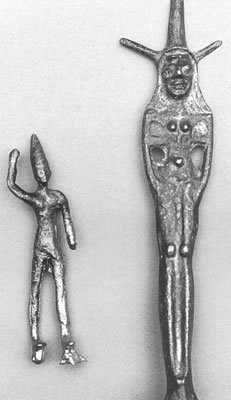
Canaanite deities, Baal and Asherah

This section includes the conquest, the judges, and the early kingdom.

Deities such as Baal, Asherah, and Dagan are properly identified in association with the right people.
City-states are also identified (e.g., Hazor as “the head of those kingdoms” [Joshua 11:10]. The excavation of Hazor corroborated its great size).

Saul’s head and armor were put into two temples at Beth-Shan. Both Philistine and Canaanite temples were found. The Bible record was endorsed when such an endorsement seemed unlikely (1 Samuel 31:9–10 and 1 Chronicles 10:10).

Major Evidences Regarding David to Solomon

At this time the Kingdom of Israel is established.

David’s elegy at Saul’s death is an accurate reflection of the literary style of his times. Excavations at Ras Shamra (the ancient Ugarit in Syria) clarified various expressions, such as “upsurgings of the deep” instead of “fields of offerings” as in 2 Samuel 1:21.

Following the discovery of the Ugaritic library, it has become clear that the Psalms of David should be dated to his times and not to the Maccabean period, 800 years later, as critics claimed. The renowned scholar William Foxwell Albright wrote, “To suggest that the Psalms of David should be dated to the Maccabean period is absurd.”4

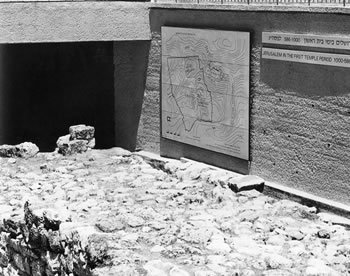
Solomonic cities such as Hazor, Megiddo, and Gezer (1 Kings 9:15) have been excavated. Solomon even used similar blueprints for some duplicated buildings.


The entrance to the Solomonic City of Gezer

Major Evidences Regarding the Assyrian Period


King Sargon of Assyria, mentioned at Isaiah 20:1

Part of a pathway excavated by Dr. Clifford Wilson between Sennacherib’s palace and the temple where his sons killed him

This was the time of “The Reign of Terror,” not long after Solomon’s death.
Isaiah 20:1 was challenged by critics because they knew of no king named Sargon in lists of Assyrian kings. Now Sargon’s palace has been recovered at Khorsabad, including a wall inscription and a library record endorsing the battle against the Philistine city of Ashdod (mentioned in Isaiah 20:1).
Assyrian titles such as tartan (commander-in-chief ), and several others, are used casually yet confidently by Bible writers.

Other Assyrian titles such as rabmag,rabshakeh, and tipsarru were also used by Bible writers. As the Assyrians disappeared from history after the Battle of Carchemish in 605 BC, this retention of “obsolete” words is a strong pointer to the eyewitness nature of the records. Thus it points also to the genuineness of the prophecies because the same men who wrote the historical facts also wrote prophecies.

The death of Sennacherib is recorded atIsaiah 37:38 and 2 Kings 19:37 and is confirmed in the records of Sennacherib’s son, Esarhaddon. It was later added to by Esarhaddon’s son Ashur-bani-pal.

Various details about Nineveh and the account of Jonah point to the Bible’s historicity. The symbol of Nineveh was a pregnant woman with a fish in her womb.

Adad-Nirari III, who might have been the king of Jonah’s time, introduced remarkable reforms—possibly after the message of the prophet Jonah. Adad-Nirari’s palace was virtually alongside the later construction of what is known as “Nebi Yunis” (“the prophet Jonah”). That structure is the supposed site of the tomb of Jonah, and although that is unlikely, the honoring of Jonah is very interesting.

Major Evidences Regarding the Babylonians and Nebuchadnezzar

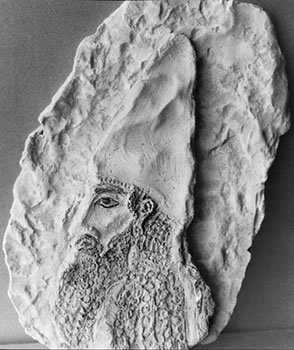
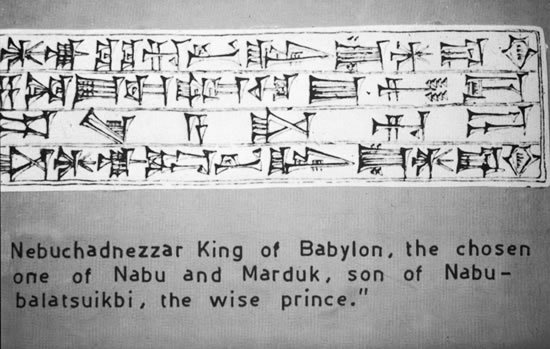
Nebuchadnezzar sacked Jerusalem and took Judah into captivity.
Daniel knew that Nebuchadnezzar was responsible for the splendor of Babylon (Daniel 4:30). This was unknown to modern historians until it was confirmed by the German professor Koldewey, who excavated Babylon approximately 100 years ago.

We now know from the Babylonian Chronicle that the date of Nebuchadnezzar’s capture of Jerusalem was the night of March 15/16, 597 BC. We also know that Belshazzar really was the king of Babylon at this time because his father Nabonidus, who was undertaking archaeological research, was away from Babylon for about 10 years. He appointed his son Belshazzar as co-regent during that time.

Prophecies against Babylon (e.g., Jeremiah 51, 52) have been literally fulfilled. Nebuchadnezzar wrote that the walls of Babylon would be a perpetual memorial to his name, but Jeremiah said, “The broad walls of Babylon shall be utterly broken” (Jeremiah 51:58). Jeremiah, inspired by God, has been confirmed.


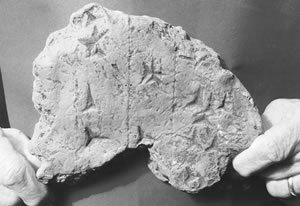
Critics said ‘There was no such king’, but his palace and library were uncovered

Major Evidences Regarding Cyrus and the Medes and Persians

The Medes and the Persians took over after the Babylonians.

Cyrus became king over the Medes and Persians. We read of Cyrus when his name was recorded prophetically in Isaiah 44:28 and 45:1. He issued the famous Cyrus Decree that allowed captive peoples to return to their own lands (2 Chronicles 36:22–23 and Ezra 1:1–4). The tomb of Cyrus has been found.

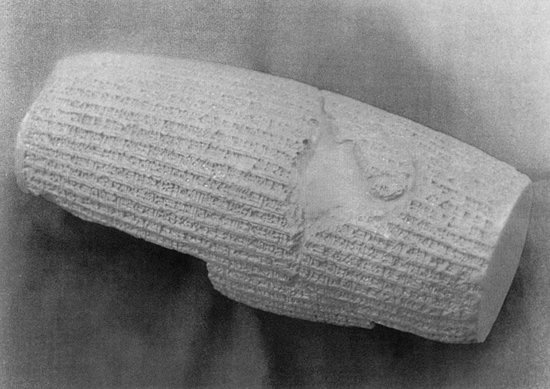
God was in control of His people’s history—even using a Gentile king to bring His purposes to pass. The Cyrus Cylinder (a clay cylinder found in 1879 inscribed in Babylonian cuneiform with an account of Cyrus’ conquest of Babylon in 539 BC) confirms that Cyrus had a conquest of Babylon.
Some Jews remained in Babylon, as shown in the book of Esther. The type of “unchanging” laws of the Medes and Persians shown therein (Esther 1:19) is endorsed from Aramaic documents recovered from Egypt.


The Cyrus Cylinder—Isaiah referred to him prophetically

Major Evidences Regarding Ezra and Nehemiah


Part of the restored wall of Nehemiah

This was the time of the resettlement in the land after the exile in Babylon.

Elephantine papyri, the Dead Sea Scrolls, Targums of Job, etc., show that Aramaic was then in use, as Ezra indicates.

Sanballat was, as the Bible says, the Governor of Samaria (Nehemiah 4 and 6), though it was claimed by many writers that Sanballat was much later than Nehemiah. Several Sanballats are now known, and recovered letters even refer to Johanan (Nehemiah 12:13). Geshem the Arab (Nehemiah 6) is also known. Despite longstanding criticisms, Ezra and Nehemiah are accurate records of an actual historical situation.

The letters about Sanballat (above) clear up a dating point regarding Nehemiah. Nehemiah’s time was with Artaxerxes I who ruled from 465 to 423 BC, not Artaxerxes II. This illustrates the preciseness with which Old Testament dating is very often established by modern research.

Major Evidences Regarding the Dead Sea Scrolls

The Dead Sea Scrolls

After approximately 2,000 years of being buried in caves near the Dead Sea, these scrolls came to light again in AD 1947. The Jews were searching for a Messiah or Messiahs—the king-like David, the great High Priest of the people of Israel, the High Priest after the order of Melchizedek, the prophet like Moses, and possibly the pierced Messiah.

I say “possibly the pierced Messiah” because this refers only to a very small fragment. Also, the future and the imperfect tenses in the Hebrew language are very often the same and can only be determined by the context.


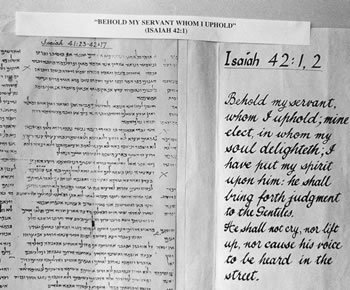
Part of the main Scroll of Isaiah recovered alongside the Dead Sea

In this case the prophecy could be saying that the expected Messiah will be “pierced” or that “he was pierced.” Isaiah 11:4 states, “And with the breath of His lips He shall slaythe wicked [emphasis added].” And in the NASB, Isaiah 53:5 says, “He was pierced through for our transgressions [emphasis added].” Both statements are relevant, for in fact the Messiah was pierced, and in a coming judgment those who have rejected the Messiah will be pierced.

The Scrolls have provided copies of most of the Old Testament, for fragments of every Old Testament book except Esther have been found in Hebrew, about 1,000 years earlier than previous extant Hebrew copies. (A writing from the book of Esther is found in another scroll.)

Considerable light was thrown on New Testament backgrounds and on the Jewish nature of John’s Gospel. For example, contrasts such as “light and darkness” are common to John and the “War Scroll,” a text that describes the eschatological last battle; and Hebrew was still a living language, not just a priestly language.

The Dead Sea Scroll of Isaiah also shows an old form of the Hebrew letter “tau,” which looks like an “X” in the margin of the scroll. It occurs 11 times, at Isaiah 32:1, 42:1, 42:5, 42:19, 44:28,49:5–7, 55:3–4, 56:1–2, 56:3, 58:13, and Isaiah 66:5. As already stated, both the records of the Assyrians and the Dead Sea Scrolls (with a near-complete copy of Isaiah) were totally hidden from human eyes for about 2,000 years. Most of the content of these two sources overlapped and thus confirmed the evidence for the genuineness of the prophecies of Isaiah.

An important point about the finding of these scrolls is that they relate to the uncovering of the Assyrian palaces from the 1840s onwards. Isaiah gives a number of historical facts relating to the Assyrians that remarkably confirm the accuracy of Isaiah.

Possibly, the finding of the Dead Sea Scrolls is one of the most wonderful facts regarding the relevance of biblical archaeology and the Bible.5

Major Evidences Regarding the Person of Our Lord Jesus


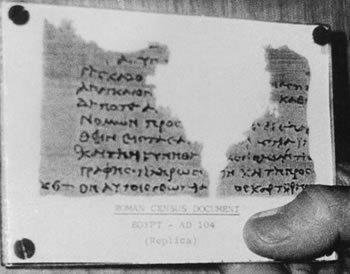
Part of an inscription about enrolling for the poll tax

Events surrounding the words and actions of Jesus have been authenticated by archaeological discoveries.

Problems about the census at the time of our Lord’s birth have been resolved by the findings of important papyrus documents. These documents were found in Egypt inside sacred, embalmed crocodiles. The documents were the Jewish priestly writings that were written immediately before, during, and just after New Testament times.

The excavators Granfell and Hunt reported that their evidence showed that this was the first census (poll tax—enrollment) that took place in the time of Quirinius. (Another inscription has shown that Quirinius was in Syria twice—first as a military leader at a time of civil unrest, and later as Governor of Syria.) The census was probably delayed in Palestine because of that civil unrest.

Those papyrus findings have thrown much light on the words our Lord used. It is indeed true that He spoke the language of His time on earth (Mark 12:37).

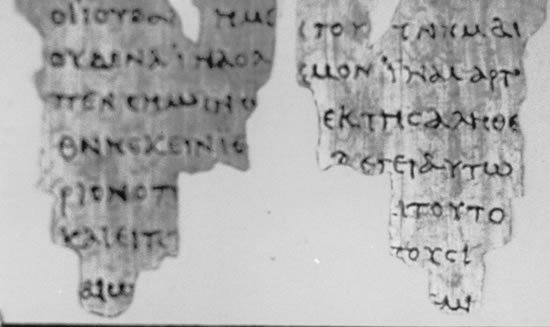
Pilate is now better known because of a recovered inscription at Caesarea. The John Rylands papyrus (AD 125) records part of the trial before Pilate, fragments of which are recorded in John 18:31–33, 37–38.


Both sides of the Rylands Papyrus

Major Evidences Regarding the New Testament, the Early Church, and the Early Years of Christianity

The documents of the New Testament have been validated as accurate historical documents.

The papyrii from those Egyptian “talking crocodiles” have demonstrated that the New Testament documents are remarkable records of the times claimed for them in the language of “everyday” people. Those everyday expressions from Paul’s time have also thrown much light on Paul’s writings themselves.

The findings of Sir William Ramsay and his successors in Asia Minor reestablished the veracity of Luke the historian and other New Testament writers.

The three Bible writings most attacked by critics were the Moses’ Pentateuch, Ezra/Nehemiah, and Luke. Every one of these has been remarkably confirmed as being accurate and reliable by the research of credible scholars.

A flood of evidence shows the continuity between the New Testament documents (e.g., the Rylands Papyrus with parts of John 18:31–33 on one side and John 18:37–38 on the other) and the abundant evidence from the secular Roman writers and the early church fathers.

Does Archaeology Prove the Bible?

Even when excavators are digging to uncover a past time period dealt with in the Bible, it is by no means sure that direct biblical history will be unearthed. Such findings are hoped for, not only by Bible students, but by disinterested archaeologists as well, because they know that they must take Bible records seriously. A link with Bible history is an excellent dating point, always desirable but not possible or achieved. These findings are excellent confirmations of God’s Word, as opposed to “proving the Bible.”

Archaeologists are scholars, usually academics with interest in the Bible as an occasional source book. A substantial number of scholarly archaeologists are committed Christians, but they are a minority. Many people believe that all archaeologists set out to verify biblical history, but that is not the case. Many excavators have virtually no interest in the Bible, but there are notable exceptions.

Superiority Despite Attacks by Critics

We have already said that we do not use the statement: “Archaeology proves the Bible.” In fact, such a claim would be putting archaeology above the Bible. What happens when seemingly assured results of archaeology are shown to be wrong after all? Very often archaeology does endorse particular Bible events. And some would say that in this way it “proves the Bible.” But such a statement should be taken with reservation because archaeology is the support, not the main foundation.

SEEMINGLY ASSURED RESULTS “DISPROVING” THE BIBLE HAVE A HABIT OF BACKFIRING.

Thousands of facts in the Bible are not capable of verification because the evidence has long since been lost. However, it is remarkable that where confirmation is possible and has come to light, the Bible survives careful investigation in ways that are unique in all literature. Its superiority to attack, its capacity to withstand criticism, and its amazing facility to be proved right are all staggering by any standards of scholarship. Seemingly assured results “disproving” the Bible have a habit of backfiring.

Over and over again the Bible has been vindicated from Genesis to Revelation. The superiority of Genesis 1–11 has been established, and the patriarchal backgrounds have been endorsed. The writings of Moses do date to his time, and the record of the conquest of Canaan under Joshua has many indications of eyewitness recording.

David’s Psalms were clearly products of his time, and records about Solomon should no longer be written off as “legendary.” Solomon was a literary giant, a commercial magnate, and a powerful ruler—under God. God alone gave Israel their “golden age.”

The Assyrian period has given dramatic confirmation to biblical records, with excavations of palace after palace over the last 150 years. Such excavations constantly add to our understanding of the background to Old Testament kings, prophets, peoples, and incidents.

The exile in Babylon is endorsed at various points, and the Cyrus Decree makes it clear that captured people could return to their own lands and worship according to their own beliefs. Ezra and Nehemiah are accurate reflections of that post-exilic period.

Likewise, the New Testament documents have been consistently demonstrated as factual, eyewitness records. Kings, rulers, and officials are named unerringly; titles are used casually but with remarkable accuracy; geographic boundaries are highlighted; and customs are correctly touched on.

It is indeed true that “truth shall spring out of the earth” (Psalm 85:11).

Archaeology as It Relates to the Biblical Record

Our understanding of essential biblical doctrine has never changed because of archaeological findings. It should be acknowledged, however, that at times it has been necessary to look again to see just what the Bible is actually saying. There have been times when new light has been thrown on words used in Scripture in both Old and New Testaments.

We have seen that the titles of officials of Israel’s neighbors are now better understood and that many words are better understood because of the records in clay, on papyrus, and on stone.

The Old Testament is an ancient book, not a modern record, and its style is that of the East and not the West. At times it must be interpreted, based on its context, in the symbolic and figurative style of the Jews of ancient times, and not according to the “scientific precision” of our modern materialistic age.

Sometimes the Bible uses “the language of phenomena”—as when it refers to the sun rising. Scientifically speaking, the earth is what “rises.” However, though the Bible is not a science textbook, it is yet wonderfully true that where the Bible touches on science it is astonishingly accurate.

The more this new science of archaeology touches the records of the Bible, the more we are convinced that it is a unique record. At many points it is greatly superior to other writings left by neighboring people.

We have not said, “Archaeology proves the Bible,” and we do not suggest it. To do so would be quite wrong, even though such a statement is often made by those introducing a lecturer on biblical archaeology. The Bible itself is the absolute; archaeology is not. If archaeology could prove the Bible, archaeology would be greater than the Bible, but it is not. The Bible comes with the authority of almighty God. It is His Word, and He is greater than all else.

Nevertheless, archaeology has done a great deal to restore confidence in the Bible as the revealed Word of God. It has thrown a great deal of light on previously obscure passages and has helped us to understand customs, culture, and background in many ways that seemed most unlikely to our fathers in a previous generation. Archaeology is highly relevant for understanding the Bible today.
The Value of Archaeology for the Bible Student

Archaeology has done a great deal to cause many scholars to take the Bible much more seriously. It has touched the history and culture of Israel and her neighbors at many points and has often surprised researchers by the implicit accuracy of its statements.

If it can be shown (as it can) that the Bible writers lived and gave their message against the backgrounds claimed for them, it becomes clear that their amazing prophetic messages are also genuine, written long before the events they prophesied. Consider five important ways in which archaeology has been of great value for Bible students.

Archaeology confirms Bible history, and it often shows that Bible people and incidents are correctly referred to.

One example is that of Sargon, a king named in Isaiah 20:1. Critics at one time said that there was no such king. But then his palace was found at Khorsabad, and there was a description of the very battle referred to by Isaiah. Another illustration is the death of the Assyrian King Sennacherib. His death is recorded in Isaiah 37 and also in the annals of Sennacherib’s son Esarhaddon, whom Isaiah says succeeded Sennacherib.

Archaeology gives local color, indicating that the background is authentic.

Laws and customs, gods, and religious practices are shown to be associated with times and places mentioned in the Bible. Rachel’s stealing her father’s clay gods illustrates the correct understanding of customs: she and Leah asked, “Is there yet any portion or inheritance for us in our father’s house?” (Genesis 31:14). She knew the teraphim (clay gods) were associated with title deeds, which was a custom of that time.

Archaeology provides additional facts.

Archaeological facts help the Bible student understand times and circumstances better than would otherwise be possible. Bible writers tell us the names of such Assyrian kings as Sennacherib and Esarhaddon, and we now know a great deal more about these rulers from records recovered in their palaces and libraries.

Archaeology has proved of tremendous value in Bible translations.

The meanings of words and phrases are often illuminated when found in other contexts. 2 Kings 18:17, for example, correctly uses three Assyrian army titles. Those terms are tartan(commander-in-chief), rabshakeh (chief of the princes), and rabsaris (chief eunuch). The meanings of these words were unknown at the time of the production of the King James Version of the Bible in 1611.

Only when Assyrian palaces were excavated was a great deal of light thrown onto their meanings. The fact that these titles are correctly used in the Old Testament is another strong argument for eyewitness recording. People do not know the titles of their enemy without some form of contact.
Archaeology has demonstrated the accuracy of many Bible prophecies.

The prophecies against Nineveh, Babylon, and Tyre in Isaiah are typical examples, as are the early records of creation in the Bible. It is also highly important that Isaiah and others so accurately pointed to the coming Messiah. At many points their history has been vindicated, and so have their prophecies about Jesus.

This spiritual application is surely one of the most important aspects of biblical archaeology, reminding us that “holy men of God spoke as they were moved by the Holy Spirit” (2 Peter 1:21).

Archaeology has done much to demonstrate that “the Bible was right after all.” Its early records of creation, Eden, the Flood, long-living men, and the dispersal of the nations are not mere legends after all. Other tablets recording the same events have been recovered, but they are often distorted and corrupted.

The Bible record is immensely superior, and quite credible. Those early Bible records can no longer be written off as myth or legend.

“For ever, O Lord, Your word is settled in heaven” (Psalm 119:89).

A Memory Aid Showing the Relevance of Archaeology to the Bible

S Superiority—Creation, Flood, Tower of Babel, Laws of Moses, Psalms of David, genuine prophets of Israel, the teachings of Jesus.

C Customs—Rachel stealing clay gods; Joseph’s story; religious practices; ruthlessness of Assyrians; unchangeable laws of Medes and Persians; enrolling for census when Jesus was born.

A Additional information—Moabite Stone; Jehu and the Black Obelisk of Shalmaneser; the assassination of Assyrian King Sennacherib; Belshazzar as co-regent with his father Nabonidus; new light on New Testament backgrounds from the Dead Sea Scrolls and other manuscripts and inscriptions.

L Language and Languages—Hebrew, Aramaic, and Greek. Others are touched in passing, including Egyptian, Canaanite, Philistine, Babylonian, Persian, Latin, and Assyrian.

P Prophecy—about Bible lands and people, as well as the Lord Jesus Christ. The local color and the integrity of prophecies demonstrate the uniqueness of the Bible.

S Specific Incidents and People—Sargon’s victory against Ashdod (Isaiah 20:1); the death of Sennacherib (Isaiah 37); Nebuchadnezzar the King of Babylon who campaigned against Jerusalem and Judah; various rulers (such as the Herods) correctly identified (the Gospels and Acts); the census in the time of Caesar Augustus.

Many people have commented that they do not have the knowledge to talk about archaeology and the Bible; this acrostic SCALPS should help.6

1 Peter 3:15 urges us to “always be ready to give a defense to everyone who asks you a reason for the hope that is in you, with meekness and fear.”

That’s a command to Christians!

Wednesday, February 17, 2016

Falar a Verdade em Amor

Compilação:

Antes, seguindo a verdade em amor, cresçamos em tudo naquele que é a cabeça, Cristo.
—Efésios 4:15[1]

*

Devemos encontrar o equilíbrio entre convicção da verdade e cordialidade ou civilidade na conduta. Algumas pessoas com fortes convicções e crenças às vezes deixam a desejar na civilidade. Outras são tão “boazinhas” que carecem de ousadia e convicção quanto aos padrões de verdade e moralidade. Falta-lhes coragem para defender o que quer que seja. A melhor postura é o meio termo, nem duro nem fraco, mas seguir averdade, falar a verdade em amor.[2]—Paul Copan

*

Aqueles que esperavam em Jesus um salvador político muitas vezes ficaram confusos com a Sua escolha de companhia. Ele Se tornou amigo de coletores de impostos, uma classe de pessoas claramente identificada como exploradores estrangeiros, não com as vítimas da exploração. Apesars de condenar o Sistema religioso da época, Ele tratou um dos seus líderes, Nicodemos, com respeito. Apesar de Se posicionar contra os perigos do dinheiro e da violência, demonstrou amor e compaixão pelo jovem rico e pelo centurião romano. Em outras palavras, Jesus honrava a dignidade das pessoas, quer concordasse com sua conduta, quer não. Ele não fundou o Seu reino com base em raça, classe social ou outras divisões desse tipo. Qualquer pessoa, até mesmo uma mestiça com cinco maridos, ou um ladrão morrendo na cruz, era bem vinda no Seu reino. Para Jesus, o indivíduo era mais importante do que categorias ou rótulos.

Toda vez que me envolvo em algo a respeito do qual tenho fortes convicções, essa qualidade de Jesus me faz refletir bastante. É muito fácil se envolver na política da polarização, de participar de manifestações contra o “inimigo” e gritar. Mas é muito difícil se lembrar que o reino de Deus me incita a amar a mulher que acabou de sair da clínica de aborto (e sim, até o médico que fez o aborto), o promíscuo morrendo de AIDS, o rico dono de terras que explora a natureza criada por Deus. Se não consigo demonstrar amor para essas pessoas, devo questionar se entendi realmente o evangelho de Jesus.

Um movimento político define limites, faz distinções, pronuncia julgamentos. O amor de Jesus, por outro lado, não tem limites. Transcende distinções e dispensa graça a todos. Independentemente dos méritos da questão… movimentos políticos correm o risco de assumir o manto do poder que abafa o amor. Com Jesus aprendo que, não importa a militância da qual eu participe, não posso rechaçar o amor e a humildade, caso contrário estarei traindo o reino dos céus.—Philip Yancey

*

Por mais persuasivo que seja o argumento, sem a presença do Espírito ele não será efetivo, assim como nenhum ato de amor ou apresentação do Evangelho. Mas se incluirmos o Espírito, a equação sofrerá uma mudança dramática. O princípio chave é:Sem a mão de Deus, nada dá certo; mas com a Sua participação, muitas coisas dão certo. Sob a influência do Espírito Santo, o amor consegue persuadir. Pelo poder de Deus, o Evangelho consegue transformar. E com Jesus em ação, os argumentos convencem. Deus gosta de usar estes métodos.—Greg Koukl

*

Uma das maneiras mais efetivas de apresentar o Evangelho é contando o que Cristo fez na sua vida. A pessoa pode discutir ou fazer perguntas que você não saiba responder, mas não poderá negar o que Cristo fez com você. Tome tempo para pensar no seu testemunho e peça ajuda a Deus para saber contá-lo de maneira concisa e clara. Ele vai lhe dar a oportunidade. A Bíblia diz: “Estejam sempre preparados para responder a qualquer que lhes pedir a razão da esperança que há em vocês”.[3]

Além disso, ore pelas pessoas ao seu redor que não conhecem Cristo. Será impossível se manter indiferente a alguém se orar de maneira constante para a pessoa vir a conhecer o Senhor. E também não é possível orar pela salvação dela sem entender que Deus talvez queira usar você para tocar sua vida. Antes da oração mudar os outros, ela muda o nosso próprio coração.

A oração é crucial no evangelismo por uma outra razão: Só Deus pode mudar o coração impenitente. Por mais lógicos que sejam nossos argumentos e por mais fervorosos que sejam nossos apelos, serão palavras vazias e sem resultados se o Espírito de Deus não fizer o trabalho de base.—Billy Graham[4]

*

Alguém que tem o amor de Jesus, não consegue escondê-lo. Não se pode esconder uma cidade edificada sobre um monte, nem se acende a candeia e se coloca debaixo do alqueire, mas sobre o velador, e dá luz a todos os que estão em casa.[5] Quem tem essa luz, não consegue escondê-la. É impossível! Temos de falar dEle aos outros. Se você acredita, se O tem no coração e se tem o Seu amor, vai mostrá-lo, vai dizer aos outros e compartilhá-lO com eles. Isto é fé: manifestar-se e dar testemunho de Jesus e da verdade. A Bíblia diz: “Aquele que ganha almas sábio é”.”[6] Exige bastante sabedoria e amor.

O seu testemunho pessoal é praticamente a coisa mais efetiva que você tem. O apóstolo Paulo, que foi uma grande testemunha, muitas vezes começava a testemunhar diante de reis e juízes ou quem quer quem fosse, dando o seu testemunho pessoal: “Isto foi o que aconteceu comigo”. Se você der o seu testemunho com sinceridade e no poder do Espírito Santo, com fervor e seriedade, as pessoas vão acreditar que está falando a verdade. Vão acreditar no seu testemunho.

Reconhecer que é possível que tenha acontecido a você, significa que aceitam que seja possível acontecer com outras pessoas. Se aconteceu uma vez, o mais provável é que volte a acontecer, e que por isso pode acontecer com eles. Admitir essa possibilidade é uma centelha de fé, uma semente de fé do tamanho de um grão de mostarda foi plantada.

Os cowboys nos EUA têm um antigo ditado: “Você pode levar um cavalo até à água, mas não pode obrigá-lo a bebê-la”. Isso também se aplica às pessoas. Você pode guiá-las à verdade em amor, mas não pode obrigá-las a bebê-la. Tomar a decisão de receber a verdade é a parte delas, não a sua. Você pode ganhar o coração delas, mas apenas o Espírito de Deus pode ganhar suas almas e espíritos.

O nosso trabalho é testemunhar e lhes mostrar a Palavra. Quando você lhes mostra Apocalipse 3:20 e veem que Ele prometeu que entrará se Lhe pedirem, Deus pode, pelo Seu Espírito, ativar-lhes a fé para que acreditem e Ele possa assim entrar. A Palavra é o fundamento da fé. “A fé vem por ouvir a mensagem, e a mensagem é ouvida mediante a palavra de Cristo.”[7]—D. Brandt Berg

Publicado no Âncora em janeiro de 2016.

[1] NLT.
[2] Efésios 4:15.
[3] 1 Pedro 3:15.
[4] The Journey (Nashville: Thomas Nelson, 2006).
[5] Mateus 5:14–15.
[6] Provérbios 11:30.
[7] Romanos 10:17 NVI.

Tuesday, February 16, 2016

What is the Christian view of stem cell research?

http://www.compellingtruth.org/Christian-stem-cell-research.html

Stem cells are cells that can be induced to become any type of tissue. They are thought to be the Holy Grail for researchers who are trying to develop therapies for diseases and injuries. Christians need to understand the basics of stem cell research so they can make informed decisions. There are several ways to get stem cells.

Embryonic: The most useful stem cells come from embryos. A fertilized egg that is left-over from anin vitro procedure is cultured for five to seven days until it develops into a blastocyst, a ball of about 100 cells with the primary embryonic cells surrounding the undifferentiated stem cells (blank builder cells that can become any cell in the body). Left to their own devices, the ball would grow into what we would more easily recognize as a baby. In research, the stem cells are removed from their cocoon and cultured for several months until they have divided into several million cells. Left in a neutral solution, the stem cells are called a stem cell line. Portions of the line can be frozen and sold to other researchers without the need to harvest from another embryo.

Fetal/Umbilical: Blood in umbilical cords also contains stem cells. These stem cells are not as coveted, as these stem cells can only replicate into a limited number of cells.

Adult: There are several different stem cells that can be harvested from an adult. One is hemopoietic stem cells, which are taken from bone marrow and can become other types of blood cells. Another kind taken from marrow, stromal stem cells, can become bone, cartilage, fat, and connective tissues. The brain, liver, skin, heart, and other organs also have stem cells that can be useful for research. There is now a procedure called induced pluripotent stem cells. It is a new technique that reprograms a stem cell that is already affiliated with a body part and reverts it into a blank stem cell which is functionally identical to those taken from embryos.

Therapeutic Cloning: It is possible to create an embryonic stem cell that does not come from a fertilized egg. An unfertilized egg is harvested and the nucleus containing the DNA is removed. The nucleus from a skin cell of an adult is harvested from its cell and inserted into the egg. Functionally, the egg is now fertilized, and can divide and develop stem cells just like an egg from an in vitroprocedure.

Stem cell research is a sticky subject because of the ambiguity on both sides. Here are some issues for Christians to consider:

Embryonic stem cells are taken from fertilized eggs.

The problem is well known. If life begins at conception, intentionally destroying an embryo is the murder of a person. But the argument is deeper than that. One embryo can be the source of many, many stem cell strains; researchers do not need a new embryo for every phase of their work. Stem cells are taken from embryos that were not used in the in vitro fertilization process. Usually, these embryos are stored indefinitely or destroyed; very few are "adopted" by being implanted into another woman. In practice, eventually these embryos would die anyway.

Therapeutic cloning is no different than using an embryo from in vitro.

To create an embryo for the purpose of scientific research is against the Convention on Human Rights and Biomedicine; state and national laws vary. There is no difference between an embryo created by nucleus transplant and one created by fertilization. Both have the potential to grow into an adult. For more, see our article on cloning.

Despite the promises, there are very few actual therapies that have come from stem cell research.

Many researchers have given the impression that stem cell research is a panacea that will solve all of the world's medical ills. As of this writing, trials are on-going to test embryonic stem cell therapies for macular dystrophy and macular degeneration. Other conditions researchers claim will be cured include: cancer, blindness, paralysis, autoimmune diseases like Multiple Sclerosis and Lupus, organ failure, Crohn's disease, and Amyotrophic Lateral Sclerosis. But as of this writing, the only therapy that has actually come from stem cell research is for blood cancers and other blood disorders—and the stem cells used are taken from adults or umbilical cords.

Not all stem cells are taken from embryos.

Researchers believe that the most flexible, powerful stem cells come from embryos, five to seven days after fertilization, but they are not the only source. Stem cells can also be harvested from bone marrow, blood, umbilical cord blood, fetal nervous tissue, and adipose tissue (fat). There is also the question of procuring embryonic stem cell lines; if the cell line is already established, is it ethical to purchase it from the manufacturer for research? Because of the controversy over using embryonic stem cells, all stem cell research is finding funding hard to come by.

Real people, all over the world, are enduring real pain that might be alleviated by therapies derived from stem cell research.

It would be irresponsible to not consider the people who could be helped or saved by stem cell research. Millions of people all over the world suffer from cancer, autoimmune diseases, AIDS, and many others. Tens of thousands need an organ transplant. It is possible, although not proven, that stem cell research could result in therapies to cure or alleviate their conditions.

Embryonic stem cell research does not require the non-viability of the embryo.

Developing a stem cell line, which could be propagated to many different research opportunities, does not always mean the embryo must be destroyed. But, while cryogenically storing a fertilized egg is a safe and effective method of preservation, cryogenically preserving a five to seven day old blastocyst is problematic and likely to result in birth defects—on the improbable chance the embryo is implanted into a host mother and brought to term.

In the days of the Old Testament, it was common for two warring tribes to choose one warrior each for a fight to the death. The army of the winning soldier would enslave and/or pillage the other. The method sounds odd now, but it served to protect the lives of both armies. Many years later, Jesus sacrificed Himself on the spiritual battlefield on our behalf. He won, and we are victors in Him because of it. In 1990, the Archbishop of Los Angeles asked for volunteers from among his elderly priests and nuns to be infected with HIV so that researchers could determine the efficacy of the vaccine they were developing. 

Embryos are not warriors (1 Samuel 17). They cannot volunteer to give their lives for the benefit of others. It is not ethical to use and destroy those who cannot agree or disagree. Even if the embryo is left over from an in vitro fertilization process and likely to be destroyed otherwise. Or if the embryo is a clone, created for the specific purpose of scientific experimentation. It is sad that we have to endure physical illnesses and injuries. It is immoral that embryos are being cryogenically preserved with little to no hope of a chance for life. But two wrongs do not make a right.

There is nothing in the Bible that indicates God would approve of the needless death of a child for the purpose of curing a disease. God never sacrifices a child for the good of those around him—He protects children. The death of baby Moses might have saved his family from harm; but instead, God protected Moses so that he could save all of Israel (Exodus 2:1-10). The loss of David and Bathsheba's first son was a punishment, not a release from shame (2 Samuel 12:15-19). As Jesus said, "Let the little children come to me and do not hinder them, for to such belongs the kingdom of heaven" (Matthew 19:14).

For the Christian, it is not biblical to support research performed on embryonic stem cells, no matter how that embryo was derived. It is biblical to support research performed on adult and umbilical stem cells. If researchers can come to a place where they understand and appreciate the difference, it's possible that stem cell research will result in many ground-breaking therapies that will help millions of people. But from a Christian perspective, that potential is not worth the intentional death of even one child.

Question: "What should a Christian's view be on stem cell research?"

http://www.gotquestions.org/Christian-stem-cell-research.html

Answer: With the current debate raging about stem cell research, Christians would do well to educate themselves on the topic and its ramifications. To cure disease and alleviate suffering are noble pursuits, and the Bible clearly supports the battle against physical ills. A major feature of Jesus’ ministry was His healing (Matthew 4:23-24), and one of the New Testament writers, Luke, was a physician (Colossians 4:14). Stem cell research has shown great promise in the fairly new field of regenerative medicine, and many groups are actively pursuing new ways of harvesting stem cells and testing the cells’ plasticity—the ability to form a wide variety of mature cell types.

The most important question concerning stem cell research is not “Is it legal?” or “Is it cost-efficient?” but “Is it right?” The true issue is what is God’s will? Before we can answer the ethical/moral question, we must distinguish between the two types of stem cells: adult stem cells and embryonic stem cells.

Research on adult stem cells has been going on for decades and has proven that there are therapeutic effects in treating cancer, autoimmune diseases, leukemia, and heart disease. Adult stem cells are obtained from living bone marrow, blood, brain tissue, skin, and body fat. Other sources rich in adult stem cells are umbilical-cord blood and the placenta.

Embryonic stem cells, as their name suggests, are derived from human embryos. In order to harvest embryonic stem cells, an embryo must be destroyed. Central to the debate, then, is our view of the human embryo. The biblical teaching is that human existence begins at conception (Psalm 139:13-16; Jeremiah 1:4-5). The international consensus of embryologists agrees with Scripture in that life begins at fertilization. At the moment of conception, the embryo is 100 percent human, with all 46 human chromosomes and a fully functioning, unique genetic code. Size and location do not determine humanity.

Because research on embryonic stem cells requires the destruction of a living human being, it is against God’s will. No amount of promised “benefit” to society or to medical knowledge can justify the killing of a human for spare parts. The end does not justify the means. It is never ethical—in fact, it is morally reprehensible—to mark people for death in order to conduct utilitarian experiments on their body parts.

In contrast, research on adult stem cells does not require the loss of life. Adult stem cells have versatility and a proven track record, and they lack the moral difficulties of embryonic stem cells. Therefore, we believe that research on adult stem cells is a legitimate field of study, well within the will of God.

Recommended Resources: The Stem Cell Debate by Ted Peters

Copyright © Fight for Your Faith