About our Guest
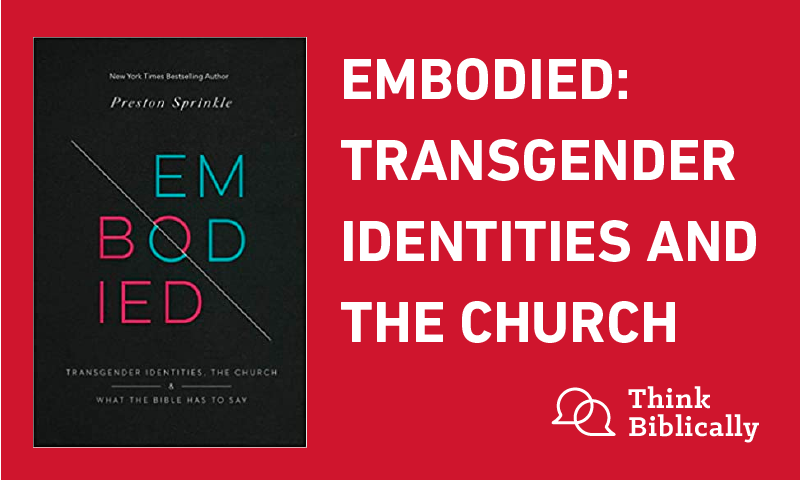
Dr. Preston Sprinkle is a professor, speaker, and a New York Times bestselling author. He earned a Ph.D. in New Testament from Aberdeen University in Scotland (2007), and he currently is the director for the Center for Faith, Sexuality, and Gender. He hosts the popular podcast “Theology in the Raw” and is the author of the recent book Embodied: Transgender Identities, the Church, and What the Bible Has to Say.
Episode Transcript
Sean McDowell: Welcome to the podcast Think Biblically: Conversations on Faith & Culture. I'm your host, Sean McDowell, professor of Apologetics at Talbot School of Theology Biola university.
Scott Rae: I'm your co-host Scott Rae, Dean of faculty and professor of Christian ethics. Also at Talbot School of Theology Biola university.
Sean McDowell: Today we're here with a friend of Biola and a friend of ours personally. He's been on the show before. In fact, you'll recognize the name Preston Sprinkle, because the interview we had with him in 2018 was the number one listened to podcast of that year. We're having a back to discuss a similar topic, a transgender identities, because he has a fantastic new book out called Embodied. Preston, thanks so much for coming back on the show.
Preston Sprinkle: Oh, yeah. Thanks for having me on you guys. I really appreciate it.
Sean McDowell: Let me start with the obvious question. I know everybody asks you this, but clearly the question of transgender identities is just a controversial, heated topic. You have a pastoral heart motivated by unity. Why write a book on this topic?
Preston Sprinkle: I do get that question a lot. Well, I mean, honestly, with any book topic that I write on, it typically is fueled by some relational context in my life. And that's definitely true of this book. I have several friends who experience some level of gender dysphoria. I've gotten to know several people who identify as trans, many people who are wrestling with their gender identity and their Christian faith, and seeing what does God desire from me as I'm trying to work out my gender and my sexuality. For me, it's just lots of names and faces in my life that have been looking for, truly looking for a biblical and theological and ethical guidance on this topic.
And it also, I would say maybe secondarily, I get asked all the time pastors and Christian leaders for some help, to help them navigate these really complex conversations, because most pastors today are getting lots of questions from people in their congregations and their ministries about transgender identities, gender dysphoria, and everything that surrounds that conversation.
Scott Rae: Preston, let's start at the very beginning on this for our listeners just so we're clear on definitions. You spend a good bit of time in the book laying this out. What is the definition of sex and the definition of gender, and how are those two things different?
Preston Sprinkle: Yeah, Scott, that's the most important question. I appreciate you asking it, because a lot of people skip that question and jump into arguing about transgender identities when we haven't even defined what sex and gender is. Sex as in biological sex has to do with the biological reality that all mammals exist in. We are as mammals as humans, we are male and female. I mean, these are biological realities that are, if I can say they are a scientific given as much as the earth is round and not flat.
Now the term gender for many years, it was used as a simple synonym for sex. We would talk about humans as male and female and people would say, that's their sex, that's their gender, that's their gender, that's their sex. And they would use sex and gender interchangeably. But I would say in the last, maybe 40, 50 years, gender has been used as a different aspect, If I can say, of the male and female experience. Whereas sex refers to the biological reality of being male or a female. And we can talk about intersex in case some people are wondering in a second, but gender has to do with both the psychological and or sociological response to our male or female embodiment. For instance, you can have a biological male who is clearly male, but they might have a psychological incongruence with their male body. They may look into the mirror and see a male body and literally be driven to throw up because they're ... if they feel like they're looking at somebody else, because their mind does not resonate with that biological reality.
Or sometimes people might be say, biologically female, but maybe they don't resonate with feminine gender stereotypes. Maybe, you're female, but you love to play sports. You hate to wear dresses. You hate the color pink. You have these kind of stereotypical masculine interests. Maybe for that person, they might not resonate with the cultural stereotypes of femininity. And a lot of people would say that, that's their sort of gender incongruence. Gender, again, can refer to one's psychological or sociological resonance or lack thereof with their biological sex.
Sean McDowell: Make the distinction then between transgender and gender dysphoria for our listeners, if you can?
Preston Sprinkle: Okay. Gender dysphoria would be the medical or psychological term used to describe the distress that some people feel in response to their biological sex. It can range from mild to severe. Sometimes it can come and go. For a lot of kids who experienced this before puberty, a lot of times going through puberty ends up relieving the [inaudible 00:05:54]. Now transgender, I would say is a broader term, it does come. I mean, in this day and age, it does come with a lot of sociological or even political assumptions. Some people would say, yeah, there's a whole movement that says you don't need to have gender dysphoria to be trans. If you say you're trans then you're trans. You don't need some medical gatekeeper to give you a piece of paper that tells you you're trans. Meaning, you don't need a medical diagnosis.
You just say you're trans. The simplest way I can put it is transgender or trans is a much broader term to convey many different kinds of identities, experiences. Whereas gender dysphoria is a more specific medical description so that most people with ... Most people who identify as trans will also have gender dysphoria, but not everybody with gender dysphoria will identify as trans and the people who identify as trans, are you confused yet? Some people who identify as trans might not even experience gender dysphoria. Long story short, we shouldn't use these two terms as synonyms.
Scott Rae: Preston, while we're on the definitions and to make it even more confusing. What is the definition of intersex? And the reason I'm asking this is because it's pretty common out there, I think, to hear that the phenomena of intersex, what follows from that is that there's this third way for gender identity that's neither male nor female. And the existence of intersex is often used as an argument against a binary way of looking at a biological sex and gender.
Preston Sprinkle: Yeah. Yeah. Thanks for bringing that up, Scott. I do hear that a lot. I would say in the more, how do I say it? In the medical community, people don't blur those categories, intersex and transgender, but it is very popular in various blogs and pop culture. Let's just back up. Yeah, intersex is a broad term used to describe a number of different medical conditions. People estimate that there's anywhere from 16 to 20 or even more different kinds of conditions whereby somebody might develop some level of atypicality or some kind of atypical feature in their biological sex. Again, going back to our sex, gender distinction, intersex has to do with sex, not gender. And gender has nothing intrinsically to do with intersex. Now, of course, some people who have an intersex condition might also experienced gender dysphoria, but these two concepts, intersex and gender, gender dysphoria are not intrinsically related.
It's important to recognize too. Some people use the term intersex as if it's a synonym for neither male nor female. But if we actually look at the medical condition that intersex covers, the 16 to 20 different kinds of conditions. It's been estimated by medical professionals that close to 99% of all people with an intersex condition are still clearly male or female. What that means is that most of these intersex conditions produce only a very minor variation or atypicality in their biological sex. I mean, I've got friends who found out they were intersex when they were like in their mid 30s, obviously they didn't wonder whether they're male or female till their mid 30s. It was so minor they didn't even notice it until they got older. Now there is within that broad category of intersex, there are some conditions like androgen insensitivity syndrome and a few others where there is a really significant, if I can say, blur in the person's male or female biological sex.
AIS for instance, is where somebody has a Y chromosome. So they have X, Y chromosomes, which is typically a male chromosome, but they have developed into a female body. And there's all kinds of reasons for that. We don't need to get into. That would be a pretty significant blend. Genetically there would be male, visibly or whatever, they would be very much female, but that's a very, very rare condition of intersex. Now, just to put a bow on it, here. Everything I'm talking about when it comes to intersex, this is talking about biological sex. But if somebody says, they're clearly male that identify as female, that's not an intersex condition. That does not have to do with some kind of atypical feature in the biological sex necessarily. It has to do with whether or not their mind or their identity resonates with their biological sex.
I do think it's important to keep these separate. And one last thing is, there are a growing number of actual intersex people who are starting to speak up, saying, please stop using me as some kind of tool in your argument to argue for a transgender identity. I do think we do need to listen to actual intersex people before we use them in an argument for, or against transgender identities.
Sean McDowell: Are you comfortable saying as far as it goes, that intersex is a biological condition and transgender is a psychological condition?
Preston Sprinkle: Yes, very much. Yeah. Yeah. Again, I don't know too many people, at least in the academic community who would argue otherwise. It does seem pretty clear. Yeah.
Sean McDowell: As Christians, we believe this, and I honestly believe it can be defended apart from scripture, that human being is body and soul. So if a person is trans and there's a lack of congruence between body and soul, which one defines who the person, I don't even know what word I would use, actually is so to speak? Is it the soul? Is it the body? Are they equal? Does the body outweigh the soul? How do we make sense and identify somebody when there's a lack of congruence between the two, biblically speaking?
Preston Sprinkle: That's a fantastic question. And it's actually chapter eight in my book. I devote a whole chapter to, what if somebody is born with a female soul in a male body? Well, that question comes with a lot of philosophical and if I can say anthropological assumptions. It's at the very least questionable, whether we can compartmentalize or divide up human nature so neatly. And you both know that there's lots of debates and philosophical circles about the material and immaterial aspect of human nature. And which one is more important and can you separate these two. It does seem biblically that however we understand the soul or the immaterial in relation to the body or the material that the Bible does tend to view them as an organic composite whole. You can't neatly separate the body, which is some shell covering the real you. That is what we would call Gnosticism.
Where that the immaterial you is way more important than the bodily you. We need to first understand that we can't just assume that there is some sort of invisible part of you that can be mismatched with your body. That is a profound philosophical claim. But when we talk about whether or not we are male or female, those categories are by definition bodily categories. For instance, if you went to a hospital and you went to a room and saw somebody who's in a coma, their brainwaves are not doing anything, I guess, I'm not a 100% sure that's what a coma is, but work with me here. That person is still either a male or female, or maybe in a rare instance, maybe intersex. Regardless of what their immaterial persona is telling them they are.
Humans are biologically, either male or female, small percentage intersex. Those are the categories we're working with and those are by definition bodily categories. It's interesting that even in the Bible, the categories of male and female, we often see male and female paired together. Both of humans and also of animals, this is not even unique to humanity. It's unique to mammals really that we are male or female. The whole idea of having, for instance, a male soul in a female body or vice versa, I think that's misunderstanding the very category of what male and female is. Now I will say, and I'll stop with this, certainly people can feel that way. Like when somebody says, I just feel like my soul is female, even though my body's male, oftentimes they're not really trying to make a philosophical claim. Oftentimes they're simply trying to describe the really unique and sometimes really difficult experience they have in life. I think we do need to look almost past or through the supposed philosophical claim to the actual lived experience of the person we're listening to.
Scott Rae: Preston, and maybe this is a little bit different claim that's being made then what you just referred to. But you point out in the book that the neurosciences have been really helpful to us in understanding some of the transgender phenomenon and that often the claim is made that it's possible to have a male brain in a female body or to have the brain put out certain signals that are characteristic of males while having a female body at the same time. What do we make of that claim? And tell us a little bit about what the neuroscience show us about that.
Preston Sprinkle: Yeah. That's another great question. And let me just, first of all, say, I'm not a scientist, I'm not a neuroscientist. I would encourage people to do their own research, but I have spent a lot of time reading through much of the scientific literature on the so-called, we call it the brain sex theory. Should we understand the human brain to be sexed like the body is, male and female bodies. That's not disputed. Do we also have male and female brains? In popular scientific, some people call it pseudo-scientific, but I don't want to stack the deck here, and it's popular scientific literature it can be common for people to talk about the male brain and female brain. But if you look at the actual the neuroscientific research, it's a bit more complicated than that.
And there's still a lot of studies being done. So I don't want to make any definitive claim. But overall it does seem fairly clear that our brains, the human brain does not come sexed as the body is. For instance, for non intersex humans, the body is either male or female, it's like clearly one or other. That doesn't mean we're a 100% different. There's a lot of overlap between males and females as well. And the same thing goes, or no, sorry, something different is going on in the brain. It doesn't seem to be the case that brains come to us as sexually dimorphic body parts. Like you have A male brain over here then a female brain over there. It does seem to be the case that males and females have general differences in their brain structures, the way our brains interact.
But these differences are not absolute. In fact, the differences in brains, it's very similar to how we can even compare differences in say like the height between males and females. If I asked you are men taller than women? Your response should say, there should be something like, well, yes, but not absolutely. Like, yes, if you lined up the tallest 100 humans on earth, it would all be men. Then the shortest, a 100 humans on earth, they would probably all be women. But some women are taller than some men. It's not an absolute claim to say that men are taller than women. It's a general claim. The same thing kind of goes with the brain like, yes, male brains do have general interests. Men do tend to be, for instance, more analytical, whereas women tend to be, they can multitask for lack of better terms. Or even the classic understanding that women are more emotional than men are less emotional, whatever. But these are all generalities.
If you're a man who is not very analytical, who maybe cries like a baby during a movie, who maybe isn't good at sports, and maybe isn't into science or technology or medicine or whatever. That doesn't mean he's not a man. It just means that he may fall outside the majority of the male experience. All that to say, I think it's, honestly, I would say, I think it's just simply scientifically inaccurate and almost dangerous to say that a biological female could, for instance, have a male brain. I think it's very accurate to say a biological female could have male typical interests, could act more masculine, but that's totally fine. If you're a woman and you don't cry during movies and you hate the color of pink, that doesn't mean you have a male brain. It just means you're not a very feminine woman in the Bible says, hooray hurrah, be a godly woman. It doesn't mean you have to be a masculine or feminine woman.
Sean McDowell: Preston, one of the things that you've addressed is some of your concern about gender stereotypes from the culture, making their way into the church and how that harms people who don't fit into those stereotypes. Can you talk a little bit about what the Bible does say about gender and maybe some ways we could be more careful and thoughtful to people who don't fit some of those stereotypes?
Preston Sprinkle: Yeah. That's a great, great question. And let me just acknowledge that there's different viewpoints on this within the evangelical church. But I would say that while the Bible might recognize that there are general differences between men and women. Throughout the Bible there are more women staying at home and raising the kids. There are more men going off to war. The Bible does recognized certain biological differences between the broad categories of men and women. I don't want to collapse male and female together and say there's no differences. Certainly there are biological and sociological differences. However, the Bible doesn't morally mandate that all males must act masculine or that all females must act feminine. While many females probably do naturally act feminine, while many males do naturally act masculine and that's a great thing. The Bible never morally mandates that and oftentimes our assumptions about what it means to be a manly man or a feminine woman.
A lot of times, if we really take that list of traits, what is it to be masculine? What is it to be feminine? And if we matched up to the Bible, oftentimes the Bible just simply doesn't resonate with that. It doesn't command that. Oftentimes our assumptions about what it means to be masculine or feminine come from culture, not the Bible. Think about how many men in the Bible weep and cry and kiss each other. Have you ever read the Psalms or even the life of Christ and how many times men are crying, even though in our culture, at least the Western culture, if a man cries, that's viewed as being a feminine trait. Or how about some women in the Bible who are prophets and judges and Jael in Judges 4 driving a tent peg through a dudes skull. It's a very masculine thing to do. And yet the Bible beautifully gives us a lot of freedom in living out our male or female identity. And again, yes, most will probably be masculine, most women will be feminine. But the Bible doesn't morally mandate those categories.
Scott Rae: Preston let's, in the time we have left here, let's tackle, I think some practical questions for the Christian who is experiencing gender dysphoria. Should that ... Say the person who's considering gender reassignment surgery, or more radical means of transitioning. Is that something that should even be on the table for somebody who's a faithful follower of Christ? Or does the Bible have prohibitions against that?
Preston Sprinkle: Yeah. Let me, first of all, say that, man I've sat down and listened to people who experience gender dysphoria, sometimes it's really severe and it's taken me a while to really get inside the skin of somebody who experiences severe gender dysphoria. And it's heart wrenching. I mean, the simple daily tasks that we take for granted, like waking up and brushing your teeth, looking into a mirror and going to the bathroom and just getting dressed and going outside, things that we don't even think about can be exacerbating for somebody with gender dysphoria. Sometimes they can't even make it outside the door day in and day out. I think before we address the ethical questions of transitioning, my heart really truly goes out to people who are wrestling with this, especially on the severe level.
Having said that, if we just look at it biblically, ethically, I think it's a really tough case to argue that God would desire somebody to try to take surgical steps to make themselves look like the opposite sex. You can't really, scientifically, at least, change your biological sex. That's not a scientific possibility. You could very much make yourself look like the opposite sex, but I don't see a good convincing biblical argument to say that in some cases, this is really the best way that a disciple of Christ should live out their human identity. We talked earlier about intersex being a condition of the body and transgender experiences being more of a condition of the mind. Well, if it is a condition of the mind, if gender dysphoria is truly something that is attacking the mind, then why would we take surgical steps toward the body to address something that's really occurring in the mind. In nowhere else in medical history in the ethical handbooks of medicine, would we take surgical bodily steps to address something that's going on in the mind.
Now, again, having said that, the tough thing is it's not like there's some pill or some quick fix you can do to relieve the dysphoria, like psychologists are oftentimes at a loss about how to help somebody relieve their dysphoria. So, I don't want to make light of that experience. But again, from an ethical standpoint, I would much rather have the body of Christ surrender their time, energy, their emotions, to invest in walking with this person to help lessen the dysphoria rather than pursuing medical transitioning. And what we're also finding out is just on a practical level, aside from the ethics, just on a practical level, in many cases, it doesn't seem that surgical or hormonal transitioning actually solves the incongruence. It might lessen the dysphoria, but the suicide rates are still very high. The mental health concerns sometimes are exacerbated through transitioning. Even transitioning, even if ethically, we can say it's permissible. Practically, it doesn't seem like it's a clear fix to the person's hardship that they're experiencing in life.
Sean McDowell: Preston I've read your book actually a couple of times.You gave me the privilege of endorsing it. And I can just tell as an author, this took a massive amount of work, individual conversations with people and research. And I framed it that way for a couple of reasons. I want our listeners to know that this is a fantastic book and I hope they pick up a copy of Embodied. It's very readable. It's research-based. You tackle some of the tough practical questions like, should you use pronouns or not? And you have an opinion of that, but you represent the other side very fairly. It's the book I will be recommending to people when people ask you about this, especially for a theological and pastoral approach, but as much as I've studied this, you've studied it significantly more than I have. And my question is having studied this so much, what do you want the church to know about loving people who are trans?
Preston Sprinkle: Mm, I appreciate that Sean, and thanks for the great compliments on the book. That means a lot coming from you and Scott. Oh man. The first thing that comes to mind is for Christians to stop paying close attention to the political conversation about transgender people. There's a lot going on there with bathrooms and activists and different bills, laws being passed and stuff, and all that's important and very real. But oftentimes political conversation can shape our hearts and minds more than the Christian or biblical conversation. I would say to any Christian, when to think through this, there's two main things you could do. One, do a lot of study on it, do a lot of research, do your own work.
And number two, sit down and get to know and listen to people who identify as trans. My friend, Mark Yarhouse, who's a Christian psychologist who deals in this area. He says, if you've met one transgender person, you've met one transgender person. Don't think that just because somebody identifies as trans, they're just like the next person who identifies as trans. We need to get to know the beautiful individual people who are walking life through this experience. And only then can we truly embody the love and truth of Jesus in their life.
Sean McDowell: That's great. And that's beautiful. And that's what I appreciate you bring to these conversations is you're not afraid to talk about the controversy and the difficulty, but it's always with a heart of how do we actually love people in the way Christ would have us love them. To our listeners, I hope you'll pick up a copy of Embodied. When people ask me for resources on issues of sexuality, the LGBTQ conversation, I recommend your work, Preston and where you're at the center for faith, sexuality, and gender. I hope our listeners will check that out. Thanks for your friendship to Biola and Talbot be encouraged. I can only imagine some of the fire you get for writing this book as graciously as you do. I can only begin to imagine. Be encouraged, know that we love you and just thanks for coming on the show.
Preston Sprinkle: Thanks for having me on you guys, really appreciate it.
Sean McDowell: This has been an episode of the podcast Think Biblically: Conversations on Faith & Culture. To learn more about us and today's guest Preston Sprinkle, and to find more episodes, go to biola.edu/thinkbiblically. That's biola.edu/thinkbiblically. If you enjoyed today's conversation, please consider giving us a rating on your podcast app and sharing it with a friend. Thanks for listening. And remember, think biblically about everything.
https://www.biola.edu/blogs/think-biblically/2021/embodied-transgender-identities-and-the-church

 An early depiction of the Hebrew Bible translated into Greek as the Septuagint. Image credit: Photo by Xerones, CC BY 2.0 via Flickr.
 A photograph of the War Scroll, one of the Dead Sea Scrolls. Photographed by Eric Matson of the Matson photo service, 21 May 2012. From the Library of Congress. Public domain via Wikimedia Commons.





Dennis Edwards: