Sunday, September 22, 2024
Tuesday, July 5, 2022
Why should we care about the Septuagint?
An early depiction of the Hebrew Bible translated into Greek as the Septuagint. Image credit: Photo by Xerones, CC BY 2.0 via Flickr.Even though the Bible is one of the most widely read books in history, most readers of religious literature have no knowledge of the Septuagint—the Bible that was used almost universally by early Christians—or how it differs from the Bible used as the basis for most modern translations.
Timothy Michael Law, author of When God Spoke Greek: The Septuagint and the Making of the Christian Bible, explains what the Septuagint is, and why it is so important to the study of Christianity.
What is the Septuagint?
The name Septuagint refers to what is mostly a collection of ancient translations. The Jewish scriptures were translated from Hebrew and Aramaic into Greek from about the third century BCE in Alexandria, a place booming with Hellenistic learning, to perhaps as late as the second century CE in Palestine. Originally the translation was of the Hebrew Torah alone.
A legend was written in the second century BCE to explain how the collection came about. In the legend, seventy learned men from the twelve tribes of Israel came to Alexandria to translate, so later when this tradition was passed down, the name “Septuagint” (seventy) was given to the entire collection of books that make up what Christians call the Old Testament.
The ancient world had known about translation activity, but there had never been a project this size and certainly not one for religious motives on this scale. I’ve always thought it’s one of the most important cultural artifacts of antiquity, but it often gets discarded as interesting only to those concerned with biblical studies. But there is also information in the Septuagint about the Greek language of the period, the socio-religious context of the Jewish Diaspora, and the very science of translation.
To me, the story of the Septuagint’s creation—what it tells us about the growth of the Hebrew Bible and the Christian Old Testament, and its role in the birth and early development of Christianity—is absorbing.
Not much is known about the Septuagint outside of the academy. Why do you think that is?
In the West, we have a cultural tradition dominated by Protestant and Catholic Christianity. An early Latin version of the Bible was made as a translation of the Septuagint, but by the end of the fourth century Jerome began to argue that the Bible was in need of revision. He thought the Old Testament should be translated from the Hebrew so that it would match the Bible of the Jews. Jerome’s new translation, later called the Vulgate, was the first significant challenge to the position of the Septuagint as the “Bible of the Church.” As the Latin Church grew apart from the Greek East in the next half millennium, Jerome’s Vulgate finally became the standard Bible. The Protestant Reformers basically accepted Jerome’s position on the authority of the Hebrew Bible, and for that reason the vernacular translations were made from the Hebrew. So for the last 1500 years, the Septuagint has struggled to find readers in the West, although it is still read in the Greek Orthodox Church. The same bias for the Hebrew Bible affects scholars, too. Because the Reformation spread throughout Europe and left its imprint on the creation of the modern European (and then the American) university, the Hebrew Bible has been studied and the Septuagint has been seen as a mere “witness” to the Hebrew text. It was thrown in the Bible scholar’s toolbox to use only when the Hebrew was difficult to understand.
A photograph of the War Scroll, one of the Dead Sea Scrolls. Photographed by Eric Matson of the Matson photo service, 21 May 2012. From the Library of Congress. Public domain via Wikimedia Commons.When we think about biblical manuscripts, the Dead Sea Scrolls have of course gained a lot of attention since their discovery in the 1940s. In some ways the Septuagint benefitted from the Scrolls.
The Septuagint is commonly treated only as a translation of the known Hebrew Bible text, and in some places a very bad one! But the discoveries in the Judean Desert provided a boost to interest in the Septuagint. Up to that time, the Hebrew Bible texts that were studied were the medieval editions. The Dead Sea Scrolls for the first time revealed many biblical texts that were a millennium older than the medieval editions. More spectacularly, these manuscripts showed significant divergences with the standard medieval text in some well-known biblical books.
The Scrolls proved that some books of the Hebrew Bible were still being edited, supplemented, reduced, etc., well into the Common Era. But if you were reading the Septuagint before the 1940s, you knew that it was produced in the Hellenistic period, and so you still might have concluded—even without the help of actual Hebrew manuscripts—that the Bible was in flux at this time based on the way these books appear in Greek in such alternative forms.
Imagine if you knew Russian, and when you were reading Dostoevsky in English you suddenly discovered that there was an entire extended passage, or one that was significantly abbreviated. You have two options. You either conclude the translator exercised a tremendous, even scandalous, amount of freedom, or you believe the English translator had a manuscript different to any others you ever knew existed in Russian.
Those were the two basic options for understanding the Septuagint, and most scholars chose the first route. But when the Dead Sea Scrolls showed these divergent text forms in Hebrew, and when some of these were represented verbatim in translation in the Septuagint, the calculus suddenly changed. Now that we had the Dead Sea Scrolls, we knew the Septuagint translators were in many of these cases translating actual biblical texts.
Septuagint scholars are about as grateful as any for the discovery of the Scrolls. The biblical texts from the Judean Desert now confirm what those familiar with the Septuagint already suspected: the divergences in some biblical books give a window into the Bible’s early formation history.
What role did the Septuagint play in the formation of Christianity?
Beginning with the New Testament itself, we see the influence of the Septuagint because these writers of what would become Christian scripture are writing in Greek. It’s natural that they turn to the Greek Jewish scriptures, but in some cases we can see how the Septuagint provided the perfect phrase—different to the same passage in the Hebrew—for them. The apostle Paul, for example, builds much of his magnum opus, the Book of Romans, with quotations from the Septuagint, not the Hebrew Bible.
Most of the early Christian movement was a Greek-speaking movement, so they too adopted the Greek Jewish scriptures as their new “Old Testament.” The early development of theological, homiletical, and liturgical language is almost exclusively indebted to the Septuagint. More needs to be done in this area, but it is clear that the Septuagint lies at the foundation of early Christianity.
Timothy Michael Law is Publisher and Editor-in-Chief of The Marginalia Review of Books. He is the author of When God Spoke Greek: The Septuagint and the Making of the Christian Bible and tweets @TMichaelLaw.
Subscribe to the OUPblog via email or RSS.
Do the Dead Sea Scrolls Support the Masoretic Text or Septuagint?
The “Original” Bible and the Dead Sea Scrolls
Can the scrolls help expose the original Bible language within the Masoretic Text and Septuagint?
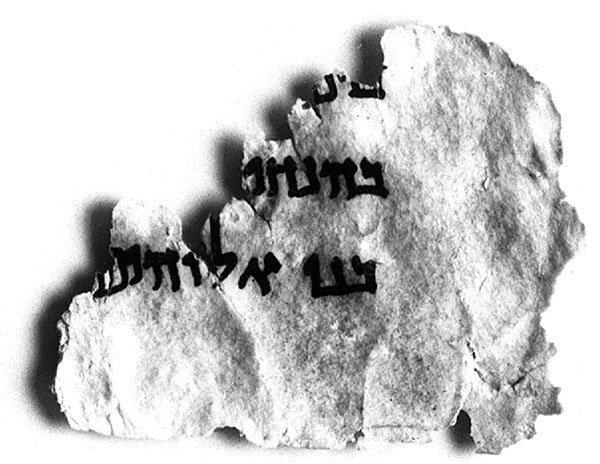
The Song of Moses (Deuteronomy 32:8) in the Masoretic Text describes the Most High dividing the nations according to number of “the sons [children?] of Israel.” This Dead Sea Scroll fragment (4QDeutj) and the third-century B.C.E. translation of the Hebrew Pentateuch into Greek (the Septuagint [LXX]), however, say the nations were divided according to the “sons of Elohim” (God). What did the original Bible text say? Photo: IAA.
Which is the “original” Bible? How do we decide which of these two ancient texts is more authoritative? In “Searching for the ‘Original’ Bible” in the July/August 2014 issue of Biblical Archaeology Review, Hebrew University of Jerusalem scholar and long-time editor-in-chief of the Dead Sea Scrolls publication team Emanuel Tov suggests we turn to the Dead Sea Scrolls to help us compare the Masoretic Text and the Septuagint.
Interested in the history and meaning of the Dead Sea Scrolls? In the free eBook Dead Sea Scrolls, learn what the Dead Sea Scrolls are and why they are important. Find out what they tell us about the Bible, Christianity, and Judaism.
Some of the Dead Sea Scrolls actually have more in common with the Greek Septuagint than the traditional Hebrew Masoretic Text. This suggests that the Greek translators must have been translating from Hebrew texts that resembled the Dead Sea Scrolls. Are the Dead Sea Scroll texts as trustworthy as these other two sources? Are they as close to the text of the original Bible?

The Great Isaiah Scroll is one of the most iconic of the Dead Sea Scrolls, yet it does not reflect the original language of the Bible. Tov calls it “a classroom example of what an inferior text looks like, with its manifold contextual changes, harmonizations, grammatical adaptions, etc.” Photo: John C. Trevor, Ph.D. Digital Image: James E. Trevor.
Some turn to the Dead Sea Scrolls simply because they are older: 2,000-year-old texts were less likely to be subjected to scribal corruption; they should reflect a more original Bible language. Tov supplements this chronological reasoning with a logical—and admittedly subjective—approach: He examines which text makes the most sense in a given context. Tov examines a number of textual discrepancies between Bible versions (Did God finish work on the sixth or seventh day before resting on the seventh day? How were the nations divided according to the number of the sons of God?) in his search for the original Bible.
The Dead Sea Scrolls have been called the greatest manuscript find of all time. Explore the BAS Dead Sea Scrolls page for dozens of articles on the scrolls’ significance, discovery and scholarship.
As an example, Tov asks: Did Hannah bring one bull or three bulls as an offering at Shiloh? (1 Samuel 1:24):
When the infant Samuel had been weaned and his mother, Hannah, finally came to Shiloh with her son, she also brought with her an offering for the Lord that is described in two ways in our textual sources. According to the Masoretic Text, she brought “three bulls,” but according to the Septuagint and a Qumran scroll (4QSama from 50–25 B.C.E.) she brought one “three-year-old bull.”
I believe that Hannah probably offered only a single bull (as in the Septuagint and 4QSama); supporting this choice is the next verse in the Masoretic Text which speaks about “the bull.” I believe the Masoretic Text was textually corrupted when the continuous writing (without spaces between words) of the original words prm/shlshh (literally: “bulls three”) underlying the Septuagint was divided wrongly to pr mshlsh (“three-year-old bull”).*
The evidence of the Septuagint, being in Greek, always depends on a reconstruction into Hebrew, and consequently the Qumran scroll here helps us decide between the various options. Incidentally an offering of a “three-year-old bull” is mentioned in Genesis 15:9. It shows that a Hebrew text underlying the Septuagint once existed in which Hannah brought only one three-year-old bull.
Tov uses the Dead Sea Scrolls to elucidate the original language of the Bible not only because they are the oldest Bible manuscripts, but also because they provide additional logical clues. He concludes: “In finding our way in the labyrinth of textual sources of the Bible, we must slowly accumulate experience and intuition. When maneuvering among the sources, we will find much help in the Dead Sea Scrolls. But they must be used judiciously.”
This Bible History Daily article about ancient translations of the Bible was originally published on June 27, 2014.
Tuesday, August 24, 2021
August 24 - Dead Sea Scroll vs Massoretic Text
The impact of this discovery (of the Dead Sea Scrolls) is in the exactness of the Isaiah scroll (125 BC) with the Massoretic text of Isaiah (916 AD) 1,000 years later. This demonstrates the unusual accuracy of the copyists of the Scripture over a 1,000 year period.
Of the 166 words in Isaiah 53, there are only 17 letters in question. Ten of these are simply a matter of spelling, which does not affect the sense. Four more letters are minor stylistic changes, such as, conjunctions. The remaining 3 letters compose the word “light,” which is added in verse 11, and does not affect the meaning greatly. Futhermore, the word is supported by the Septuagint Isaiah. Thus, in one chapter of 166 words, there is only one word (of three letters) in question after 1,000 years of transcription and this word does not significantly change the meaning of the passage. – Josh McDowell, The Evidence Deserves a Verdict (2017)
