Does your faith need strengthening? Are you confused and wondering if Jesus Christ is really "The Way, the Truth, and the Life?" "Fight for Your Faith" is a blog filled with interesting and thought provoking articles to help you find the answers you are seeking. Jesus said, "Seek and ye shall find." In Jeremiah we read, "Ye shall seek Me, and find Me, when ye shall seek for Me with all your heart." These articles and videos will help you in your search for the Truth.

Wednesday, May 20, 2026

The Information in DNA is Best Explained by a Creator


Dennis Edwards

Where does the information in the DNA come from? Option One: From a purely undirected, unguided, purposeless material process. Option Two: It is the product of some kind of designing intelligence.

Our bodies not only have irreducibly complex biological machines at work in each and every cell, but each cell has a DNA molecule which holds the information needed for the cell to reproduce itself, repair itself, etc. The DNA is an information code, the computer code of the cell. Where did the information, the computer code we find in the DNA molecule come from? Information Scientist Dr Werner Gitt in his book In the Beginning Was Information tells us,

"There is no known law of nature, no known process and no known sequence of events which can cause information to originate by itself in matter.” [1] 

Therefore, where does the information in the DNA come from? 

Dr Stephen Meyer, a proponent of the Intelligent Design hypothesis, has written extensively on the subject. In his book, The Signature in the Cell, he deals with the problem that specified information, the kind we find in DNA - which is specific and purposeful, gives to the Darwinian Theory of Evolution. He writes, 

“Our uniform experience affirms that specified information – whether inscribed in hieroglyphics, written in a book, encoded in a radio signal, or produced in a simulation experiment – always arises from an intelligent source, from a mind and not a strictly material process. So, the discovery of the specified digital information in the DNA molecule provides strong grounds for inferring that intelligence played a role in the origin of DNA. Indeed, whenever we find specified information and we know the causal story of how that information arose, we always find that it arose from an intelligent source. It follows that the best, most causally adequate explanation for the origin of the specified, digitally encoded information in DNA is that it too had an intelligent source. Intelligent Design best explains the DNA enigma.”[2] 

The information encoded in the DNA molecule points decisively to an intelligent source, not an undirected natural process.

Nobel laureate and biochemist E.C. Kornfeld (1919-2012) had a similar thought on the complexity within the cell, when he observed the biological machines at work therein. He wrote,

“While labouring among the intricacies and definitely minute particles in a laboratory, I frequently have been overwhelmed by a sense of the infinite wisdom of God…One is rather amazed that a mechanism of such intricacy could ever function properly at all…The simplest man-made mechanism requires a planner and a maker; how a mechanism ten times more involved and intricate can be conceived as self-constructed and self-developed is completely beyond me.”

Astrophysicist and mathematician Fred Hoyle (1915-2001), who framed mathematically the Steady-State model of the universe and studied the mathematical probabilities of life forming randomly from non-life, made the following comments in his book The Intelligent Universe

“There is not a shred of objective evidence to support the hypothesis that life began in an organic soup here on earth. Indeed, Francis Crick, who shared the Nobel Prize for the discovery of the structure of DNA, is one biophysicist who finds this theory unconvincing. So why do biologists indulge in unsubstantiated fantasies in order to deny what is so patently obvious, that 200,000 amino acid chains, and hence life, did not appear by chance. The answer lies in a Theory developed over a century ago, which sought to explain the development of life as an inevitable product of the purely local natural process. Its author, Charles Darwin, hesitated to challenge the Church´s doctrine on the creation, and publicly at least did not trace the implications of his ideas back to their bearing on the origin of life. However, he privately suggested that life itself may have been produced in “some warm little pond,” and to this day his followers have sought to explain the origin of terrestrial life in terms of a process of chemical evolution from the primordial soup. But, as we have seen, this theory simply does not fit the facts.”[3]

In Engineering and Science, he wrote,

“A common-sense interpretation of the facts suggests that a super-intelligence has monkeyed with physics, as well as with chemistry and biology, and that there are no blind forces worth speaking about in nature. The numbers one calculates from the facts seem to me so overwhelming as to put this conclusion almost beyond question.”[4]

With the help of his university students, Hoyle calculated the probability of life forming from non-life from some unknown natural process. In his book Evolution from Space he concluded, 

“The likelihood of the formation of life from inanimate matter is one to a number with 40,000 zeros after it. (Probability scientists consider one to a number with 50 zeros after it impossible, so thousands of zeros would dimmish impossible beyond our ability to imagine. - Dennis) It is enough to bury Darwin and the whole General Theory of Evolution. There was no primordial soup, neither on this planet nor any other, and if the beginnings of life were not random, they must, therefore, have been the product of purposeful intelligence.”[4]

“We must now admit to ourselves that the probability of life arising by chance by evolution is the same probability of throwing six in dice 5 million consecutive times.”

“Let’s be scientifically honest with ourselves, the probability of life arising to greater and greater complexity and organization by chance is the same probability of having a tornado tear through a junk-yard and form out the other end a Boeing 747.”
 

The leaders of today’s scientific community are aware of these difficulties. Because of Hoyle’s vociferous attacks against the idea of life forming from non-life spontaneously, he was denied a Nobel Prize, though he was one of the most prominent astrophysicist and mathematician of his time. So why do scientists ignore the obvious? A Professor of Genetics for many years at Harvard University, Richard Lewontin (1929-2021), candidly reveals the secret.

“We take the side of evolutionary science (that life came from non-life spontaneously) in spite of the patent absurdities of some of its constructs, in spite of the tolerance of the scientific community for unsubstantiated just so stories, because we have a prior commitment to materialism, and that materialism is absolute for we cannot allow a divine foot in the door.”[6]

In other words, it is their prior belief system and commitment to only materialistic explanations that force the scientists to reject supernational explanations even though the physical evidence is best explained by metaphysical means. They do not want a Divine foot in the door of scholastic thinking. Students would not be so quick to abandon their faith and believe the unsubstantiated evolutionary stories.
Richard Dawkins has agreed and said,

“Even if there were no actual evidence in favour of the Darwinian theory, we should still be justified in preferring it over all rival theories.”

As far as modern science is concerned, the supernatural does not exist, and should not be considered in a scientific theory. God is out of the question of science and cannot be considered as a mechanism in the search for origins. Even if the data seems to point to a metaphysical or supernatural cause, scientists will defer to an unsubstantiated natural cause, because they do not want to let that Divine foot in the door. Their house of cards might become obvious to everyone and come quickly tumbling down.

However, Albert Einstein (1879-1955) himself touched on the idea of Intelligent Design seen in the universe when he wrote the following:

“A scientist’s religious feelings take the form of rapturous amazement at the harmony of natural law, which reveals an intelligence of such superiority that, compared with it, all the systematic thinking and acting of human beings is an utterly insignificant reflection.”[7]

“Everyone who is seriously involved in the pursuit of science becomes convinced that a spirit is manifest in the laws of the universe—a spirit vastly superior to that of man, and one in the face of which, we with our modest powers must feel humble.”
 

Some 300 years earlier Sir Isaac Newton (1643-1727) came to a similar conclusion, but went a bit further along in his thinking, which led him to the God of the Bible and not just the "Universal Consciousness," of Einstein, which Einstein had drawn from the philosopher Spinoza (1632-1677). Newton, considered the greatest scientist of all time in 2005 by the Royal Society of London for the Improvement of Natural Knowledge, wrote,

“This most beautiful system of the sun, planets, and comets, could only proceed from the counsel and dominion of an intelligent and powerful Being…This Being governs all things, not as the soul of the world (as the New Age and Eastern philosophies teach – Dennis), but as Lord over all; and on account of His dominion He is wont to be called Lord God, or Universal Ruler.”[8]
 

From the DNA, to the biologically complex machines, to the harmony of natural law, to the movement of the celestial bodies themselves, all the evidence points to a Divine Creator God of superior intelligence. God is the best explanation for the information in the DNA molecule and God is the best explanation for the world we see and live in. 

As the psalmist has written, “The heavens declare the glory of God and the firmament shows his handiwork,” Psalm 19:1. “I will praise thee; for I am fearfully and wonderfully made: marvellous are thy works; and that my soul knows right well,” Psalm 139:14. Apostle Paul has similarly concluded, "For his invisible attributes, namely, his eternal power and divine nature, have been clearly perceived, ever since the creation of the world, in the things that have been made. So, they are without excuse," Romans 1:21.

Notes
[1] Gitt, Werner; In the Beginning Was Information; pg.107, 1994.
[2] Meyer, Stephen; Signature in the Cell, 2009.
[3] Hoyle, Fred; The Intelligent Universe; 1983; p.23.
[4] Hoyle, Fred; Engineering and Science, 1981, p8-12.
[5] Hoyle, Fred; Evolution from Space, 1984.
[6] Lewontin, Richard; Billions and Billions of Demons, 1997, p.97.
[7] Einstein, Albert; The World as I See It, 1922.
[8] Newton, Isaac. The Principia: Mathematical Principles of Natural Philosophy, 1687.

Originally published September 19, 2024  


Sunday, January 4, 2026

Are You Offering the Sacrifices of Righteousness? - Psalm 4


A Psalm of David: Psalm 4: Comments by Dennis Edwards

1 Here me when I call, O God of my righteousness: You have enlarged (or relieved) me when I was in distress; have mercy upon me, and hear my prayer.

David is reminding himself that his righteousness depends completely upon the Lord. We in ourselves are not righteous in comparison to God. We are incapable of reaching up to God in our own righteousness. Our own righteousness is stinking filthy rags, Isaiah 64:6. We are dependent upon God Himself, coming into the world as the Second Person of the Trinity, laying down His life for us, to reconcile us with God. His blood covers our sins, and offers to us the gift of eternal life through Jesus Christ our Lord to all those who believe.

“Not by works of righteousness which we have done, but according to His mercy He saved us, by the washing of regeneration, and the renewing of the Holy Ghost,” Titus 3:5. It is Jesus’ righteousness that saves us, through God’s mercy. “For by grace are you saved through faith; and that not of yourselves: it is the gift of God: not of works, lest any man should boast,” Ephesians 2:8-9. The gift of God is Jesus Christ to all those that believe.

The gospel message, the good news, is that God Himself has made a way of escape for us from our human condition because of the fall of Adam. “Wherefore, as by one man sin entered the world, and death by sin; and so, death passed upon all men, for all have sinned,” Romans 5:12. Mankind has inherited a tendency to rebel against God from Adam. However, Jesus is the door to eternal life and offers an escape from the cycle of sin and death. Jesus said, “He that hears My word, and believes on Him that sent Me, has everlasting life, and shall not come into condemnation; but is passed from death into life,” John 5:24.

Apostle Paul explains, “Therefore, as by the offence of one judgment came upon all men to condemnation; even so by the righteousness of one (Jesus) the free gift came upon all men unto justification of life. For as by one man’s disobedience many were made sinners, so by the obedience of one shall many be made righteous,” Romans 5:18-19. “For He (God the Father) has made Him (God the Son) to be sin for us, Who knew no sin; that we might be made the righteousness of God in Him (Jesus),” 2 Corinthians 5:21. “And be found in Him, not having my own righteousness, which is of the law, but that which is through faith of Christ, the righteousness which is of God by faith,” Philippians 3:9.

Our sins have separated us from God, but through Jesus’ submission and obedience to God, through His willingness to go to the cross for our sake, we can now be clothed in Jesus’ righteousness through our faith and obedience to Him. “But as many as received Him (Jesus), to them (the new believers) gave He power to become the sons of God, even to them that believe on His name,” John 1:12. “Wherefore, God also has highly exalted Him, and given Him a name which is above every name: that at the name of Jesus every knee should bow, of things in heaven and things in earth, and things under the earth; and that every tongue should confess that Jesus Christ is Lord, to the glory of God the Father,” Philippians 2:9-11.

In the second half of the first verse, David is reminding God of His past faithfulness to hear David’s prayers and he implores God to hear him once again.

2 O you sons of men, how long will you turn my glory into shame? How long will you love vanity and seek after leasing (or sin)? Selah

David compares himself in contrast with the men of the world that love the things of the world and follow after sin and pride. Apostle John has written, “Love not the world, neither the things that are in the world. If any man love the world, the love of the Father is not in him. For all that is in the world, the lust of the flesh, and the lust of the eyes, and the pride of life, is not of the Father, but is of the world. And the world passes away, and the lust thereof: but he that does the will of God abides forever,” 1 John 2:15-17.

3 But know that the LORD has set apart him that is godly for Himself: the LORD will hear when I call unto Him.

The word sanctify means to set apart or be separated for a sacred purpose or for religious use. God has set apart His people to be an example to the world. Apostle Peter explains, “But you are a chosen generation, a royal priesthood, a holy nation, a peculiar people; that you should show forth the praises of Him who has called you out of darkness into His marvellous light,” 1 Peter 2:9. Apostle Paul also wrote, quoting from the Old Testament: “Wherefore, come out from among them, and be you separate, says the Lord, and touch not the unclean thing (sin, in whatever form it tempts you); and I will receive you, and will be a Father unto you, and you shall be my sons and daughters, says the Lord almighty,” 2 Corinthians 6:17-18.

As we set apart ourselves for God, God will bring His presence upon us. Jesus promised, “If a man love Me, he will keep My words: and My Father will love him, and we will come unto him, and make our abode with him,” John 14:23. “If you shall ask anything in My name, I will do it,” John 14:14. God will answer our prayers because we are abiding in Him and being obedient to Him.

4 Stand in awe, and sin not: commune with your own heart upon your bed, and be still. Selah.

God wants us to get quiet before Him. In the psalms we read, “Be still, and know that I am God: I will be exalted among the nations, I will be exalted in the earth,” Psalm 46:10. It is in those quiet moments with God that we receive His strength. “In quietness and confidence shall be your strength,” Isaiah 30:15b. If we stop for a moment to enjoy God’s creation during a sunrise, or sunset, or a walk under the stary sky at night, or by sitting on a quiet beach, or in almost any nature filled environment, we can feel His presence and hear His voice. Before we start the day, we can also commune with God through the gift of prayer, and let His presence commune to us the needed strength and wisdom for the day.

Apostle Paul admonishes, “Be anxious for nothing; but in everything by prayer and supplication with thanksgiving let your request be known unto God. And the peace of God, which passes all understanding, shall keep your hearts and minds through Christ Jesus,” Philippians 4:6-7. If we seek the face of God early in the morning or in the evening, God’s presence will go with us and give us peace. In Isaiah we find, “I will keep him in perfect peace whose mind is stayed on Me, because he trusts in me,” Isaiah 26:3.

5 Offer the sacrifices of righteousness, and put your trust in the LORD.

As we expressed earlier, our only righteousness is in Jesus. However, David wrote, “The sacrifices of God are a broken spirit: a broken and a contrite heart, O God, you will not despise,” Psalm 51:17. Therefore, God wants us to be humble and broken before Him. Elsewhere David penned, “The Lord is nigh unto them that are of a broken heart; and saves such as be of a contrite spirit,” Psalm 34:18. Apostle James wrote, “God resists the proud, but gives grace to the humble,” James 4:6b. The Lord also has spoken through Isaiah, “To this man will I look, even to him that is poor and of a contrite spirit, and who trembles at My word,” Isaiah 66:2b. Are we humble and God fearing? If so, God will attend to our prayers.

Elsewhere, Apostle Paul says our lives should be a living sacrifice to God. “I beseech you therefore, brethren, by the mercies of God, that you present your bodies a living sacrifice, holy, acceptable with God, which is your reasonable service. And be not conformed to this world: but be you transformed by the renewing of your mind, that you may prove (or demonstrate) what is that good, and acceptable, and perfect will of God,” Romans 12:1-2. We should live our lives in sacrificial service to God and our fellow man. We do that by having our lives transformed by God’s word and Holy Spirit. We love the Lord our God with all our heart, mind, and soul; and we love our neighbour as ourselves, Matthew 22:37-39.

6 There be many that say, Who will show us any good? LORD, lift up the light of Your countenance (or presence) upon us.

Though there may be doubters and unbelievers all around us, the Lord will put His spirit, His presence, upon us if we fear Him and follow in His steps. His presence shall go with us, Exodus 33:14.

7 You have put gladness in my heart, more than in the time that their corn and their wine increased.

God presence is better than wealth and riches. In the psalms we find, “The law of Your mouth is better unto me than thousands of gold and silver,” Psalm 119:72. God’s word is such a comfort and strength that its effects are better than material benefits. Habakkuk says, “Although the fig tree shall not blossom, neither shall fruit be in the vines; the labour of the olive shall fail, and the fields shall yield no meat; the flock shall be cut off from the fold, and there shall be no herd in the stalls: yet I will rejoice in the Lord, I will joy in the God of my salvation. The Lord God is my strength, and He will make my feet like hinds’ feet, and He will make me to walk upon the high places,” Habakkuk 3:17-19.

Did ever see a mountain goat climbing on the sides of a mountain sometimes in the most precarious places? God promises that if we walk in extreme praise, in the face of whatever difficulty in life we may be facing, whether it be health, family, or finances; He will keep us and give us feet like a mountain goat, in that, like a mountain goat, we will be able to keep our feet even in the most difficult and dangerous places. If we are able to praise God through our testing’s and our afflictions, He will make our feet to stand, and we will run and keep our balance, even in the winds of adversity.

8 I will both lay me down in peace, and sleep: for You, LORD. Only make me to dwell in safety.

If we are abiding in Jesus, following His word, listening and obeying the voice of the word and the voice of the Holy Spirit in our conscience, we can have the peace of God that passes all understanding. The psalms tell us, “Great peace have they which love thy law and nothing can offend them,” Psalm 119:165. Jesus said, “These things I have spoken unto you, that in Me you shall have peace. In the world you shall have tribulation, but be of good cheer, (be encouraged), I have overcome the world,” John 16:33.

Our peace is in Jesus, He is our peace. He has said, “Peace I leave with you, My peace I give unto you: not as the world gives, give I unto you. Let not your heart be troubled, neither let it be afraid,” John 14:27. As we keep our minds stayed on Him, He gives us His peace that passes all understanding. We can rest assured, because we trust in Him, and in His promises to us. Apostle Paul, also affirms, “Those things, which you have both learned, and received, and heard, and seen in me, do: and the God of peace shall be with you,” Philippians 4:9. The psalmist tell us, “Because you have made the Lord, which is my refuge, even the most High, your habitation; there shall no evil befall you, neither shall any plague come nigh your dwelling. For He shall give His angels charge over you, to keep you in all your ways,” Psalm 91:9-11. Lord, keep us in Your ways. Let us dwell in the secret place of the most High, under the shadow of Your wings, Psalm 91:1.

Originally published 11-05-2024.

Wednesday, July 10, 2024

Summit for the Future - The UN´s Global Summit for Good or for Evil?

https://www.un.org/en/summit-of-the-future 


HOW THE UN’S SUMMIT OF THE FUTURE COULD BE A TURNING POINT FOR GLOBAL DIPLOMACY
BLOGEMERGING ISSUESHOW THE UN’S SUMMIT OF THE FUTURE COULD BE A TURNING POINT FOR GLOBAL DIPLOMACY

BY DAVID STEVEN ON MARCH 26, 2024

In September 2024, world leaders will gather at UN headquarters in New York for the Summit of the Future, which aims to “forge a new global consensus on what our future should look like.” Source: OpenAI’s ChatGPT Image Generator

As part of a monumental effort to reset global cooperation, the United Nations will host hundreds of world leaders, policymakers, experts, and advocates in September at the Summit of the Future. The ultimate goal: To rethink what multilateralism means in a rapidly changing world. Drawing on a new paper he co-authored, UN Foundation Senior Fellow David Steven outlines why — and how — to seize this moment to engage everyday citizens at the UN and beyond.

Choose a country — any country — and you will likely find the same trends: Trust in public institutions is plummeting, wealth inequality is on the rise, and societies are increasingly polarized.

If nothing else, citizens of the world are united behind one grim truth: The status quo is failing us all.

That’s why the stakes for the UN’s Summit of the Future are high. Simultaneously hailed as a once-in-a-generation opportunity and criticized for being the right summit at the wrong time, this high-level event in New York City is expected to produce not one, but three international frameworks: the Pact for the Future (currently available as a zero draft), the Global Digital Compact, and the Declaration on Future Generations.

The multilateral system is no longer fit to meet today’s complex, interconnected, and rapidly changing world. One solution, argues UN Foundation David Steven and his co-authors, is to more effectively harness the experience and expertise of everyday citizens in global decision-making. Source: OpenAI’s ChatGPT Image Generator

But what can the Summit deliver that will continue to resonate in five to 10 years? Some transformational proposals can easily be spotted in the working texts of each document. For example, the Emergency Platform, if approved, is likely to play a central role when triggered by the next global shock on the magnitude of the COVID-19 pandemic or the 2008 economic meltdown.

Other promising developments are more subtle, such as the opportunity to use the Summit as a platform for deepening the engagement of citizens in international cooperation. In its current draft, the Pact for the Future is less ambitious on this topic than the 2030 Agenda or the declaration that marked the UN’s 75th anniversary in 2020.

But as I, along with my co-authors, argue in a new challenge paper, Strengthening Citizen Participation in Global Governance, launched in partnership with Blue Smoke Alliance, the Iswe Foundation, Plataforma CIPÓ, and Southern Voice, there is still time for this to be fixed:

"The zero draft of the Pact promises 'a new beginning in international cooperation,' based on a foundation of renewed trust between people and the institutions that represent them.

But in a Pact that promises concrete action, there are as yet few practical commitments to increasing engagement. As negotiations continue, member states should take the opportunity provided by the Summit to support and invest in frameworks that take the active participation of citizens onto a new level.

Looking beyond the Summit, the UN’s 80th anniversary, the World Social Summit, the selection of the next Secretary-General, and the replacement of the 2030 Agenda present opportunities to entrench participation."

WE THE PEOPLES 2.0

Citizen engagement is not a new concern for the multilateral system. As its Charter proclaims, the UN was launched in the name of “We the Peoples” and made early attempts to understand what citizens needed from the new institution in the aftermath of World War II. The UN was also ahead of its time in the way it communicated with people about its role as a platform for global cooperation.

More recently, the Sustainable Development Goals (SDGs) were informed by a “global conversation” with over 1 million people, while the 75th anniversary of the UN (dubbed UN75) also explored what people want the international system to deliver.

This translated into commitments to engage citizens more effectively within the UN. In the 2030 Agenda, world leaders declared that the SDGs would be successful only if they were “of the people, by the people, and for the people.” They also promised to debate implementation of the UN75 commitments with their citizens as part of a more inclusive approach to multilateralism.

With half the world’s population under the age of 30, leaders have been especially keen to emphasize listening to and working with young people — inviting them, in the words of the 2030 Agenda, to “channel their infinite capacities for activism into the creation of a better world.”

AVOIDING THE SEVEN SINS OF CITIZEN ENGAGEMENT

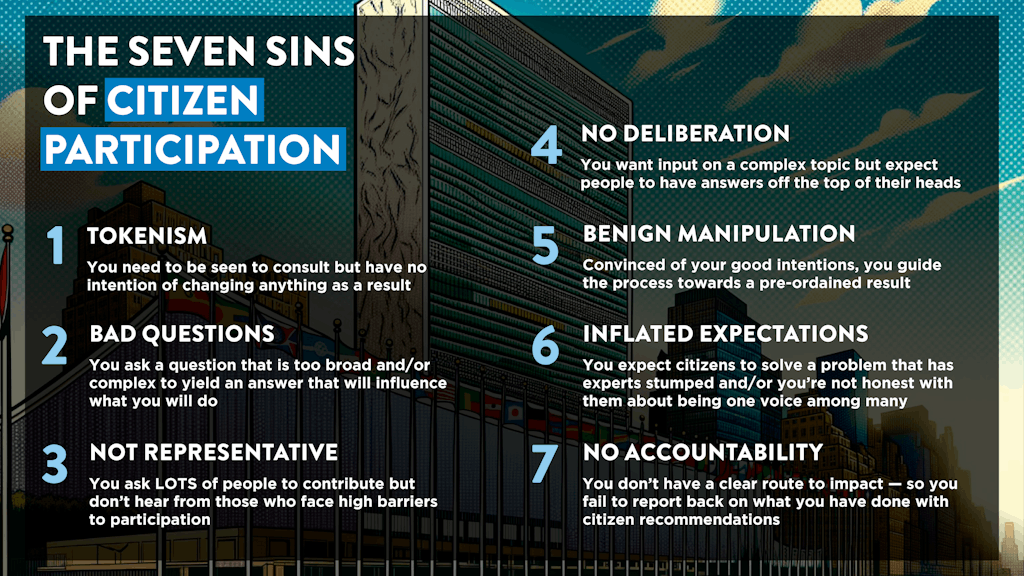
Unfortunately, citizen engagement is often poorly executed. In the challenge paper, we explore what happens when the international system reaches out to people in an ad hoc and unstrategic way, identifying what we call the seven sins of citizen participation. Engaging in tokenistic practices, asking questions that are too broad, not giving people a chance to deliberate, and resorting to “benign manipulation” that can push a process toward a preordained end are some of the most common missteps that undermine effective citizen engagement.

Seven common pitfalls for civic participation include tokenism, lack of accountability, and inflated expectations. Source: Strengthening Citizen Participation in Global Governance

We also draw a contrast with the involvement of experts and the private sector. Not only are they engaged far more often (and with more generous budgets), but there has also been impressive institutional innovation to systematize their engagement. Think of the UN’s Intergovernmental Panel on Climate Change (IPCC), which has enabled scientists from around the world to inform climate policy, or the Global Compact, which Kofi Annan set up for businesses when he was UN Secretary-General.

While the engagement of everyday citizens was written into the UN Charter, global efforts have been sporadic instead of structural, and must be reimagined given the increasingly complex and rapidly changing geopolitical landscape. Source: OpenAI’s ChatGPT Image Generator

At a time of deep crisis and growing polarization, my co-authors and I believe that this is a time for Member States to be similarly ambitious in making people partners in the international system. As our challenge paper argues, structures to deepen engagement can build trust as well as inform more farsighted decision-making.

The paper recommends ways in which the international system can get the basics right by using polling more strategically, mobilizing people behind global goals, and enabling a greater diversity of civil society organizations to play a full role in international forums.

But this is also a time for innovation, during a period when a deliberative wave has demonstrated new ways of allowing citizens to address complex challenges. Much of the experimentation has been at national and local levels, but the international system is beginning to catch up.

In an age of growing division, misinformation, and polarization, a new challenge paper recommends informing and engaging global citizens through innovative structural changes to the multilateral system. Source: OpenAI’s ChatGPT Image Generator

Take the first Global Citizens’ Assembly, which was held ahead of the UN Climate Change Conference in Glasgow known as COP26 and brought together citizens from 49 countries selected by a lottery to ensure they were representative of the global population. UN Secretary-General António Guterres hailed this as “a practical way of showing how we can accelerate action through solidarity and people power.”

FROM RHETORIC TO REALITY: ESTABLISHING A GLOBAL CITIZENS’ ASSEMBLY

In the challenge paper, we argue that next time the Secretary-General or his successor brings together a high-level panel or other expert body to advise on policy, he should ask a Global Citizens’ Assembly to explore the same set of questions.

For COP26, the core assembly was supported by discussions in community assemblies around the world. This offers a model for the UN’s 80th anniversary in 2025, building on and improving the global conversation held for UN75, and for the World Social Summit that is also planned for next year.

With time and investment, a permanent deliberative body could be established, providing a sustainable and legitimate voice for citizens in global governance. That is most likely to happen if the Pact for the Future strengthens the UN’s commitment to listening to and working with the world’s citizens — and promises to explore new and effective ways of facilitating engagement.

The Summit of the Future would then be remembered for helping to turn the rhetoric about inclusive multilateralism into reality.

SHAPING THE FUTURE OF MULTILATERALISM

The new challenge paper, Strengthening Citizen Participation in Global Governance, outlines recommendations to make everyday people central to the future of international cooperation while positioning the Summit of the Future as the moment to move beyond piecemeal approaches to civic engagement.


Dennis Edwards: Concerning the Antichrist and his government the Bible says the following.

Daniel 11:21b "He (the Antichrist) shall come in peaceably, and obtain the kingdom by flatteries." 
Daniel 11:23 "And after a league made with him, he shall come up, and shall become strong with a small people." 
Revelation 17:10-18 "And there are seven kings (seven previous great world empires that ruled over Jerusalem): five are fallen (five previous world governments that ruled over Israel: Egypt, Assyria, Babylon, Medio-Persia, Greece), and one is (Roman was the World power at the time of John's writing), and the other is not yet come; and when he comes, he must continue a short space (the Bible calls it the last 7 years). And the beast (the Antichrist) that was, and is not, even he is the eighth (the Antichrist takes over the World Government formed by the International bankers and rich men, which is the seventh World Government), and is of the seven, and goes into perdition. And the ten horns which thou saw are ten kings (ten important nations that give their power to the Antichrist and help him defeat the Worldwide Commercial Banking System of the seventh World Government), which have received no kingdom as yet; but receive power as kings one hour with the beast. These have one mind, and shall give their power and strength unto the beast. These shall make war with the Lamb (Jesus and by proxy His followers), and the Lamb shall overcome them: for he is Lord of lords, and King of kings: and they that are with him are called, and chosen, and faithful. (Jesus overcomes the Antichrist at the Battle of Armageddon found in Revelation 19:11-21 and Ezekiel 38-39.And he said unto me, The waters which thou saw, where the whore sits, are peoples, and multitudes, and nations, and tongues. And the ten horns which thou saw upon the beast (the Antichrist and his one-world government with ten principle allies), these shall hate the whore (the world-wide commercial banking system working from USA and Europe), and shall make her desolate and naked, and shall eat her flesh, and burn her with fire (Will there be a nuclear exchange?). For God hath put in their hearts to fulfil his will, and to agree, and give their kingdom unto the beast (God is using the Antichrist to chastise those that said they knew and followed God, but didn't.), until the words of God shall be fulfilled. And the woman which thou saw is that great city, which reigns over the kings of the earth."
Revelation 18:23b "For thy merchants (the merchants of Babylon the Whore, the Worldwide Commercial Banking System functioning from USA and Europe) were the great men of the earth; for by thy sorceries (or Farmakia in the Greek) were all nations deceived." Ultimately the Antichrist and his allies will destroy Babylon in one hour (signifying a very short period of time) by burning her with fire (a possible nuclear exchange). 

World government is coming and the United Nations is doing all they can to bring about its existence. Once we have world government, the Antichrist will maneuver his way into power and then defeat and eliminate those he no longer needs. Eventually he breaks the Holy Covenant and set up the abomination in Jerusalem and begins his methodical elimination of all those who refuse to accept the mandatory Mark of the Beast and who refuse to worship his image. After the rapture, the Antichrist is defeated by Jesus' supernatural return at the end of the Wrath of God, that 75 days between the Rapture and the entering into the Millennium period which we have seen above in Revelation 19.

Is the Global Pact which is talked about in the above article referring to the Peace Pact or Holy Covenant of Bible Prophecy? 
Daniel 9:27 "And he (the Antichrist) shall confirm the covenant (or pact) with many for one week (a seven-year Biblical reference): and in the midst of the week (half way through the seven-year period) he shall cause the sacrifice and the oblation (prayers) to cease, and for the overspreading of abominations he shall make it desolate..."
Daniel 11:30-31 "For the ships of Chittim (Cyprus where USA has naval base) shall come against him, therefore he shall be grieved and return, and have indignation against the holy covenant (that let the Jews begin sacrificial worship on the Temple Mount in Jerusalem): so shall he do; he shall even return, and have intelligence with them that forsake the holy covenant (those other nations that are sick of Israel's disobedience to International Law). And arms (military might) shall stand on his part, and they shall pollute the sanctuary of strength, and shall take away the daily sacrifice (that the covenant gave permission to the Jewish people to perform), and they shall place the abomination that makes desolate."

The placing of the abomination of desolation is the sign Jesus gave as the starting point to the great tribulation.

Matthew 24:15&21 "When you therefore shall see the abomination of desolation, spoken of by Daniel the prophet, standing in the holy place, (whosoever reads let him understand)...For then shall be great tribulation, such as was not since the beginning of the world to this time, no, nor ever shall be."

The abomination of desolation is placed in the holy place in the midst of the last seven-year period by the Antichrist and his forces and sets off the three and one-half years of great tribulation, followed by the rapture, and the 75 days of the wrath of God.

For more information see the following link of articles on Bible Prophecy: https://fightforyourfaith.blogspot.com/2016/10/where-is-america-in-bible-prophecy.html

Copyright © Fight for Your Faith