They Want Total Finance Control


https://www.foxnews.com/world/argentinas-milei-blasts-un-over-support-covid-lockdowns-appeasing-bloody-dictatorships To see video

UNITED NATIONS, New York - Argentinian President Javier Milei, in his first address before the United Nations General Assembly, blasted the organization, saying it "has transformed into a Leviathan with multiple tentacles that intends to decide not only what each nation-state should do but also how all the citizens of the world should live."
He added, "This is how we moved from an organization that pursued peace to an organization that imposes an ideological agenda on its members," according to a Reuters translation.
He then took aim at the world body's latest offering, calling its "Pact for the Future" "twisted," saying the policy was the "wrong course" to follow.
"The adoption of this agenda is fully in line with these privileged interests, and, looks beyond the principles that were set out in the Universal Declaration of Human Rights, and it is therefore twisted the role of this organization and set it on the wrong course," Milei said during his impassioned speech.
Milei accused the U.N. of turning into "one of the main proponents of systemic violations of freedom," citing the organization’s support for the COVID pandemic lockdowns and allowing "bloody dictatorships" such as Venezuela to sit on the Human Rights Council "without reproach."
"For this reason, I'd like to officially express our dissent on the pact for the future that was signed on Sunday, and I invite all nations of the free world to support us, not only in the U.N. in relation to this pact, but also in the establishment of a new agenda for this noble institution that is the agenda for freedom," Milei declared.
UN SILENT AS GUTERRES CALLS FOR HOSTAGE RELEASE, RECEIVES ‘THUNDEROUS’ APPLAUSE ON GAZA

Argentinean President Javier Milei addresses the 79th United Nations General Assembly at U.N. headquarters in New York City on Sept. 24, 2024. (Reuters/Eduardo Munoz)
"As the ‘Pact for the Future’ purports to dictate, this long list of errors and contradictions has led to a loss of credibility for the United Nations before the citizens of the free world," Milei said. "I'd like to issue a warning here we are coming to the end of a cycle: Collectivism and moral posturing and the woke agenda is coming up against reality. There are no further credible solutions to the real problems of the world."
The "Pact for the Future" was the centerpiece of the Summit for the Future, which kicked off the high-level week for the U.N. General Assembly this week. The pact serves as the culmination of policies and mission statements issued by U.N. Secretary-General António Guterres over the past few years.
The pact aims to expand the scope and focus of the U.N. and its members to handle "global shocks," such as "disruptions to global flows of goods, people or finance."
BIDEN DEFENDS WITHDRAWING FROM AFGHANISTAN, DROPPING RE-ELECTION BID IN LAST UN ADDRESS AS PRESIDENT

United Nations Secretary-General António Guterres speaks during a U.N. Security Council meeting on Ukraine, on the sidelines of the 79th United Nations General Assembly at U.N. headquarters in New York City on Sept. 24, 2024. (Reuters/Brendan McDermid)
Milei compared these new policies, which he alleged amounted to overreach by the organizations, to the original mission and achievements of the U.N., going on to blast the celebration of countries who "punish their women just for showing their skin in this same house that have voted against the State of Israel, which is the only country in the Middle East to defend a liberal democracy."
Israel’s returning Ambassador to the United Nations Danny Danon applauded Milei’s challenge to the General Assembly and Guterres’ pact, calling Milei "a true friend of the State of Israel."
"In this hall where they slandered Israel all day, you expressed courage and supported Israel!"

Ambassador Danny Danon, permanent representative of Israel to the United Nations, holds a picture of Hersh Goldberg-Polin, who was kidnapped by Hamas during the Oct. 7 attacks and whose body was found underground in the Rafah area of the Gaza Strip, during a United Nations Security Council meeting about the Israel-Hamas conflict in Gaza, at the U.N. headquarters in New York City on Sept. 4, 2024. (Reuters/David 'Dee' Delgado)
Milei insisted that if the current agenda should fail, the U.N. members must ask "whether or not this was an ill-conceived program from the outset."
"We should accept this reality and change what we’re doing," he argued. "The same thing always happens with ideas that come from the Left … When individuals freely decide to act otherwise, they have no better solution than to restrict, repress or cut off their freedom."
CLICK HERE TO GET THE FOX NEWS APP
"In Argentina, we’ve seen with our own eyes what they have done at the end of this path of envy and sad passion: Poverty, anarchy and a total lack of liberty," Milei said. "We still have time to choose another direction."
Milei ended with his often said slogan, ""Long live freedom, damn it! Thank you very much."
Reuters contributed to this report.
https://www.un.org/en/summit-of-the-future

 BLOGEMERGING ISSUESHOW THE UN’S SUMMIT OF THE FUTURE COULD BE A TURNING POINT FOR GLOBAL DIPLOMACY
In September 2024, world leaders will gather at UN headquarters in New York for the Summit of the Future, which aims to “forge a new global consensus on what our future should look like.” Source: OpenAI’s ChatGPT Image Generator
As part of a monumental effort to reset global cooperation, the United Nations will host hundreds of world leaders, policymakers, experts, and advocates in September at the Summit of the Future. The ultimate goal: To rethink what multilateralism means in a rapidly changing world. Drawing on a new paper he co-authored, UN Foundation Senior Fellow David Steven outlines why — and how — to seize this moment to engage everyday citizens at the UN and beyond.
Choose a country — any country — and you will likely find the same trends: Trust in public institutions is plummeting, wealth inequality is on the rise, and societies are increasingly polarized.
If nothing else, citizens of the world are united behind one grim truth: The status quo is failing us all.
That’s why the stakes for the UN’s Summit of the Future are high. Simultaneously hailed as a once-in-a-generation opportunity and criticized for being the right summit at the wrong time, this high-level event in New York City is expected to produce not one, but three international frameworks: the Pact for the Future (currently available as a zero draft), the Global Digital Compact, and the Declaration on Future Generations.
The multilateral system is no longer fit to meet today’s complex, interconnected, and rapidly changing world. One solution, argues UN Foundation David Steven and his co-authors, is to more effectively harness the experience and expertise of everyday citizens in global decision-making. Source: OpenAI’s ChatGPT Image Generator
But what can the Summit deliver that will continue to resonate in five to 10 years? Some transformational proposals can easily be spotted in the working texts of each document. For example, the Emergency Platform, if approved, is likely to play a central role when triggered by the next global shock on the magnitude of the COVID-19 pandemic or the 2008 economic meltdown.
Other promising developments are more subtle, such as the opportunity to use the Summit as a platform for deepening the engagement of citizens in international cooperation. In its current draft, the Pact for the Future is less ambitious on this topic than the 2030 Agenda or the declaration that marked the UN’s 75th anniversary in 2020.
But as I, along with my co-authors, argue in a new challenge paper, Strengthening Citizen Participation in Global Governance, launched in partnership with Blue Smoke Alliance, the Iswe Foundation, Plataforma CIPÓ, and Southern Voice, there is still time for this to be fixed:
"The zero draft of the Pact promises 'a new beginning in international cooperation,' based on a foundation of renewed trust between people and the institutions that represent them.
But in a Pact that promises concrete action, there are as yet few practical commitments to increasing engagement. As negotiations continue, member states should take the opportunity provided by the Summit to support and invest in frameworks that take the active participation of citizens onto a new level.
Looking beyond the Summit, the UN’s 80th anniversary, the World Social Summit, the selection of the next Secretary-General, and the replacement of the 2030 Agenda present opportunities to entrench participation."
Citizen engagement is not a new concern for the multilateral system. As its Charter proclaims, the UN was launched in the name of “We the Peoples” and made early attempts to understand what citizens needed from the new institution in the aftermath of World War II. The UN was also ahead of its time in the way it communicated with people about its role as a platform for global cooperation.
More recently, the Sustainable Development Goals (SDGs) were informed by a “global conversation” with over 1 million people, while the 75th anniversary of the UN (dubbed UN75) also explored what people want the international system to deliver.
This translated into commitments to engage citizens more effectively within the UN. In the 2030 Agenda, world leaders declared that the SDGs would be successful only if they were “of the people, by the people, and for the people.” They also promised to debate implementation of the UN75 commitments with their citizens as part of a more inclusive approach to multilateralism.
With half the world’s population under the age of 30, leaders have been especially keen to emphasize listening to and working with young people — inviting them, in the words of the 2030 Agenda, to “channel their infinite capacities for activism into the creation of a better world.”
Unfortunately, citizen engagement is often poorly executed. In the challenge paper, we explore what happens when the international system reaches out to people in an ad hoc and unstrategic way, identifying what we call the seven sins of citizen participation. Engaging in tokenistic practices, asking questions that are too broad, not giving people a chance to deliberate, and resorting to “benign manipulation” that can push a process toward a preordained end are some of the most common missteps that undermine effective citizen engagement.
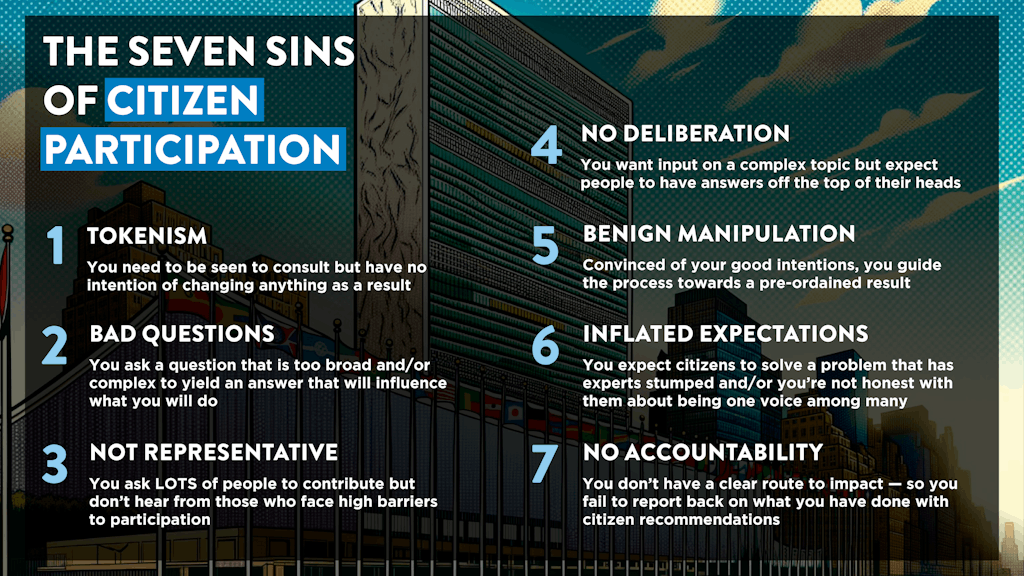
Seven common pitfalls for civic participation include tokenism, lack of accountability, and inflated expectations. Source: Strengthening Citizen Participation in Global Governance
We also draw a contrast with the involvement of experts and the private sector. Not only are they engaged far more often (and with more generous budgets), but there has also been impressive institutional innovation to systematize their engagement. Think of the UN’s Intergovernmental Panel on Climate Change (IPCC), which has enabled scientists from around the world to inform climate policy, or the Global Compact, which Kofi Annan set up for businesses when he was UN Secretary-General.
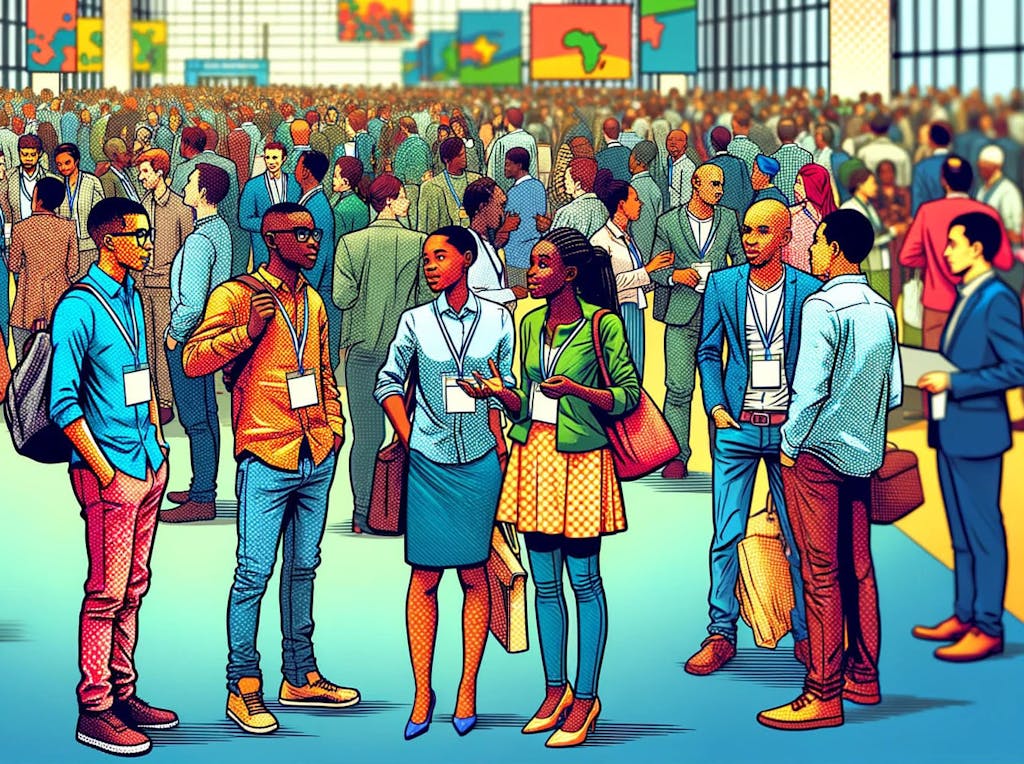
While the engagement of everyday citizens was written into the UN Charter, global efforts have been sporadic instead of structural, and must be reimagined given the increasingly complex and rapidly changing geopolitical landscape. Source: OpenAI’s ChatGPT Image Generator
At a time of deep crisis and growing polarization, my co-authors and I believe that this is a time for Member States to be similarly ambitious in making people partners in the international system. As our challenge paper argues, structures to deepen engagement can build trust as well as inform more farsighted decision-making.
The paper recommends ways in which the international system can get the basics right by using polling more strategically, mobilizing people behind global goals, and enabling a greater diversity of civil society organizations to play a full role in international forums.
But this is also a time for innovation, during a period when a deliberative wave has demonstrated new ways of allowing citizens to address complex challenges. Much of the experimentation has been at national and local levels, but the international system is beginning to catch up.
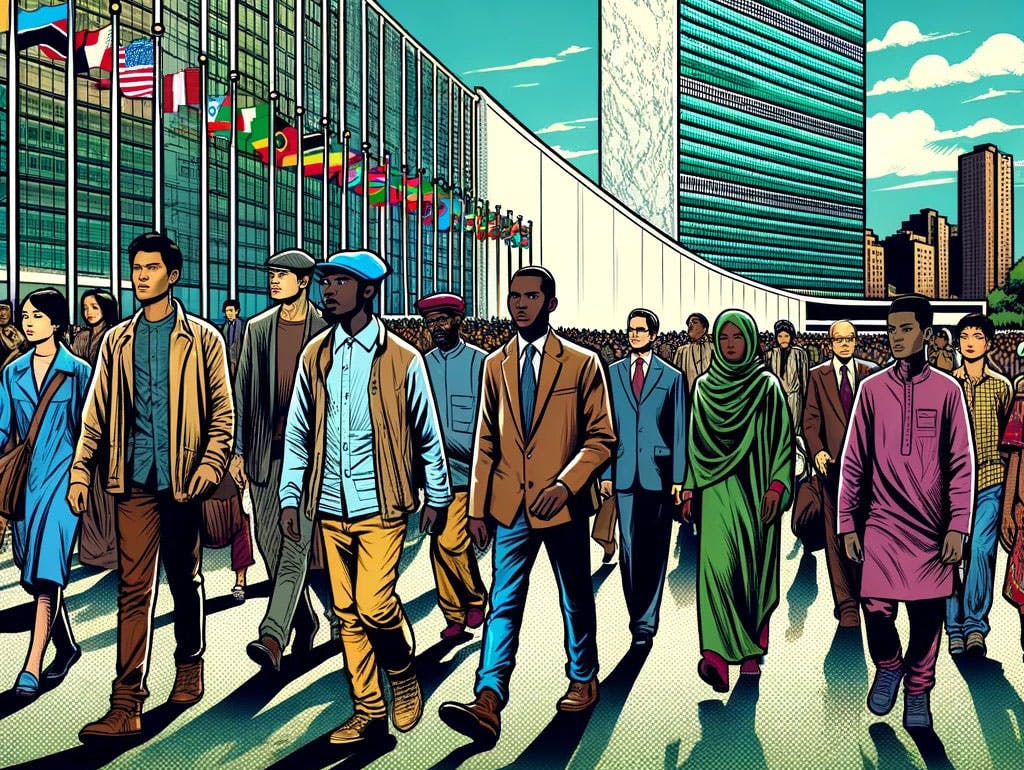
In an age of growing division, misinformation, and polarization, a new challenge paper recommends informing and engaging global citizens through innovative structural changes to the multilateral system. Source: OpenAI’s ChatGPT Image Generator
Take the first Global Citizens’ Assembly, which was held ahead of the UN Climate Change Conference in Glasgow known as COP26 and brought together citizens from 49 countries selected by a lottery to ensure they were representative of the global population. UN Secretary-General António Guterres hailed this as “a practical way of showing how we can accelerate action through solidarity and people power.”
In the challenge paper, we argue that next time the Secretary-General or his successor brings together a high-level panel or other expert body to advise on policy, he should ask a Global Citizens’ Assembly to explore the same set of questions.
For COP26, the core assembly was supported by discussions in community assemblies around the world. This offers a model for the UN’s 80th anniversary in 2025, building on and improving the global conversation held for UN75, and for the World Social Summit that is also planned for next year.
With time and investment, a permanent deliberative body could be established, providing a sustainable and legitimate voice for citizens in global governance. That is most likely to happen if the Pact for the Future strengthens the UN’s commitment to listening to and working with the world’s citizens — and promises to explore new and effective ways of facilitating engagement.
The Summit of the Future would then be remembered for helping to turn the rhetoric about inclusive multilateralism into reality.
The new challenge paper, Strengthening Citizen Participation in Global Governance, outlines recommendations to make everyday people central to the future of international cooperation while positioning the Summit of the Future as the moment to move beyond piecemeal approaches to civic engagement.

By Dennis M. Edwards All Bible verses are from the King James Bible, although I have changed some of the old English. Any similarity ...

Help me in my mission of helping others. Thanks!

Copyright © Fight for Your Faith