Tuesday, December 3, 2024
Monday, July 3, 2023
Wednesday, April 14, 2021
The Word "Soceries" in the New Testament Comes from the Greek Word "Pharmakeia"
PHARMAKEIA Deception

Revelation chapter 18 gives a description of the fall of Babylon and in verse 23 it gives us the reason why all nations were deceived. This may be shocking for many people. Let’s read what the Bible says. Referring to the fall of Babylon Revelation 18:23 says “And the light of a candle shall shine no more at all in thee; and the voice of the bridegroom and of the bride shall be heard no more at all in thee: for thy merchants were the great men of the earth; for by thy sorceries were all nations deceived.”
By the “sorceries” of Babylon all nations were deceived. The Greek word for “sorceries” in verse 23 is “pharmakeia” [far-mak-i’-ah]. According to the Thayer Greek Dictionary “pharmakeia” is “the use or administering of drugs; poisoning; and sorcery, magical arts, often found in connection with idolatry and fostered by it.” If you put the original Greek word “pharmakeia” in place of the English word “sorceries” the end of verse 23 would say, “For by thy pharmakeia were ALL nations deceived”! “Pharmakeia” is where we get our English word “pharmacy”! Pharmacy is a well organized and professionalized system that administers poisonous drugs.
The Bible reveals that Babylon will deceive all nations by the use of pharmacy that is in connection to “magical arts” and idolatry. “Magical arts” has its deep roots in witchcraft and the occultic world. We don’t have to do a deep Bible study to know that Satan is directly behind the magical arts and God’s people should have nothing to do with it. Professed deceived Christians today use “magical arts” under the disguise of contemplative prayer, “christian” humanism, and spiritual formation. In general those involved in sorcery, witchcraft, and magic are known to use “magic” potions to “heal”, deceive, poison, control, or kill someone.
Pharmacy mainly uses a mixture of toxic chemicals, metals, and/or synthetic elements to produce “pharmaceuticals” that are designed to manipulate the biochemistry or metabolic functions of the body in an attempt to get a “desired” affect in the treatment of a disease or sickness. In other words, pharmacy mixes up different types of poison, package it, patent it, and claims that it can treat certain types of diseases. The main problem with that system is that poison is poison. Pharmaceutical drugs are poisonous. When poison is put into the body it has negative effects on the entire body system from head to toe. These are not just “side effects” or “unintended” sicknesses or diseases that a person suffers as a result of using a drug. These are “direct effects” because the reality is that drugs have direct effects on the entire body system including the brain. When you go back to Revelation 18:23, Jesus uses the Greek word “pharmakeia” to reveal to us the main thing that will be used to deceive ALL people in the last days is a well organized system of administering poisonous drugs to billions of people that are not only toxic to the organs of body, but have direct negative effects on the brain. Many of these drugs used for a variety of reasons are known to cause problems with memory, mood, and contribute to negative personality changes.
Who is the main one behind the system of pharmacy and the administering of poisonous drugs that Babylon uses to deceive all nations? A logo or symbol reveals the values and the purpose of a business, organization, or professional occupation. They use a logo or symbol as an identifying “mark” to the world. In other words, that logo makes a direct link to a business or occupation. When a person thinks of the “swoosh” they immediately think of the Nike corporation. The symbols and logos of modern medicine clearly reveal who is behind the scenes orchestrating the whole system of the administering of poisonous drugs that manipulate the bodies and minds of billions of people around the world. Let’s just look at three recognizable symbols and unmask the truth!

Figure A: Bowl of HygieiaThe symbol in Figure A is the international symbol for pharmacy known as the “Bowl of Hygieia.” Who is Hygieia? Hygieia comes from Greek mythology. Mythology is the study of myths, or lies and pagan false gods. In other words, though it is not true, millions worship it as if it is true. Who is the father of lies? Satan. According to Greek pagan worship, Hygieia is the goddess of health and hygiene, the daughter of Aesculapius. He is the god of medicine, healing, and physicians.
Ettie Rosenberg, a doctor in pharmacology and attorney describes the meaning of the Bowl of Hygieia. She says, “The ‘Bowl of Hygieia’ symbol is the most widely recognized international symbol of pharmacy. In Greek mythology, Hygieia was the daughter and assistant of Aesculapius, the God of Medicine and Healing. Hygieia’s classical symbol was a bowl containing a medicinal potion with the serpent of Wisdom (or guardianship) partaking it. This is the same serpent of Wisdom, which appears on the caduceus, the staff of Aesculapius, which is the symbol of medicine.” - Ettie Rosenberg, Pharm.D., Esq.
Figure B is a picture of the statue of Hygieia. Notice the serpent drinking the magic potion from the “bowl of wisdom”. In Genesis 3:1-14, Satan, known as the serpent, used a serpent to deceive Eve. Verse 1 reveals that this serpent was “more subtil” meaning that it was thin or very light, not dense or gross, but smooth and refined in order to accomplish its deceptive purpose.Figure B: “Hygieia”

In verse 6, Eve believed the serpent’s subtil lies. Thinking that she could become wise, Eve disobeyed God by eating from the tree that God said not to eat from. In verse 13 after eating the fruit from the forbidden tree, Eve acknowledged that the serpent deceived her. When a person is deceived, are they aware of it? According to Webster’s dictionary to deceive means “to cause to believe what is false.” So when people are deceived, they really believe the lie. Notice Satan used the serpent to deceive Eve so she would believe the lie. This serpent drinking from the “bowl of wisdom” is from Satan. It represents the deceptive character of Satan that is still deceiving people today. Should God’s people have anything to do with this deception?
Figure C is known

Figure C: Rod of Aesculapius as the staff of Aesculapius. His rod represents the healing aspects of the art of medicine. Many Christians think that this symbol is the same as the serpent of brass that Moses put on a pole, but it is not. The serpent on the rod of Aesculapius is a counterfeit to Moses’ bronze serpent on the pole. This counterfeit symbol gives a false message that the serpent is wise and harmless.
Remember, the serpent on the rod of Aesculapius is the same serpent that is drinking from the Bowl of Hygieia. The message that the serpent of this Satanic symbol is also giving is that it is okay to take the poisonous “magic potent” from the bowl. These symbols that are used to represent the professions of pharmacy and medicine are giving a deceptive message from Satan that taking poisonous drugs are wise and has the power to heal and not kill. This is a lie! Those who submit to this poisonous counterfeit system will be swept away.
Figure D is a statue of Aesculapius with his rod wrapped with the “Snake of Wisdom”. This “Snake of Wisdom” is seen throughout the symbolism of the modern medical profession. It is in the symbol of the American Medical Association, an association that set the standards for physicians and the medical profession in America. It is found in the middle of the logo of the World Health Organization. It is also found on the logos of medical schools, doctor offices, and many other medical organizations.

Figure D: Statue of Aesculapius
Figure E: CaduceusThe next symbol in Figure E really sums up who is really behind the poisonous drugging system of Babylon. Figure E is another symbol recognized throughout the medical field, it is known as the “caduceus.” A caduceus has two serpents mating around a rod, topped by a pair of wings. The caduceus,also known as a magic wand, belongs to the Greek god Hermes or the Roman god Mercury. These gods are supposed to be the messengers of gods, inventors of magic, communicators to the “dead” and one who protects business and thieves (drblayney.com/ Asclepius.html). Many in witchcraft and sorcery still use the caduceus for magic and to cast spells. Also the caduceus in sorcery is known to “restrain and control” its victims.
In Greek mythology and the occultic world the caduceus had nothing to do with medicine, healing or health. So why has modern medicine adopted the caduceus as their symbol of medicine? Remember its original function and meaning. Who holds the caduceus? The false god of Mercury holds it. What is his claim? Inventor of magic, conductor of the dead, protector of merchants, thieves, and to restrain and control is his claim! Could it be that modern medicine has adopted the caduceus as their symbol of medicine and physicians to PROTECT the merchants of the earth that make billions of dollars poisoning people and to protect the corporate thieves and to control and restrain masses of people? This may shock you. Even though the caduceus had nothing to do with healing or medicine, an officer in the U.S. ARMY Medical Corps in 1902 insisted to adopt the caduceus as their symbol. Since then others in the medical profession began to adopt the caduceus as a symbol of medicine or physicians.
Let’s lift the veil of what the caduceus really means. In the occultic world, Satan depicts himself as a goat known as Baphomet with two wings and a caduceus between his crossed legs! Yes, Baphomet has a caduceus between his legs. Look at the pictures in Figure F and compare. Here is the direct link between the poisonous practices of modern medicine through pharmakeia and Satan. Satan is behind this drugging system. A caduceus is actually an abbreviated version of Baphomet, Satan himself.
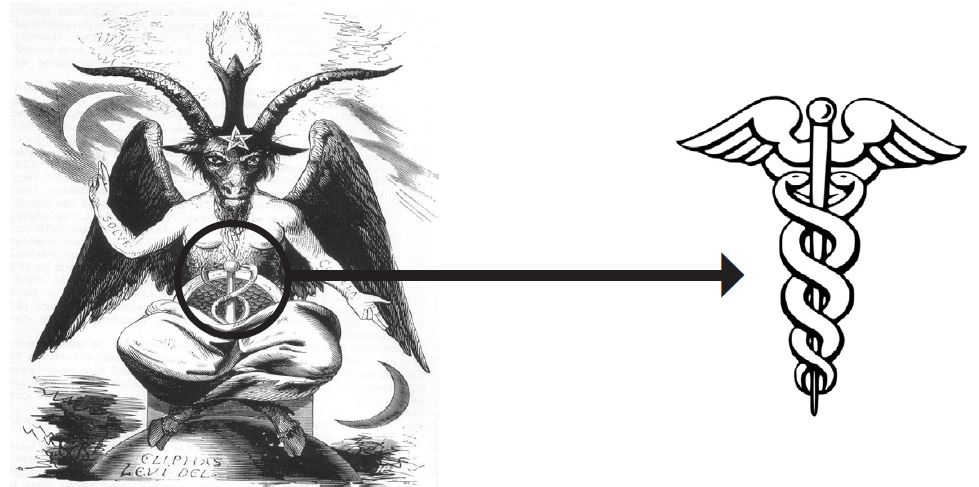
Figure F: BaphometDo you think Jesus is a part of this system? NO. Should true Christians be a part of this drugging system? No. This systematic poisoning is of Babylon and God’s people need to get out. We need to learn natures way of healing that God approves of through lifestyle and plant-based eating and herbs.
Did you know that the “father” of pharmacology was an occultist? He was a worshiper of Satan! Born as Philippus Aureolus Theophrastus Bombastus von Hohenheim in 1493, he called himself Paracelsus. He was well known as a Swiss German physician, botanist, alchemist, astrologer, and general occultist. He founded the field of toxicology better known as pharmacy. For hundreds of years physicians used natural herbs and food for healing. Paracelsus defied this notion. From his studies on chemistry and metallurgy with the mix of occultic worship and astrology, he theorized that metals such as mercury, lead, tin, copper, and gold could “purify” the body. He believed that the stars and planets were the main cause of human illness and disease. He believed that ALL diseases should be treated with metals which are poisonous to the body. This was a very radical practice during his time. He treated many diseases with mercury better known as quicksilver. Many physicians who bought into Paracelsus method and used quicksilver (mercury), also known as Quack Salber, were known as “quacks”. This was a very rebellious way of treating the body at the time (Jethro Kloss, Back to Eden, 2nd ed., pp. 52, 53). Many died as a result of Paracelsus way of treatment. At 50 or 51 years old the story is told that Paracelsus was thrown out the window by other physicians at the time who believed him to be very dangerous in 1541. It is amazing today that Paracelsus is known as the father of modern pharmacy! Where did he get his inspiration? Baphomet, Satan!
This system of Paracelsus is the foundation in which modern medicine is built. It has killed and poisoned millions of people. Pharmaceutical drugs never cure disease – they only try to manage it by inhibiting or manipulating a function in the body that is supposed to happen naturally. In a June 2010 report in the Journal of General Internal Medicine, authors said that in looking over records that spanned from 1976 to 2006 they found that out of 62 million death certificates, 25 million deaths were coded as having occurred in a hospital setting due to medication errors. The total number of deaths due to the American modern medical system of drugging, unnecessary surgeries, infections, medical errors, etc., is nearly 800,000 people per year! This is more than people who die from heart disease with over 600,000 deaths per year and cancer with over 500,000 deaths per year. - articles.mercola.com/sites/articles/ archive/2003/11/26/death-by-medicine-part-one.aspx
This system of administering poisonous drugs worldwide is a trillion dollar industry and the medical merchants of the earth profit greatly from it. They love the money it produces and ignore the many lives it destroys. Millions worship the system as an idol.
Poisonous drugs are NOT a cure for disease. Many who prescribe and administer pharmaceutical drugs will admit it. If drugs cured disease, why are many who are being treated for diseases prescribed to take drugs until the day they die. This does not sound like a cure but a money making hoax.
“People need to be taught that drugs do not cure disease. It is true that they sometimes afford present relief, and the patient appears to recover as the result of their use; this is because nature has sufficient vital force to expel the poison and to correct the conditions that caused the disease. Health is recovered in spite of the drug. But in most cases the drug only changes the form and location of the disease. Often the effect of the poison seems to be overcome for a time, but the results remain in the system, and work great harm at some later period. By the use of poisonous drugs, many bring upon themselves lifelong illness, and many lives are lost that might be saved by the use of natural methods of healing.” - Ellen White, Counsels on Health, p. 89
What message does the Bible give for those in pharmakeia – the poison of Babylon? Galatians 5:20-21says
20 Idolatry, witchcraft [pharmakeia], hatred, variance, emulations, wrath, strife, seditions, heresies, 21Envyings, murders, drunkenness, revellings, and such like: of the which I tell you before, as I have also told you in time past, that they which do such things shall not inherit the kingdom of God.” The Greek word for “witchcraft” in verse 20 is pharmakeia. Those who are in this poisoning drugging business need to repent and turn away from it. If they do not repent they will not inherit the kingdom of God. This is confirmed in the book of Revelation. Revelation 21:8 says, “But the fearful, and unbelieving, and the abominable, and murderers, and whoremongers, and sorcerers [pharmakeus =druggist/poisoner], and idolaters, and all liars, shall have their part in the lake which burneth with fire and brimstone: which is the second death.” The Greek word for sorcerers in verse 8 is “pharmakeus” defined as a druggist or poisoner. This is repeated in the last chapter of the Bible. Revelation 22:14, 15 says, 14“Blessed are they that do his commandments, that they may have right to the tree of life, and may enter in through the gates into the city. 15 For without are dogs, and sorcerers [pharmakeus = druggist], and whoremongers, and murderers, and idolaters, and whosoever loveth and maketh a lie.”
Pharmakeia is a part of Babylon. This is what the Bible predicts that Babylon would use to deceive all nations. You don’t have to be deceived. There is no way to be a part of God’s true people at the end of time and be connected with this system of administering poisonous drugs that manipulate and confuse the mind. This comes from Satan himself. You have seen the evidence. Babylon is fallen, get out before it is too late. It is a broken and poisonous system, “GET OUT” is God’s earnest plea.
Article Written by:
Cary Rodgers, Jr., pastor and health director of Pathway to Peace Ministries in Peachland, NC with four children and a wonderful godly wife, Elene. A portion of “Pharmakiea” was taken from his three angel’s sharing book “The Forgotten Commandment and the Mark of the Beast Crisis”, chapter 19. Please go to www.PathwaytoPeace.net for more details. Phone: 704-695-1441. Email: info@pathwaytopeace.net. Address: Pathway to Peace Ministries, 11775 NC 109 South, Peachland, NC 28133.
Original article found at https://www.pathwaytopeace.net/index.php/blogs-and-articles/pharmakeia-deception
If you would like to read my book on Where is America in Bible Prophecy? click on the title.
Monday, May 4, 2020
Monday, September 15, 2014
CBS 60 Minutes: 300 death claims from 1976 swine flu vaccine, only one death from flu
http://www.examiner.com/article/cbs-60-minutes-300-death-claims-from-1976-swine-flu-vaccine-only-one-death-from-flu
Fred BurksUS Intelligence Examiner
Subscribe
Google Plus
July 10, 2009
300 swine flu vaccine deaths: Is it really safe?
(AP Photo/Charlie Neibergall)
300 swine flu vaccine deaths in 1976
A headline in today's newspaper proclaims "U.S. to vaccinate millions against swine flu." Yet don't miss the powerfully revealing video clip below from the CBS investigative reporting program 60 Minutes before making your decision on whether or not to get the swine flu vaccine when it comes out.
This excellent 60 Minutes exposé reveals blatant U.S. government propaganda and fear-mongering in the swine flu outbreak and mass vaccination of 1976. The incisive report states that though only one person died as a result of the swine flu, "4,000 Americans are claiming damages from Uncle Sam amounting to three and a half billion dollars because of what happened when they took that [swine flu] shot."
This Nov. 4, 1979 program further reveals, "there are 300 claims now pending from the families of GBS [Guillain-Barre Syndrome] victims who died, allegedly as a result of the swine flu shot." With a Washington Post article today stating "The federal government should get about 100 million doses of vaccine by mid-October," think carefully about your decision after watching this important information.
For the final six minutes of this powerful clip, click here. For a full written transcript of this video, click here. Could it be that President Ford and other government officials saw this as a wonderful opportunity to shunt millions of dollars of taxpayer money into the pockets of the pharmaceutical companies in which they had investments? Remember the $5 million Donald Rumsfeld made on his investments during the avian flu, as reported in one of the U.K.'s top newspapers? Could it be the fear makes for big profits for the power elite in our world?
The box immediately below provides several ideas on what you can do to educate yourself and others to stop certain politicians from fleecing the public through vaccination and other unnecessary programs. We also invite you to comment below and let us know what you think. How can we hold the government accountable for unnecessarily spreading fear and anxiety in our world?
What you can do:
For a thoroughly researched article exploring many important, little-know facts about the swine flu vaccine, including the deeperpolitics behind the scare tactics, click here. Other excellent, revealing articles on the swine flu are available here.
Inform your media and political representatives of this key information. To contact those close to you, click here. Urge them not to overreact to all of the fear being spread about the swine flu and to investigate who is profiting from all the fear-mongering.
Explore vital information from reliable sources on how money corrupts both the medical industry and members of Congress to the detriment of our health in this powerful lesson from the free Hidden Knowledge Course.
Read concise summaries of revealing media reports on swine and avian flus available here.
Visit our Health Information Center at www.WantToKnow.info/healthinformation.
Spread this news to your friends and colleagues, and bookmark this article on key news websites using the "Share This" icon just below the title of this article, so that we can fill the role at which the major media is sadly failing. Together, we can make a difference.
Fred Burks served as personal language interpreter to Clinton, Bush, Cheney, Gore, and other top dignitaries in secret meetings. As part of an international network of researchers and news analysts, Fred obtains and disseminates key, reliable information about powerful, yet little-known forces which shape our world. For more, see articles and links in the right column of this page.
Thursday, June 6, 2013
Meet the Doctor Big Pharma Can't Shut Up
The pharmaceutical industry has compromised the Western medical establishment and hooked America on drugs. One psychiatrist is fighting back.
For the last 33 years, David Healy, an Irish psychiatrist and professor at Cardiff University School of Medicine in Wales, has written heavily researched university press books and academic journal articles on various aspects of psychopharmaceuticals. His output includes 20 books, 150 peer-reviewed papers and 200 other published works. He is not only well-pedigreed, with degrees and fellowships from Dublin, Galway and Cambridge medical schools, he is a widely recognized expert in both the history and the science of neurochemistry and psychopharmacology.
Yet Healy says his output and reputation have had little to no effect—both on the pharmaceutical industry he argues buries relevant information about prescription drug harms, and on the psychiatric and medical professions he claims are being “eclipsed” by drug companies.
“It’s been clear to me that writing books or articles banging on the risks and hazards of drugs is just going to increase the sale of drugs,” said Healy, who speaks calmly, dresses mostly in black and looks a bit like Rod Serling.
Rather than write another university publication, Healy has taken his frustration to the street. In November, he launched a nonprofit website called Rxisk.org with a group of like-minded and highly credentialed international colleagues. The site aggregates FDA data about prescription drug side effects and urges patients to submit a detailed report on their own pharmaceutical drug reactions.
Healy is not the first psychiatrist to express boiling frustration with the pharmaceutical industry or to pen dire warnings about drug-based healthcare. He is joined by people like American psychiatrist Peter Breggin, who has written several books critical of “biological psychiatry,” and Irving Kirsch, who directs the Program in Placebo Studies at Harvard Medical School/Beth Israel Deaconess Medical School and is best known for The Emperor’s New Drugs: Exploding the Antidepressant Myth. Healy is the author of such dire sounding titles as Pharmageddon and Let Them Eat Prozac: The Unhealthy Relationship Between the Pharmaceutical Industry and Depression.
For years, it was fairly easy for people in the pharmaceutical and medical industries to label Healy, Kirsch and Breggin as alarmists. But two summers ago, one of the most prominent members of U.S. medical establishment, Marcia Angell, former editor-in-chief of New England Journal of Medicine, published an article damning the over-prescription of psychoactive drugs. In two essays in the June 23, 2011 and July 14, 2011 New York Review of Books, Angell backed arguments by the university clinician Kirsh, the mental health journalist Robert Whitaker, and Boston psychiatrist Daniel Carlat that there is something extremely suspicious about the following trends: the number of people treated for depression has tripled since the launch of Prozac in 1987; 10 percent of Americans over age six are taking antidepressants; and 30 antipsychotics like Risperdal, Zyprexa and Seroquel are replacing cholesterol-lowering agents as the top-selling class of drugs in the U.S., largely because they are being prescribed to children.
Angell’s articles should have been a bomb on the medical establishment. She wrote:
“The industry-sponsored studies usually cited to support psychoactive drugs—and they are the ones that are selectively published—tend to be short-term, designed to favor the drug, and show benefits so small that they are unlikely to outweigh the long-term harms. … Both the pharmaceutical industry and the psychiatry profession have strong financial interests in convincing the public that drug treatment is safe and the most effective treatment for mental illnesses, and they also have an interest in expanding the definitions of mental illness.”
But like Healy, Angell’s warnings have fallen on deaf ears. Recent data indicates that U.S. prescription drug use is growing. The September 2012 Consumer Reports National Research Center report found that among the 46 percent of American adults taking prescription drugs, a fourth of those ages 18 to 39 regularly take two prescription drugs, indicating that multiple drug use is no longer confined to older Americans. Congressional testimony in 2012 by the American Society of Interventional Pain Physicians revealed that Americans consume 80 percent of opiate painkillers produced in the world. And a January 2011 report from Stanford University Medical School warned that antispychotics are now regularly being prescribed to treat conditions for which they have not been approved, including anxiety, attention-deficit disorder, sleep difficulties, behavioral problems in toddlers and dementia.
According to a Feb. 7, 2013 report from Drugs.com, the No. 1 best-selling U.S. drug (in dollar volume) is an atypical antipsychotic for schizophrenia treatment called Abilify. Sales for the last quarter of 2012 soared to $1.5 billion, because Abilify is widely prescribed off-label—i.e., not for schizophrenia in adults, but, for example, for irritability in children. Although Bristol-Myers Squibb, the maker of Abilify, was fined $515 million in September 2007 for recommending off-label uses of Abilify, doctors are still doling out the drug. Why?
“The reason for the increase in prescription drug use is that the entire Western medical complex is run by pharmaceutical companies,” said a Stanford University professor of medicine who preferred to remain anonymous (and who was not involved in the 2011 report on antipsychotics). “The medical training you get in Western medical schools is largely about learning which drugs to treat which diseases.” She added: “You would think that recent studies, such as the one that said antidepressants are no more helpful than a placebo, would have an effect. But they haven’t.”
Other university psychiatrists and medical doctors I contacted for this article either wouldn’t talk on the record or didn’t want to be interviewed, confirming an atmosphere Healy describes as “McCarthyist.” “There is a climate of fear,” he said during our interview. “You find that they are very nervous about saying anything about drug treatments or adverse effects of drugs at all. Doctors keep patients on lots of drugs, even if they are uncomfortable with it. And if you ask them why they’re doing so, the answer you’ll get is: ‘Well, this is the standard of care, and if I don’t take care of it this way, I’m going to be in awful trouble.’”
This standard of care is why Rxisk is directed at patients, not doctors, whose financial ties to the pharmaceutical industry are well documented. Rxisk allows users to enter into its search engine the name of a prescription drug and to see the side effects that have been reported to the FDA’s MedWatch website since 2004 as well as from Rxisk’s international data base, for more than 35,000 drug names from 103 countries, totaling 4.5 million adverse drug event reports.
Since the November 2012 launch, Rxisk has received only 10,000 visitors per month. But Healy, Applbaum and the other founders, like Nancy Olivieri, a senior scientist at Toronto General Hospital and University of Toronto Professor of Pediatrics, Medicine, and Public Health Sciences, are not particularly concerned and plan to ramp up and market their efforts slowly. “We’re doing something that’s new and it’s probably going to take awhile for people to cotton on to what’s new about it,” said Healy.
David Healy does not consider himself a radical. He prescribes antidepressants and other prescription drugs to his patients. He runs a national university school of psychological medicine. “I’m fairly conservative. I’m a very mainstream doctor, really,” he said. But as New York Times reporter Benedict Carey pointed out in a 2005 story, the Irishman living on an island off the coast of Wales “has achieved a rare kind of scientific celebrity: he is internationally known as a scholar and pariah.”
Healy’s status as an outcast arises from his grave concern that blockbuster drugs like Prozac and other antidepressants can lead to suicide, murder and unforeseen mental health problems. In the 1990s, he began to publish academic journal papers providing evidence that antidepressants could increase the risk of suicide. Although many colleagues denied the link, by 2004 American and British drug regulators issued strong warnings supporting Healy’s and other’s claims.
This was vindication for Healy. But it did not prevent him from losing in 2001 a job offer to direct the Center for Addiction and Mental Health in the University of Toronto’s Department of Psychiatry.
Healy has tried to draw attention to the connection between the increasing use of antidepressants and antispychotics and the increasing number of school shootings. On a Jan. 30, 2013 blog and video on Rxisk.org, he claimed that 90 percent of school shooters in North America and Europe were on or withdrawing from meds at the time of the incident. In our interview he pointed to a list on SSIRStories.com, a patient anecdote website that is being integrated into Rxisk, that documents which perpetrators were on which drugs for violent acts in schools between 1988 and 2011.
The only semi-mainstream figure to have paid attention to this claim is filmmaker Michael Moore, who created a video on the subject in 2012, calling for an investigation. Unsurprisingly, there has been no move to look at the correlation, since one could argue that the school shooters are psychologically disturbed and should be on more meds. Indeed, across the country, there is a drive to keep a lookout for students with possible mental health problems and to report those who seem odd.
“The problem is,” says Healy, “that it’s really going to lead to a greater use of pills. The key thing is to make sure that people who get put on them are really going to be helped by them. Once you identify the problem, the pill will be the answer, because it’s the answer for the person who has identified the problem. It may not be the answer for the person who is having to take the pill.”
One of Healy’s main problems these days is that few people listen to him. “I published a list of 98 drugs that can cause you to commit suicide or homicide. I was waiting for the world to come to an end, but nothing happened.” He continued, “If I make a claim and I don’t have scientific proof to back it up, pharmaceuticals are going to sue me.” There have been no lawsuits, which makes Healy think that silence is part of pharmaceutical companies’ tactics. “They’ve learned that the worst thing they can do is argue. If they jump up and down and say, ‘Listen to the foolish things Healy is saying,’ that would be a good way to hear about Healy. So they’re very good at not responding, maintaining their cool.”
All of this sounds rather paranoid, but then again none of the dozen university psychiatrists or drug company scientists I reached out to wanted to talk about Healy or his claims. Neither Eli Lilly nor GlaxoSmithKline could “find time” to respond to my inquiries about Healy and Rxisk.
Among David Healy’s many concerns about the state of modern medicine is the marginalization of doctors. Doctors, he’s said, are like cogs in a machine, spending a minimum of time with patients, doling out drugs pushed by pharmaceutical companies, and wrangling with insurance companies over costs.
In his 2012 book Pharmageddon, Healy argues (and provides evidence) that close to 30 percent of the clinical drug trials that have been undertaken remain unreported; and of the 50 percent that have been reported, almost all are ghostwritten by scientists for pharmaceutical companies.
Perhaps more frighteningly, Healy reports that roughly 25 percent of published clinical drug trials are statistically altered, to provide evidence that a drug works well and is safe. And in 100 percent of the cases, the data from the trials remain inaccessible to scrutiny. Yet, he writes, 80 percent of the reports on adverse consequences of drug treatment, dismissed as anecdotes, have turned out to be correct. “Given these facts,” Healy writes, “it is not reasonable to suggest that the observations of doctors and patients are less reliable than clinical trial evidence.”
Tanya Jensen is a fairly typical middle-aged woman. She is 37 years old, has two little kids, and occasional bouts of mild depression. (To protect her identity, her name has been changed.) When her husband lost his job in 2008 and had trouble finding work, Tanya took on a full-time job with a long commute and a part-time job. Within a few months, she felt frazzled. She began to notice that some of her mom friends, who had their own reasons for feeling frazzled, were taking antidepressants, especially Celexa. So at a checkup with her general practitioner, she inquired whether she could try the drug. Her physician agreed and wrote her a prescription for the generic version of Celexa, citalopram, at 10 mg a day, the lowest dosage, asking Jensen to check in if anything went wrong.
Jensen liked the drug. It made her feel less anxious. But a year later, the Jensens’ situation improved and Tanya decided it was time to wean herself from the pills. Jensen said she worried “about being on the drug for the rest of her life, when it was unclear how it could affect her brain or behavior long-term.” As recommended by her physician, Jensen cut the dosage to 5 mg a day for 10 days and then to 5 mg a day every other day for the next 10 days. But at the end of the 20-day period, she had withdrawal symptoms: night sweats, emotional volatility, anger, aggression, suicidal impulses. Her husband begged her to go back on citalopram and she did.
A year passed, and Jensen decided she was ready to go off citalopram again. She proceeded with the same reduced dosage regimen and by the end of the 20-day period was, she said, “as close to manic as I hope I’ll ever come: full of rage, prone to tantrums, sweating buckets at night, and feeling suicidal, especially while driving.” Again her husband begged her to go back on citalopram and she did so.
That’s when Jensen started doing Internet research on citalopram and found Rxisk.org. There, she said, she found the best available information on citalopram and other people’s withdrawal symptoms, including a long list of adverse side-effects and the percentage of people who had reported them. When Jensen filled out a Rxisk Report, she received a 9+ score, indicating that she had become drug dependent. “This was alarming, but not really surprising,” she said.
Per RxISK’s recommendation, Jensen made an appointment with her doctor to discuss her problem. Jensen had switched health insurance providers, so she had a new general practitioner, a female MD with a degree from the University of Bombay, whom she chose, “hoping that she would be a less typical American doctor.” But Jensen was disappointed. The doctor said, “But you feel less anxious, and your dose is so low. When I fill out a prescription for 10 mg of citalopram, the computer prompts me to up the dose. It actually recommends I prescribe 20 mg, not 10 mg.” Jensen asked if she had other recourse, but her doctor waved off her concern. Before leaving the examination room, she handed Jensen a six-month prescription of citalopram. Jensen did get her doctor’s permission to review her Rxisk Report. But Jensen said that since emailing the report on May 10, 2013, she has heard nothing from her doctor.
“What upsets me most,” Jensen said, “is that my original doctor never told me about citalopram’s very well-documented withdrawal problems. This was just never part of the discussion, either because she didn’t have the time or didn’t know that stopping citalopram can be very tricky for some people. And what’s scary is that when I tried to communicate my problem with the second doctor, I was patted on the head like a child and handed 900 more pills.”
Healy is aware that changing doctor’s views on pharmaceuticals is a David and Goliath battle. That’s why he and his colleagues have another potential audience for Rxisk data: investors and insurance companies. “The shrewd investor in pharma companies wants to know what the adverse effects of a drug are,” said Healy. Rxisk is therefore positioning itself to provide data from the trials the companies are most keen to hide. In addition, Rxisk hopes to find clients in HMOs and insurance companies, which are looking for ways to cut drug costs.
“Many of drugs advertised are rigged to look better than previous generations of drugs and are costed sometimes 10, 20, 30, or 40 times higher than the generic drug,” Rxisk co-founder Applbaum said. “A bit of research through the data will show that the claims of improvement are false.”
Applbaum and Healy also point out that the cost of adverse side-effects to prescription drugs in the U.S. is huge—estimated to be $100 million in hospital costs alone. The same 1998 University of Toronto study they cite found that pharmaceuticals are the country’s fourth leading cause of death. Healy and Applbaum point to other galling statistics: the U.S. spends twice as much on healthcare as anyone else in the world, consuming a total of 45 percent of the world’s pharmaceuticals. Meanwhile, the World Health Organization ranks the country 37th in the quality of our care.
“So it’s killing the economy overall, and the recognition is seeping in that we’re doing something wrong,” said Applbaum. “We believe that our little piece of it—the over-prescription of drugs, the polypharmacy, the prescribing of drugs when none are needed—can help healthcare costs come down.”
Both Applbaum and Healy believe the FDA won’t or can’t be a force for change. Since the Drug Efficacy Amendments were passed in 1962, requiring drug manufacturers to prove to FDA the effectiveness of their products before marketing them, Healy says drug makers must show, first, that a drug works, and second, that it is safe. “The result has been that the effectiveness profile has taken over and safety has been lost sight of,” said Healy. “At Rxisk, we’re trying to restore safety to its due place.”