Does your faith need strengthening? Are you confused and wondering if Jesus Christ is really "The Way, the Truth, and the Life?" "Fight for Your Faith" is a blog filled with interesting and thought provoking articles to help you find the answers you are seeking. Jesus said, "Seek and ye shall find." In Jeremiah we read, "Ye shall seek Me, and find Me, when ye shall seek for Me with all your heart." These articles and videos will help you in your search for the Truth.

Tuesday, September 10, 2024

Monday, September 2, 2024

Tuesday, August 27, 2024

Friday, February 10, 2017

World’s largest hedge fund manager predicts bleak future for markets

by Simon Black
February 9, 2017
Santiago, Chile

There are lots of famous investors and hedge fund managers who are legendary stock-pickers.

Warren Buffet is a great example.

Others are hard-core quantitative analysts who build complex trading algorithms.

Ray Dalio, the billionaire founder of Bridgewater Associates, is neither.

He’s a macro investor whose fortune was built on an uncanny ability to spot big macro trends.

He predicted in 2007, for example, that the US housing bubble would burst, and warned the Bush administration that major banks were on the verge of collapse.

The government ignored him.


After the 2008 collapse of Lehman Brothers, Dalio immediately recognized that the Federal Reserve would have to print trillions of dollars to bail out the system... so he positioned his firm for big profits, buying assets like gold and foreign currencies.

Dalio was right again.

Now Dalio has a new warning for anyone who’s willing to listen.

In October he admonished a room full of central bankers in New York that there was simply too much debt in the world.

At the time, total global debt was an astounding $152 trillion.

Image result for Total World debt has now risen to $217 trillion, Institute for International Finance.

Total debt has now risen to $217 trillion, according to a report published last month by the Institute for International Finance.

And as Dalio points out, this has consequences.

He told central bankers back in October that “there is only so much one can squeeze out of a debt cycle, and most countries are approaching those limits.”

Governments often go into debt in order to finance big spending projects which stimulate economic growth.

But eventually the amount of growth you can generate from debt reaches a point of diminishing returns.

We can already see plenty of data to support this assertion.

Image result for Total Chinese debt

China has taken on hundreds of billions of debt over the last several years in order to maintain its economic growth.

But measures of China’s “debt efficiency” now show, according to the Wall Street Journal, that it takes “increasingly more debt to generate the same GDP growth.”

So China is rapidly reaching its limit in terms of how much economic growth it can squeeze from its debt.

Debt, i.e. government bonds, are supposed to be boring, low-risk investments.

Image result for total world debt 2016

Grandparents buy government savings bonds for their grandkids. Retirees and pension funds hold them as “risk free” assets.

But in a recent piece written for the Economist, Dalio suggests that “the bond market is risky now and will get more so. Rarely do investors encounter a market that is so clearly overvalued and so close to its clearly defined limits…”

He bleakly projects that “investment returns will be very low” and that investment risk will increase, i.e. the “reward-to-risk ratio will worsen.”

Dalio concludes his piece predicting that “savers will seek to escape financial assets and shift to gold and similar non-monetary preserves of wealth, especially as social and political tensions intensify.”

The funny thing about these big-picture, macro trend predictions, is that they seem so obvious in retrospect.

Image result for the debt crisis

Just look at the 2008 financial crisis.

Banks had spent years accumulating $1.3 trillion worth of no-money-down mortgages made to unemployed borrowers with terrible credit.

Eventually the entire financial system blew up.

Duh. It makes so much sense looking back.

But in 2007 almost everyone thought the boom would last forever.

Nearly every major crisis begins with a false set of beliefs, like “housing prices always go up.”

And after the collapse everyone wonders how we could have believed such nonsense.

Today’s false belief is that these unsustainable debts don’t matter.

Looking back a few years from now it will seem painfully obvious.

Image result for the debt crisis

$200+ trillion in global debt? $20+ trillion in US debt? Did we seriously believe this would turn out OK?

Dalio’s is a powerful warning, and he poses a logical solution: precious metals and real assets.

Maybe he’s wrong. Maybe $200+ trillion in debt really is consequence free.

Maybe the ultimate false belief of “This time is different” turns out to be true.

Maybe.

But it’s hard to imagine you’ll be worse off taking some very simple steps to reduce your exposure to such obvious risks.

Until tomorrow,

Simon Black

Founder, SovereignMan.com

PS:
Consider a membership in Sovereign Man: Confidential to learn about the most cutting edge ways to invest in real assets and reduce your exposure to these obvious risks.

Thursday, February 9, 2017

Unbelievable facts from the US government's own financial reports


Simon Black
February 8, 2017
Santiago, Chile
Podcast Episode #73
Audio Player
Subscribe on iTunes
Subscribe through RSS
Write review on iTunes
Download MP3

Yesterday I told you that the US government had recently released its annual financial report to the public.

And the numbers are pretty gruesome.

For example, the government’s “net loss” in fiscal year 2016 more than doubled, from MINUS $467 billion to MINUS $1 trillion.

It’s astonishing that anyone could manage to lose so much money, let alone in a year where devoid of major wars, recessions, financial crises, or infrastructure projects.

But what else can we expect from an institution that spent billions of dollars to build a website?

Today I wanted to highlight a few other items from the government’s report that are worth repeating:

1) The federal government failed its own audit. Again. (page 37)

Auditors have a bad reputation. People typically conflate ‘auditor’ with the guys at the IRS who harass taxpayers.

This isn’t the case.

Auditors actually work for you.

Their job is to be an independent, objective set of eyes. They go into a company on your behalf and review all the records to make sure that there’s no fraud or deceit.

Every year, big companies submit their financial statements to auditors for inspection, and auditors spend weeks doing their own studies to determine if those statements accurately reflect the company’s true condition.

In fact, our agriculture company is undergoing an audit right now by a large, international accounting firm.

It’s important: audits provide an independent assessment to the shareholders indicating that everything we’ve said about the company is true.

Needless to say, when a company fails its audit report, it’s a BIG deal.

That’s what happened to the US government.

The government submits its own financial statements each year to the Government Accountability Office (GAO), its in-house auditor.

But the GAO gave the federal government a failing grade, yet again, and specifically singled out the Defense Department for “serious financial management problems.”

If this were a private company, the senior executives would be out on the street and probably facing criminal charges.

2) The government’s single biggest asset is $1 trillion in student debt (p.81)

This is pretty sad.

Like any large business or bank, the US federal government holds a number of financial investments.

Big banks, for example, have bonds, loans, and mortgages on their balance sheet.

For borrowers and homeowners, a mortgage is a liability. We owe the bank money.

But to a bank, a loan is an asset; they’ve loaned the money, and they’re the ones receiving interest payments each month from us.

The government also holds loans as financial assets– specifically student loans.

As of September 30, 2016, America’s youth owed the federal government $953.6 billion from student loans.

By the end of December, that number increased another $100 billion to $1.05 trillion.

This constitutes the US government’s single biggest asset, even more than the aggregate value of their aircraft carriers or national parks.

In other words, the government’s most lucrative asset is the continued indentured servitude of young people in the Land of the Free.

3) This is just the tip of the iceberg… there’s so much more to tell you.

Click here to listen in on today’s podcast– I’ll explain how, based on the government’s own numbers, their actual “net worth” is nearly MINUS $100 TRILLION.

We’ll debunk so many myths from the debt sheep who think it doesn’t matter.

And we’ll discuss a VERY plausible scenario about how this could play out over the next few years… as well as some simple strategies to limit your exposure.

Do you have a Plan B?

If you live, work, bank, invest, own a business, and hold your assets all in just one country, you are putting all of your eggs in one basket.

You’re making a high-stakes bet that everything is going to be ok in that one country — forever.

All it would take is for the economy to tank, a natural disaster to hit, or the political system to go into turmoil and you could lose everything—your money, your assets, and possibly even your freedom.

Friday, October 14, 2016

US Debt Up Over $120 Billion in Six Business Days!

October 13, 2016 - Santiago, Chile

First of all, I want to say thanks for all the well-wishes.

I’ve been flat on my back for the past several days with a particularly nasty case of the flu that I likely contracted en route to Los Angeles last week.

But, now that I’m better and getting brought up to speed, one of the things that caught my attention this morning was that the US government’s debt level has soared to just a hair under $19.7 trillion.

To give it some context, that’s up over $120 billion in just six business days.

It’s almost as if Barack Obama is intentionally and desperately trying to breach the $20 trillion mark before he leaves office in January.

Of course, this hasn’t been reported anywhere because the media is too busy pretending to be shocked that Donald Trump is a womanizer.

And yet the debt is a much, much bigger story... though admittedly one that is far less entertaining.

The election is merely a fight over who gets to be the band conductor while the Titanic sinks. And the debt is precisely the reason for this.

Total US public debt has skyrocketed over the last eight years by $9 trillion, from $10.6 trillion to $19.7 trillion.

And in the 2016 fiscal year that just closed two weeks ago, the government added a whopping $1.4 trillion to the debt, the third highest amount on record.

Plus, they managed to accumulate that much debt at a time when they weren’t even really doing anything.

It’s not like the government spent the last year vanquishing ISIS or rebuilding US infrastructure. They just… squandered it.

Now, Nobel Prize-winning economist Joseph Stiglitz says we shouldn’t worry about America’s prodigious debt, and anyone who fusses over it doesn’t understand economics.

Stiglitz claims that we wouldn’t judge a private company like Apple based solely on its debt.

We’d look at other factors like assets, income, and growth before making an assessment of the company’s financial health.

And he’s right.

Singapore, for example, is a country with an extremely high level of debt. At first glance, it looks dangerous.

But if you dive deeper into the government’s balance sheet, you see an enormous abundance of cash reserves.

So taking into account just its cash assets, Singapore has absolutely ZERO net debt.

The US, on the other hand, is not in this position.

The Treasury Department publishes regular financial statements detailing its income, expenses, assets, and liabilities.

You already know the income numbers-- the government loses billions of dollars per year, and the trend is negative.

As for its balance sheet, the government reports just $3.2 trillion in assets against $21.4 trillion in liabilities, for a NET position of NEGATIVE $18.2 trillion.

Now, when we’re dealing with trillions, it’s clearly not an exact science.

There are many economists who argue that the federal highway system, military, and federal tax authority should count as “assets” that are worth trillions of dollars.

Maybe so. But to be fair, one should also count the trillions of dollars of repairs needed on the highway system as liabilities.

Or the trillions more in cost of wars. Or the $40+ trillion in unfunded liabilities from Medicare, Social Security, etc.

It’s also important to note that America’s debt is growing at a far quicker rate than its economy.

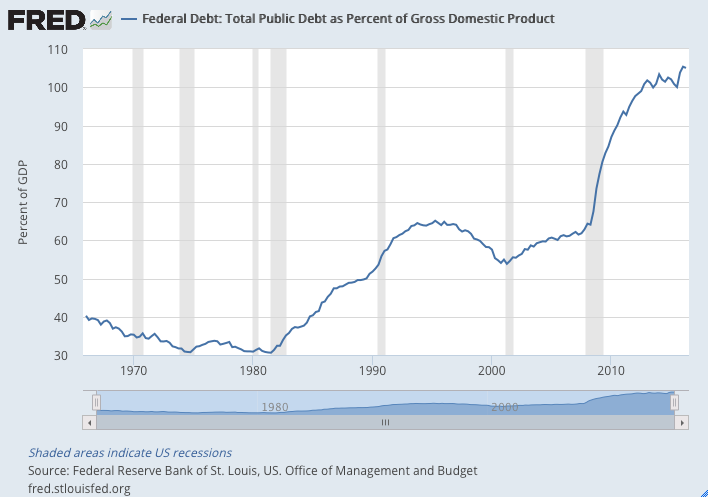
When President Obama took office, US public debt was about 73% of GDP. Today it’s 105%. So even as the economy has grown, the debt has grown much faster.

Any way you look at it, the US government is already insolvent, and its situation is becoming worse.

This leaves essentially two options.

We can choose to willfully ignore this obvious trend and delude ourselves into thinking that the continued expansion of US debt will forever be consequence-free;

Or, we can acknowledge the tiny possibility that maybe, just maybe, there may be some adverse consequence, and plan accordingly.

That’s the great thing about risks-- we can take out insurance to protect against their consequences.

That’s why we have fire insurance to protect our homes, life insurance to protect our families.

Of course, there is no policy from Met Life or GEICO which will protect you from capital controls, a default on Social Security, or Global Financial Crisis 2.0.

Yet there are countless options to protect against these consequences.

The premise is simple: if your country is broke, don’t keep 100% of your assets there.

If your banking system is precariously illiquid and questionably solvent, don’t keep 100% of your savings there.

Most of all, it never, ever hurts to have a Plan B and give yourself additional options.

For example, you may be able to take some steps to legally reduce your tax bill; move some funds to a safer, better capitalized bank abroad that pays a higher rate of interest; or obtain a second passport based on your grandparents’ Irish or Polish nationality.

It’s hard to imagine that you’ll be worse off for having taken any of these steps.

And like any great insurance policy, these steps not only protect you against risk, but also give you the chance to make more money and prosper.

(That’s why the ultra-wealthy often invest in insurance policies as an asset class.)

Having a Plan B doesn’t mean hiding in a bunker with a tin-foil hat.

But taking some risk off the table is something that smart, rational people do, especially in light of such overwhelming data.

Until tomorrow,

Simon Black
Founder, SovereignMan.com

Dennis Edwards: Do you have some emergency food and cash on hand? Do you have a place to go to or some friends or family to meet up with in case some international emergency takes place? Have you ever sat down with your wife and older children and talked about what to do in an emergency situation? It's not too late to begin thinking and praying about your emergency plans. Better to have them and not need them, than to need them and not have them.

Friday, October 7, 2016

International Monetary Fund warns that global debt has hit an all-time high of $152 TRILLION.

Simon Black  October 6, 2016 En route to Los Angeles

“This is a global problem,” said billionaire hedge fund manager Ray Dalio yesterday to a packed audience of central bankers. 

“Japan is closest to its limits, Europe is a step behind it, the US is a step or two behind Europe, and China is a few steps behind the United States.” 

I can only imagine the mood in the room was a bit tense after that comment. 

Mr. Dalio, founder of the $160 billion investment firm Bridgewater Associates, was invited to speak at the Federal Reserve Bank of New York’s 40th Annual Central Banking Seminar yesterday. 

Rather than gush about how wonderful the Fed’s zero interest rate policies have been since the financial crisis, Dalio gave them a fire hose of reality. 

His primary thesis was that the debt supercycle that has lasted for decades is coming to an end, and that there’s going to be a “big squeeze”. 

“The biggest issue,” he said, “is that there is only so much one can squeeze out of a debt cycle, and most countries are approaching those limits.” 

The largest economies in the world– Japan, Europe, the United States, and China are racking up record amounts of debt and absolutely nearing those limits. 

Just this morning the International Monetary Fund warned that global debt has hit an all-time high of $152 TRILLION. 

That’s an astounding figure that’s nearly TWICE the size of the world economy.

But it’s more than that, because in addition to nominal debt, there are further obligations that must be paid– like healthcare and pension programs which are largely underfunded. 

We’ve been discussing this a lot lately; in the US, Social Security is completely underfunded and will become cashflow negative in just a few more years. 

Soon after it will entirely run out of money. 

Dalio summed it up by telling his audience, “There are too many promises that can’t be kept, not only in the form of debt, but also in the form of health care and pension costs. . .” 

In other words, not only is government debt, corporate debt, and household debt at record levels worldwide, but pension and healthcare obligations have become impossible to pay. 

Bear in mind that all of this is happening at a time when economic growth and productivity are slowing. 

This means that while debt is piling up, the ability to service those obligations is actually decreasing. 

Central bankers have been desperately trying to hold the system together by keeping interest rates at record lows and printing trillions of dollars. 

But as Dalio pointed out to his audience of central bankers, their strategy is also “approaching its limits.” 

Yesterday we discussed why central banks are between a rock and a hard place.

If the Fed doesn’t raise interest rates quickly, they’ll be forced to make interest rates negative in the next recession. 

But if the Fed does raise interest rates, they’ll cause a massive decline in asset prices, and potentially even engineer the recession that they’re trying to prevent. 

Dalio again: “[I]t would only take a 100 basis point [1%] rise [in interest rates] to trigger the worst price decline in bonds since the 1981 bond market crash.” 

So no matter which direction central banks go, i.e. to raise or not to raise interest rates, there are severe consequences. 

This is why Dalio expects a “big squeeze.” And it won’t be pretty. 

A crash in bond prices could easily wipe out bank balance sheets around the world, especially across Europe where most of the banks are already insolvent. 

This is the reality of our financial system, not some theory or conjecture. It is dangerously overleveraged and quickly reaching its limits. 

And as Dalio began his remarks, it’s no longer controversial to make these assertions. 

The question is– what to do about it? 

The most important thing is to have some perspective. The world isn’t coming to an end. 

Make no mistake, the consequences are severe, especially for the unprepared. But our species has suffered far worse incidents than the collapse of a debt supercycle. 

Moreover, there’s nothing that’s going to happen immediately. China, Japan, Europe, and the US aren’t going to default tomorrow morning. 

This is a slow-moving train where the consequences pile up little by little. 

Today we can already see early stage capital controls in Europe, corporate defaults in China, multiple debt-ceiling crises in the US, and negative interest rates around the world. 

None of these things existed ten years ago. And in a few more years, today’s financial conditions will seem tame by comparison. 

Yet while this snowball keeps getting bigger, no one can possibly predict precisely WHEN or HOW it will finally strike. 

That’s why perspective is so important. 

Anyone who hunkers down expecting the financial apocalypse could be waiting a while… and simultaneously missing out on some compelling opportunities. 

Similarly, people who delude themselves into believing that everything is going to be just fine will likely have their entire lives turned upside down by an erupting financial crisis. 

It is possible to strike a balance. 

As an example, we’ve talked a lot about holding physical cash. 

If the objective data proves that your banking system is illiquid and questionably solvent, then why take the risk and keep all your money there, especially when all you’re being paid is 0.1% interest anyhow? 

You can take a LOT of that risk off the table by simply withdrawing a few months worth of savings and holding some cash. 

Similarly, if you know that your currency is underpinned by record amounts of debt and promises that are impossible to keep, why not take some of that risk off the table with an asset like gold that has a 5,000 year history of preserving wealth? 

It’s hard to imagine you’ll be worse off holding a bit of physical cash or a universal asset like gold or silver. 

But if the worst happens, those holdings could turn out to be the best insurance policy you’ve ever had. 

Until tomorrow, 


Monday, March 21, 2016

Simon Black explaining the financial situation

Here is Simon Black explaining what our financial situation is. Of course, Simon is a secular person giving his advice without knowledge of the Bible and Bible prophecy. Nevertheless, his analysis confirms our expectations that a global financial crash is imminent. Our knowledge of Bible prophecy helps us understand that this up and coming crash could very well lead to a New World order and the predicted One World government which eventually will be lead by the dictatorial Antichrist figure. Are you preparing for the days ahead?

https://www.sovereignman.com/sm-presentation/?utm_source=sm_prospects&utm_medium=email&utm_campaign=egw_webinar&utm_content=dedicated_shockingdata&inf_contact_key=d56da325a3be0fbb5023844949546b1fc7f4ef815f35d686624cc649153c82b6

Wednesday, September 2, 2015

Tuesday, April 14, 2015

Simon Black - Notes from the Field! US government was more forgiving of the Nazis than its own citizens

April 14, 2015
Santiago, Chile

70 years ago, the United States of America had just emerged from World War II as the most dominant superpower in the world.

At that point America’s economy was the only one left standing.

And the US government had essentially dictated terms in establishing a new global financial system (known as the Bretton Woods agreement).

Doing so thrust the dollar at the center of world trade and banking.

Suddenly every government, central bank, and major corporation needed to hold and transact in US dollars... and to establish a banking relationship in the United States.

This gave the United States a tremendous amount of power—power they respected and never abused.

At the same same time, high ranking members of the Nazi party had fled to the four corners of the world, often with a vast treasure trove stashed away at Swiss banks.

Most of this wealth was acquired through mass genocide. And yet Switzerland’s secrecy laws protected Nazi clients from having their information turned over to authorities.

No one pressed the issue further.

Think about it—the US government could have done something.

They had the power back then. They could have punished Switzerland with all sorts of banking and financial penalties. They could have threatened to kick them out of the financial system.

But they didn’t.

Instead, in 1945, the US government gave the Nazis a pass.

This is extraordinary when you think about it. Because if you fast forward several decades, we see now that the US government is chasing people to the ends of the earth.

Even more, they’ve brought the full extent of their financial resources to bear against entire banking systems (including Switzerland’s).

They’ve successfully shuttered some of the oldest banks in the world, imprisoned foreign bank executives, and even gotten foreign governments to change their laws.

So who exactly are the nefarious criminal terrorists that Uncle Sam is spending so much effort to chase down?

Americans. Specifically, Americans who have failed to file administrative paperwork with the IRS to declare overseas financial accounts.

There are countless stories out there of people having their life savings confiscated by the government because they didn’t file a disclosure form (even if there are no back taxes due).

Certainly there is some meaningful percentage of these people who have been hiding undeclared income overseas hoping to never pay tax on it. And it’s important to acknowledge that.

But while this sort of behavior had been going on for decades, it took until 2010 for the US government to pass the Foreign Account Tax Compliance Act (FATCA), establishing the power to bully global financial institutions into compliance.

The reason is obvious: the United States government is broke.

Decades ago the future was bright. And they could afford to give the Nazis a pass. They didn’t really need the money, and it wasn’t worth abusing the tremendous financial power that they had been entrusted with.

But today, every penny matters.

The US government is in a position where they have to borrow money just to pay interest on the money they’ve already borrowed.

Their own internal numbers estimate their ‘net worth’ at MINUS $60 trillion, which includes their own estimates of long-term social security liabilities.

So they have no qualms about abusing the trust that the rest of the world has given them... or even creating new powers out of thin air through the most destructive legislation imaginable.

It’s often said that there are only a few times in a person’s life when you can really see what someone’s character is made of—typically times of extreme adversity such as being near death or flat broke.

That’s where the US government is right now. Enabling us to now see its true character.

This is not a government of the people, for the people, by the people. It is a government that takes from the people. By any means necessary. And they grow bolder with each passing day.

Until tomorrow,

Simon Black
Founder, SovereignMan.com

Friday, November 15, 2013

Andrew Huszar: Confessions of a Quantitative Easer

By Andrew Huszar, WSJ, Nov. 11, 2013

I can only say: I’m sorry, America. As a former Federal Reserve official, I was responsible for executing the centerpiece program of the Fed’s first plunge into the bond-buying experiment known as quantitative easing. The central bank continues to spin QE as a tool for helping Main Street. But I’ve come to recognize the program for what it really is: the greatest backdoor Wall Street bailout of all time.

Five years ago this month, on Black Friday, the Fed launched an unprecedented shopping spree. By that point in the financial crisis, Congress had already passed legislation, the Troubled Asset Relief Program, to halt the U.S. banking system’s free fall. Beyond Wall Street, though, the economic pain was still soaring. In the last three months of 2008 alone, almost two million Americans would lose their jobs.

The Fed said it wanted to help—through a new program of massive bond purchases. There were secondary goals, but Chairman Ben Bernanke made clear that the Fed’s central motivation was to “affect credit conditions for households and businesses”: to drive down the cost of credit so that more Americans hurting from the tanking economy could use it to weather the downturn. For this reason, he originally called the initiative “credit easing.”

My part of the story began a few months later. Having been at the Fed for seven years, until early 2008, I was working on Wall Street in spring 2009 when I got an unexpected phone call. Would I come back to work on the Fed’s trading floor? The job: managing what was at the heart of QE’s bond-buying spree—a wild attempt to buy $1.25 trillion in mortgage bonds in 12 months. Incredibly, the Fed was calling to ask if I wanted to quarterback the largest economic stimulus in U.S. history.

This was a dream job, but I hesitated. And it wasn’t just nervousness about taking on such responsibility. I had left the Fed out of frustration, having witnessed the institution deferring more and more to Wall Street. Independence is at the heart of any central bank’s credibility, and I had come to believe that the Fed’s independence was eroding. Senior Fed officials, though, were publicly acknowledging mistakes and several of those officials emphasized to me how committed they were to a major Wall Street revamp. I could also see that they desperately needed reinforcements. I took a leap of faith.

In its almost 100-year history, the Fed had never bought one mortgage bond. Now my program was buying so many each day through active, unscripted trading that we constantly risked driving bond prices too high and crashing global confidence in key financial markets. We were working feverishly to preserve the impression that the Fed knew what it was doing.

It wasn’t long before my old doubts resurfaced. Despite the Fed’s rhetoric, my program wasn’t helping to make credit any more accessible for the average American. The banks were only issuing fewer and fewer loans. More insidiously, whatever credit they were extending wasn’t getting much cheaper. QE may have been driving down the wholesale cost for banks to make loans, but Wall Street was pocketing most of the extra cash.

From the trenches, several other Fed managers also began voicing the concern that QE wasn’t working as planned. Our warnings fell on deaf ears. In the past, Fed leaders—even if they ultimately erred—would have worried obsessively about the costs versus the benefits of any major initiative. Now the only obsession seemed to be with the newest survey of financial-market expectations or the latest in-person feedback from Wall Street’s leading bankers and hedge-fund managers. Sorry, U.S. taxpayer.

Trading for the first round of QE ended on March 31, 2010. The final results confirmed that, while there had been only trivial relief for Main Street, the U.S. central bank’s bond purchases had been an absolute coup for Wall Street. The banks hadn’t just benefited from the lower cost of making loans. They’d also enjoyed huge capital gains on the rising values of their securities holdings and fat commissions from brokering most of the Fed’s QE transactions. Wall Street had experienced its most profitable year ever in 2009, and 2010 was starting off in much the same way.

You’d think the Fed would have finally stopped to question the wisdom of QE. Think again. Only a few months later—after a 14% drop in the U.S. stock market and renewed weakening in the banking sector—the Fed announced a new round of bond buying: QE2. Germany’s finance minister, Wolfgang Schäuble, immediately called the decision “clueless.”

That was when I realized the Fed had lost any remaining ability to think independently from Wall Street. Demoralized, I returned to the private sector.

Where are we today? The Fed keeps buying roughly $85 billion in bonds a month, chronically delaying so much as a minor QE taper. Over five years, its bond purchases have come to more than $4 trillion. Amazingly, in a supposedly free-market nation, QE has become the largest financial-markets intervention by any government in world history.

And the impact? Even by the Fed’s sunniest calculations, aggressive QE over five years has generated only a few percentage points of U.S. growth. By contrast, experts outside the Fed, such as Mohammed El Erian at the Pimco investment firm, suggest that the Fed may have created and spent over $4 trillion for a total return of as little as 0.25% of GDP (i.e., a mere $40 billion bump in U.S. economic output). Both of those estimates indicate that QE isn’t really working.

Unless you’re Wall Street. Having racked up hundreds of billions of dollars in opaque Fed subsidies, U.S. banks have seen their collective stock price triple since March 2009. The biggest ones have only become more of a cartel: 0.2% of them now control more than 70% of the U.S. bank assets.

As for the rest of America, good luck. Because QE was relentlessly pumping money into the financial markets during the past five years, it killed the urgency for Washington to confront a real crisis: that of a structurally unsound U.S. economy. Yes, those financial markets have rallied spectacularly, breathing much-needed life back into 401(k)s, but for how long? Experts like Larry Fink at the BlackRock investment firm are suggesting that conditions are again “bubble-like.” Meanwhile, the country remains overly dependent on Wall Street to drive economic growth.

Even when acknowledging QE’s shortcomings, Chairman Bernanke argues that some action by the Fed is better than none (a position that his likely successor, Fed Vice Chairwoman Janet Yellen, also embraces). The implication is that the Fed is dutifully compensating for the rest of Washington’s dysfunction. But the Fed is at the center of that dysfunction. Case in point: It has allowed QE to become Wall Street’s new “too big to fail” policy.

Mr. Huszar, a senior fellow at Rutgers Business School, is a former Morgan Stanley managing director. In 2009-10, he managed the Federal Reserve’s $1.25 trillion agency mortgage-backed security purchase program.

Copyright © Fight for Your Faith