Does your faith need strengthening? Are you confused and wondering if Jesus Christ is really "The Way, the Truth, and the Life?" "Fight for Your Faith" is a blog filled with interesting and thought provoking articles to help you find the answers you are seeking. Jesus said, "Seek and ye shall find." In Jeremiah we read, "Ye shall seek Me, and find Me, when ye shall seek for Me with all your heart." These articles and videos will help you in your search for the Truth.

Tuesday, February 23, 2016

Monday, February 22, 2016

Antonin Scalia routinely ruled against gay rights. Those opinions explain his philosophy.


Justice Antonin Scalia has died. The death is already causing a bit of a political crisis as Democrats and Republicans argue over how the justice's successor will be named to the Court, particularly in an election year.

Behind all of this political wrangling is one simple fact: Scalia was very conservative. He consistently wrote opinions that drew the ire of liberals, while conservatives praised his incredible ability — as perhaps the Court's strongest writer — to eloquently explain their legal positions.

Fundamentally, Scalia's conservatism rested on one idea: The US Constitution is more constrained than his more liberal colleagues would suggest — and trying to interpret the Constitution loosely will allow the Court to strike down legitimate laws and, in the end, undermine democracy.

Perhaps no chain of cases demonstrated this better than Scalia's very consistent opposition to gay rights. In his view, it wasn't so much that he was opposed to gay rights — although he was — but that such rights simply weren't protected by a very originalist interpretation of the Constitution and its amendments.

Scalia's opposition to gay rights showed his brand of conservatism

Scalia was a consistent opponent of constitutional claims made on behalf of gay rights. He opposed striking down states' anti-sodomy laws. He opposed striking down the federal ban on same-sex marriage. And he opposed striking down states' bans on same-sex marriage.

At the heart of Scalia's opposition to gay rights was his view that the US Constitution simply did not protect the rights of gay people. So in the three major cases that came to the court since 2003, Scalia opined against gay rights in sometimes brutal dissents.

His colleagues, of course, argued that the 14th Amendment protected gay people — by forbidding any level of government from passing discriminatory laws that denied people their fundamental rights.

Scalia rejected the view, claiming the Constitution, the 14th Amendment, and their framers made no mention of gay rights and therefore did not intend to protect gay people.

More broadly, Scalia feared that his colleagues were reading their views into the Constitution and dangerously expanding the document's reach, so that the Court could undermine democracy and upend state and federal laws that were, in his view, perfectly legitimate.

For instance, in Lawrence v. Texas in 2003, where the Court ruled that states' anti-sodomy laws — which effectively banned gay sex — were unconstitutional, Scalia warned in his dissent that the logic used to strike down the ruling could upend states' laws against same-sex marriage:

State laws against bigamy, same-sex marriage, adult incest, prostitution, masturbation, adultery, fornication, bestiality, and obscenity are likewise sustainable only in light of Bowers’ validation of laws based on moral choices. Every single one of these laws is called into question by today’s decision; the Court makes no effort to cabin the scope of its decision to exclude them from its holding.

He did it again in 2013, in United States v. Windsor, when he warned in his dissent that striking down the federal ban on same-sex marriage would lead to the legalization of same-sex marriage nationwide:

In my opinion, however, the view that this Court will take of state prohibition of same-sex marriage is indicated beyond mistaking by today’s opinion. As I have said, the real rationale of today’s opinion, whatever disappearing trail of its legalistic argle-bargle one chooses to follow, is that DOMA is motivated by "'bare . . . desire to harm'" couples in same-sex marriages. Supra, at 18. How easy it is, indeed how inevitable, to reach the same conclusion with regard to state laws denying same-sex couples marital status.

Scalia, ultimately, proved to be right. The Supreme Court reasoned that all these anti-gay laws were unconstitutional for largely the same reason: They discriminated against a group of people by withholding fundamental rights and violated the 14th Amendment.

In the 2015 ruling that ultimately legalized same-sex marriage nationwide, Obergefell v. Hodges, Scalia made it very clear in his dissent that he was very unhappy that he turned out to be right. He argued that the Court had empowered itself to effectively overturn democracy at its will.

In his scathing opinion, Scalia wrote that the majority opinion a "threat to American democracy," and argued it "robs the People of … the freedom to govern themselves" while "lacking even a thin veneer of law."

Scalia even argued that the Court was too elitist and out of touch with much of the country to overturn states' bans on same-sex marriage:

Take, for example, this Court, which consists of only nine men and women, all of them successful lawyers who studied at Harvard or Yale Law School. Four of the nine are natives of New York City. Eight of them grew up in east- and west-coast States. Only one hails from the vast expanse in-between. Not a single South-westerner or even, to tell the truth, a genuine Westerner (California does not count). Not a single evangelical Christian (a group that comprises about one quarter of Americans), or even a Protestant of any denomination.

At every step, from 2003 to 2015, one can see Scalia's increasing frustration about what he saw as his out-of-touch colleagues taking their broad interpretations of the Constitution too far — and that broad interpretation ultimately allowed the Court to strike down statutes that were democratically enshrined into state law.

One can of course question Scalia's logic — many legal scholars arguethat the 14th Amendment was deliberately phrased in a vague way in order to protect groups that the framers may not have conceived of. But Scalia simply rejected that notion.
Scalia advocated for an originalist interpretation of the Constitution

Underpinning his opinions was Scalia's view of a much more constrained Constitution than his liberal colleagues held. Scalia defined himself as an originalist: He argued that the Constitution should be read purely in the context of its text and the intentions of the framers, not personal beliefs or modern social conventions. This differs from some of the more liberal justices on the Court, who take a more fluid interpretation of the Constitution.

"The Constitution is a dead document," Scalia argued in 2005. "It is an enduring document that does not change, or at least does not change at the whim of the Supreme Court, but rather it changes as provided in its text as amendments are adopted."

Scalia claimed that this extended to some of the conservative causes he himself supported: "[Because of originalism] I cannot do the wicked conservative things I would want to do to this society."

(One could of course argue whether Scalia applied his originalist principles consistently. Here is one such critique.)

Scalia's stance on gay rights demonstrated his originalist view: He believed the Constitution couldn't protect gay rights, because no one could envision, for example, same-sex marriage as an issue back when the Constitution and its amendments were written.

So in Scalia's view, the court's pro–gay rights decisions read rights and limits into the Constitution that simply didn't exist, and therefore allowed the Court to strike down laws that were, in his opinion, constitutionally valid.

As Scalia told the American Enterprise Institute in 2012, "Abortion? Absolutely easy. Nobody ever thought the Constitution prevented restrictions on abortion. Homosexual sodomy? Come on. For 200 years, it was criminal in every state."

Palestinian villagers tilled their land so well, Israel is now confiscating it from them

By Nir Hasson, Haaretz, Feb. 19, 2016

Two weeks ago, soldiers hung posters in the village of Al-Walaja, south of Jerusalem: “Notice of intent to acquire rights to the land and purchase ownership of the land required for public purposes.” In translation to non-legalese, these are orders to confiscate Palestinian land for the purpose of continuing building the West Bank separation barrier near the village.

The notice does not explain where exactly the additional land will be confiscated from. A resident who wishes to find out has to go to the Israel Land Authority offices in Jerusalem.

The problem is that the vast majority of the residents of Al-Walaja are unable to enter Jerusalem, because they are residents of the territories without Israeli work permits. That’s but one example of the Kafkaesque story that has made up the lives of the village’s residents in recent years.

As part of the absurdity, Al-Wajala’s terraces were cultivated for many years by the local Palestinian farmers. Now they’re one of the reasons for declaring the area around the village a national park–which, along with the separation barrier, threatens to keep the farmers away from the very terraces they nurtured.

The desire to preserve the landscape was one of the considerations for building the separation barrier almost adjacent to the homes of the residents rather than next to the Green Line (the pre-1967 borders of Israel).

In the name of landscape preservation, the barrier’s present route separates the villagers’ homes from their agricultural land. But the landscape already suffered serious damage when the Defense Ministry drove a wide road through the terraces several years ago. That road became superfluous after the route of the barrier was ordered changed by the Supreme Court.

A few weeks before the notices were posted in the village, the Antiquities Authority, Israel Nature and Parks Authority and the Jerusalem Development Authority published a tender for “preservation and development work” in Ein Haniya, north of the village. Ostensibly there is no connection between the notice about the barrier and the tender. In the eyes of the residents of the small farming village, though, there’s a very clear connection: They see the barrier, a national park and appropriation of the Ein Haniya spring as a tourist attraction for Israelis as part of a larger plan to expel them from the area.

The current village of Al-Walaja was founded by refugees of the original Al-Walaja, which until 1948 was located on the other side of the Refaim stream (Nahal Refaim), and was abandoned during the War of Independence. With the expansion of the boundaries of Jerusalem after the Six-Day War, part of the village was also included inside the city. But Israel made sure to annex only the land, without granting the people living on it residence status. That’s why residents of Al-Walaja have been arrested several times for illegal residence in their own homes.

Eventually, the settlement of Har Gilo was built south of the village and a high concrete wall built between it and Al-Walaja. Now the security barrier and national park will close in the village from its other three sides (heading southeast to Bethlehem will be the only route out).

Anyone visiting the area these days will easily understand the desire of the Jerusalem municipality, Jerusalem Development Authority and INPA to turn the land into a national park for city residents. The village is built above Nahal Refaim, and dozens of ancient terraces descend from it to the stream below. The green landscape sparkles and is dotted with blossoming almond trees and anemones; the heavy rains have brought abundant water to the springs and one can find brooks in places.

At the heart of this area lies Ein Haniya, one of the most beautiful springs in the Judean Hills. Two large pools and numerous archaeological remains can be found next to it. The spring is also considered a sacred place for Greek Orthodox Christians. But the spring is important not only for hikers and pilgrims, but also the residents of Al-Walaja. Shepherds used to bring their sheep and goats to drink from it, and young men from the village would bathe or hang out there, alongside visiting Israelis.

In the past year, large-scale archaeological excavations have been carried out by the Antiquities Authority. The work was done as part of the project for developing the city’s ongoing Metropolitan Park–a large park that will eventually surround Jerusalem from the south and the west. According to the plan, Ein Haniya is scheduled to become one of the park’s focal points, with a restaurant, visitors’ center, paths and lighting.

There are plans for an educational farm next to the spring for organic produce. On the other side of the stream, they are working energetically to restore terraces as part of the park, while above them, the Biblical Zoo’s huge new aquarium is being built. Ein Haniya will join many other springs that were used previously by Palestinian residents, but subsequently became attractions for Israelis.

In the collective memory of village residents, they recall 17 springs they used to have during the village’s salad days. Village resident Yasser Halifa dug a small pool many years ago that drained the water of an adjacent spring in order to irrigate green plots on his terraces. About three years ago, tourists arrived and informed him that the pool appears in the tour guides as Ein Hezi.

Zeev Hacohen, the INPA’s regional planner, promises that, for now, the village residents will be able to use Ein Haniya–but he can’t promise what will happen after the barrier is built.

Aviv Tatarsky belongs to the nonprofit Ir Amim, and has been helping the village residents for years. “Today,” he explains, “it’s clear to anyone who goes there that it’s on Palestinian territory. But you can imagine how it will be in a few years from now, with a visitors’ center, restaurant and hikers? People’s awareness will change and they will relate to it as Israeli territory. If they were to build a new settlement here, the whole world would be up in arms. But they’re making the area Israeli by means of the national park and nobody says anything.”

The terraces were cultivated for decades, perhaps even centuries, by the farmers of Al-Walaja. But now they are being used as one of the main reasons for expelling them from their land. When the route of the separation barrier was being planned, it was decided to factor the national park into the equation. In effect, a national park that was only possible because of the terraces is keeping out those who maintained them for so many years.

Antonin Scalia’s funeral reflects the justice’s life of faith

By Robert Barnes, Washington Post, February 20, 2015

Justice Antonin Scalia was prayerfully offered up by his son Paul and Washington’s political and legal elite Saturday in a formal but simple funeral Mass in the American Catholic Church’s grandest venue.

Vice President Biden, all of the living Supreme Court justices with whom Scalia served save one, congressional leaders and the city’s legal establishment were among the thousands who attended the ceremony in the Basilica of the National Shrine of the Immaculate Conception.

Washington Archbishop Cardinal Donald Wuerl welcomed the crowd to the largest Catholic church in North America, and he drew laughter when he said it was a proper setting for the Scalia family’s request for a “simple family parish Mass.” An angelic-sounding choir and scores of white-robed priests filled the massive chamber.

But despite the setting, the ceremony was free of the encomiums that mark the send-offs of Washington’s political class. Instead, it followed the dictates of religion and placed the emphasis on the Christian promise of resurrection.

Paul Scalia said his father was a “practicing Catholic” in the sense that he was not yet perfect.

“We are gathered here because of one man,” Paul Scalia said. “A man known personally to many of us, known only by reputation to even more. A man loved by many, scorned by others. A man known for great controversy and great compassion.”

He paused. “That man of course is Jesus of Nazareth. It is he who we proclaim.”

It was a fitting service for Scalia, who died Feb. 13 at 79. He was a devout Catholic and was the member of the Supreme Court most vocal about his religion. He urged fellow intellectuals to be “fools for Christ” and once used an interview to underscore his belief in the existence of the Devil, whose latest maneuver, he said, “is getting people not to believe in him or in God.”

Scalia had made known his view that weddings and funerals “but especially funerals, are the principal occasions left in modern American when you can preach the Good News not just to the faithful, but to those who have never really heard it.”

Thomas ended his reading with the verses: “If while we were enemies we were reconciled to God through the death of his Son, how much more, once reconciled, will we be saved by his life? Not only that, but we also boast of God through our Lord Jesus Christ, through whom we have now received reconciliation.”

“The Mass is a celebration of Christ’s sacrificial death for our sins,” said Chad C. Pecknold, a theology professor at the Catholic University of America, adjacent to the basilica. Long eulogies about the deceased distract from that central point.

Scalia said he did not approve of flowery eulogies. “Even when the deceased was an admirable person–indeed, especially when the deceased was an admirable person–praise for his virtues can cause us to forget that we are praying for, and giving thanks for, God’s inexplicable mercy to a sinner.”

Saturday, February 20, 2016

Friday, February 19, 2016

O Sono É Essencial para o Ser Humano

Por M. Fountaine: 
Original aqui: http://directors.tfionline.com/pt/post/o-sono-e-essencial-para-o-ser-humano/

Você já ficou frustrado por sentir necessidade de muitas horas de sono, achando que estava “perdendo” quando poderia fazer coisas que desejava ou precisava fazer? Já parou para pensar por que Deus embutiu em nós tanta necessidade de dormir? Na verdade, da maneira que fomos criados, a maioria de nós precisa passar um terço de nossas vidas inativos enquanto o mundo continua girando. Já pensei nisso, principalmente quando meus afazeres me parecem muito mais importantes do que dormir. Por um lado, dormir pode parecer um luxo que me dá bem-estar, e por outro algo do qual preciso me abster em prol de atividades que considero mais importantes.

É muito fácil cortar esses períodos aparentemente improdutivos que roubam horas inestimáveis do nosso limitado número de anos nesta vida. Em um primeiro momento, o sono parece ser um empecilho na conquista de nossos objetivos, pois nos força a deixar coisas por fazer, deixar de ajudar alguém que precisa e de alcançar nossas metas porque ficamos ali estáticos esperando o corpo recarregar suas baterias.

Com essa percepção, não é de admirar que muitas vezes eu cortava horas de sono para fazer isto ou aquilo ou cuidar disto ou daquilo. Mas depois de um tempo percebi que esse hábito de me privar do sono gerava certas consequências. Aprendi pela experiência que o sono é indispensável. É fundamental para termos equilíbrio e não ficarmos exauridos.

Por isso, quando comecei a ter problemas de saúde e orei a respeito, o Senhor disse que uma das coisas que eu precisava corrigir era o meu hábito de dormir. Foi um duro discurso, porque eu nem tinha percebido o déficit de sono acumulado ao longo do tempo. Eu achava que o cansaço que sentia era porque estava ficando mais velha, trabalhava muito, e porque eu já não era mais a mesma fisicamente.

O Senhor me disse que eu precisava tentar ir para a cama mais cedo, especificamente umas duas horas antes da meia noite, que são as horas mais importantes do sono. Além disso, Ele me disse que eu precisava dormir até mais tarde.

Eu sabia que se esse conselho estava vindo do Senhor, então era um conselho sábio e sensato, o que despertou meu interesse em descobrir por que Ele considerava tão importantes esses aspectos relativos ao meu sono. Há anos, especialistas tratam da importância do sono na nossa vida. Ainda assim, só quando comecei a fazer uma compilação das muitas razões porque o sono é importante eu percebi que é prioridade ter o tipo certo de sono e dormir o suficiente no geral.

O sono tem uma grande e positiva influência em muitos aspectos das nossas vidas, e existem muitas pesquisas sobre os efeitos do sono. Ele recarrega o cérebro, melhora a memória, prolonga a vida e aumenta a criatividade. Os momentos de repouso servem para evitar inflamações e melhoram nosso desempenho no geral, tanto física quanto mentalmente, no trabalho, estudo e atividades recreativas. O sono nos deixa mais atentos, ajuda a manter um peso saudável, a reduzir o estresse e evitar acidentes. O sono também gera muitos outros benefícios, como, por exemplo, aliviar a depressão.

A necessidade de sono varia de uma pessoa para outra, mas decididamente é um elemento importante para todos. Seguem-se alguns pontos que podem nos motivar a dar a devida prioridade a esse elemento essencial da vida.

Durante o sono, nossa mente se mantém ocupada, e nesse período fortalecemos memórias, ou “praticamos” habilidades aprendidas enquanto acordados. (Esse processo é denominado consolidação da memória.)

Um estudo de 2010 revelou que o nível da proteína C-reativa, relacionada a inflamações e ao risco de acidentes cardiovasculares era mais alto em pessoas que dormiam seis horas ou menos por noite. (Inflamação também está relacionada a derrame, diabetes, artrite e envelhecimento precoce)
Pesquisadores na Universidade de Harvard e Faculdade de Boston descobriram que os componentes emocionais da memória, aparentemente fixados durante o sono, podem contribuir para o processo criativo.

Um estudo realizado em 2010 pelo boletim científico Sleep, revela que crianças entre 10 e 16 anos que apresentam problemas respiratórios durante o sono, como ronco, apneia e outras interrupções da respiração durante o período de repouso têm mais probabilidade de apresentar dificuldade de atenção e aprendizado.

A falta de sono pode gerar sintomas de TDAH em crianças, diz o Dr. David Rapoport. … “A criança não reage da mesma forma que adultos à falta de sono”, ele acrescenta. “Os adultos, se não dormem bem, sentem sono, mas as crianças ficam hiperativas.”
Pesquisadores na Universidade de Chicago descobriram que pessoas em dieta que descansavam o suficiente perdiam mais gordura — 56% da perda de peso — do que aquelas que dormiam pouco, as quais perdiam mais massa muscular.
“O sono decididamente pode reduzir o estresse e equilibrar a pressão sanguínea”, diz o Dr. Raymonde Jean. “Acredita-se que o sono afeta o nível de colesterol, um elemento muito importante nas doenças coronarianas.”
Segundo a Secretaria norte-americana de segurança de tráfico rodoviário, em 2009 o motivo principal da maioria dos acidentes fatais com um carro foi o cansaço do motorista — mais do que o álcool!
“Não dormir o suficiente contribui para a depressão”, diz o Dr. Jean. “Uma boa noite de sono ajuda bastante a diminuir a ansiedade e alterações de humor. O bom sono gera mais estabilidade emocional.”[1]

As consequências da privação do sono vão muito além da eficiência nas tarefas. A privação do sono pode debilitante ou fatal. Seguem-se alguns pontos mostrando as consequências de repetidas noites mal dormidas.
Redução do número de células e anticorpos que combatem infecções nos períodos em que dormimos pouco.
Menos de sete horas de sono por noite aumenta em até três vezes o risco de ser contagiado com o vírus da gripe.
Privação de sono crônica (dormir menos de seis horas à noite) está associada a:
- Envelhecimento da pele
- Quatro vezes mais risco de derrame para pessoas de meia idade e idosos.
- 50% maios risco de tumores malignos colorretais e de outros tipos.
- Pressão alta.
- 48% mais chance de desenvolver ou morrer de doença cardíaca.
- Nível de fertilidade mais baixo.
Perda crônica de sono pode gerar uma redução de 30 a 40% da glicose no metabolismo.
O sono retira proteínas nocivas do cérebro, melhorando a saúde mental. “Quando você não dorme o suficiente, o cérebro fica ‘sujo’.”
Perda de sono pode causar dano psicológico, porque o sono regula o fluxo de epinefrina, dopamina e serotonina, associados ao humor e comportamento.
Estudo de pesquisadores na Universidade Columbia revela que adolescentes que se deitavam às 22 horas ou antes, tinham menos probabilidade de sofrer depressão ou ter pensamentos suicidas, do que aqueles que tinham o hábito de ir para a cama depois da meia noite.
Seis horas ou menos de sono triplica o risco de acidentes relacionados a cansaço ao volante.

Estima-se que a falta de sono onera em 63 bilhões de dólares os negócios nos EUA. Os piores custos resultam do fato de a privação de sono causar problemas de saúde e lapsos na segurança. D. A. Carson escreveu:

“Somos seres humanos complexos; nossa existência física está ligada ao nosso bem-estar espiritual, perspectiva mental, relação com outros e inclusive com Deus. Às vezes, a coisa mais sagrada que se pode fazer é ter uma boa noite de sono, não passar a noite orando, mas dormindo. Com certeza não estou negando que existem ocasiões em que devemos passar a noite orando. Mas insisto que, no dia a dia, a disciplina espiritual exige as horas de sono necessárias ao nosso corpo.”[2]

Esta citação de D. A. Carson parece com algo que o Senhor já havia me mostrado. Por mais importante que a oração seja na nossa vida, se não dormirmos o suficiente ficaremos com a mente anuviada, o corpo fraco e será muito mais difícil orar de forma efetiva.

E, por fim, um pensamento de John Piper sobre a necessidade de sono do cristão: “É irracional a perspectiva de um futuro sombrio devido a quatro ou cinco horas de sono diversas noites seguidas. Mas isso é irrelevante. São os fatos. E devo viver dentro dos limites dos fatos. Recomendo que você durma o suficiente para beneficiar a sua própria visão de Deus e das Suas promessas.”[3]

Gostaria de deixar aqui alguns pontos recebidos do Senhor em profecia sobre a vital importância do equilíbrio no tocante ao sono.

Jesus: “Dormir faz bem até para o espírito. As horas que passa dormindo permitem uma conexão clara e desimpedida Comigo. É um momento de repousar, processar os pensamentos e tirar conclusões, e desenvolver mais entendimento.

“No físico, o sono permite que o corpo repare os danos, crie reservas de força espiritual, se reabasteça para combater doenças, aumentar a massa muscular ou outras áreas que ficaram enfraquecidas ou prejudicadas, e eliminar o que seu corpo não conseguiu processar enquanto estava acordado.

“Mentalmente, o sono nos oferece tempo para organizar tudo que o cérebro observou e vivenciou enquanto estávamos acordados, tirar conclusões e considerar possibilidades. É bem verdadeira a expressão em inglês que algumas pessoas usam quando não têm certeza da decisão que devem tomar: ‘Vou pensar nisso enquanto durmo’. Os pensamentos, sentimentos e input do dia precisam ser selecionados e organizados para serem usados de maneira efetiva.

“A mente precisa de tempo e foco para entender e assimilar experiências, e comparar com acontecimentos passados, um processo mais efetivo quando se está dormindo. O sono nos ajuda a entender as coisas que acontecem em nossas vidas e criar maneiras de usar esse conhecimento ou experiências de forma efetiva. Falta de sono suficiente, deteriora o corpo físico e a condição mental, por causa das funções que só são realizadas durante o sono.

“É inevitável o surgimento de emergências que não nos permitam dormir, mas o que pode causar prejuízos é a constante falta de sono um dia após o outro, sem falar que isso também vai levar embora nossa alegria, saúde, motivação e paz, porque ficaremos exaustos.”

Em paz me deito e logo adormeço, pois só tu, Senhor, me fazes viver em segurança. — Salmo 4:8 NVI

Quando se deitar, não terá medo, e o seu sono será tranquilo. — Provérbios 3:24 NVI

Será inútil levantar cedo e dormir tarde, trabalhando arduamente por alimento. O Senhor concede o sono àqueles a quem ama. — Salmo 127:2 NVI


[1] http://www.health.com/health/gallery/0,,20459221,00.html
[2] http://headhearthand.org/blog/2014/05/14/arrogance-of-ignoring-our-need-of-sleep. Citação extraída do livro Scandalous: The Cross and Resurrection of Jesus, de D. A. Carson (Crossway, 2010), 147.
[3] De uma palestra de John Piper (1995) sobre Charles Spurgeon. Fonte indisponível.

Archaeology’s Lost Conquest

Answers in Genesis
Answers
Bible
Archaeology
Archaeology’s Lost Conquest

by Henry B. Smith, Jr. July 1, 2014 Audio Version

When Palestine was first opened to archaeologists, they were excited to seek evidence of Israel’s Conquest. When the findings didn’t match their expectations, they decided to throw out the Bible rather than question their assumptions.

Archaeological research in the Holy Land began in earnest in the 1800s, driven by a keen interest in the history of Bible lands. Joshua’s Conquest of Canaan soon became an important focus. Unfortunately, two developments eventually led most scholars to deny that the Conquest ever happened.

At first the digs were promising. One of the first cities excavated in Israel was Jericho, the first stop in Joshua’s campaign of conquest in the Promised Land. A group of German scholars did the first excavations at Jericho in the early 1900s. In the 1930s, British archaeologist John Garstang started new excavations at Jericho, finding local Canaanite pottery from Joshua’s time and evidence for massive destruction by a fierce fire, including ash deposits up to 3 feet (1 m) thick. The evidence was consistent with an Israelite attack on the city around 1400 BC, the biblical date for the Conquest.1

Then in the 1950s, Garstang’s colleague Kathleen Kenyon continued excavations at Jericho, but she reached a much different conclusion: Jericho was not destroyed at the time of Joshua but 150 years earlier, around 1550 BC. Indeed, she claimed the Canaanite city was unoccupied when the Israelites supposedly entered the land. Hence, there was no city for the Israelites to conquer.

KENYON’S CONCLUSIONS QUICKLY BECAME SCHOLARLY DOGMA.

Kenyon’s conclusions quickly became scholarly dogma. Those conclusions are still held tenaciously by most archaeologists and Old Testament scholars, despite the work of a later archaeologist, Bryant G. Wood, who demonstrated Kenyon’s dating errors and lack of in-depth analysis of the pottery.2

What led to this rejection of the Bible’s timeline? Before Kenyon’s pronouncements, archaeologists had difficulty finding archaeological evidence of a large population influx and widespread destruction throughout Canaan around 1400 BC. They had expected to find lots of evidence that Israel had overthrown the old Canaanite cities and culture and established their own, unique material culture throughout the land.

Since evidence for such an influx seemed to be missing, they developed a new idea: the arrival of the Israelite people must have coincided with military clashes in Canaan during the thirteenth century BC. (This was the violent era of the Judges, though secular archeologists don’t recognize this connection.) The promoter of this idea was William F. Albright.3

In due course, archaeologists were unable to find enough archaeological evidence to finger the Israelites as thirteenth century invaders, either. As a result, a majority of archaeologists and Old Testament scholars jettisoned any notion of a historical Conquest at all and began formulating esoteric and unbiblical theories for the origin of Israel.4

So, what are serious-minded Christians to do about this “problem”?

Biblical Chronology

First, we must carefully turn our attention to the text of Scripture to properly ascertain when the Conquest took place. Predictably, present-day liberal scholars largely ignore the chronological data in the Bible that clearly indicates the time of the Conquest. Further confusing the issue, a number of prominent evangelical scholars have accepted the thirteenth-century-BC date for the Conquest, trying to correlate the archaeological evidence with that timeframe.5

The primary biblical reference, 1 Kings 6:1, leaves no room for doubt. “In the 480th year after the people of Israel came out of the land of Egypt, in the fourth year of Solomon’s reign over Israel, . . . he began to build the house of the Lord.” The date Solomon began building the Temple is well established as 967 BC.6 Simple addition places the Exodus at 1446 BC,7 and the Conquest at 1406 BC.8

Proponents of the thirteenth century theory (a 1220 BC Conquest) argue that the figure of 480 years represents 12 nonliteral, idealized (“full”) generations. The actual “generations,” they say, were approximately 25 years each (in real years), but they were idealized to 40 years each. This somewhat confusing maneuver amounts to 300 real years, not 480, placing the actual Exodus around 1260 BC and the Conquest at 1220 BC.

This viewpoint is fraught with serious difficulties. First, not one shred of evidence can be marshaled to show that the Old Testament reckons time in this manner. Second, other biblical texts indicate 19 generations passed during this time span, not 12 (see 1 Chronicles 6:33 and following). Third, 1 Kings 6:1 literally reads in Hebrew, “in the eightieth year and four hundredth year”; it is not a rounded, idealized number like “480 years.” Israel had just entered the 480th year; the Hebrew is not saying that 480 full years had passed. The actual passage of time is technically 479 years, and is not divisible by an “idealized” generation of 40 years. Based on these and many other considerations, a thirteenth-century-BC Conquest date must be rejected.

A Limited Conquest

It is a grave mistake to assume that the Israelite influx must have created an archaeological footprint that would necessarily be found by archaeologists. This is an argument from silence, for only a small percentage of the ancient world has been meaningfully excavated. Worse yet, this argument is built on a false assumption that contradicts Scripture.

WE READ IN SCRIPTURE THAT YAHWEH REVEALED A WISE STRATEGY, COMMANDING ISRAEL TO TAKE OVER THE EXISTING INFRASTRUCTURE IN CANAAN INSTEAD OF OBLITERATING IT.

It assumes that the Israelites took over the entire land and immediately began building their own cities and establishing their own distinct, material culture. Quite the contrary. We read in Scripture that Yahweh revealed a wise strategy, commanding Israel to take over the existing infrastructure in Canaan instead of obliterating it: “When the Lord your God has cut off the nations whose land the Lord your God is giving you, and you dispossess them and dwell in their cities and in their houses . . .” (Deuteronomy 19:1). And, “I have given you a land for which you did not labor and cities which you did not build, and you dwell in them; you eat of the vineyards and olive groves which you did not plant” (Joshua 24:13).

When they defeated various Canaanite kings in battle (Joshua 12:7–24), the Israelites simply took over the preexisting infrastructure. There was no need to build new cities, because God delivered the existing cities into their hands.


After 40 years of wandering in the desert, and the death of the adult generation who had departed from Egypt (Numbers 13–14), it makes perfect sense that the Israelites would not have left a footprint in the archaeological record during these early, nation-forming days. They had been living in tents as sojourners in the desert for 40 years. They would have had little or no pottery-making expertise, and none of them had ever built a city.

THE REJECTION OF JOSHUA’S CONQUEST IS A VIVID EXAMPLE OF SCHOLARS’ QUESTIONING GOD’S WORD INSTEAD OF QUESTIONING THEIR OWN ASSUMPTIONS AND INTERPRETATIONS.

Moreover, Scripture records that the Israelites did not take over the entire land all at once. In fact, the Conquest was not truly complete until the days of David and Solomon. This is clearly spelled out in the book of Judges, where the Canaanites remained a deeply negative influence through multiple cycles of idolatry and oppression over several centuries. Joshua lists several places the Israelites could not conquer (11:22, 13:1–5, 15:63, 16:10, 17:11–12, 17:16). The Israelites primarily conquered the highlands of Canaan, called the central hill country. Important areas were left unconquered, especially the lowlands.

Pottery production facilities and social infrastructure used by the indigenous population would have remained intact throughout the Judges era. The Israelites were not required to start a new material culture from scratch. Thus, we should not expect to find large-scale archaeological evidence of immediate Israelite takeover around 1400 BC, because the Bible explicitly tells us it took several centuries for such a takeover to happen.

As they slowly took over the land of promise and the Canaanite culture disappeared, the Israelites eventually would have to develop their own material culture. And this is what we find in the archaeological record starting around 1200 BC.9

Ironically, the lack of a widespread Israelite archaeological footprint is perfectly consistent with the biblical accounts.

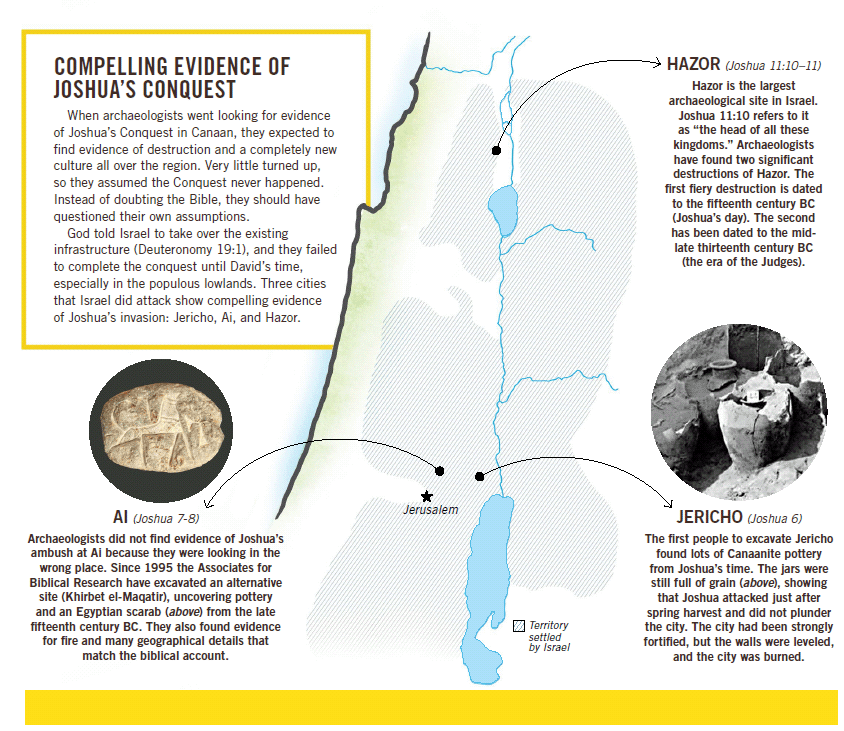
The Bible does record three events that we would expect to find in the archeological record. Joshua destroyed and burned precisely three cities: Jericho, Ai, and Hazor. At all three cities, archaeologists have found compelling evidence consistent with the Bible.

Jericho (Joshua 6).

Kenyon based her 1550 BC destruction date primarily on the absence of expensive imported pottery from Cyprus, a feeble argument from silence. Imported Cypriote pottery would have been much more readily available near trade routes, such as the Way of the Sea (Via Maris), which ran through the coastal plain of Israel. As Wood has thoroughly documented, extensive amounts of local Canaanite pottery from the time of Joshua were discovered by both Garstang and Kenyon in the destruction layer at Jericho.10 The correlations between the biblical account and the archaeological record are impressive:

The city was strongly fortified (Joshua 2:5, 2:7, 2:15, 6:5, 6:20).
The attack occurred just after harvest time in the spring (Joshua 2:6, 3:15, 5:10).
The inhabitants had no opportunity to flee with their foodstuffs (Joshua 6:1).
The siege was short (Joshua 6:15).
The walls were leveled, possibly by an earthquake (Joshua 6:20).
The city was not plundered (Joshua 6:17–18).
The city was burned (Joshua 6:24).

Instead of being an indictment on the Bible, the archaeology from Jericho is a powerful extrabiblical witness to the accuracy of the Conquest narratives.

Ai (Joshua 7–8)

The large mound of et-Tell, commonly identified as Ai, was excavated in the 1960s. It shows no evidence of occupation or destruction at the time of the Conquest, so many scholars have rejected the basic historicity of the account in Joshua 7–8.

The problem is that they’re looking in the wrong place. The narrative of Joshua 7–8 provides a number of topographical and geographical details that narrow any potential candidate for Ai. At least 12 specific criteria must be satisfied for a site to be identified as the Ai of Joshua. The Associates for Biblical Research (ABR) has conducted archaeological excavations at nearby Khirbet el-Maqatir since 1995, uncovering significant evidence to establish this as the site of Ai. This includes pottery evidence from the late fifteenth century BC, evidence for a fire, a shallow valley north of Ai, a viable location for Joshua’s ambush forces, and additional criteria in accord with the Bible.11

In 2013, ABR discovered a rare Egyptian scarab that can be dated to the fifteenth century BC. It was found in an undisturbed layer with pottery from the time of Joshua. This amazing discovery validates ABR’s dating of the fortress at Khirbet el-Maqatir to the time of Joshua.

Hazor (Joshua 11:10–11).

Hazor is the largest archaeological site in Israel. Joshua 11:10 properly refers to it as “the head of all these kingdoms.” Two significant destructions of Hazor have been discovered. The first fiery destruction is dated to the fifteenth century BC. The second has been dated to the mid-late thirteenth century BC. The fifteenth-century destruction should be attributed to the Israelites under Joshua. The mid-late thirteenth century BC destruction of Hazor should be attributed to the campaign of Deborah and Barak against Jabin, king of Hazor in Judges 4.12Both destructions provide confirmation of the biblical accounts.


Images courtesy of Associates for Biblical Research

Conclusions

Biblical scholars began excavating in Israel to find evidence for the Conquest of Canaan during the time of Joshua. When they did not seem to find evidence consistent with the Bible, they began to manipulate the chronology of the Bible. When that manipulation fell short of expectations, they then began to reject the basic historicity of the Conquest and developed unbiblical models to explain the origins of Israel. A rejection of the Conquest also served to support already-rampant skepticism concerning the Exodus.

AT EACH CITY, EVIDENCE CORRELATES PRECISELY WITH THE BIBLICAL TEXT AND THE BIBLICAL DATE OF THE CONQUEST.
The Israelites did not take over all of Canaan immediately, nor did they obliterate its cities and infrastructure. The Bible explicitly tells us that God gave preexisting cities and houses to the people of Israel. In addition, Joshua mentions the destruction of three cities in Canaan. At each city, evidence correlates precisely with the biblical text and the biblical date of the Conquest.

The lessons are many. Closely examine all the relevant biblical texts first to get an accurate picture of events. Beware of arguments from silence. Examine the archaeological evidence very carefully. And never exalt the interpretations of fallible, sinful archaeologists over the inerrant and infallible Word of Yahweh, Lord of heaven and earth.

Henry B. Smith Jr. earned his MA degree in theology with an emphasis on apologetics from Trinity Seminary, and presently attends Westminster Theological Seminary. He is the Director of Development for the Associates for Biblical Research.

Copyright © Fight for Your Faith