Does your faith need strengthening? Are you confused and wondering if Jesus Christ is really "The Way, the Truth, and the Life?" "Fight for Your Faith" is a blog filled with interesting and thought provoking articles to help you find the answers you are seeking. Jesus said, "Seek and ye shall find." In Jeremiah we read, "Ye shall seek Me, and find Me, when ye shall seek for Me with all your heart." These articles and videos will help you in your search for the Truth.

Tuesday, April 3, 2018

Gaza families call for investigation into Israeli use of fatal force

By Loveday Morris and Hazem Balousha, Washington Post, March 31, 2018

BEIT LAHIA, Gaza–The morning after burying 19-year-old Abdul Fattah Abdul Nabi, his family gathered in a tent set up to receive mourners, watching and re-watching a video of the moment they say Israeli soldiers shot him in the back of the head.

The video appears to show the teenager, dressed in black, running away from Gaza’s border fence with Israel carrying a tire. Just before reaching a crowd, he crumples under gunfire.

“He had no gun, no molotov, a tire. Does that harm the Israelis, a tire?” asked his brother Mohamed Abdul Nabi, 22. “He wasn’t going toward the Israeli side. He was running away.”

The teenager was one of at least 15 people killed in the Gaza Strip by Israeli forces on Friday during what Palestinian factions billed as a peaceful “March of Return” to mark Land Day, the anniversary of the expropriation of Arab-owned land by the Israeli government in 1976. But it ended as the bloodiest day in the 140-square-mile territory since the 2014 war between Israel and Hamas, the militant group that controls Gaza.

Israeli Prime Minister Benjamin Netanyahu praised the Israeli military for guarding the country’s borders. “Israel will act firmly and decisively to protect its sovereignty and the security of its citizens,” he said in a statement Saturday.

The Israeli military has warned that it will “expand” its response if violence continues. Hamas and other factions in Gaza have vowed to keep up demonstrations, raising fears of more clashes.

Video posted to YouTube appears to show the moment Abdul Fattah Abdul Nabi was shot.

Abdul Fattah’s family is among those demanding an investigation into the Israeli response to the protest, saying videos show he posed no threat. More than 700 people were injured with live ammunition in the demonstration, according to the Palestinian Health Ministry in Gaza. Forty-nine were wounded Saturday, it said.

The United Nations on Saturday said it was “deeply concerned” and called for a transparent, independent investigation. The Israeli human rights group Adalah and the Gaza-based Al Mezan Center for Human Rights wrote to Israeli Attorney General Avichai Mandelblit to demand accountability.

In the letter, they said the use of live fire against civilians was a “blatant violation of international laws.”

The Israeli military did not immediately respond Saturday to requests to clarify the rules of engagement that were followed. In the days preceding the demonstration, the military dropped leaflets warning residents of Gaza to stay at least 300 meters from the border fence or risk being shot.

Abdul Fattah’s family said he worked in his brother’s falafel shop during the week and in a kitchen on Fridays. They said he did not belong to an armed faction.

Unlike at funeral tents for dead militants, there were no signs indicating he had an allegiance to any group.

Posters bearing his photo in the funeral tent showed him wearing a black bow tie rather than the military garb typical of fighters.

His family, though, made no effort to hide the fact that Abdul Fattah went to demonstrations and threw stones. That was no reason for him to be shot, they said.

“They were throwing stones, but the stones never even reached the fence,” said 28-year-old Alaa Abdul Nabi, another brother of the slain demonstrator. “It’s a message, to throw a stone from our land.”

Many demonstrators said they were there to protest peacefully. The family of 20-year-old Badr Sabbagh said he had just arrived to watch the demonstrations when he was shot. They rejected the Israeli army’s assertion that everyone killed was involved in violence.

“He asked for a cigarette, I gave it to him, he had two puffs, and then he was shot in the head,” said Mohammed Sabbagh, his 29-year-old brother. “He’d only been there 10 minutes.”

“I took my grandchildren. We went to a peaceful demonstration,” said his father, Fayik Sabbagh, 64. “We went there to tell them this is our land, but what we found was different.”

Palestinian photographer Mahmoud Abu Salama was taking pictures at the time and captured Abdul Fattah’s last moments. He had little hope that anyone would be held accountable, a sentiment echoed by the Israeli human rights group B’Tselem.

“These are the predictable outcomes of a manifestly illegal command: Israeli soldiers shooting live ammunition at unarmed Palestinian protesters,” said Amit Gilutz, a spokesman for the group. “What is predictable, too, is that no one–from the snipers on the ground to top officials whose policies have turned Gaza into a giant prison–is likely to be ever held accountable.”

Dennis Edwards: The sad state of today's world is seen here. The oppressor who claims the blessing of God is the victor and ruler. The oppressed dare not confront him. You would think that the oppressors would have learned from history, their own personal history, that oppression is not the solution. But they have not, nor have we. We continue to oppress the weak and the downtrodden and refuse to lead them in love to our Lord and God. When will we ever learn?

Tuesday, January 9, 2018

As a 2-State Solution Loses Steam, a 1-State Plan Gains Traction

By David M. Halbfinger, NY Times, Jan. 5, 2018

JERUSALEM–The Israeli right, emboldened by President Trump’s recognition of Jerusalem as Israel’s capital, is not the only faction arguing for a single state between the Jordan River and the Mediterranean Sea.

The Palestine Liberation Organization has also begun to ask whether that might not be such a bad idea, though it has a radically different view of what that state would look like.

As momentum ebbs for a two-state solution to the Israeli-Palestinian conflict, both sides are taking another look at the one-state idea. But that solution has long been problematic for both sides.

For the Israelis, absorbing three million West Bank Palestinians means either giving up on democracy or accepting the end of the Jewish state. The Palestinians, unwilling to live under apartheid-like conditions or military occupation, have also seen two states as their best hope.

Now, for the first time since it declared its support for a Palestinian state side-by-side with Israel in 1988, the P.L.O. is seriously debating whether to embrace fallback options, including the pursuit of a single state.

“It’s dominating the discussion,” said Mustafa Barghouti, a physician who sits on the P.L.O.’s central council, which is to take up possible changes to the national movement’s strategy later this month.

Palestinian supporters envision one state with equal rights for Palestinians and Jews. Palestinians would have proportionate political power and, given demographic trends, would before long be a majority, spelling the end of the Zionist project.

That outcome is unacceptable to the Israeli right wing, which is pressing to annex the land on the occupied West Bank where Jewish settlers have built communities while consigning Palestinians to the areas where they live now.

Israeli proponents of these ideas freely acknowledge that the Palestinian areas would be considerably less than a state, at least to start: Prime Minister Benjamin Netanyahu has even called it a “state-minus.” Eventually, they say, the Palestinians could achieve statehood in a confederation with Jordan or Egypt, as part of Israel, or perhaps even independently–but not soon.

Both sides have long officially supported the idea of a two-state solution to the conflict while accusing the other of harboring designs on the whole territory. But Mr. Trump’s Jerusalem declaration last month changed the calculus.

The Trump administration has not endorsed a one-state solution, and it is working on its own peace plan, insisting that any final agreement, including borders, be negotiated by the two sides. But last month’s decision by the president to recognize Jerusalem as Israel’s capital, in defiance of a decades-old United States policy and international consensus and with no mention of a Palestinian claim on the city, was seen as putting his thumb on the Israeli side of the scale.

Saeb Erekat, the veteran Palestinian negotiator, said that Mr. Trump’s declaration was the death knell for the two-state solution and that Palestinians should shift their focus to “one state with equal rights.” His position has since gained traction among the Palestinian leadership.

Under that idea, the Palestinian movement would shift to a struggle for equal civil rights, including the freedoms of movement, assembly and speech, and the right to vote in national elections. “Which could mean a Palestinian could be the prime minister,” Mr. Barghouti said.

To its Palestinian supporters, the one-state idea is bitter consolation after decades of striving for statehood under the Oslo peace accords, which many believe has achieved little aside from providing cover, and buying time, for Israel to expand settlements.

“When you support the two-state solution, you’re supporting Netanyahu,” said As’ad Ghanem, a political science lecturer at the University of Haifa who has been working with a group of Israelis and Palestinians on a one-state strategy for some time. “It is time for us Palestinians to present an alternative.”

“At least 30 percent of Palestinians support one-state when no one is talking about it,” said Hamada Jaber, an organizer of a group called the One State Foundation. “If there’s at least one political party on each side that will talk about it and adapt this strategy, the support will grow.”

The idea has stronger support among the young, said Khalil Shikaki, a Palestinian pollster, particularly students and professionals who have clamored for a change in strategy since the Arab spring in 2011.

“I’m 24,” said Mariam Barghouti, a writer and activist involved in one of the one-state efforts, and a distant relation of Mr. Barghouti. “All I’ve known is Oslo and the two-state negotiation process. I’ve witnessed how it’s only gotten worse for me and my generation.”

To the Israeli right, abandoning the two-state goal is a good thing, a long-term threat averted. But the Israeli right has not fully explained how its single state overcomes the demographic conundrum. Absorbing the nearly three million Palestinians on the West Bank would either spell the end of a Jewish state or destroy Israeli democracy if Palestinians were denied equal rights. Even a slim Jewish majority would be politically unable to deny Palestinians full citizenship and rights in a single sovereign state.

“I would never give citizenship to the masses of the Arab population in Judea and Samaria,” said Yoav Kisch, a member of Parliament from Mr. Netanyahu’s party who is advancing one autonomy plan, using the biblical names for the West Bank.

Eventually, he said, what’s left of the Palestinian areas could become part of Jordan or Egypt, or become some kind of “state-minus” with limited sovereignty. In the meantime, Mr. Kisch said, he would be willing to give full Israeli citizenship to only about 30,000 West Bank Palestinians who live in areas where he wants Israel to assert sovereignty.

Such a move would be unacceptable to the Palestinians.

What these two sharply different one-state visions share is a conviction that a two-state solution is out of reach.

To be sure, the P.L.O. is not giving up entirely on a two-state solution. It is still pursuing other diplomatic avenues. On Friday, for example, Mr. Erekat called on Arab League member states to act on past commitments to cut ties with any country that recognizes Jerusalem as Israel’s capital.

And there is skepticism among both Palestinians and Israelis that Palestinian leaders like Mr. Erekat and Mahmoud Abbas, president of the Palestinian Authority, would ever truly abandon the Oslo process, to which they have devoted their careers and to which they owe their livelihoods.

If and when a more liberal Israeli government is elected, it could also revive a two-state peace process.

But the costs and political difficulty of withdrawing Israelis from the West Bank grow with every settler family that moves in.

Daniel C. Kurtzer, a Princeton professor who was ambassador to Egypt in the Clinton administration and to Israel under George W. Bush, noted that about 120,000 Palestinian workers commuted to Israel every day, the Palestinian security services provided help to Israel in protecting its own population and the Palestinian Authority’s administration relieved Israel of the occupying power’s obligation to care for refugees.

“You and I will say, ‘It’ll never happen, they’ll come to their senses,’ “ Mr. Kurtzer said. “But how long can you live with the status quo? We’re going to wake up one day and it’s going to be effectively one state. It’s like ‘Thelma and Louise.’ You’re going down the highway and life is great. But there’s a cliff.”

Dennis Edwards: The Bible tells us in the last days before the dramatic Armageddon event takes place some amazing events are going to happen.

"And the sixth angel poured out his vial upon the great river Euphrates (located in Iraq); and the water there of was dried up, that the way of the kings of the east (Iran and Pakistan?) might be prepared....For they are spirits of devils, working miracles, which go forth unto the kings of the earth and of the whole world, to gather together them to battle of that great day of God Almighty....And he gathered them together into a place called in the Hebrew tongue Armageddon."[Revelation 16:12,14,16]

One of those key events is that a Holy Covenant will be made and signed by many nations concerning the situation in the Middle East.

"And he (the Antichrist or beast) shall confirm the covenant with many for one week (7 year period)"[Daniel 9:27a]

However, 3 and 1/2 years after the signing of the Holy Covenant, the agreement will be broken. Israel will be invaded and the Abomination of Desolation will be placed in the Temple. 

"and in the midst of the week (or half way through the seven year period) he (the Antichrist) shall cause the sacrifice and the oblation to cease (no doubt the renewed sacrifice performed at a new Third Temple in Jerusalem), and for the overspreading of abominations he shall make it desolate, even until the consummation...."[Daniel 9:27b] 

In another chapter of Daniel we are given more information: Daniel writes,

"For the ships of Chittem (Cyprus, where the NATO forces have a port, which just happens to be almost directly opposite of where Russia is building a permanent naval base in Tartus, Syria.) shall come against him (the Antichrist): therefore he shall have indignation against the holy covenant (though he was its author, see verse 11:22b "He is also the prince of the covenant."): so shall he do; he shall return, and have intelligence with them that forsake the holy covenant. And arms shall stand on his part, and they shall pollute the sanctuary of strength, and shall take away the daily sacrifice, and they shall place the abomination that makes desolate."[Daniel 11:30-31] 

Concerning the "abomination of desolation" Jesus himself said,

"When ye therefore shall see the abomination of desolation, spoken by Daniel the prophet, stand in the holy place, (whosoever reads let him understand:) Then let them which be in Judea flee into the mountains:...For then shall be great tribulation, such as was since not since the beginning of the world to this time, no, nor ever shall be."[Matthew 24:15,16, 21]

The importance of the events taking place in Israel is that there are certain sign posts proclaimed by the prophets concerning the end times and Christ's second coming. We must past through these sign posts before Christ can return according to Scripture. Knowing what those sign post are helps us to understand the events taking place in the Middle East and to where they will eventually culminate. 

Here's what we are to expect:

[1] A rise of the Antichrist to power as a political/military leader and negotiator on the international scene.

[2] The signing of some sort of Holy Covenant which will give the Jewish people the possibility of renewing their religious sacrificial worship. We assume that this will take place in a restored Third Temple. We also speculate that the Holy Covenant will therefore involve the negotiation of the rebuilding of a Jewish Third Temple on or near to the present Temple Mount.

[3] The Holy Covenant will be confirmed by many nations or perhaps the United Nations. It will initially be a 7 year agreement.

[4] Because of the continual tensions and differing of opinions concerning the Middle East peace process, the covenant will be broken by its author who is none other than the Antichrist.

[5] He will stop the sacrificial worship and place the abomination that makes desolate in the Temple which marks the beginning point of the terrible period of world history known in the Bible as the Great Tribulation or Jacob's Trouble.

[6] The Great Tribulation will be a horrible period of religious persecution against all who do not conform to the Antichrist's one-world program, which includes the mark of the beast technology, possibly some sort of computer implant for identification to buy or sell. 

"And he causes all, both small and great, rich and poor, frfee and dond, to receive a mark in their right hand, or in their foreheads: And that no man might buy or sell, save he that had the mark, or the name of the beast, or the number of his name....and his number is Six hundred threescore (a score is twenty, therefore three score equals sixty) and six," or 666.[Revelation 13:16,17]

This period could very well culminate with a nuclear confrontation. At the end of the horrendous tribulation period Christ returns in the clouds to catch his followers away in the famous rapture event.

"Immediately after the tribulation of those days shall the sun be darkened, and the moon shall not give her light, and the stars shall fall from the heaven, and the powers of the heavens shall be shaken: And then shall appear the sign of the Son of man in heaven: and then shall all the tribes of the earth mourn, and they shall see the Son of man coming in the clouds of heaven with power and great glory. And he shall send his angels with a great sound of a trumpet, and they shall gather together his elect from the four winds, from one end of heaven to the other."[Matthew 24:29-31]

[7] Not long afterwards, possibly 45-75, the Battle of Armageddon takes place in Israel and ends with Christ's return to stop the warfare that is in danger of destroying all of mankind.[Revelation 19:11-21; Ezekiel 39:1-7, 17-22]

That's a short look at Bible prophecy as I see it. We are living in amazing times. That's why we have that uncertain feeling in our hearts that the world is going down the wrong road fast and furiously. A good understanding of Bible prophecy helps relieve the tension, and helps us trust in Him who is creator of Heaven and Earth, that He is in deed ultimately in control. He has told us before hand so that when these events come upon us, and they shall do some day, we will hold fast to His words and promises and be faithful witnesses unto the end just like our faithful ancestors were before us. Hold on to your horses, we could be in for the ride of our lives.

Friday, January 5, 2018

Trump threatens stop to Palestinian aid over Jerusalem row

BBC, 3 January 2018

The US may stop aid payments to Palestinians who are “no longer willing to talk peace”, President Trump said.

On Twitter, Mr Trump said the United States received “no appreciation or respect” in return for its aid.

He also said his controversial recognition of the contested city of Jerusalem as Israel’s capital took the hugely divisive issue “off the table” for new peace talks.

Palestinians had said the move showed the US could not be a neutral broker.

Soon after Washington’s decision was announced in December, Palestinian President Mahmoud Abbas said he would not accept any US peace plan for the Middle East.

The decision on Jerusalem was also overwhelmingly condemned at the United Nations, where 128 countries voted against Mr Trump’s fulfilment of a campaign promise.

The US president was following up earlier comments about aid payments to Pakistan, in which he said the US had received only “lies and deceit” in exchange for billions of dollars in aid.


@realDonaldTrump: It’s not only Pakistan that we pay billions of dollars to for nothing, but also many other countries, and others. As an example, we pay the Palestinians HUNDRED OF MILLIONS OF DOLLARS a year and get no appreciation or respect. They don’t even want to negotiate a long overdue…

@realDonaldTrump: …peace treaty with Israel. We have taken Jerusalem, the toughest part of the negotiation, off the table, but Israel, for that, would have had to pay more. But with the Palestinians no longer willing to talk peace, why should we make any of these massive future payments to them?

Jerusalem is one of the world’s most contested sites.

Israel claims the whole of the city as its capital. The Palestinians want East Jerusalem, occupied by Israel in the 1967 Middle East war, to be the capital of a future Palestinian state.

Mr Trump, however, decided to formally recognise Jerusalem as Israel’s capital, despite being warned it could cause unrest in the region.

He also said he would move the US embassy there from Tel Aviv, where all other nations have their consulates.

For the Palestinians, Mr Abbas said: “The United States has proven to be a dishonest mediator in the peace process.”

He also called Jerusalem the “eternal capital of the state of Palestine”.

How did the Palestinians respond to Mr Trump’s threat to cut aid?

Angrily. A Twitter feed of the governing Palestine Liberation Organisation accused Mr Trump of sabotaging their “search for peace”.


@nadplo: Palestinian rights are not for sale. By recognizing Occupied Jerusalem as Israel’s capital Donald Trump has not only violated of international law, but he has also singlehandedly destroyed the very foundations of peace and condoned Israel’s illegal annexation of the city.

@nadplo: We will not be blackmailed. President Trump has sabotaged our search for peace, freedom and justice. Now he dares to blame the Palestinians for the consequences of his own irresponsible actions!

Mr Trump’s tweets followed remarks from Nikki Haley, the US envoy to the United Nations, in which she said the US would stop contributing to the UN’s relief agency for Palestinian refugees.

The agency runs education, health, and social programmes. The United States is its largest governmental donor, handing over almost $370m (£270m) in 2016.

Speaking at a news conference, Ms Haley said: “The president has basically said that he doesn’t want to give any additional funding, or stop funding, until the Palestinians are agreeing to come back to the negotiation table.”

She said the UN’s vote to condemn Mr Trump’s Jerusalem decision was “not helpful to the situation”.

“The Palestinians now have to show their will that they want to come to the table. As of now, they’re not coming to the table but they asked for aid.

“We’re not giving the aid, we’re going to make sure that they come to the table,” she said.

The withdrawal of aid is likely to have a significant impact on the UN agency’s work, as the US contributes almost 30% of its overall funding.

In 2016, the second-largest donor, the European Union, donated less than half as much as the US.

Dennis Edwards: Again we see America and Israel becoming more and more isolated from world opinion. If we are understanding Bible prophecy correctly, this isolation of these two nations will lead us to that terrible day of Armageddon. The Book of Revelation chapters 16,17,18 and 19 in the New Testament, and Ezekiel 38 and 39, plus Daniel 11:30-45 in the Old Testament seem to be referring to the same apocalyptic events. These events culminate with the invasion of Israel during the end times. The present positions of both Israel and America are in line with what the prophets predicted. If we are understanding correctly, Israel will be invaded and at the same time or near to the same time,  the Babylonian city system will be destroyed. 

So keep your eyes and ears open. We may have some sort of "Holy Covenant" regarding Jerusalem, which could be a compromised agreement on the Palestinian issue and the state of Jerusalem. Whatever the Holy Covenant is however, it is the breaking of the covenant and the placing of the "abomination that makes desolate" in the temple that Jesus gave as a sign point to the beginning of the Great Tribulation or Jacob's Trouble. It is at the end of the Great Tribulation period and the Wrath of God that follows that the destruction of Babylonian city system takes place and the invasion of Israel. Christ's predicted return will take place during the Armageddon period to prevent mankind form destroying all of civilisation. 

In Ezekiel 38 and 39 we see Russia with its allies Turkey and Iran cooperating in Israel's invasion. These nations are presently strengthening their accords and military cooperation. We see Russia making a permanent base in Syria, not far from Israel itself. All these events are confirmations that we are moving down the road to destruction just as we sang many years ago, and just as the Bible predicts. Our turning our backs on God has brought bad results and will continue to do so. One thing is turning our backs on the religious system, the other is turning our backs on God. Most people don't seem to be able to distinguish the two and God is completely left out of their knowledge. But He doesn't have to be. He says, "Draw nigh to Me, and I will draw nigh to you." Make your resolution to draw nigh to God this year. It may be your last!

Sunday, November 19, 2017

John Kerry: Israel doesn’t want peace with Palestine

[Dennis: Here's a article from Newsweek about Israelis' refusal to seek for real peace with the Palestinians. This is what I have been saying since 1974. I remember distributing a Comix published by an alternative Christian press which clearly, in comic form, presented this very truth. I was living in England at the time. But I had unwisely distributed the pamphlet in a strongly pro-Jewish town. The next day two plain clothed members of the British Secret Police knocked at my door asking to talk to me. They were expecting a radical Muslim group. But there I was with my wife and small family. They politely informed me I could not distribute that piece of literature on the streets of England. I protested something about "free-speech." They laughed and said of course we have free speech in Britain, but if I didn't want to get a red mark on my passport and deported, I would be wise to not distribute that pamphlet any more.

The Comix was about how Israel's position towards the Palestinians was really a position of extermination, similar to Hitler's "Final Solution" for the Jewish people in Germany. The dream of "Greater Israel," or all the land that God had promised to Abraham, would mean that Israel would push for every inch of land that the Palestinians had been living on for some 1,400 years. Israel believes it has the Biblical right to the land and will do everything in its power to gain control over all the land, even in the face of opposition by the whole world. For isn't God Himself with them.? Hasn't He Himself made that decree? Many of the American Evangelicals believe that God's promise to Abraham that those people that would bless him, God would in turn bless, applies to the modern state of Israel today.  Let's read the article from Newsweek about former Yale graduate, and Skull and Bones member John Kerry's remarks.]
 
Former Secretary of State John Kerry believes that the Israeli government is not doing its part to foster peace with Palestine.

In recordings published earlier this week by Channel 10, an Israeli TV news station, Kerry celebrates Palestine for committing to a peaceful solution to the decades-long conflict.

“The Palestinians have done an extraordinary job of remaining committed to nonviolence,” Kerry says. “When the intifada took place [in 2015] they delivered non-violence in the West Bank.”

“This is overlooked by the general [Israeli] populations because it is not a topic of discussion,” Kerry continues. “Why? Because the majority of the cabinet currently in the Israeli government has publicly declared they are not ever for a Palestinian state.”

According to Channel 10, the recording is from a conference last year in Dubai attended by some of the Middle East’s most influential policymakers.

It is unclear if Kerry knew he was being recorded.
10_12_UNESCO_Israel_Palestine_US Both the United States and Israel announced on Thursday their withdrawal from UNESCO, the U.N.’s cultural organization. The countries cited anti-Israel bias as one of the main reasons.  Getty Images 

[Dennis: Israel and America will stand together against the world in the final armed conflict in the Middle East. So says the Bible in the book of Ezekiel chapters 38 and 39. Again we see the present political situation seems to be lining up just like the Bible foretold. Many eschatology researchers believe that the Holy Covenant prophesied in the Bible could involve a temporary compromise between Israel and the Palestinians. Some have speculated that a Holy agreement would allow the Jewish people to build their desired Third Temple somewhere in Jerusalem, possibly on the Holy Mount. The Palestinians would get some sort of self-rule or statehood. However, the Bible predicts the agreement will blow up in our faces, leading to the horrendous period in the Bible called the Great Tribulations in direction to the famous Battle of Armageddon. Israel and America will continue to be bosom buddies till the end.]
 
The recordings are in line with many of Kerry’s comments regarding the Israeli-Palestinian conflict.
In an hour-long speech in December 2016, Kerry—still as Secretary of State—chastised the Israeli government for being unproductive in recent peace talks.

“Friends need to tell each other the hard truths, and friendships require mutual respect,” he said.
The speech drew rapid fire condemnation from Israeli Prime Minister Benjamin Netanyahu and many members of Congress from both parties, including Senator John McCain and Senator Chuck Schumer.

The speech came three years after a failed round of peace talks between Israeli and Palestinian leaders organized by Kerry.

RTSVLZT January 15, 2017. REUTERS/Bertrand Guay 

This week’s released recordings add to Kerry’s past comments regarding Israel.

Specifically, the former Secretary of State does not believe Israel is exhibiting leadership in its handling of the situation.

“If you see 40,000 kids marching up to the wall every day with signs saying, ‘Give us our rights,’ I mean I don’t think Palestine is going to be immune forever to the civil rights movements that have swept other nations in the world and somehow Israel’s ignoring this. That’s not leadership,” Kerry said.

Unless Israel begins a serious and committed process of reconciliation, Kerry believes that war is imminent.

“If you don’t have leaders who don’t want to make peace, if the equation doesn’t change, I’ll be amazed if within the next 10 years if we don’t see some young [Palestinian] leader come along who says, ‘We have tried non-violence for the last 30 years and look, it hasn’t gotten us anything,’” Kerry said.

According to The Times of Israel, the office of Israeli Prime Minister Benjamin Netanyahu told Channel 10 in a statement that his office would “continue to safeguard Israel’s security and national interests,” regardless of “those who tried to prod [Israel] to make dangerous concessions and failed.”

Netanyahu also said that peace talks with Palestine have stalled because they refuse to “recognize Israel within any border.”

“It is unfortunate John Kerry still doesn’t get this,” the statement concluded.

Wednesday, August 10, 2016

Sunday, June 5, 2016

Israel’s settlement drive is becoming irreversible, diplomats fear

By Luke Baker, Reuters, June 1, 2016:

MITZPE YERICHO, WEST BANK–In the hills east of Jerusalem, overlooking the Palestinian city of Jericho and the Jordan Valley, stands a religious Jewish settlement whose red-tile roofs, neat gardens and brightly colored playgrounds give the sense of permanence.

Mitzpe Yericho has stood on this escarpment close to the Dead Sea–the lowest point on earth–since 1978. It is one of more than 230 settlements Israelis have built on occupied land in the West Bank and East Jerusalem over the past half-century.

Diplomats and international monitors are increasingly concerned that the drive, which has seen Israel settle more than half a million of its people at a cost of tens of billions of dollars, may be reaching the point of irreversibility.

The ongoing expansion further diminishes the prospect of any significant progress being made when foreign ministers from 20 countries meet in Paris this week to discuss how to revive Middle East peace efforts, given the settlements have been a central obstacle for at least two decades.

If a peace deal were magically struck tomorrow, the Palestinians would expect the Israelis living in Mitzpe Yericho to leave. But its 3,000 residents, nearly all whom are religious nationalists, have no such intention. To them, the settlement enterprise is God-given and irreversible.

“If there’s peace with the Palestinians we’re staying and if there’s no peace we’re staying,” said Yoel Mishael, 65, who has lived in Mitzpe Yericho since its founding. “It’s part of Israel, according to the Bible. It’s something from God.”

The foreign ministers will meet on Friday with the aim of paving the way for a summit later in the year that they hope the Israeli and Palestinian leaders will attend.

On Monday, in a sign that he is aware of the growing international pressure, Prime Minister Benjamin Netanyahu said he was in favor of parts of the Arab peace initiative, a proposal put forward by Saudi Arabia in 2002 that would grant Israel recognition in exchange for withdrawing from the West Bank and East Jerusalem, among other steps.

Yet while some momentum may be building, there is scant indication the settlement enterprise can be halted, let alone reversed, leaving a fundamental barrier in the path to peace.

The settlement project began after Israel captured the West Bank and East Jerusalem in the 1967 war. In the 1970s, with the government’s encouragement, large number of Jews began moving onto the occupied land. There are now 550,000 of them.

Many live in large blocs near Jerusalem or the ‘green line’ that separates Israel from the Palestinian territories, while others live deep inside the West Bank, in highly protected enclaves or pre-fabricated ‘outposts’ perched on hill tops. All the constructions are considered illegal under international law. Israel disputes this, and plays down the term occupation.

Calculating the financial cost of settlements to Israel is difficult; as well as the capital required to build there are defense and infrastructure costs and the price of tax breaks for residents who move there. But the Macro Center for Political Economics, an Israeli think-tank, estimates building alone has cost around $30 billion over the past 40 years.

Barely a month goes by without a fresh announcement from the government or one of its ministries about West Bank territory being declared “state land”, a precursor to settlement building, or a decision to allow new construction to proceed.

At the same time, Palestinians living in a part of the West Bank known as Area C, which accounts for 60 percent of the total and is where most settlements are located, are being uprooted from the land in increasing numbers.

During a visit to a sensitive part of the West Bank near the Palestinian city of Nablus, where settlements occupy almost every hilltop and are steadily expanding their footprint, U.N. diplomats studied maps and pointed out how the Israeli enclaves were spreading east toward the Jordan Valley.

“It starts to look irreversible,” said one official, a view separately supported by half a dozen foreign diplomats.

Under the Oslo accords of the mid-1990s, Israel retains full control over Area C, where large tracts have been declared closed military areas. As a result, Israeli courts tend to approve the removal of Palestinians from the area and the demolition of their homes, even though the accords did not change the illegal status of settlements there.

“Settlements are the vehicle for taking control of the land,” said Catherine Cook, an official with the U.N. office for the coordination of humanitarian assistance and an authority on settlements, speaking last month.

Asked whether she believed the settlement enterprise was irreversible, she replied: “Some of it has to be reversible.”

If a peace deal were struck, many settlements would undoubtedly remain. While not openly acknowledged, Palestinian negotiators accept that land swaps, in which the Israelis would keep major settlement blocs along the green line and near Jerusalem, and the Palestinians would receive equivalent amounts of land from Israel in return, would be part of the deal.

But that would still leave vast areas of the West Bank, where 2.8 million Palestinians live in major cities such as Hebron, Nablus and Ramallah, dotted with more than a hundred settlements, many large and protected by the military.

Within Israel’s right-wing government, there is little appetite to cede any ground to the Palestinians.

Education Minister Naftali Bennett is an ardent supporter settlements and wants Israel to annex all of Area C rather than allowing a Palestinian state to emerge. Defence Minister Avigdor Lieberman lives in a settlement and is similarly wary of Palestinian statehood, even if like Netanyahu he has welcomed elements of the Arab peace initiative.

Hagit Ofran, a senior official at Peace Now, an Israeli NGO opposed to settlements, believes lines could be drawn that would allow a Palestinian state to emerge even if Israel kept many of its enclaves. But even then she estimates that as many as 150,000 settlers may have to be uprooted.

While some might leave willingly if offered the right compensation, many others would not. The removal of just 8,500 settlers from Gaza in 2005 caused violence and outrage.

Many of the settlers in the heartland of the West Bank are religious nationalists who believe all the land, which they call Judea and Samaria, was gifted to Israel in the Bible. They are not interested in financial incentives to leave.

On the northern edge of Mitzpe Yericho, a lookout point provides sweeping views of Jericho and the Jordan Valley. An audio recording gives visitors a selective history of the region, with an English narration explaining how in the Bible God spoke to Joshua after the death of Moses, saying:

“Prepare to cross the River Jordan together with all these people into the land which I am giving the Israelites. Every spot on which your foot treads, I will give to you.”

At the end of the account, the narrator adds: “Today, more than 3,000 years later, Israeli settlements have once again renewed this Biblical landscape … We wish you a pleasant visit.”

Wednesday, May 25, 2016

Israeli prosecutors target group that collects testimony on soldiers’ conduct

By William Booth, Washington Post, May 22, 2016

PETAH TIKVA, Israel–An Israeli organization that publishes anonymous testimony from soldiers, often alleging use of excessive force against Palestinian civilians in the West Bank and the Gaza Strip, appeared in court Sunday to fight the government prosecutor’s demand that the group reveal its sources.

The organization of current and former soldiers, called Breaking the Silence, released a sobering report last year on the 2014 Gaza war that included anonymous testimony suggesting that permissive rules of engagement coupled with indiscriminate artillery fire contributed to mass destruction and high numbers of civilian casualties in the coastal enclave.

Many Israeli leaders have branded the group’s activists as traitors, funded by foreign donors, whose anonymous and unverifiable testimonials are used to undermine the Israel Defense Forces and to smear the country before an international audience.

Israel’s state attorney is seeking a court order to force the group to reveal names of soldiers whose testimonies appear in the Gaza report.

In court Sunday, Michael Sfard, a lawyer representing Breaking the Silence, told the judge that the group would be destroyed if it broke its promise to soldiers and provided names.

Sfard also argued the testimonials serve a vital public interest, exposing ordinary Israelis to the actions of their forces in the field. “The only other alternative is the Israel Defense Forces’ spokesman’s unit,” he said. The group is also claiming protection as “journalists.”

Attorneys for the group said that the soldiers being sought were low-ranking troops and that the crimes alleged involved destruction of property, not killing civilians–and so there is no compelling reason for the state to insist that the anonymous soldiers be named.

The Breaking the Silence website contains dozens of videotaped interviews with soldiers, but it blurs their faces and disguises their voices. One example: a young tank gunner describing how during the Gaza war his commander told them to fire at random buildings.

Israeli officials denied that such acts were committed.

Israeli critics of Breaking the Silence say the group makes wild accusations but does not help the army probe possible offenses.

In March, Prime Minister Benjamin Netanyahu said Breaking the Silence had “crossed a red line” after an undercover Israeli TV investigation reported that the group sought classified operational details.

The Breaking the Silence activists say that all of their reports are reviewed by the military censor before release.

Yehuda Shaul, one of the group’s founders and a former grenade gunner who was stationed in the West Bank city of Hebron, said, “The government doesn’t care about the testimony of our soldiers. It cares about us. This is about the messenger.” Breaking the Silence is opposed to the occupation of the West Bank.

In an interview earlier this year, Avigdor Lieberman, who is slated to be Israel’s new defense minister, said Breaking the Silence was funded by the same people who finance Hamas.

Tuesday, May 24, 2016

Parallels Between Israel and 1930s Germany

By Uri Avnery, Antiwar.com, May 20, 2016

“Please don’t write about Ya’ir Golan!” a friend begged me, “Anything a leftist like you writes will only harm him!”

So I abstained for some weeks. But I can’t keep quiet any longer.

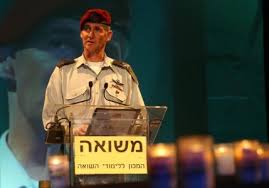
General Ya’ir Golan, the deputy Chief of Staff of the Israeli army, made a speech on Holocaust Memorial Day. Wearing his uniform, he read a prepared, well-considered text that triggered an uproar which has not yet died down.

Dozens of articles have been published in its wake, some condemning him, some lauding him. Seems that nobody could stay indifferent.

The main sentence was: “If there is something that frightens me about the memories of the Holocaust, it is the knowledge of the awful processes which happened in Europe in general, and in Germany in particular, 70, 80, 90 years ago, and finding traces of them here in our midst, today, in 2016.”

All hell broke loose. What!!! Traces of Nazism in Israel? A resemblance between what the Nazis did to us with what we are doing to the Palestinians?

90 years ago was 1926, one of the last years of the German republic. 80 years ago was 1936, three years after the Nazis came to power. 70 years ago was 1946, on the morrow of Hitler’s suicide and the end of the Nazi Reich.

I feel compelled to write about the general’s speech after all, because I was there.

As a child I was an eyewitness to the last years of the Weimar Republic (so called because its constitution was shaped in Weimar, the town of Goethe and Schiller). As a politically alert boy I witnessed the Nazi Machtergreifung (“taking power”) and the first half a year of Nazi rule.

I know what Golan was speaking about. Though we belong to two different generations, we share the same background. Both our families come from small towns in Western Germany. His father and I must have had a lot in common.

There is a strict moral commandment in Israel: nothing can be compared to the Holocaust. The Holocaust is unique. It happened to us, the Jews, because we are unique. (Religious Jews would add: “Because God has chosen us”.)

I have broken this commandment. Just before Golan was born, I published (in Hebrew) a book called “The Swastika”, in which I recounted my childhood memories and tried to draw conclusions from them. It was on the eve of the Eichmann trial, and I was shocked by the lack of knowledge about the Nazi era among young Israelis then.

My book did not deal with the Holocaust, which took place when I was already living in Palestine, but with a question which troubled me throughout the years, and even today: how could it happen that Germany, perhaps the most cultured nation on earth at the time, the homeland of Goethe, Beethoven and Kant, could democratically elect a raving psychopath like Adolf Hitler as its leader?

The last chapter of the book was entitled “It Can Happen Here!” The title was drawn from a book by the American novelist Sinclair Lewis, called ironically “It Can’t Happen Here”, in which he described a Nazi takeover of the United States.

In this chapter I discussed the possibility of a Jewish Nazi-like party coming to power in Israel. My conclusion was that a Nazi party can come to power in any country on earth, if the conditions are right. Yes, in Israel, too.

The book was largely ignored by the Israeli public, which at the time was overwhelmed by the storm of emotions evoked by the terrible disclosures of the Eichmann trial.

Now comes General Golan, an esteemed professional soldier, and says the same thing.

And not as an improvised remark, but on an official occasion, wearing his general’s uniform, reading from a prepared, well thought-out text.

The storm broke out, and has not passed yet.

Israelis have a self-protective habit: when confronted with inconvenient truths, they evade its essence and deal with a secondary, unimportant aspect. Of all the dozens and dozens of reactions in the written press, on TV and on political platforms, almost none confronted the general’s painful contention.

No, the furious debate that broke out concerns the questions: Is a high-ranking army officer allowed to voice an opinion about matters that concern the civilian establishment? And do so in army uniform? On an official occasion?

Should an army officer keep quiet about his political convictions? Or voice them only in closed sessions–”in relevant forums”, as a furious Binyamin Netanyahu phrased it?

General Golan enjoys a very high degree of respect in the army. As Deputy Chief of Staff he was until now almost certainly a candidate for Chief of Staff, when the incumbent leaves the office after the customary four years.

The fulfillment of this dream shared by every General Staff officer is now very remote. In practice, Golan has sacrificed his further advancement in order to utter his warning and giving it the widest possible resonance.

One can only respect such courage. I have never met General Golan, I believe, and I don’t know his political views. But I admire his act.

(Somehow I recall an article published by the British magazine Punch before World War I, when a group of junior army officers issued a statement opposing the government’s policy in Ireland. The magazine said that while disapproving the opinion expressed by the mutinous officers, it took pride in the fact that such youthful officers were ready to sacrifice their careers for their convictions.)

The Nazi march to power started in 1929, when a terrible worldwide economic crisis hit Germany. A tiny, ridiculous far-right party suddenly became a political force to be reckoned with. From there it took them four years to become the largest party in the country and to take over power (though it still needed a coalition).

I was there when it happened, a boy in a family in which politics became the main topic at the dinner table. I saw how the republic broke down, gradually, slowly, step by step. I saw our family friends hoisting the swastika flag. I saw my high-school teacher raising his arm when entering the class and saying “Heil Hitler” for the first time (and then reassuring me in private that nothing had changed.)

I was the only Jew in the entire gymnasium (high school.) When the hundreds of boys–all taller than I–raised their arms to sing the Nazi anthem, and I did not, they threatened to break my bones if it happened again. A few days later we left Germany for good.

General Golan was accused of comparing Israel to Nazi Germany. Nothing of the sort. A careful reading of his text shows that he compared developments in Israel to the events that led to the disintegration of the Weimar Republic. And that is a valid comparison.

Things happening in Israel, especially since the last election, bear a frightening similarity to those events. True, the process is quite different. German fascism arose from the humiliation of surrender in World War I, the occupation of the Ruhr by France and Belgium from 1923-25, the terrible economic crisis of 1929, the misery of millions of unemployed. Israel is victorious in its frequent military actions, we live comfortable lives. The dangers threatening us are of a quite different nature. They stem from our victories, not from our defeats.

Indeed, the differences between Israel today and Germany then are far greater than the similarities. But those similarities do exist, and the general was right to point them out. The discrimination against the Palestinians in practically all spheres of life can be compared to the treatment of the Jews in the first phase of Nazi Germany. (The oppression of the Palestinians in the occupied territories resembles more the treatment of the Czechs in the “protectorate” after the Munich betrayal.)

The rain of racist bills in the Knesset, those already adopted and those in the works, strongly resembles the laws adopted by the Reichstag in the early days of the Nazi regime. Some rabbis call for a boycott of Arab shops. Like then. The call “Death to the Arabs” (“Judah verrecke”?) is regularly heard at soccer matches. A member of parliament has called for the separation between Jewish and Arab newborns in hospital. A Chief Rabbi has declared that Goyim (non-Jews) were created by God to serve the Jews. Our Ministers of Education and Culture are busy subduing the schools, theater and arts to the extreme rightist line, something known in German as Gleichschaltung. The Supreme Court, the pride of Israel, is being relentlessly attacked by the Minister of Justice. The Gaza Strip is a huge ghetto.

Of course, no one in their right mind would even remotely compare Netanyahu to the Fuehrer, but there are political parties here which do emit a strong fascist smell. The political riffraff peopling the present Netanyahu government could easily have found their place in the first Nazi government.

One of the main slogans of our present government is to replace the “old elite”, considered too liberal, with a new one. One of the main Nazi slogans was to replace “das System”.

By the way, when the Nazis came to power, almost all high-ranking officers of the German army were staunch anti-Nazis. They were even considering a putsch against Hitler. Their political leader was summarily executed a year later, when Hitler liquidated his opponents in his own party. We are told that General Golan is now protected by a personal bodyguard, something that has never happened to a general in the annals of Israel.

The general did not mention the occupation and the settlements, which are under army rule. But he did mention the episode which occurred shortly before he gave this speech, and which is still shaking Israel now: in occupied Hebron, under army rule, a soldier saw a seriously wounded Palestinian lying helplessly on the ground, approached him and killed him with a shot to the head. The victim had tried to attack some soldiers with a knife, but did not constitute a threat to anyone any more. This was a clear contravention of army standing orders, and the soldier has been hauled before a court martial.

A cry went up around the country: the soldier is a hero! He should be decorated! Netanyahu called his father to assure him of his support. Avigdor Lieberman entered the crowded courtroom in order to express his solidarity with the soldier. A few days later Netanyahu appointed Lieberman as Minister of Defense, the second most important office in Israel.

Before that, General Golan received robust support both from the Minister of Defense, Moshe Ya’alon, and the Chief of Staff, Gadi Eisenkot. Probably this was the immediate reason for the kicking out of Ya’alon and the appointment of Lieberman in his place. It resembled a putsch.

It seems that Golan is not only a courageous officer, but a prophet, too. The inclusion of Lieberman’s party in the government coalition confirms Golan’s blackest fears. This is another fatal blow to the Israeli democracy. 

Am I condemned to witness the same process for the second time in my life?

Uri Avnery is a peace activist, journalist, writer, and former member of the Israeli Knesset.

Friday, May 13, 2016

Here’s what happened when some famous writers went to visit some hardcore Jewish settlers

By William Booth, Washington Post, May 7, 2016:

HEBRON, West Bank–Arriving aboard a tour bus, accompanied by a former Israeli machine-gunner turned human rights activist, an international delegation of pretty famous writers came to the heart of this old city to see for themselves how 850 hardcore Jewish settlers, protected by 650 young Israeli soldiers, live among 200,000 angry Palestinians.

The writers didn’t like what they saw.

The settlers didn’t like the writers much either, especially their hosts.

The Israeli military occupation is “the most grievous injustice I have seen in my life,” Michael Chabon, the American author of the Pulitzer Prize-winning novel “The Amazing Adventures of Kavalier & Clay,” told the Forward, a Jewish newspaper, a day after seeing Hebron.

“Liars!” the settlers shouted at the writers.

Through the summer, 25 novelists will journey to Israel, the West Bank and the Gaza Strip to gather material for a book of essays to be published by HarperCollins in June next year (and simultaneously released in a half-dozen other languages).

The book is designed to mark the 50-year anniversary of the Israeli occupation of the Palestinian territories–and to make a political splash.

The organizers hope their words will kindle reflection, outrage, change. They think that after five decades of daily news coverage, often numbing in its narrative of stalled “peace processes” and kill-reprisal-repeat, the Israel-Palestinian conflict needs a novelist’s chops to tell old stories in new ways.

Yet on a recent morning in Hebron, the Jewish settlers weren’t waiting for the book to come out. They were ready to pan the effort now.

A gray-bearded settler driving a beater down Shuhada Street hit the brakes, honked his horn and began to shout at the group and point at Yehuda Shaul, a burly former sergeant from the Israel Defense Forces who is a founder of an anti-occupation group called Breaking the Silence.

“Don’t believe him! He’s a traitor. The Israeli army is the best in the world. Don’t believe him.” Then the settler waved and called, “Shabbat shalom!” before he sped away.

It was the first of several slightly surreal mini-encounters–all scenes in the Hebron Show, which may have felt fresh to the writers, but is a rerun. Settlers here frequently taunt tours led by left-wing activists.

So the settler children, well-schooled in the routine, surrounded Shaul and tried to block his way, being careful not to touch him (physical assault against a Jewish Israeli would have probably been stopped by the soldiers).

Instead, the children called him “fatso,” stuck their hands over the lenses of cameras carried by the journalists accompanying the writers, including The Washington Post, and gave the Breaking the Silence support staff the finger.

The book project is being led by a husband-and-wife team, novelists Chabon and Ayelet Waldman, assisted by their éminence grise, Mario Vargas Llosa. Other visiting writers include Geraldine Brooks, Colm Tóibín, Cheryl Strayed, Assaf Gavron, Rachel Kushner, Taiye Selasi and Dave Eggers (who traveled to Gaza).

The visits are controversial in Israel, in part because they are organized by Breaking the Silence, a group of current and former Israeli soldiers who oppose the occupation and do so by revealing how it looks and feels to a conscript enforcing it. Many Israelis–especially the 600,000 Jewish settlers in the West Bank and East Jerusalem–despise the group and its tactics, which include anonymous testimonies.

Shaul led the writers through a sterilized zone where Palestinians are forbidden to walk. The Palestinian shops were all closed, the metal doors welded shut. The vegetable and meat markets are a memory. A few Jewish children kicked a soccer ball around. Soldiers roared past in armored jeeps, and a squad with automatic rifles and body armor followed the tour on foot, mostly to keep the settler children from harassing the writers.

At one point, Chabon stopped to thank the soldiers, saying he understood they were put into a difficult situation.

One of the young soldiers, a red-haired private with an American accent, told Chabon, “I’ve read your books, actually.” He was obviously a fan.

His commanding officer told him to knock it off.

A handful of Palestinian families remain in the area immediately around the Jewish settlements of Hebron. They must enter their houses through back entrances and rooftops. They did not appear.

“Welcome to downtown Hebron,” Shaul said, stopping at an empty intersection. “This was the busiest, most lively section of the city.” He held up a “before” photograph that showed throngs of shoppers. “Now it’s a ghost town.”

Shaul related the basic history of Hebron to the writers.

This is where tradition says the patriarch Abraham bought a cave to serve as a tomb for his wife, Sarah, and where she and Abraham, along with Isaac and Rebecca, and Jacob and Leah, were buried. There is an ancient mosque and synagogue to mark the spot.

The Jews were marginalized but steadfast residents of Hebron for centuries, forbidden by Muslim conquerors to enter the Tomb of the Patriarchs. In 1929, an Arab mob slaughtered some 67 Jews here, mutilating their bodies. If the writers had entered the museum built by the settlers at the old Hadassah hospital here, they could have seen the photographs of the bloody stumps.

In 1967, after the Six-Day War, the Israel Defense Forces took control of Hebron and an army rabbi was the first Jew to enter the tomb in 700 years.

In 1994, an Israeli American physician named Baruch Goldstein entered the mosque and unloaded his machine gun, killing 29 Palestinians and wounding more than a hundred, until the crowd overwhelmed him and beat him to death. That event is not in the museum.

Goldstein’s grave is located a mile away in the nearby settlement of Kiryat Arba. Today it is a pilgrimage site for Jewish extremists, who leave pebbles on his tombstone; the inscription praises him as a martyr with clean hands and pure heart.

The writers visited the grave. Waldman said the tomb disgusted her.

Chabon said the couple sought out an international group of writers, young and established, most neither Jewish nor Muslim, to tell the story. They didn’t seek out conservatives or liberals–but it’s fair to say the group tilts left. “There’s no way such a diverse group of writers could have an agenda,” Chabon said.

Each writer will pursue their own research, which could be the subject of their essay. Some of the topics include: Ramallah nightlife, Palestinian football, the separation barrier, West Bank hip-hop, child inmates in Israeli prisons and military courts.

“They’ll write what they want to write,” said Waldman, author of a series of self-described “mommy-track” mystery novels and the best-selling work of nonfiction “Bad Mother.”

Waldman was born in Jerusalem, the daughter of a kibbutznik. She immigrated to Canada and then the United States as a child.

Asked whether the tours are presenting a one-sided take on the Israel-Palestinian conflict, Waldman said no, not at all.

“There are not two sides to an occupation. There are two sides to a conflict, but there are not two sides to an occupation,” she said. “There are occupied and the occupiers.”

Waldman added that she wasn’t blind.

“I’m not denying the reality of terror, I’m not denying that buses blow up in Jerusalem, that there are knife attacks,” she said. “But what this book is designed to do is give the world a glimpse of what it is like to live for 50 years under a military occupation.”

Copyright © Fight for Your Faith