Does your faith need strengthening? Are you confused and wondering if Jesus Christ is really "The Way, the Truth, and the Life?" "Fight for Your Faith" is a blog filled with interesting and thought provoking articles to help you find the answers you are seeking. Jesus said, "Seek and ye shall find." In Jeremiah we read, "Ye shall seek Me, and find Me, when ye shall seek for Me with all your heart." These articles and videos will help you in your search for the Truth.

Friday, October 17, 2014

Saber Ouvir Muda Vidas


Maria Fountaine

Eu sei que na internet, e em livrarias, é possível encontrar muita coisa sobre a importância de saber ouvir. No entanto, queria saber o que Jesus tem a dizer sobre o assunto, principalmente em relação a nós, Seus seguidores e representantes. Temos a função de refletir a Sua natureza em um mundo onde existe uma carência enorme de um exemplo vivo do amor, cuidado e do Espírito de Deus. Ele disse o seguinte:

Jesus: Uma das maiores carências atualmente é uma conexão entre as pessoas. As famílias estão dispersas e amizades se desfazem como consequência do estresse e das lutas do dia a dia. Casamentos muitas vezes se tornam parcerias por conveniência, em vez de um alicerce para a criação de famílias estáveis em um ambiente de fé.

A cultura do individualismo que impera em grande parte do mundo, e o aumento da criminalidade (até mesmo em cidades pequenas e vilarejos), podem nos deixar sem saber a quem recorrer na hora da necessidade. A decadência moral tão disseminada na sociedade pode deixar as pessoas solitárias, temerosas, e sem a paz de espírito e a motivação que a interação positiva e de confiança mútua entre os seres humanos ajudam a fomentar.

Vocês possuem um instrumento poderoso que é saberem ouvir, e devem usá-lo. Mesmo achando que não têm um coração partido pelos que precisam de Mim, se esforçarem-se por ser um ombro amigo, começarão a ver algo inédito — que as pessoas desejam ser valorizadas, e precisam de cuidados e compreensão.

Muitas pessoas nunca têm a sua necessidade de serem ouvidas suprida. Ao perceberem como isso as deixa tristes e solitárias, você se sentirá impelido a ser um ombro amigo, e a sua compaixão será uma manifestação do Meu amor. O fato de alguém considerar a pessoa importante o suficiente para ouvi-la contribui para ela adquirir autoconfiança e uma perspectiva positiva. Você não pode resolver todos os problemas, mas pode transmitir a Minha esperança, amor e força, simplesmente sendo um ombro amigo.

Recentemente li um artigo com um bom exemplo da importância de ouvir. A jovem autora explica que sofreu de depressão, solidão, e sentia-se incompreendida, principalmente por não ter com quem dividir suas dificuldades. Ela sentia um imenso vazio e se sentia um fracasso. Achava que familiares e amigos não a entendiam e não tinham tempo ou paciência para ouvi-la. Ela se sentia sufocada, isolada, e invisível.

Então lhe aconteceu algo maravilhoso. Um estranho entrou em sua vida, uma pessoa disposta e interessada em ouvi-la sem julgar. Esse simples ato de interesse sincero teve um impacto poderoso em sua saúde, atitude, senso de valor e perspectiva de vida. Ela relata:

Foi o poder desse ombro amigo que me trouxe uma cura inexplicável. Pela primeira vez na vida eu me sentia compreendida, que alguém realmente me ouvia e que o que eu dizia fazia sentido. Voltei a me sentir importante e visível, pois eu, como a maioria das pessoas deprimidas, não tinha motivação e valor próprio. Sentir-se compreendido é a mais básica das necessidades humanas, e durante um período depressivo é tão crítico quanto à necessidade de oxigênio.

Ser compreendida mudou instantaneamente a minha perspectiva. A invisibilidade se foi e passei a me sentir visível; a depressão desvaneceu e o ânimo invadiu o meu íntimo; deixei de me sentir travada e me tornei expansiva. Criei esperança. Ajudou a me reerguer e cuidar das minhas necessidades básicas. Aos poucos, com a ajuda de um ombro amigo, consegui sair da depressão e minha vida mudou para sempre.[1]

Essa moça não recebeu soluções, conselhos ou respostas. Em vez disso, a pessoa que tomou tempo para ouvi-la lhe fazia perguntas pungentes, como: “No fundo, no fundo, o que você realmente deseja?” “O que a deixa feliz?” “Pelo que você está agradecida?”, e “Como pode perdoar?” Neste caso, os resultados de ter e ser um ombro amigo foram evidentes e profundos.

A depressão, mesmo em um grau mais fraco, atrapalha o desempenho da pessoa e lhe rouba a alegria de viver. As estatísticas do Center for Disease Control (Centro para Controle de Doenças, órgão de saúde nos EUA), mostram que um em cada dez adultos nos EUA sofrem de depressão.[2]

Aqueles que trabalham com pessoas em estado de profunda depressão ou com tendências suicidas precisam saber ouvir com muita compaixão. O mesmo se aplica aos que trabalham com diferentes tipos de gestão de crise, negociações com sequestradores, ou aconselhamento após a perda de alguém. Muitas vezes, as pessoas sendo aconselhadas, que estão em crise, passaram anos prendendo as emoções e estão em um ponto em que não aguentam mais a angústia e reagem no desespero e com raiva.

Muitas vezes são dominadas pela dor ou tristeza, ou por um sentimento de que nada valem, e não têm esperança de que alguém as compreenda. Saber ouvir mostra que você se importa com a pessoa. Dar sua atenção integral a alguém pode mudar drasticamente a vida da pessoa, e, em alguns casos, até salvar sua vida.

Mas não são só os deprimidos que precisam de um ombro amigo. Todos precisam de alguém que os ouça.

Quando as pessoas nos ouvem nós crescemos e ficamos mais animados e expansivos.[3]

Quando ouvimos as pessoas, começamos a entender o seu grau de necessidade. Ouvir abre caminho para lhes apresentar Aquele que é o maior ombro amigo. O fato de você ouvir a pessoa pode ajudá-la a acreditar que Deus vai ouvi-la. Ao saber que você se importa ela começa a confiar no que você tem a lhe dizer, o que pode abrir oportunidades para falar com ela sobre Jesus.

Saber ouvir denota respeito, faz a pessoa se sentir valorizada. É sinal de amor. Saber ouvir ajuda a pessoa a mudar.

Nas ocasiões em que alguém me ouviu e me entendeu, consegui repensar meu mundo e seguir adiante. É impressionante ver que situações aparentemente sem solução se tornam possíveis quando alguém ouve. Quando alguém sabe nos ouvir, confusões que pareciam irremediáveis se transformam em ribeiros cristalinos.[4]

Keith, um membro da AFI, transmitiu esse conceito lindamente:

Temos aprendido muito no nosso trabalho com pessoas sem teto que, saber ouvir, é um presente de valor inestimável que lhes damos. Essas pessoas já passaram por tantas dificuldades, e, além de tudo isso, têm que conviver com o desdém e desprezo de outros, mesmo que, em alguns casos, o seu infortúnio poderia ter acontecido com qualquer um. Muitas delas perderam o amor próprio e a motivação. Por isso, sentar com elas, ouvir, e extrair seus profundos sentimentos as faz se sentir valorizadas. Elas ficam curadas e passam a ter esperança e a acreditar que também devem ser especiais para Deus.

As pessoas sem teto não são as únicas que precisam de um ombro amigo. Todo o mundo quer ser ouvido!

Saber ouvir de verdade nos dá a oportunidade de causar impacto na vida de alguém que Jesus ama. É uma oportunidade de sermos um exemplo vivo do cuidado e amor daquele que não só é um ombro amigo, mas também possui poder e sabedoria para direcioná-las na superação de todo e qualquer desafio. O Criador nos criou com o desejo de sermoscompreendidos e de entendermos os outros. Não é possível ser compreensivo sem ouvir. Se demonstrarmos interesse sincero pelas pessoas, elas vão sentir que alguém se importa e que elas têm algo de valor a oferecer. Consequentemente, conseguirão encontrar soluções para as situações que as travam.

Saber ouvir de forma sincera, sem julgar, pode mudar a autoimagem da pessoa, a sua maneira de ver suas situações e futuro. Demonstrar que se importa pode criar vínculos de confiança entre aquele que ouve e o que abre o coração, quer sejam colegas de trabalho, adolescentes, outros membros da família ou amigos. Contribui para reduzir ou aliviar a aliviar o temor, a ira, a insolência, rebeldia ou depressão.

Saber ouvir derruba barreiras e une as pessoas. Saber ouvir tem poder criativo, tira a pessoa da sua concha, ela se abre e passa a entender que pode avançar ou efetuar mudanças em sua vida. Conforme você ouve, a tendência é a pessoa sentir-se guiada intimamente pelas ideias ou planos que Deus embutiu em seus corações. Você já sentiu a necessidade de falar dos desafios e problemas que enfrenta com alguém, e sem a pessoa dizer nada, as coisas ficaram mais claras e você viu uma possibilidade de solução?

Ao ouvir a pessoa, você a ajuda a ouvir a si mesma, algo que todos precisam fazer. Vivemos em uma correria tão grande que muitos nem tomam o tempo ou sabem como se sintonizar a seus próprios pensamentos. Os resultados são: esperança renovada, cura emocional, motivação para se reerguer e tentar de novo, perceber que é importante para você e Deus. Esses são alguns benefícios incríveis que qualquer um pode alcançar. Certamente leva tempo e exige prática; não é fácil ouvir mais e falar menos e só estar ali pela pessoa e focar totalmente nela. Mas vale muitíssimo a pena.

Pense em alguém cuja vida você pode ajudar a mudar demonstrando interesse em ouvir o que ela tem no coração? Você não precisa saber conversar ou ser super culto. Não precisa de um lugar especial para isso. Precisa apenas estar presente com o coração repleto do amor e do cuidado do Senhor. O seu centro de operações é o lugar onde se encontra. O seu cliente é a pessoa mais próxima. Os instrumentos de trabalho são o coração, os olhos e ouvidos. O coração para sentir; os olhos para reparar na aparência desanimada, no olhar triste ou na expressão preocupada; e os ouvidos para ouvir. Pode demonstrar que se importa tomando tempo para ouvir, sendo compreensivo, e, na hora certa, mostrar à pessoa como se aproximar de Jesus, que pode ajudá-la a transpor toda dificuldade, resolver todo problema, e suprir todas as suas necessidades. Investir seu tempo na vida de alguém pode ajudar a efetuar mudanças eternas no coração e espírito da pessoa. Tudo começa com o simples ato de ouvir.


[1] Dhara Jani, “How to Help Someone Feel Loved and Understood.” (Como ajudar alguém a se sentir amado e compreendido, em tradução livre)

[2] Veja o artigo aqui.

[3] Karl Menninger.

[4] Carl Rogers.

Tradução Hebe Rondon Flandoli.

Thursday, October 16, 2014

J Harlen Bretz - And The Great Scablands Debate

http://www.detectingdesign.com/harlenbretz.html
By Sean D. Pitman, M.D. © April 2004

One of the most interesting debates in the history of geology has to do with the origins of the Channeled Scabland region in eastern Washington State - so named by J Harlen Bretz because of the region's distinctive channels with intervening "scabs" of loess or soil covering the underlying basaltic rock. But how, exactly, were these channels and scabs formed? Were they formed over millions of years of time by process of erosion currently active in the region or were they formed by some other means?

By the time of the early twentieth century, the most prominent scientists of the day were decidedly "uniformitarian" in their thinking.1,2 That is, they believed that the regular observed processes of usual geologic events acting over vast periods of time were able to explain most if not all of the observed geologic record. J Harlen Bretz, who earned his Ph.D. in geology from the University of Chicago, was the first geologist to seriously challenge this notion, but it was by no means an easy. The process to change the prevailing dogma of the day was a tremendous struggle for Bretz despite his use of a great deal of very good evidence - and that is what is most interesting about this story.

Many people think that scientists are dispassionate in their investigations, conclusions and their general search for truth. As we will soon discover, most scientists have always been very passionate people who, just like most of the rest of us, do not like to admit a long-held error even in the face of otherwise overwhelming evidence.

Bretz's interest in the Scablands was first aroused in 1910 by the newly published Quincy topography map of the area. This map clearly revealed great potholes now known as the Potholes Cataract. During this same year, Joseph Thomas Pardee published a paper describing the geomorphological evidence for a great glacial lake occupying the intermountain basins of western Montana during the late Pleistocene. He described the prominent horizontal shorelines or "strandlines" previously noted by T. C. Chamberlin. This lake, which was to eventually play a prominent role in this story, was named for Missoula Montana, where its strandlines were particularly prominent. 2


Bretz began the field research of the Scablands in 1922 with the help of a few advanced geology students. He continued these summer outings over the course of seven years, traveling largely by foot. What he saw was truly remarkable. For example, the cliffs of Dry Falls are 3.5 miles wide and drop some 400 to 600 vertical feet.1,4 By comparison, Niagara Falls is only a measly 1.5 miles wide and drops just 165 vertical feet. Bretz took note of the very steep sides of the channels and their relatively straight pathways as well as the presence of very large gravel bars deposited by water. Also, throughout the scablands Bretz saw huge islands of land protruding from the surrounding landscape with streamlined features as if they were carved by massive torrents of water. 2

Bretz first presented his initial observations in 1923 to the Geological Society of America. In that first paper he simply described what he saw on his various field trips. He deliberately took special care not to present any sort of explanation or interpretation for his observations. He did note, however, that the observed channel erosion required large non-specified quantities of water. On the other hand, in his second 1923 paper Bretz decided to stir up his fellow geologists just a little bit. In the second paper Bretz presented his theory that a truly huge catastrophic flood was in fact the creator of the most prominent features of the Scabland region. 2

Of course this conclusion was less than enthusiastically received by Bretz's fellow geologists. In fact, Bretz was openly and vigorously ridiculed for presenting such a ludicrous notion as a flood model for the scablands since this region had obviously been carved out over millions of years by uniformitarian processes. In support of this derision, Pardee's brief 1922 paper concerning the scabland region near Spokane, Washington (the Cheney-Palouse Scabland Tract) was used to discredit Bretz. In that paper Pardee proposed that unusual glaciation, acting over very long periods of time, created the Scablands.

However, when Bretz went to visit this area a couple years later he found that Pardee's "glacial" deposits were actually flood bars. What is even more interesting is that, after hearing of Bretz's ideas, Pardee seemed to change his mind. He actually wrote to Bretz in 1925 suggesting that Bretz consider the draining of a glacial lake as a possible source for his suggested cataclysmic flood. In reference to this communication, Bretz wrote the following to J. C. Merriam:

Mr. Pardee of the Federal Survey, who has seen much of the scablands, has suggested that his glacial Lake Missoula might have afforded the water for these enormous rivers if it were suddenly drained out across the plateau. This comment indicates that his former view of the scablands by land ice and concomitant subglacial drainage under ordinary climatic melting has been abandoned. Even our ultraconservative in Pleistocene geology, Dr. Alden, wrote that the phenomena I describe certainly appear to be river work "if you could only show where all the water came from in so short a time." 2

Later, in a 1943 correspondence with Hobbs, Pardee himself wrote:

The "drift" referred to in the article Science consists of bouldery deposits which at that time (1922) I interpreted as a gravelly till transported and deposited by glaciers that extended far over the Columbia Plateau. The principal feature of the deposits that suggests glacial action is the presence of large boulder, some of them of foreign origin. From information of the region that has been made available since 1922, however, I have concluded that the deposits are more likely the work of flood waters, such as postulated by Bretz, rather than of glacial ice. That is -- I do not regard them as conclusive evidence of glaciation. On the other hand the deposits are indirectly, if not directly, related to glaciation and may have been formed by streams that gouged out the channels and basins under an ice cover as you suggest.2

It seems then that Pardee actually considered the flood hypothesis with Lake Missoula as the source, but was probably dissuaded from pursuing such a heretical notion any further by Alden and Kirk Bryan (Pardee's superiors at the time). This idea is at least consistent with Pardee's silence when Bretz presented his rather shocking catastrophic flood idea at the now infamous 1927 "scabland debate". 2

Sometime before 1927 geologists were catching on to the seriousness of what Bretz was suggesting. If true, Bretz's theory would undermine the very foundation of Uniformitarianism. Just as anticipated, the general outcry against any hint of a catastrophic model was very loud indeed. In fact, there was a very strong desire to publicly discredit and humiliate Bretz. So, to this purpose, Bretz was asked to present his ideas in public forum to the Geological Society of Washington. Bretz himself was rather unaware of the underlying purpose of this gathering or just how hostile his audience actually was to his ideas. Unawares to Bretz, six "challenging elders", as Bretz later referred to them, were chosen to counter Bretz's claims and beat him in public debate.6

The first to speak in response to Bretz's presentation was W. C. Alden. Alden suggested that many of the features Bretz observed could be explained as collapsed lava caves. He also noted that a flood large enough to create the features observed by Bretz would require an incredible volume of water, and he confidently declared that such a volume of water was simply impossible to achieve. Therefore, another source for the origin of these features must be responsible. Other challengers agreed arguing that the relatively small rivers already existing in the region were in fact responsible, in their current state given enough time, for the observed formations. Instead of a catastrophic flood of magnificent proportions sweeping over the region in a few days they suggested that the rivers took several million years to carve out the scabland features and that Bretz should abandon his ludicrous catastrophic notions.6

Bretz was not easily defeated however. He came to this meeting very well prepared with a great deal of evidence to support his position. He countered all six speakers by pointing out that the channels and bars found in the scablands were much too large, even for a very swollen Columbia River to create over millions of years. The great weight of observational evidence suggested in fact that a huge amount of water traveling at tremendous speed had carved out the entire region in just a few days.2,5,6

Despite the overwhelming evidence in support of Bretz's interpretations, the "six elders" would have none of it. Nothing would convince them of such a catastrophic model, especially since Bretz was unable to identify or explain the source of so much water. Though the uniformitarian hypothesis did not fit the observed evidence nearly as well as Bretz's catastrophic model, no one would openly admit to believing Bretz and thus be forced to admit that holy Uniformitarianism was nothing more than an empty dogma.

Though Pardee was at this debate, he said nothing in Bretz's defense. He simply sat silently listening to the debates. Perhaps if Pardee had spoken up earlier, things might have been different for Bretz. But, as it was, the Uniformitarianism of the geology community was not going to even consider a catastrophic origin for the scabland formations. After all, everybody knew that such geological features were perfectly consistent with slow formation over very long periods of time - even without considering the rather overwhelming fieldwork evidence that Bretz was presenting. So, the opposition against Bretz was vigorously continued for many many years.

It was not until June 18, 1940 that things began to slowly change for Bretz. At the American Association for the Advancement of Science in Seattle Washington, many papers were presented in a session entitled, Quaternary Geology of the Pacific, which strongly supported a non-catastrophic origin for the channeled scablands. A post-meeting field trip was also organized during which Richard Foster Flint of Yale University proposed to demonstrate the evidence for the non-cataclysmic model. Bretz was invited to attend both the meetings as well as the field trip, but he refused. Perhaps he was just tired of being constantly held up to public ridicule after so many years? In any case, Flint gave a fine synopsis of his complex argument of proglacial outwash along with stream aggradation and incision. Flint boldly proposed that the surface form of the scabland flood bars was that of "non-paired stream-cut terraces in various states of dissection." E. T. Hodge followed with his scenario of involving glacial erosion associated with complex damming and diversions by river ice. I. S. Allison then countered Flint just a bit by comparing Flint's "fill" hypothesis with his own "ice-jam" uniformitarian hypothesis. Finally, Pardee, the eight speaker of the session, spoke benignly about the "Ripple Marks in Glacial Lake Missoula." 2

In a low key manner Pardee described the huge "ripple marks" of Camas Prairie in northwestern Montana, with heights of up to 15 meters and spacings of as much as 150 meters, as well as his old theory that Lake Missoula was the source of the water that obviously created the unusual current beds found in the Montana prairie region. He went on to suggest that about 2,000 km3 of water were held in the lake and that the evidence showed that a glacial dam had once blocked off the mouth of this lake. He presented convincing evidence, to include severely scoured constrictions in the lake basin, huge bars of current-transported debris, and giant current ripple marks, which all strongly suggested that the ice dam had been breached in a very dramatic fashion.2,3,5,6 Pardee went on to propose that the way this occurred was that the ice dam had blocked the water until the water became deep enough to lift up the ice dam and allow the blocked water to rush out with almost unimaginable force so that the lake was completely emptied within just 48 hours. He suggested that the lobe of the Cordilleran Glacier was the actual plug or dam that blocked the Clark Fork River. This ice dam caused the formation of Lake Missoula (4,150 feet above sea level) to reach a depth of about 2,000 feet over some 3,000 square miles.5 When the ice dam failed, 500 cubic miles of water rushed out of Lake Missoula at 50 to 60 miles per hour (or 9.46 cubic miles per hour), which translates into a 2,000 foot wall of water smashing with Herculean force all the way to the pacific ocean.4

Today it is believed that this huge flood of water rushed across Idaho's northern Rathdrum Prairie and into eastern Washington where it divided into three huge flows, each up to 600 feet deep traveling at 45 miles per hour.5 To understand a bit of this magnitude, this flow was ten times more massive than the flow of all the rivers in the entire world today. As this flood raged across the Spokane Valley and out across the loess-covered basalt plateau, it carved out the 20-mile-wide Cheney-Palouse Tract, the 14-mile-wide Crab Creak Channel, and the 50-mile-long Grand Coulee as well as numerous cross or "braded" channels. When blocked by Horse Heaven Hills on the west and the Blue Mountains to the south, the water raced to Walula Gap where the Columbia River heads west to the Pacific Ocean. Since this gap was too narrow to allow the massive flood to flow through fast enough, the flood waters reversed themselves up the Snake River all the way past Lewiston, Idaho. Eventually however, the water drained down to the Pacific and flooded Oregon's Willamette Valley along the way. During this time, Portland would have been under some 400 feet of water.5

Of course, Pardee's evidence for the origin of massive amounts of flood waters was just what Bretz needed. This evidence was just enough proof for Bretz to confirm the source for and cause of the watery cataclysm that he knew must be there somewhere. The rest all fell into place since all the information to back up the effects of such a cataclysm had already been ready and waiting for many years. Interestingly enough though, Pardee did not himself state the obvious connection of the Lake Missoula features to the Channeled Scabland features of Washington State. Some have suggested that he generously left that point for Bretz to make.2

In 1952 Bretz made yet another field trip to the scablands and returned with even more evidence to include detailed maps, aerial photographs, and sedimentological information. In his subsequent 1956 paper, Bretz concluded that the most convincing evidence for a cataclysmic flood proved to be the presence of giant current ripples on bar surfaces. These ripples clearly showed that bars up to 30 meters high were completely inundated by phenomenal flows of water. Numerous examples of giant current ripples were found on the same bars that Flint had interpreted as normal river terraces. As it turns out, Pardee's recognition of the giant current ripples of Lake Missoula was followed by Bretz's documentation of 15 more scabland ripple fields and then by Baker's and Nummedal's identification of 100 more rippled areas. Such features could only have been produced by the flow of very deep water at velocities of truly enormous catastrophic proportions. This was the beginning of early acceptance and painful recognition of the validity of Bretz's position by geologists.2

Bretz's remarkable work was built painstakingly over many years, but he had to fight great opposition for many decades for its final acceptance. Finally, in 1979, the geological establishment publicly acknowledged Bretz's work by awarding him the prestigious Penrose Medal - the most prestigious honor in the field of geology.3 Bretz was in his late 90s, and had been holding the line for more than 50 years before finally realizing general acceptance of his "insane" catastrophic model for the formation of the Channeled Scablands of eastern Washington State.


Footnotes:
1. Allen, J. E., Burns, M., Sargent, S. C., Cataclysms on The Columbia, Timber Press, (1986), Samuel Strok book review for Geology 103 at Bellevue Community College - Winter, 2003
( http://scidiv.bcc.ctc.edu/rv/103/reviews/docs/Strok.ncl )
2. Baker, V., Joseph Thomas Pardee and the Spokane Flood Controversy, GSA Today, 5:(9), September 1995(http://gsahist.org/gsat2/pardee.htm )
3. Helfferich, C., Boulders, Braids, and J Harlen Bretz, Alaska Science Forum, Article #1160, November 17, 1993( http://www.gi.alaska.edu/ScienceForum/ASF11/1160.html )
4. Spokane Astronomical Society, 1998(http://www.webmaker-nw.com/bustomars/mars-dry-falls-1.html )
5. Kids Cosmos, 2001(http://www.kidscosmos.org/kid-stuff/mars-trip-scablands.html )
6. Newman, J., Missoula Floods, Oregon Field Guide, Episode 1001, 2002-2004
(http://www.opb.org/programs/ofg/episodes/1001/missoula/index.php )

. Home Page . Truth, the Scientific Method, and Evolution

. Methinks it is Like a Weasel . The Cat and the Hat - The Evolution of Code

. Maquiziliducks - The Language of Evolution . Defining Evolution

. The God of the Gaps . Rube Goldberg Machines

. Evolving the Irreducible . Gregor Mendel

. Natural Selection . Computer Evolution

. The Chicken or the Egg . Antibiotic Resistance

. The Immune System . Pseudogenes

. Genetic Phylogeny . Fossils and DNA

. DNA Mutation Rates . Donkeys, Horses, Mules and Evolution

. The Fossil Record . The Geologic Column

. Early Man . The Human Eye

. Carbon 14 and Tree Ring Dating . Radiometric Dating

. Amino Acid Racemization Dating . The Steppingstone Problem

. Quotes from Scientists . Ancient Ice

. Meaningful Information . The Flagellum

. Harlen Bretz . Milankovitch Cycles

The Wider Life: Chapter 14 - The School of Life

J.R.Miller
http://articles.ochristian.com/article17221.shtml
The business of noble Christian living--is learning. We know nothing when we begin. On the tomb of an English historian is the inscription, "He died learning." Learning is not confined to what we get from reading books. All of life is a school--and 'books' are ever being put into our hands, and 'lessons' are set for us continually.

Paul tells us of one of the lessons he had learned in the 'school of experience'. "I have learned," he said, "the secret of being content in any and every situation." We are glad to know that Paul had to learn to be contented. We are apt to get the impression that such a man as he was--did not have to learn to live as common people do, that he always knew, for instance, how to be contented. Here, however, we have the confession that he had to 'learn the lesson' just as we do. He did not always know 'the secret of contentment'. He was well on in years when he said this, from which we conclude that it took him a long time to learn the lesson, and that it was not easy for him to do it.

There is a remarkable verse in the book of Hebrews, which tells us that even Jesus learned his lessons as we must do: "He learned obedience from what he suffered." Hebrews 5:8. It was not always easy for him to do the Father's will. Even in Gethsemane we see him learning. Each time he prayed that the cup might pass--the pleading was a little less intense and it was growing easier for him to submit. The fact of the truth and reality of his humanity, shows us that even Christ, the Son of God, had to learn the lessons of life--just as his followers must do. He learned to be content in whatever state he was. He learned to be patient, to suffer injustice and wrong, to endure insults and not resent them. He learned to submit, to accept unkindness quietly--and return kindness instead.

We are all in Christ's school. Disciples are 'learners' and all true Christians are disciples. We enter the lowest grade when we begin to be Christians. We have everything to learn. Each new experience, is a new lesson set for us by the great Teacher. Tomorrow, a sharp temptation may come to you. You wonder why God permits it, if he loves you. Why does he let you be assailed and put to the test? He certainly does not want you to fail. Satan's purpose in bringing temptation upon us is to entice us to sin, to disobey Christ and prove disloyal to him; but that is not God's thought in permitting us to be tempted. He means for the temptation to prove us, and then to strengthen us and fit us for braver, better life.

It seems strange to us that Jesus had to be tempted; he of the pure soul and the sinless life. But we know that a large element in his helpfulness as our Savior and Friend, comes from his own experience of temptation. We know that he is able to help us, and deliver us in our temptations, because he was tempted himself--and was victorious. If he had been defeated--he could not have helped us. He is able also to sympathize with us in our struggles because he endured the same. In like manner temptation met and overcome, makes our lives mean more to others. One who by God's grace has kept himself unspotted from the world, becomes thus a comfort and a strength to many others.

One brave and valiant soul that is not besmirched by the world's evil, and does not fail in the testing, becomes indeed a strength to many others. He has not failed--and we need not fail. For others' sake, as well as for our own--we should stand firm and true in every experience of testing. If we falter and fail, others are made less strong to endure. One courageous man who never turns back to the foe, puts courage into others and they grow strong, too. But one faint heart, puts fear and dismay into many other hearts. Remembering that others will do what we do--that they will be brave and victorious; or cowardly and defeated--should be in us a mighty motive to stand firm.

Then, we need not fail. We may win in the battle. "No temptation has seized you except what is common to man. And God is faithful; he will not let you be tempted beyond what you can bear. But when you are tempted, he will also provide a way out so that you can stand up under it." Each temptation is a lesson set for us by the Master, and the lesson is never too hard to learn with his help.

Sorrow is also a lesson in Christ's school. Sorrow is not an accident breaking into our life, without meaning or purpose. God could prevent the coming of the sorrow--if he so desired. He has all power, and nothing can touch the life of any of his children--unless he is willing. Since we know that God loves us and yet permits us to suffer, we may be quite sure that there is a blessing, something good, in whatever it is that brings us pain or grief. We have this in the Master's Beatitude, "Blessed are those who mourn--for they shall be comforted."

The child of a patriotic soldier had been listening to his father as he told of a great battle in which he had been engaged. As the soldier spoke of the terrific struggle, the boy said, "I would have run away!" The father replied, "Ah, there are some things, my son, dearer than life." The cause of country was dearer to the soldier.

We shrink from pain. We would run away from afflictions. We would refuse to accept sorrow. But there are things worth suffering for, things dearer than ease and pleasure. We learn lessons in pain which repay a thousand times, the cost of our tears. Suffering is hard, grief is bitter. To some people it seems almost cruel in Jesus Christ to say, "Blessed are those who mourn." How could he say it, they ask, if his heart is tender and loving as we claim it is? How can God permit such suffering and pain, so much grief and sorrow, as we see everywhere, if he is a God of love and of compassion as he says he is?

"If I were God," said one, "I would take away all pain, all grief, all suffering from the world." That is just what God is doing through the gospel of his grace and love. "He will wipe away every tear from their eyes." But we must not forget what it costs, to do this. Jesus wept--that our tears may be dried.

"It seems to me," said another, "that if God is the compassionate being that the Bible says he is--his heart would break as he looks down upon the world and beholds the pain and anguish, the injustice and wrong, which are everywhere." The answer is, "His heart did break!" That is the meaning of the cross! From God's own sorrow--comes blessing for the world and comfort for all sorrow!

Jesus does not say that mourning itself is blessed, is good or pleasant or beautiful. What he says is that the comfort of God is blessed, that those who mourn and receive comfort are so enriched, their lives so enlarged, so lifted up into the blessing of God's love--that they can rejoice even in their tears!

A young man who for fourteen years has had a great sorrow in his home--his wife being an incurable sufferer--speaks of the hard years bravely and joyfully, without a word or a tone of bitterness, testifying that he owes to the burden and sorrow of these years--all that is worthy and beautiful in his life. Whatever he is as a man, especially as a Christian man, is the fruit of what he has suffered. He can say that he has learned to rejoice in his pain and trial. He accepted the lesson which God set for him--and has learned it.

An ingenious photographer has been photographing the heart of a dried teardrop, under a microscope, revealing in it myriads of forms of beauty. The Bible tells us that God preserves the tears of his children, putting them in his tear-bottle. Tears are sacred to God, because of the blessings that come through them, to those who love God. In heaven, we will look back on our lives of pain and sorrow on the earth--and will find that our best lessons have come through our tears!

All the 'Christian graces' have to be learned in 'Christ's school'. There Paul had learned contentment. He never would have learned it, however, if he had had only pleasure and ease all his life. Contentment comes from learning to do without things, which we once supposed to be essential to our comfort. Paul had learned contentment through finding such fullness of blessing in Christ--that he did not need the 'secondary things' any more.

Perhaps we would succeed better in learning this same grace--if we had fewer of life's comforts, if sometimes we had experience of need. The continuity of blessings that flow like a river into our lives, gives us no opportunity to learn contentment. We think we are very happy and grateful for our favors; but how would we behave if instead of the unbroken supply of pleasant things--we were to suffer without them for a few days? If instead of our splendid health--we fell sick for a while? If instead of the happy circle of love and the sweetness of unfailing joy--sorrow came and we were bereft and lonely? Perhaps it is well that we have some 'dark days'--that we may learn to appreciate the 'blue sky'.

There are beautiful things in the 'darkness' which we never would see--if there were no break in the sunshine. When sufferings come into our life: disagreeable things--instead of pleasant things; hunger and poverty--instead of plenty; rough ways--instead of flower-strewn paths; God is teaching us the 'lesson of contentment', so that we can say at length, that we have learned the lesson!

Patience is another lesson set for us in life's school. Many of us are impatient with others. We are impatient with their slowness in learning. An English head-master used to tell how once he sharply reproved a pupil for dullness, when he failed to know his lesson. The boy looked up into the teacher's face and said, conscious of the injustice he was enduring: "Why do you speak so severely to me? Indeed, sir, I am doing the very best I can!" The teacher used to tell years afterward, how he always had regretted his loss of patience with that boy.

Great wrong is often done to a child--by impatience in reproving him. We should remember that it was an outbreak of impatience which kept Moses out of the promised land. We do not know how often impatience limits our usefulness. Impatience is often shown in hasty temper.

Ruskin, in a letter to his children, has this good advice: "Keep sweetly calm of temper under all circumstances, recognizing the thing that is provoking or disagreeable to you--as coming directly from Christ's hand. And the more it is likely to provoke you--thank him for it the more, as a young soldier would thank his general for trusting him with a hard place to hold on the rampart." We should always remember that, when we are disposed to become vexed, to fly into a passion, to speak harshly or pettishly--a lesson has been set for us--and we are to learn to keep sweet, to endure patiently. The fact that we are inclined to become impatient, shows that we have not yet fully learned our lesson, and therefore it is set for us again.

Lessons are also set for us when we are sick. The doctor sends you to your room and bids you to be quiet for a season. This means a good deal more than merely being sick. Your sickness has some mission for you. If your minister or your friends pray for you, there are two requests they should make. One is, that you may recover in God's good time--but the still more important prayer is that the mission of the sickness may not fail, that you may come from your sick-room in due time with a new blessing in your life.

When you are sick, you should ask God what the mission of your illness is to you and then ask him to teach you the lesson set for you. It is not accidental. Nor does it come purposeless. It would be a sad thing--if you should get over your fever--and miss the lesson which the fever was sent to teach you, or the good it came to work in you. It gives life a new sacredness, to think of it thus as a school, the 'school of Christ'. The Master is always saying to us, "Come unto me, and learn of me."

Are we learning? Some men set for themselves the rule to learn some new fact every day. Goethe says we ought every day to see at least one fine work of art, to hear one sweet strain of music, to read one beautiful poem. Are we learning something new in Christ's school each day? Are we adding a line of beauty every day to our character?

Back to J.R. Miller index.

See Also:
Chapter 1 - The Wider Life
Chapter 2 - Visions and Dreams
Chapter 3 - Loyalty to Christ
Chapter 4 - God in our Common Life
Chapter 5 - The Things That Are above
Chapter 6 - The Inner and the Outer Life
Chapter 7 - The Print of the Nails
Chapter 8 - Influence
Chapter 9 - Is God Always Kind?
Chapter 10 - Peril in Life's Changes
Chapter 11 - Helping by Prayer
Chapter 12 - Being a Comfort to Others
Chapter 13 - Nevertheless Afterward
Chapter 14 - The School of Life
Chapter 15 - Words of Life
Chapter 16 - Presenting Men Perfect
Chapter 17 - As I Have Loved You
Chapter 18 - The Beauty of Christ
Chapter 19 - The Law of Sacrifice
Chapter 20 - Learning to Pray

The Wider Life

http://anchor.tfionline.com/post/wider-life/
By J. R. Miller

Audio length: 11:26
Download Audio (10.4MB)

“Enlarge the place of your tent, stretch your tent curtains wide, do not hold back; lengthen your cords, strengthen your stakes!”—Isaiah 54:2

We do not realize half our possibilities. We do not more than begin to possess our inheritance. Our hills are full of gold—and we only scratch the sand and the shallow soil on the surface! We live in little bungalows in the valley—when there are splendid palaces waiting for us on the hilltops.

We should never be content with a narrow life. We are made for breadth and fullness, and we rob God when we fail to reach our best. Some people assert that Christianity’s ideal for life is narrow. They say it cramps and limits us. It has no place, for example, for physical or intellectual development. It says nothing about art, music, science, or the many phases of human activity. It presents only the moral side—conscience, obedience to heavenly laws, spiritual attainments and achievements.

The answer is that while Christianity may not definitely name the things of the intellect, or distinctly call men to noble achievements in art, in exploration, in invention, in research, in the culture of the beautiful, it really includes in its range everything that will add to the fullness and completeness of life and character. It excludes nothing but what is sinful: disobedience to law, impurity, selfishness, uncharity, and these only narrow and debase, do not broaden and enrich life. It includes “whatever things are true, whatever things are honorable, whatever things are just, whatever things are pure, whatever things are lovely, whatever things are of good report.” Is this a narrow life?

Our Christian faith places no limitation whatever on life—except what would mar, blot, or debase the character. Japanese horticulturists have a trick of stunting trees, and the world is full also of stunted men, only dwarfs of what God made them to be. But the call of Christianity is always for whole men—men reaching up to their best, and out to their broadest in every way. … Christianity seeks the fullest development of every power and capacity of the being. Jesus Christ, our pattern, would have us become full-grown men. As leaders of others, as teachers, as followers of Christ—our influence should be toward the enriching and broadening of lives. … There is no way in which we can prove ourselves better friends to others—than by such influence over them as will make their lives fuller, truer, more loving, more helpful. …

There are many people who live in only one room, so to speak. They are intended to live in a large house, with many rooms, rooms of the mind, rooms of the heart, rooms of taste, imagination, sentiment, feeling. But these upper rooms are left unused, while they live in the basement!

A story is told of a Scotch nobleman who, when he came into possession of his estates, set about providing better houses for his people, who were living huddled together in single-roomed cottages. So he built for them pretty, comfortable houses. But in a short time each family was living, as before, in one room, and letting out the rest of the house.

They did not know how to live in larger, better ways. The experiment satisfied him, that people could not be really benefited by anything done for them merely from the outside. The only true way to help them is from within, in their minds and hearts.

Horace Bushnell put it in an epigram, “The soul of improvement, is the improvement of the soul.” It is not a larger house that is needed for a man—but a larger man in the house! A man is not made larger by giving him more money, better furniture, finer pictures, richer carpets, an expensive automobile—but by giving him knowledge, wisdom, good principles, strength of character; by teaching him love. …

Some lives are narrow, by reason of the way their circumstances have dwarfed them. We may not say, however, that poverty necessarily has this effect, for many who are poor, who have to live in a little house, with few comforts and no luxuries—live a life that is large and free—as wide as the sky in its gladness. While on the other hand there are those who have everything of an earthly sort that heart could desire—yet whose lives are narrow.

There are some people to whom life has been so heavy a burden that they are ready to drop by the way. They pray for health, and instead illness comes with its suffering and its expense. Their work is hard. They have to live in continual discomfort. Their associations are uncongenial. There seems no hope of relief. When they awake in the morning, their first consciousness is of the load they must take up and begin again to carry. Their disheartenment has continued so long that it has grown into hopelessness. The message to such is, “ENLARGE the place of your tent.” No matter how many or how great are the reasons for discouragement, a Christian should not let bitterness enter his heart and blind his eyes—so that he cannot see the blue sky and the shining stars.

Looked at from an earthly viewpoint, could any life have been more narrow in its condition than Christ’s? Think who he was—the Son of God, sinless, holy, loving, infinitely gentle of heart. Then think of the life into which he came—the relentless hate that was about him, the bitter enmity that pursued him, the rejection of love that met him at every step. Think of the failure of his mission, as it seemed, and his betrayal and death. Yet he was never discouraged. He never grew bitter.

How did he overcome the narrowness? The secret was love. The world hated him—but he loved on. His own received him not, rejected him—but his heart changed not toward them. Love saved him from being embittered by the narrowness. This is the one and the only secret that will save any life from the narrowing influence of the most distressing circumstances. Widen your tent! Make room in it for Christ and for your neighbor; and as you make place for enlargement, the enlargement will come.

There was a woman who had become embittered by a long experience of sickness and of injustice and wrong, until she was shut up in a prison of hopelessness. Then, by reason of the death of a relative, a little motherless child was brought to her door. The door was opened most reluctantly, at first; the child was not warmly welcomed. Yet when she was received, Christ entered with her, and at once the dreary home began to grow brighter. The narrowness began to be enlarged. Other human needs came and were not turned away. In blessing others, the woman was blessed herself. Today there is no happier home than hers. Try it if you are discouraged. Begin to serve those who need your love and ministry. Encourage some other disheartened one—and your own discouragement will pass away. Brighten another’s lonely lot—and your own will be brightened.

Some lives are made narrow by their limitations in opportunity. Some men seem not to have the same chance that others have. They may be physically incapacitated for holding their place in the march of life. Or they may have failed in business after many years of hard toil—and may lack the courage to begin again. They may have been hurt by folly or sin and do not seem able to take the upward flights they used to take. There are some people in every community who, for one cause or another, do not seem to have a chance to make much of their life. But whatever it may be that shuts one in a narrow environment, as in a little tent, the gospel of Christ brings a message of hope and cheer. Its call ever is, “ENLARGE the place of your tent, stretch your tent curtains wide, do not hold back; lengthen your cords, strengthen your stakes!”

There is danger that some of us overdo our contentment. We regard as an impassable wall, certain obstacles and hindrances which God meant to be to us only inspirers of courage. Difficulties are not intended to stop our efforts but to arouse us to our best. We give up too easily. We conclude that we cannot do certain things, and think we are submitting to God’s will—in giving up without trying to overcome, when in fact we are only showing our indolence. We suppose that our limitations are part of God’s plan for us, and that we have only to accept them and make the best of them.

In some cases this is true—there are barriers that are impassable; but in many cases God wants us to gain the victory over the limitations. His call is, “Enlarge the place of your tent!” …
Life should never cease to widen. A man ought to be at his best during the last years of his life. He ought always to be enlarging the place of his tent—until its curtains are finally pushed out into the limitless spaces of immortality!

Read by Jon Marc. From The Wider Life, Chapter 1, by J. R. Miller, 1908. The full book is available at: http://articles.ochristian.com/book17208.shtml.

Influência

http://anchor.tfionline.com/pt/post/influencia/
Uma compilação

É impressionante a influência de uma vida sobre outra! Apenas um olhar pode mudar um destino. Reuniões de apenas momentos deixaram marcas para o resto da vida e pela eternidade! Ninguém entende esse elemento misterioso denominado influência. Lemos a respeito do nosso Senhor que virtude saiu dEle e curou a tímida mulher que O seguia atrás da multidão e, aproximando-se, tocou a orla da Sua veste... Logicamente, a vida de Cristo é incomparável, no entanto, cada um de nós exerce influência constante — para curar, abençoar e embelezar; ou para gerir, magoar, contaminar e prejudicar a vida de outros.

É possível contribuir constantemente para a saúde, felicidade e bondade no mundo, ou então para as dores, pesares, ou sofrimento. Todo momento vivido de maneira honesta e verdadeira, toda vitória sobre o ego ou o pecado, e até mesmo a mínima fração de doçura na vida, contribui para outros serem corajosos, leais e gentis. Exercemos influência constante. — J. R. Miller

*

Certo, dia, voltando da escolar, Mark viu quando o rapaz à sua frente tropeçou e deixou cair os livros que tinha nos braços, junto com dois suéteres, um boné de beisebol, uma luva, e um pequeno gravador. Ajoelhando-se, Mark ajudou o rapaz a recolher os artigos espalhados pela calçada.

Como estavam indo na mesma direção, Mark levou parte da “carga” do rapaz. No trajeto, descobriu que o jovem se chamava Bill, adorava videogames, beisebol, História, estava tendo muita dificuldade com outras matérias e tinha acabado de terminar o namoro.

Depois de ajudar Bill, Mark continuou andando até sua casa. Continuaram se encontrando na escolar, almoçavam juntos de vez em quando e ambos terminaram o Fundamental I. Acabaram indo para a mesma escola secundária, onde tiveram contato brevemente durante os anos. Finalmente chegou o tão esperado último ano do ensino médio. Três semanas antes da formatura, Bill pediu para conversar com Mark.

Bill mencionou o dia, muitos anos antes, quando se conheceram. “Você por acaso se perguntou por que eu estava carregando tudo aquilo?” perguntou Bill. “Eu tinha esvaziado meu armário na escola para não deixar bagunça para os outros arrumarem. Eu tinha escondido alguns soníferos da minha mãe e ia me suicidar quando chegasse em casa. Mas depois daquela caminhada de volta pra casa conversando e rindo, percebi que, se eu me matasse, perderia bons momentos como aquele, e muitos outros que teria no futuro. Mark, aquele dia, você fez muito mais do que apenas me ajudar a recolher os livros da calçada. Você salvou a minha vida.” — John W. Schlatter

*

As lindas florezinhas dente-de-leão, com suas finas pétalas amarelas são consideradas mato, uma praga. No entanto, são as mais lindas flores quando juntadas para formar um ramalhete nas mãos sujas de uma criancinha. Ninguém ralha com as crianças quando as arrancam da grama. Talvez porque elas crescem apenas para serem usados e desfrutados pelas crianças.

Os dentes-de-leão são ignorados ou atacados, nunca cultivados; no entanto crescem em abundância. Não precisam de cuidados ou atenção especial para dar aquelas lindas florezinhas. Brotam nos campos, nos gramados, e entre as rachaduras nas calçadas — até mesmo nos melhores bairros. Já imaginou plantar dente-de-leão no jardim? Eles iam pular para o gramado do lado e ali exibir sua carinha alegre e brilhante. Jamais ficariam só no seu jardim!

O cristão deveria ser mais como o dente-de-leão. Nossos rostinhos alegres e brilhantes deveriam refletir a mensagem de que uma fé simples possui raízes firmes e inabaláveis. Nosso número deveria mostrar ao mundo que, mesmo não sendo sofisticados ou bem cuidados, nossa presença se faz evidente em todos os campos...

Deveríamos ser tão acessíveis quanto possível, como o dente-de-leão. Jesus é assim. Precisamos sair de nossos jardins, pular as divisas e estar onde as pessoas esperam nos encontrar. Nossos rostos alegres e brilhantes deveriam estar presentes em todos os lugares onde as pessoas precisam de ânimo — tanto nas rachaduras na calçada, como no bem cuidado gramado de um clube de campo. — Autor anônimo

*

Na travessia por este mundo pecador,
As pessoas observarão o seu viver,
Então seja limpo e puro no seu interior,
Para verem Jesus revelado em você.

A sua vida é um livro aberto;
Lido por todos a cada momento,
Ela aponta para o céu da acolhida,
E revela Jesus ali vivendo?

Que alegria teremos no ocaso da vida,
Nas moradas além dos montes,
Ao encontrarmos uma alma resgatada,
Porque em nós viu Jesus.

Continue contando a história. Seja fiel e verdadeiro.
Que todos vejam Jesus em você.
— B. B. McKinney

*

Deixe-Me usar seus olhos para ver as necessidades de outros, quer seja algo grande, quer insignificante. Deixe-Me usar seus ouvidos para ouvir os clamores dos perdidos, e a sua língua para expressar Minhas palavras de amor e compaixão, de oração e encorajamento para uma irmã ou irmão desanimado. Permita-Me usar a sua mente e ali colocar apenas os Meus pensamentos — pensamentos de amor e amabilidade. Permita-Me tomar seu coração nas mãos e inspirá-lo com amor pelas multidões que ainda não ouviram falar do Meu amor.

Que Eu possa usar suas mãos para enxugar as lágrimas dos que choram, dar um tapinha nas costas dos desanimados e para ajudar alguém que está caído. Deixe-Me usar a sua boca para um instrumento de amor para alguém que precisa ouvir palavras amáveis. Mesmo que você não esteja buscando maneiras de ser um exemplo do Meu amor, se estiver disposto e atender aos Meus gentis sussurros, Eu colocarei essas situações no seu caminho. Talvez pareçam coisa pouca e sem importância, mas para Mim são muito importantes. É uma elevada vocação ser um instrumento do Meu amor. — Jesus falando em profecia

*

Às vezes, apenas uma palavra, um olhar, ou um sorriso, podem fazer uma grande diferença. A maneira como olhamos, nosso tom de voz, ou aparência podem fazer uma grande diferença. Se não mostrarmos alegria, atitude vitoriosa e animada, podemos muito bem puxar alguém para baixo. Os outros vão partilhar dos nossos espíritos e ser influenciados por nossas atitudes. Por isso é tão importante enfatizarmos o positivo, não o negativo. Pense nas coisas boas.[1] Seja uma pessoa que encoraja, ama e anima os outros. O amor gera amor. Se tivermos uma atitude tranquila e paciente, de confiança e cheia de fé, inspiraremos essa reação em outros. Um pouco de amor tem um longo alcance!

Ninguém é uma ilha; todos têm influência. Uma pessoa amorosa vai inspirar outras a terem a mesma atitude. Se demonstrar amor, as pessoas vão ser contagiadas por esse espírito. O amor de Cristo em ação é contagiante, ele se espalha de coração em coração.

Se convivermos o suficiente com Deus, como Moisés, vamos assimilar um pouco do Seu Espírito, ficaremos felizes, e nosso semblante brilhará com alegria e o Espírito de Deus.[2] Esse é o segredo! Se brilharmos com amor, é isso o que as pessoas refletirão.David Brandt Berg

Publicado no Âncora em setembro 2014. Tradução Hebe Rondon Flandoli.


[1] Filipenses 4:8.

[2] Êxodo 34:29–34; Números 6:25–26.

Wednesday, October 15, 2014

E bola outbreak: Officials seeking people who flew with nurse


http://www.bbc.com/news/world-us-canada-29632433
Both infected nurses treated Duncan at Texas Health Presbyterian Hospital
Ebola outbreak
How many have died?
How soon for treatments?
How not to catch Ebola
Living with Ebola

US health officials are seeking 132 people who flew on a plane with a Texas nurse on the day before she came down with symptoms of Ebola.

The nurse, the second person to catch Ebola in the US, fell ill on Wednesday.

Both she and Nina Pham, 26, had treated Liberian Thomas Eric Duncan, who died on 8 October, in Dallas.

Meanwhile, the UN's Ebola mission chief says the world is falling behind in the race to contain the virus, which has killed more than 4,000 in West Africa.

On Wednesday, the US Centers for Disease Control and Prevention (CDC) said it wanted to interview the people who flew on Frontier Airlines flight 1143 from Cleveland, Ohio, to Dallas, Texas on 13 October.

It said it was taking the measure "because of the proximity in time between the evening flight and first report of illness the following morning".

The nurse, who has yet to be identified, was not showing symptoms of the disease when she flew, the crew has told CDC investigators.

Health experts say people who are not showing symptoms are not contagious.

On 14 October, the nurse came down with a fever and was isolated within 90 minutes. Her diagnosis was announced early on Wednesday.

Both the nurse and Ms Pham treated Mr Duncan at Texas Health Presbyterian Hospital in Dallas.

Mr Duncan, who was the first person to be diagnosed in the US with Ebola, started showing symptoms of the disease just days after he arrived in Texas from Liberia, where he contracted the disease.

The World Health Organization (WHO) says 4,447 people have died from the outbreak, mainly in West Africa.

Sierra Leone, Liberia and Guinea have been hardest hit by the outbreak, which began in December 2013 but was confirmed in March.

The second nurse had flown to Cleveland on 10 October, two days after Duncan died, then returned three days later on Frontier Airlines.

In a statement, the airline said the plane "remained overnight at [Dallas] airport... at which point the aircraft received a thorough cleaning per our normal procedures which is consistent with CDC guidelines prior to returning to service the next day. "

"It was also cleaned again in Cleveland last night," the airline said.

The Influenza Pandemic of 1918

https://virus.stanford.edu/uda/
The influenza pandemic of 1918-1919 killed more people than the Great War, known today as World War I (WWI), at somewhere between 20 and 40 million people. It has been cited as the most devastating epidemic in recorded world history. More people died of influenza in a single year than in four-years of the Black Death Bubonic Plague from 1347 to 1351. Known as "Spanish Flu" or "La Grippe" the influenza of 1918-1919 was a global disaster.


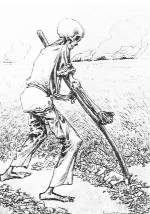
The Grim Reaper by Louis Raemaekers

In the fall of 1918 the Great War in Europe was winding down and peace was on the horizon. The Americans had joined in the fight, bringing the Allies closer to victory against the Germans. Deep within the trenches these men lived through some of the most brutal conditions of life, which it seemed could not be any worse. Then, in pockets across the globe, something erupted that seemed as benign as the common cold. The influenza of that season, however, was far more than a cold. In the two years that this scourge ravaged the earth, a fifth of the world's population was infected. The flu was most deadly for people ages 20 to 40. This pattern of morbidity was unusual for influenza which is usually a killer of the elderly and young children. It infected 28% of all Americans (Tice). An estimated 675,000 Americans died of influenza during the pandemic, ten times as many as in the world war. Of the U.S. soldiers who died in Europe, half of them fell to the influenza virus and not to the enemy (Deseret News). An estimated 43,000 servicemen mobilized for WWI died of influenza (Crosby). 1918 would go down as unforgettable year of suffering and death and yet of peace. As noted in the Journal of the American Medical Association final edition of 1918:

"The 1918 has gone: a year momentous as the termination of the most cruel war in the annals of the human race; a year which marked, the end at least for a time, of man's destruction of man; unfortunately a year in which developed a most fatal infectious disease causing the death of hundreds of thousands of human beings. Medical science for four and one-half years devoted itself to putting men on the firing line and keeping them there. Now it must turn with its whole might to combating the greatest enemy of all--infectious disease," (12/28/1918).


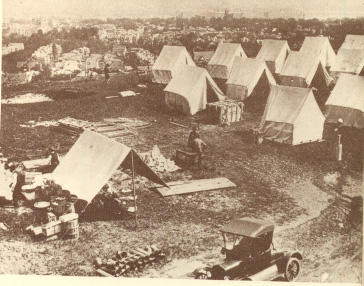
An Emergency Hospital for Influenza Patients


The effect of the influenza epidemic was so severe that the average life span in the US was depressed by 10 years. The influenza virus had a profound virulence, with a mortality rate at 2.5% compared to the previous influenza epidemics, which were less than 0.1%. The death rate for 15 to 34-year-olds of influenza and pneumonia were 20 times higher in 1918 than in previous years (Taubenberger). People were struck with illness on the street and died rapid deaths. One anectode shared of 1918 was of four women playing bridge together late into the night. Overnight, three of the women died from influenza (Hoagg). Others told stories of people on their way to work suddenly developing the flu and dying within hours (Henig). One physician writes that patients with seemingly ordinary influenza would rapidly "develop the most viscous type of pneumonia that has ever been seen" and later when cyanosis appeared in the patients, "it is simply a struggle for air until they suffocate," (Grist, 1979). Another physician recalls that the influenza patients "died struggling to clear their airways of a blood-tinged froth that sometimes gushed from their nose and mouth," (Starr, 1976). The physicians of the time were helpless against this powerful agent of influenza. In 1918 children would skip rope to the rhyme (Crawford):

I had a little bird,Its name was Enza.I opened the window,And in-flu-enza.

The influenza pandemic circled the globe. Most of humanity felt the effects of this strain of the influenza virus. It spread following the path of its human carriers, along trade routes and shipping lines. Outbreaks swept through North America, Europe, Asia, Africa, Brazil and the South Pacific (Taubenberger). In India the mortality rate was extremely high at around 50 deaths from influenza per 1,000 people (Brown). The Great War, with its mass movements of men in armies and aboard ships, probably aided in its rapid diffusion and attack. The origins of the deadly flu disease were unknown but widely speculated upon. Some of the allies thought of the epidemic as a biological warfare tool of the Germans. Many thought it was a result of the trench warfare, the use of mustard gases and the generated "smoke and fumes" of the war. A national campaign began using the ready rhetoric of war to fight the new enemy of microscopic proportions. A study attempted to reason why the disease had been so devastating in certain localized regions, looking at the climate, the weather and the racial composition of cities. They found humidity to be linked with more severe epidemics as it "fosters the dissemination of the bacteria," (Committee on Atmosphere and Man, 1923). Meanwhile the new sciences of the infectious agents and immunology were racing to come up with a vaccine or therapy to stop the epidemics.

The experiences of people in military camps encountering the influenza pandemic:

An excerpt for the memoirs of a survivor at Camp Funston of the pandemic Survivor

A letter to a fellow physician describing conditions during the influenza epidemic at Camp Devens

A collection of letters of a soldier stationed in Camp Funston Soldier

The origins of this influenza variant is not precisely known. It is thought to have originated in China in a rare genetic shift of the influenza virus. The recombination of its surface proteins created a virus novel to almost everyone and a loss of herd immunity. Recently the virus has been reconstructed from the tissue of a dead soldier and is now being genetically characterized. The name of Spanish Flu came from the early affliction and large mortalities in Spain (BMJ,10/19/1918) where it allegedly killed 8 million in May (BMJ, 7/13/1918). However, a first wave of influenza appeared early in the spring of 1918 in Kansas and in military camps throughout the US. Few noticed the epidemic in the midst of the war. Wilson had just given his 14 point address. There was virtually no response or acknowledgment to the epidemics in March and April in the military camps. It was unfortunate that no steps were taken to prepare for the usual recrudescence of the virulent influenza strain in the winter. The lack of action was later criticized when the epidemic could not be ignored in the winter of 1918 (BMJ, 1918). These first epidemics at training camps were a sign of what was coming in greater magnitude in the fall and winter of 1918 to the entire world.

The war brought the virus back into the US for the second wave of the epidemic. It first arrived in Boston in September of 1918 through the port busy with war shipments of machinery and supplies. The war also enabled the virus to spread and diffuse. Men across the nation were mobilizing to join the military and the cause. As they came together, they brought the virus with them and to those they contacted. The virus killed almost 200,00 in October of 1918 alone. In November 11 of 1918 the end of the war enabled a resurgence. As people celebrated Armistice Day with parades and large parties, a complete disaster from the public health standpoint, a rebirth of the epidemic occurred in some cities. The flu that winter was beyond imagination as millions were infected and thousands died. Just as the war had effected the course of influenza, influenza affected the war. Entire fleets were ill with the disease and men on the front were too sick to fight. The flu was devastating to both sides, killing more men than their own weapons could.


With the military patients coming home from the war with battle wounds and mustard gas burns, hospital facilities and staff were taxed to the limit. This created a shortage of physicians, especially in the civilian sector as many had been lost for service with the military. Since the medical practitioners were away with the troops, only the medical students were left to care for the sick. Third and forth year classes were closed and the students assigned jobs as interns or nurses (Starr,1976). One article noted that "depletion has been carried to such an extent that the practitioners are brought very near the breaking point," (BMJ, 11/2/1918). The shortage was further confounded by the added loss of physicians to the epidemic. In the U.S., the Red Cross had to recruit more volunteers to contribute to the new cause at home of fighting the influenza epidemic. To respond with the fullest utilization of nurses, volunteers and medical supplies, the Red Cross created a National Committee on Influenza. It was involved in both military and civilian sectors to mobilize all forces to fight Spanish influenza (Crosby, 1989). In some areas of the US, the nursing shortage was so acute that the Red Cross had to ask local businesses to allow workers to have the day off if they volunteer in the hospitals at night (Deseret News). Emergency hospitals were created to take in the patients from the US and those arriving sick from overseas.


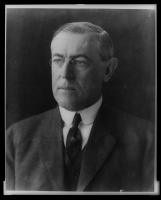
The pandemic affected everyone. With one-quarter of the US and one-fifth of the world infected with the influenza, it was impossible to escape from the illness. Even President Woodrow Wilson suffered from the flu in early 1919 while negotiating the crucial treaty of Versailles to end the World War (Tice). Those who were lucky enough to avoid infection had to deal with the public health ordinances to restrain the spread of the disease. The public health departments distributed gauze masks to be worn in public. Stores could not hold sales, funerals were limited to 15 minutes. Some towns required a signed certificate to enter and railroads would not accept passengers without them. Those who ignored the flu ordinances had to pay steep fines enforced by extra officers (Deseret News). Bodies pilled up as the massive deaths of the epidemic ensued. Besides the lack of health care workers and medical supplies, there was a shortage of coffins, morticians and gravediggers (Knox). The conditions in 1918 were not so far removed from the Black Death in the era of the bubonic plague of the Middle Ages.

In 1918-19 this deadly influenza pandemic erupted during the final stages of World War I. Nations were already attempting to deal with the effects and costs of the war. Propaganda campaigns and war restrictions and rations had been implemented by governments. Nationalism pervaded as people accepted government authority. This allowed the public health departments to easily step in and implement their restrictive measures. The war also gave science greater importance as governments relied on scientists, now armed with the new germ theory and the development of antiseptic surgery, to design vaccines and reduce mortalities of disease and battle wounds. Their new technologies could preserve the men on the front and ultimately save the world. These conditions created by World War I, together with the current social attitudes and ideas, led to the relatively calm response of the public and application of scientific ideas. People allowed for strict measures and loss of freedom during the war as they submitted to the needs of the nation ahead of their personal needs. They had accepted the limitations placed with rationing and drafting. The responses of the public health officials reflected the new allegiance to science and the wartime society. The medical and scientific communities had developed new theories and applied them to prevention, diagnostics and treatment of the influenza patients.

Return to the Top

Graphs of the Influenza Epidemic Impact

The Public Health ResponseAuthoritative Measures
Preventative Measures
Prophylaxis
 The Scientific and Medical Response

Viewpoint: The deadly disease that killed more people than WW1

http://www.bbc.com/news/magazine-29541235
Public buildings were turned into hospitals to cope with all the cases

A deadly illness took hold as WW1 ended and killed an estimated 50 million people globally. But the horror made the world aware of the need for collective action against infectious diseases, says Christian Tams, professor of International Law at the University of Glasgow.

On Armistice Day, 1918, the world was already fighting another battle. It was in the grip of Spanish Influenza, which went on to kill almost three times more people than the 17 million soldiers and civilians killed during WW1.

Dangerous diseases only reach the headlines if there is a risk of a pandemic, like the current Ebola outbreak. Other than that they are the largely ignored global killers, but every year they kill many more people than wars and military conflicts.

In 1918 the world faced a pandemic. Within months Spanish Flu had killed more people than any other illness in recorded history. It struck fast and was indiscriminate. In just one year the average life expectancy in America dropped by 12 years, according to the US National Archives.


A peace to end all wars?


After WW1, global leaders dreamed of a new world order. How close did they get? Prof Christian Tams explores whether they succeeded in a free online course (MOOC) from the BBC and the University of Glasgow. Click on the like below to learn more.
World War 1: Paris 1919 - A New World Order?


In many countries public health services responded, while societies used to wartime restrictions bore quarantines and other measures with resilience. But massive troop deployments and increased global travel meant that no nation could fight the Spanish Flu singlehandedly. Warring nations would need to co-operate if they wanted to combat global diseases.

In the aftermath of WW1 global security was the major concern. At the Paris Peace Conference of 1919 the Allies redrew boundaries, carved up empires and established the first-ever world organisation, the League of Nations.


How deadly was Spanish Influenza?

One fifth of the world's population was attacked by this deadly virus
Most vicious influenza strain of the 20th Century
Deaths even surpassed the Black Death of the Middle Ages

Source: US Department of Health and Human Services (HHS) and BBC

Discover how actions taken after WW1 still affect you today


The League was set up primarily to preserve peace, which it did with limited success. But it was also to be a centre for co-ordinating international co-operation. The prevention and control of disease was one of the matters of "international concern" listed in its founding treaty. And very quickly - drawing lessons from the Spanish Flu and other global diseases - the League would lay the foundations of our modern system of global healthcare control.


The League's work for international health is largely forgotten, but it is a remarkable story. Under-staffed and under-resourced, various League health agencies during the 1920s and 1930s began to view global health as a global challenge. This involved crisis responses on the ground, but also long-term work towards prevention and health education.

When the League began its work, the worst waves of the Spanish Flu were over. However, countries in Central and Eastern Europe found themselves in the grip of another disease - typhus. The League mobilised international action that by 1921 had largely managed to contain the spread of the epidemic, through mass examinations, de-lousing and bathing and the imposition of quarantines.

While crisis responses remained important, the League greatly improved work towards the prevention of diseases and pioneered health education. Early-warning systems were set up to gather information on the most common infectious diseases such as Cholera, Yellow Fever or Small Pox. This was then communicated by telegraph to a global network.

The League also promoted health-related research and standardised the use of vaccinations around the globe. And it engaged in the first global attempt at health training. This included large-scale programmes of Malaria education and a concerted effort in the 1920s to improve healthcare in China.

While little of this generated news headlines, it would be foolish to dismiss the League's work. Prevention remains the best cure and the League's efforts are likely to have saved countless lives.
In many countries like France people were urged to wear protective masks
Shop staff in Chicago also wore them
As did did police officers in Washington

In an early form of public-private partnership, international health co-operation brought together League experts, national governments and private charities. All this marked no more than a beginning, but it brought home the basic idea that global health can only be protected through international co-operation.

Current reports about the likely spread of Ebola show threats to the world's health are not over. Such threats of deadly pandemics can still meet with haphazard responses.

But beyond pandemics, which are widely reported, the truly shocking figures are the ones that hardly ever reach the headlines, like that of seven million children dying every year from preventable diseases.

But global health has massively improved since 1918 and there are numerous untold success stories. Polio, one of the deadliest scourges of mankind, is nearly eradicated thanks to the combined efforts of UN agencies and private charities like the Gates Foundation and Rotary.


What are MOOCS?


MOOCs stands for massive open online courses and are a new way of learning from the world's leading academics. The BBC is launching four WW1 MOOCs, working with leading universities.
Paris 1919 - A New World Order? University of Glasgow
Aviation Comes of Age, University of Birmingham
Changing Faces of Heroism, University of Leeds
Trauma and Memory, The Open University

Explore the courses by registering here.


Where the League relied on telegraphs to spread information, the World Health Organization now holds the means to prepare for health emergencies. And while millions died of Spanish Flu, research and international co-operation have helped us to deal with risks of more recent influenza epidemics.

But the key challenge remains, outside dramatic outbreaks like those of Ebola today or of the Spanish Flu almost a century ago, global health too often remains a side-issue.

In a year that marks the centenary of WW1, it deserves our full attention and the League's network on global health still has much to teach us.

Find out more about MOOCs and register here. Also, discover moreabout the World War One Centenary.

You can follow the Magazine on Twitter

Copyright © Fight for Your Faith