Does your faith need strengthening? Are you confused and wondering if Jesus Christ is really "The Way, the Truth, and the Life?" "Fight for Your Faith" is a blog filled with interesting and thought provoking articles to help you find the answers you are seeking. Jesus said, "Seek and ye shall find." In Jeremiah we read, "Ye shall seek Me, and find Me, when ye shall seek for Me with all your heart." These articles and videos will help you in your search for the Truth.

Sunday, September 13, 2020

Arms, Arms and More Arms! – It’s Blood Money, Baby! - Chapter 32


Arms, Arms and More Arms! – It’s Blood Money, Baby!

America has also polluted the world through her sales of armaments and weapons of war. Although other countries also sell arms, the USA has had the biggest share in sales of military equipment and weapons of death and destruction. Researcher Michael Klare wrote back in May, 2013,

International weapons sales have proved to be a thriving global business in economically tough times. According to the Congressional Research Service (CRS), such sales reached an impressive $85 billion in 2011, nearly double the figure for 2010. Arms sales have always served multiple functions. Valuable trade commodities, weapons can prove immensely lucrative for companies that specialize in making such products. Between 2008 and 2011, for example, U.S. firms sold $146 billion worth of military hardware to foreign countries, according to the latest CRS figures.[1]

New York Times article from October 2013 says,

According to IHS Jane’s, an industry consulting and analysis company, the total global arms trade revenue in 2012 was estimated to be $73.5 billion, and the United States had a 39 percent share.[2]

That’s around 18.4 billion in arms sales for the USA. Another article in Aljazeera America from March 2015 informs us that,

The international arms trade is booming, with America the major driver of its growth, according to a new report from the Stockholm International Peace Research Institute (SIPRI). SIPRI researchers Pieter D. Wezeman and Siemon T. Wezeman found that the “volume of international transfers of major weapons” from 2010 to 2014 was 16 percent higher than it was in the four preceding years. The United States was the biggest exporter during that period, ahead of Russia and China. U.S. weaponry accounted for 31 percent of exports from 2010 to 2014, the study states.[3]

In August 2015, Amnesty International reiterated the point that the US holds 31% of the international arms sales. Quoting from the Stockholm International Peace Research Institute they claim that the total global military expenditure has risen from US$1.14 trillion in 2001 to US$1.71 trillion in 2014, a rise of 50%.[4] 

Another article from The Arms Industry: Control Arms Campaign written in back October 2003, explains the horrid state of the arms industry. 
The arms industry is unlike any other. It operates without regulation. It suffers from widespread corruption and bribes. And it makes its profits on the back of machines designed to kill and maim human beings. So who profits most from this murderous trade? It is none other than the five permanent members of the UN Security Council—the USA, UK, France, Russia, and China. Together, they are responsible for eighty eight per cent of reported conventional arms exports. “We can’t have it both ways. We can’t be both the world’s leading champion of peace and the world’s leading supplier of arms,” so said Former US President Jimmy Carter, during his 1976 presidential campaign.[5]

A more recent article from April 2016 echoes earlier reports: 

World military spending rose 1 percent in 2015, the first annual increase in four years, a Stockholm think tank said on Tuesday as it estimated 10 percent of this could cover the costs of global goals aiming to end poverty and hunger in 15 years. The Stockholm International Peace Research Institute (SIPRI) said military expenditure nudged up to almost $1.7 trillion last year, with the United States accounting for by far the greatest amount despite its spending dipping 2.4 percent to $596 billion.[6]

That would mean America has around 35% of world military spending. Any way we look at it, arms sales are big business. 

The book of Revelation in the New Testament tells us,

And in her (Babylon the Whore) was found the blood of the prophets, and of saints, and of all that were slain upon the earth.[7]

President and former General Dwight E. Eisenhower warned of the danger of the Military Industrial Complex back in the beginning of the 1960s. He predicted that the Military Industrial Complex would continue to encroach on the power of the government. In his farewell speech in 1961 he said the following:

We annually spend on military security more than the net income of all United States corporations. This conjunction of an immense military establishment and a large arms industry is new in the American experience. The total influence -- economic, political, even spiritual -- is felt in every city, every State house, every office of the Federal government. We recognize the imperative need for this development. Yet we must not fail to comprehend its grave implications. Our toil, resources and livelihood are all involved; so is the very structure of our society. 

In the councils of government, we must guard against the acquisition of unwarranted influence, whether sought or unsought, by the military-industrial complex. The potential for the disastrous rise of misplaced power exists and will persist. We must never let the weight of this combination endanger our liberties or democratic processes. We should take nothing for granted. Only an alert and knowledgeable citizenry can compel the proper meshing of the huge industrial and military machinery of defense with our peaceful methods and goals, so that security and liberty may prosper together.[8] 

In talking about the waste caused by excessive military spending, Eisenhower, a former military man himself, had previously said the following:

Every gun that is made, every warship launched, every rocket fired signifies, in the final sense, a theft from those who hunger and are not fed, those who are cold and are not clothed. This world in arms is not spending money alone. It is spending the sweat of its laborers, the genius of its scientists, (and) the hopes of its children.
The cost of one modern heavy bomber is this: a modern brick school in more than 30 cities. It is two electric power plants, each serving a town of 60,000 (in) population. It is two fine, fully-equipped hospitals. It is some 50 miles of concrete highway. We pay for a single fighter plane with a half-million bushels of wheat. We pay for a single destroyer with new homes that could have housed more than 8,000 people.

Is this, I repeat, the best way of life to be found on the road the world has been taking? (No), this is not a way of life at all, in any true sense. Under the cloud of threatening war, it is humanity hanging from a cross of iron.[9] 
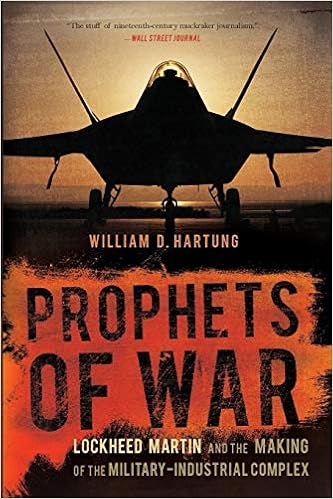
In spite of Eisenhower’s warning, the percentage of America’s military spending continues to increase every year with approximately half of the Federal Budget going to military spending. Read William Hartung’s book Prophets of War: Lockheed Martin and the Making of the Military-Industrial Complex[10] if you still don’t believe me, or his short article on the internet entitled There’s No Business Like the Arms Business: Weapons “R” Us (But You’d Never Know It).[11]
We are reminded of the verses in Genesis,

And God saw that wickedness of man was great in the earth, and that every imagination of the thoughts of his heart was only evil continually. And it repented the Lord that he had made man on the earth, and it grieved him at his heart.[12]
War is big business and the bankers know it. Read F. William Engdahl’s A Century of War,[13] or watch him on YouTube.[14] 
Bankers make their greatest profits from war and the national debts that incur from them. Yes, our excessive military budget and spending grieves God in His heart. Like Brigadier General Smedley Butler said,

War is a racket. It is the only one international in scope. It is the only one in which the profits are reckoned in dollars and the losses in lives.[15]

You can watch an 18 minute enactment of some of his speeches below. 
Dwight L Moody, the famous Christian evangelist, when speaking after the Civil War about the then possible war with Spain, said the following:
War, awful war! Never has our country had more need of your prayers than at the present time. God keep us from war, if it be possible, and God keep hate of Spain out of our hearts! I have not met a man who served in the last war who wants to see another. God knows that I do not want to see the carnage and destruction that such a war would bring. God pity America and Spain. There are many mothers who will be bereaved, many homes broken up, if we have war. Have you thought of this?[16]
Right now as I am writing this war is taking place in both Ukraine and Gaza. It is taking place in Syria and Iraq. How many times will we fight “wars to end all wars” or “wars to make it safe for democracy”? When I was faced with the prospect of war as a youth, it was the words from the New Testament that spoke to me and which I could not remove from my consciousness. The Beatitudes found in Jesus' sermon on the mount in Matthew chapter 5 assured me that the war machine would not get the blessing.
Blessed are the poor in spirit: for theirs is the kingdom of heaven. Blessed are they that mourn: for they shall be comforted. Blessed are the meek: for they shall inherit the earth. Blessed are they which do hunger and thirst after righteousness: for they shall be filled. Blessed are the merciful: for they shall obtain mercy. Blessed are the pure in heart: for they shall see God. Blessed are the peacemakers: for they shall be called the children of God.
Blessed are they which are persecuted for righteousness' sake: for theirs is the kingdom of heaven. Blessed are ye, when men shall revile you, and persecute you, and shall say all manner of evil against you falsely, for my sake. Rejoice, and be exceeding glad: for great is your reward in heaven: for so persecuted they the prophets which were before you.[17] 

Jesus went on to say,

Ye have heard that it hath been said, An eye for an eye, and a tooth for a tooth: But I say unto you, That ye resist not evil: but whosoever shall smite thee on thy right cheek, turn to him the other also. And if any man will sue thee at the law, and take away thy coat, let him have thy cloak also. And whosoever shall compel thee to go a mile, go with him twain. Give to him that asks thee, and from him that would borrow of thee turn not thou away.
Ye have heard that it hath been said, Thou shalt love thy neighbour, and hate thine enemy. But I say unto you, Love your enemies, bless them that curse you, do good to them that hate you, and pray for them which despitefully use you, and persecute you; That ye may be the children of your Father which is in heaven: for he makes his sun to rise on the evil and on the good, and sends rain on the just and on the unjust. For if ye love them which love you, what reward have ye? do not even the publicans the same? And if ye salute your brethren only, what do ye more than others? do not even the publicans so? Be ye therefore perfect, even as your Father which is in heaven is perfect. [18] 
When the Apostle Peter wanted to defend Jesus in the Garden of Gethsemane on the Mount of Olives, Jesus told him,

Put up again thy sword into his place: for all they that take the sword shall perish with the sword.[19]

Apostle James went on to write that it was the lust for power and possessions that caused wars.

From whence come wars and fighting among you? come they not hence, even of your lusts that war in your members? Ye lust, and have not: ye kill, and desire to have, and cannot obtain: ye fight and war, … that ye may consume it upon your lusts.[20]
It seems to me that the whole world is groaning for deliverance from man’s incessant wars. We used to sing Give Peace a Chance.[21] 

But it seems the world has almost given up on peace and the expectation of peace. Israel invades Gaza resulting in hundreds of innocent deaths, and all we hear is Hamas is using civilians as human shields. When will it stop?

And they cried with a loud voice, saying, How long, O Lord, holy and true, dost thou not judge and avenge our blood on them that dwell on the earth?[22]
I will need to add a comment here as the situation in Iraq and Syria has recently deteriorated with ISIS’s killing of American and British journalist/photographers kidnapped or captured in the Middle East. We need to remember that ISIS was a creation of America’s military policy in Syria and Libya. We need to also remember that the hatred that is manifested against America and Britain is the result of our military and political position in the Middle East for the last fifty years or more, which many believe has been manipulated by the International Bankers, and or the Mossad, the Bilderbergers or the Illuminati.
We have sowed death and destruction to support Israel’s right for existence. We have rejected Christ’s commandment to go into all the world and preach the Gospel to all nations teaching the ways of peace and brotherly love.[23] We have given up our duty to share His message of love to all men. Instead we have fed the world from Hollywood’s froth and filth. We have submitted our Godly convictions to those of the bankers and military men and politicians who together in the bed of war make their living. We will reap what we have sowed.[Picture of Iraq's retreating military destroyed by America firepower in first Iraqi war.]
Today’s terrorist could be tomorrow’s political leader. Menachem Begin was a terrorist in the Irgun organization that killed British mandated troops in Palestine before the 1948 declaration of independence.[24] George Washington led guerrilla warfare against traditional British troops to later become President of a new nation. Gerry Adams of IRA’s Sinn Féin later became member of Ireland’s Parliament and the British House of Commons. Mario Soares in Portugal was a long time political activist frequently arrested and detained by the secret police. He was twice sentenced to live abroad but eventually became both Prime Minister and President of Portugal.[25]
We cannot hold back the winds of change. But we can influence them for good as much as possible. We can use dialogue, reasoning, and diplomacy in as many ways as are possible. The voice of the poor and downtrodden, whether they are Arab, Asian or African, must be heard. We can and will use force to protect our own, like Sergeant York showed.[26] 
But it must be tempered with love and mercy, like Dr. George Ellis emphasized in the Scottish commander’s patient, controlled response to the terrorist attacks in Yemen in 1967, which we covered in a previous chapter.
But remember, in the world where might makes right, God’s people will always be marginalized, persecuted or maligned. Nevertheless, we must try to influence, as much as we can, worldly men to make Godly decisions. We may be called cowards or communist sympathizers because of it. But ultimately, we are called by our committed Christian conscience to speak the truth to our neighbor.[27] Our hope is that he too will come to know and love Him who is the Creator of the universe and our God, the Prince of Peace, Jesus Christ![28]

To go to the previous chapter click HERE
To go to the next chapter click HERE
To go to the index of chapters for the book click HERE

Notes:

[1] Michael Klare, Do Arms Sales by Major Powers Signal a Move to a 21st Century Cold (Or Hot) War?, Tom Dispatch, May 30, 2013
http://www.alternet.org/do-arms-sales-major-powers-signal-move-21st-century-cold-or-hot-war (accessed 03/2016)
[2] Edward Wong and Nicola Clark, China's Arms Industry Makes Global Inroads, NY Times, October 20, 2013 http://www.nytimes.com/2013/10/21/world/asia/chinas-arms-industry-makes-global-inroads.html?_r=0 (accessed 03/2016)
[3] http://www.reuters.com/article/us-global-military-goals-idUSKCN0X12EQ (03/2016)
[4] https://www.amnesty.org/en/latest/news/2015/08/killer-facts-the-scale-of-the-global-arms-trade/(accessed 03/2014)
[5] http://www.globalissues.org/article/74/the-arms-trade-is-big-business (03/16)
[6] http://news.trust.org/item/20160404220403-g66yf?view=print (03/2016)
[7] Revelation 18:24
[8] https://www.youtube.com/watch?v=Gg-jvHynP9Y (accessed 03/2016)
[9] http://www.informationclearinghouse.info/article9743.htm (accessed 03/16)
[10] https://www.amazon.com/Prophets-War-Lockheed-Military-Industrial-Complex/dp/1568586973?ie=UTF8&ref_=nosim&tag=tomdispatch-20
[11] http://www.tomdispatch.com/post/176169/tomgram%3A_william_hartung,_how_to_arm_a_%22volatile%22_planet/
[12] Genesis 6:5-6
[13] http://www.takeoverworld.info/pdf/Engdahl__Century_of_War_book.pdf (03/16)
[14] https://www.youtube.com/watch?v=GVctGHYQcOw (accessed 03/16)
[15] Smedly Butler, War is a Racket, 1935. http://www.ratical.org/ratville/CAH/warisaracket.pdf(accessed 2016)
https://www.youtube.com/watch?v=EI3lckqaSk0 (accessed 03/2016)
http://www.brainyquote.com/quotes/authors/s/smedley_butler.html (03/16)
[16] http://www.biblebelievers.com/moody/12.html (accessed 2016)
[17] Matthew 5:3-12
[18] Matthew 5:38-48
[19] Matthew 26:52
[20] James 4:1-3
[21] https://www.youtube.com/watch?v=0yU0JuE1jTk (accessed 03/2016)
[22] Revelation 6:10
[23] Mark 16:15 And he said unto them, Go ye into all the world, and preach the gospel to every creature.
[24] http://en.wikipedia.org/wiki/Menachem_Begin (accessed 03/2016)
[25] http://en.wikipedia.org/wiki/M%C3%A1rio_Soares (accessed 03/2016)
[26] http://en.wikipedia.org/wiki/Alvin_C._York (accessed 03/2016)
[27] Zechariah 8:16 These are the things that ye shall do; Speak ye every man the truth to his neighbour; execute the judgment of truth and peace in your gates.
[28] Isaiah 9:6 For unto us a child is born, unto us a son is given: and the government shall be upon his shoulder: and his name shall be called Wonderful, Counselor, The mighty God, The everlasting Father, The Prince of Peace.

To go to the previous chapter click HERE
To go to the next chapter click HERE
To go to the index of chapters for the book click HERE

Wednesday, April 19, 2017

Dwight E. Eisenhower on War

Dwight E. Eisenhower 34th President of the USA

"I hate war as only a soldier who has lived it can, only as one who has seen its brutality, its futility, its stupidity."

"Every gun that is made, every warship that is launched, every rocket that is fired, signifies, in the final sense, a theft from those who are hungry and are not fed, those who are cold and are not clothed.  This world in arms is not spending money alone. It is spending the sweat of its labors, the genius of its scientists, and the hope of its children."

"We annually spend on military security more than the net income of all US corporations This conjunction of an immense military establishment and a large arms industry is new in the American experience. The total influence -- economic. political, even spiritual -- is felt in every city, every State house, every office of the Federal government. We recognize the imperative need for this development. Yet, we must not fail to comprehend its grave implications. Our toil, resources, and livelihood are all involved; so is the very structure of our society."

"In the councils of government, we must guard against the acquisition of unwarranted influence, whether sought or unsought, by the military-industrial complex. the potential for the disastrous rise of misplaced power exists and will persist. We must never let the weight of this combination endanger our liberties or democratic processes. We should take nothing for granted. Only an alert and knowledgeable citizenry can compel the proper meshing of the huge industrial and military machinery of defense with our peaceful methods and goals, so that security and liberty may prosper together."

"The cost of one modern heavy bomber [in the 1950s] is this: a modern brick school in more than 30 cities. It is two electric power plants, each serving a town of 60,000 in population. It is two fine, fully-equipped hospitals. It is some 50 miles of concrete highway. We pay for a single fighter plane with a half-million bushels of wheat. We pay for a single destroyer with new homes that could have housed more than 8,000 people."

"Is this, I repeat, the best way of life to be found on the road the world has been taking? [No], this is not a way of life at all, in any true sense. Under the cloud of threatening war, it is humanity hanging from a cross of iron."

http://www.informationclearinghouse.info/article9743.htm

Please watch Eisenhower's speech here: http://www.youtube.com/watch?v=Gg-jvHynP9Y

Dennis Edwards: The Bible tells of the Four Horses of the Apocalypse are four spiritual forces going forth to act upon mankind. One of the horses is the Red horse. The Bible says,

"And power was given to him that sat thereon to take peace from the earth, and that they should kill one another: and there was given unto him a great sword."[Revelations 6:4]

The Red horse is therefore none other than the spirit of war causing nations to rise up against one another, or causing civil and ethnic wars within nations. This is the spirit of anti-christ, as God's law is love and each human life is important to Him. Therefore, there is an actual spiritual force pushing for war, pushing men to kill one another in war.

Closely related to the War horse is the Black horse of the Apocalypse. We read in the Bible,

"And I beheld, and lo,a Black horse; and he that sat on him had a pair of balances in his hand."

And I heard a voice in the midst of the four beasts say, A measure of wheat for a penny, and three measures of barley for a penny; and see thou hurt not the oil and the wine." [Revelation 6:5-6]

From the Old Testament we get the interpretation.

"He is a merchant, the balances of deceit are in his hand: he loves to oppress." [Hosea 12:7]

In another section we see the prophet exposing the deceitful merchant who oppresses and deceives. We read,

"Hear, this, O ye that swallow up the needy, even to make the poor of the land to fail. Saying, When will the new moon be gone, that we may sell corn? and the Sabbath, that we may set forth wheat, making the shekel great, and falsifying the balances by deceit? That we may buy the poor for silver, and the needy for a pair of shoes; yea, and sell the refuse of the wheat." [Amos 8:4-6]

As Eisenhower so warned the industrial-military complex together pushes for war. The merchants make their greatest profits from the sales of arms, the reconstruction of nations, the debts incurred by nations and guaranteed by governments. See the following link: https://www.youtube.com/watch?v=lglMx3_kKcc War is big business as Congressional Honor Brigadier General Smedley Butler said after WWI.

"War is a racket. It is the only one international in scope. It is the only one in which the profits are reckoned in dollars and the losses in lives."[Smedley Butler, War is a Racket, 1935]

"God keep us from war," prayed Dwight L. Moody before the Spanish American War. He went on to say,

"Never has our country had more need of your prayers than at the present time....I have not met a man who served in the last war who wants to see another. God knows that I do not want to see the carnage and destruction that such a war would bring.... There are many mothers who will be bereaved, many homes broken up, if we have war. Have you thought of this?"[http://www.biblebelievers.com/moody/12.html]

Are you praying for peace or are you patting yourselves on the back for Trump's victorious bombing? Please be peace-makers. Pray for peace.

Thursday, September 15, 2016

Record new U.S. military aid deal for Israel to be signed in days

By Matt Spetalnick and Luke Baker, Reuters, Sept. 13, 2016

The United States and Israel have reached final agreement on a record new package of at least $38 billion in U.S. military aid and the 10-year pact is expected to be signed within days, sources close to the matter told Reuters on Tuesday.

The deal will represent the biggest pledge of U.S. military assistance ever made to any country but also includes major concessions granted by Israeli Prime Minister Benjamin Netanyahu, according to officials on both sides.

Those include Israel’s agreement not to seek additional funds from Congress beyond what will be guaranteed annually in the new package, and also to phase out a special arrangement that has allowed Israel to spend part of its U.S. aid on its own defense industry instead of on American-made weapons, the officials said.

Drawn-out aid negotiations have underscored continuing friction between U.S. President Barack Obama and Netanyahu over last year’s U.S.-led nuclear deal with Iran, Israel’s arch-foe. The United States and Israel have also been at odds over the Palestinians.

But the right-wing Israeli leader decided it would be best to forge a new arrangement with Obama, who leaves office in January, rather than hoping for better terms from the next U.S. administration, according to officials on both sides.

A deal now allows him to avoid uncertainties surrounding the next president, whether Democrat Hillary Clinton or Republican Donald Trump, and to give Israel’s defense establishment the ability to plan ahead.

Obama’s aides want a new deal before his presidency ends, seeing it as an important part of his legacy. Republican critics accuse him of not being attentive enough to Israel’s security, which the White House strongly denies.

The deal, known as a memorandum of understanding, or MOU, calls for at least $3.8 billion a year in aid, up from $3.1 billion annually under the current pact, which expires in 2018, officials say. Netanyahu had originally sought upwards of $4.5 billion a year.

The new package for the first time will incorporate money for Israeli missile defense, which until now has been funded ad hoc by Congress. U.S. lawmakers have in recent years given Israel up to $600 million in annual discretionary funds for this purpose.

Officials say Israel has agreed not to lobby Congress for additional missile defense funds during the life of the new MOU, a pledge expected to be made in a side letter or annex to the agreement. But the wording is likely to be flexible enough to allow exceptions in case of a war or other major crisis.

Barring a last-minute snag, the new agreement is expected to be officially rolled out within days, possibly as early as this week, one source close to the matter said.

Another source familiar with the negotiations confirmed that the signing would be “in the coming days”.

It will not be signed by Obama and Netanyahu, who have had a fraught relationship, but instead by lower-ranking officials, in keeping with the way the two governments have formally sealed previous deals of this type.

Saturday, August 27, 2016

How Many Guns Did the U.S. Lose Track of in Iraq and Afghanistan? Hundreds of Thousands.

By C. J. Chivers, NY Times Magazine, Aug. 24, 2016

Early this year, a Facebook user in Baghdad using the name Hussein Mahyawi posted a photograph of a slightly worn M4 assault rifle he was offering for sale. Veterans of the latest war in Iraq immediately recognized it. It was a standard American carbine equipped with a holographic sight, a foregrip that was military-issue during the occupation and a sticker bearing a digital QR code used by American forces for inventory control. Except for one detail–an aftermarket pistol grip, the sort of accessory with which combatants of the current generation often pimp their guns–it was a dead ringer for any of the tens of thousands of M4s the Pentagon handed out to Iraqi security forces and various armed militias after toppling Saddam Hussein in 2003. And here it was on the open market, ready for bids.

Was this a surprise? No. A little more than four years after the United States withdrew all its military forces from Iraq, and not quite two years after a smaller number of American troops began returning to the country to help fight the Islamic State, the open sale of such an M4 was part of Iraq’s day-to-day arms-trafficking routine. Mahyawi’s carbine was another data point attesting to an extraordinary and dangerous failure of American arms-trafficking and public accountability and to a departure from a modern military’s most basic practice: keeping track of the guns.

Since the Sept. 11 terrorist attacks, the United States has handed out a vast but persistently uncountable quantity of military firearms to its many battlefield partners in Afghanistan and Iraq. Today the Pentagon has only a partial idea of how many weapons it issued, much less where these weapons are. Meanwhile, the effectively bottomless abundance of black-market weapons from American sources is one reason Iraq will not recover from its post-invasion woes anytime soon.

An inkling of just how expansive these arms transfers were, and how stubbornly resistant they are to precise measurement, is apparent in a new attempt at weapons-tallying compiled in a project led by Iain Overton. Overton is a former BBC journalist who is now the executive director of Action on Armed Violence, a charity based in London that researches and lobbies against weapons proliferation and violence against civilians; he is also the author of “The Way of the Gun,” a dark examination of some of the roles firearms play in modern society. With a string of Freedom of Information Act requests that began last year, he and his small team of researchers pooled 14 years’ worth of Pentagon contract information related to rifles, pistols, machine guns and their associated attachments and ammunition, both for American troops and for their partners and proxies. They then crosschecked the data against other public records. Overton is releasing the data and his analysis today. It covers 412 contracts and merits pause for reflection as the parties to the international Arms Trade Treaty gather this week in Geneva. The treaty, which took effect in 2014 and of which the United States is a signatory, is intended to promote transparency and responsible action in the transfer of conventional arms and to reduce their diversion to unintended hands–exactly what the United States often failed to do in recent wars.

In all, Overton found, the Pentagon provided more than 1.45 million firearms to various security forces in Afghanistan and Iraq, including more than 978,000 assault rifles, 266,000 pistols and almost 112,000 machine guns. These transfers formed a collage of firearms of mixed vintage and type: Kalashnikov assault rifles left over from the Cold War; recently manufactured NATO-standard M16s and M4s from American factories; machine guns of Russian and Western lineage; and sniper rifles, shotguns and pistols of varied provenance and caliber, including a large order of Glock semiautomatic pistols, a type of weapon also regularly offered for sale online in Iraq.

Many of the recipients of these weapons became brave and important battlefield allies. But many more did not. Taken together, the weapons were part of a vast and sometimes minimally supervised flow of arms from a superpower to armies and militias often compromised by poor training, desertion, corruption and patterns of human rights abuses. Knowing what we know about many of these forces, it would have been remarkable for them to retain custody of many of their weapons. It is not surprising that they did not.

As an illustration of how haphazard the supervision of this arms distribution often was, last week, five months after being asked by The New York Times for its own tally of small arms issued to partner forces in Afghanistan and Iraq, the Pentagon said it has records for fewer than half the number of firearms in the researchers’ count–about 700,000 in all. This is an amount, Overton noted, that “only accounts for 48 percent of the total small arms supplied by the U.S. government that can be found in open-source government reports.”

This gap between the tallies, the Pentagon said, is partly because at first the United States military was trying to stand up to two governments that were busily fighting wars. “Speed was essential in getting those nations’ security forces armed, equipped and trained to meet these extreme challenges,” Mark Wright, a Pentagon spokesman, wrote in an email. “As a result, lapses in accountability of some of the weapons transferred occurred.”

Why counting weapons, and making a record of serial numbers and recipients, was seen as so time-consuming that it would have slowed down war is not clear. Anyone who has served in a military unit knows that documenting who received what weapon is both a fundamental task and a habit that fits easily into a routine. It takes no more time than issuing a uniform to a soldier or feeding him a meal. But often the Pentagon did not require these steps–although Wright noted that once a weapon is provided to another force, “It is their responsibility to account for that weapon.”

As Overton worked earlier this year on his own exercise in accounting, I asked Nic Marsh, a researcher at the Peace Research Institute Oslo, to take a crack at the same tally, but using other sources he tracks, most notably export data from the European Union and American military inspector-general reports. Marsh’s back-of-the-envelope total for the two wars also exceeded the Pentagon’s by a large margin. By examining declared arms transfers from Europe, he found official reported totals of more than 465,000 firearms provided by the Pentagon to Afghanistan since 2001. Marsh said the exports included weapons from Albania, Britain, Bulgaria, Canada, Croatia, Czech Republic, Germany, Hungary, Italy, Montenegro, Pakistan, Poland, Romania, Russia, Serbia, Slovakia, Slovenia and the United States. He also found at least another 628,000 firearms exported to Iraq from 2003 to 2014, from a similar list of nations, plus Bosnia, Estonia, France, Latvia and Turkey. His Iraq count does not include almost 300,000 more firearms that he suspects were moved there for the Pentagon but for which the records are not quite clear. “The number is much larger” than 628,000, he said, “but we are not certain the exact number exported from Bosnia.”

The weapons sent from Europe to Iraq, and the crates of ammunition necessary to keep them fed, filled cargo planes–though Marsh said the available data also does not say how many were directly paid for by the United States, as opposed to those bought by Iraqi ministries with American-donated funds or those donated by countries unloading old stock. This is an important observation, because the latter two categories–state-to-state gifts via American handlers or otherwise and firearms purchased directly by Afghanistan or Iraq–might not be in Overton’s final count. This is one of many reasons to suspect that the 1.45 million tally might understate the real quantity of weapons disbursements during a long run of years when the Pentagon played the role in Afghanistan and Iraq of small-arms provider. “It could be twice as much, as far as we know,” Overton said last Friday, not entirely in jest.

Overton’s analysis also does not account for many weapons issued by the American military to local forces by other means, including the reissue of captured weapons, which was a common and largely undocumented practice.

Adding to the suspicion that the number is even larger, Overton is certain that his tally missed shipments, because the data that the Defense Department made available was incomplete or laden with contradictions that were not readily reconciled. For example, the contracts it released were for more than $6.5 million or $7 million, depending on the year. Overton suspects that this hides many smaller purchases. And the contract data often labeled purchases vaguely, sometimes making it difficult to determine exactly what was bought, much less for whom. The Pentagon’s data, in short, did not declare much of what the Pentagon actually bought.

One point is inarguable: Many of these weapons did not remain long in government possession after arriving in their respective countries. In one of many examples, a 2007 Government Accountability Office report found that 110,000 Kalashnikov assault rifles and 80,000 pistols bought by the United States for Iraq’s security forces could not be accounted for–more than one firearm for every member of the entire American military force in Iraq at any time during the war. Those documented lapses of accountability were before entire Iraqi divisions simply vanished from the battlefield, as four of them did after the Islamic State seized Mosul and Tikrit in 2014, according to a 2015 Army budget request to buy more firearms for the Iraqi forces to replace what was lost.

These spectacular losses were on top of the more gradual drain that many veterans of the wars watched firsthand–including such scams as Afghan National Army recruits showing up for training and disappearing after rifles were issued. They were leaving, soldiers suspected, to sell their weapons. On the outposts where American troops and Afghan and Iraqi units worked together, the local units were often a fraction of their reported strength and dwindled as ever more national police officers or soldiers disappeared or deserted, vanishing with their firearms. The American arming of Syrian rebels, by both the Central Intelligence Agency and the Defense Department, has also been troubled by questions of accountability and outright theft in a war where the battlefield is thick with jihadists aligned with Al Qaeda or fighting under the banner of the Islamic State.

By this year, various internet arms traders, including many on Facebook, were hawking a seemingly unending assortment of weapons of obvious American origin, including the M4 offered by Hussein Mahyawi, whose Facebook profile spoke of his background in interior design. In April, after being approached by The New York Times and reviewing data from Armament Research Services, a private arms-investigation consultancy, Facebook closed many pages in the Middle East that were serving as busy arms bazaars, including pages in Syria and Iraq on which firearms with Pentagon origins accounted for a large fraction of the visible trade. Hussein Mahyawi’s profiled vanished. But many new arms-trading Facebook pages have since cropped up, including, according to their own descriptions, virtual markets operating from Baghdad and Karbala. The trade goes on.

The new data also suggest ways in which ground combat for American troops raged and changed over the past decade and a half. According to its tally, the American military issued contracts potentially worth more than $40 billion for firearms, accessories and ammunition since Sept. 11, including improvements to the ammunition plants required to keep the cartridge production going. Most of these planned expenditures were for American forces, and the particulars tell the story of two wars that did not go as pitched. More than $4 billion worth of contracts was issued for small arms, including pistols, machines guns, assault rifles and sniper rifles, and more than $11 billion worth was issued for associated equipment, from spare machine-gun barrels to sniper-rifle scopes, according to Overton’s count. A much larger amount–nearly $25 billion–was issued for ammunition or upgrades to ammunition plants to keep those firearms supplied. That last figure aligns with what most any veteran of ground combat in Iraq and Afghanistan could tell you–American troops have been involved in a dizzying number of gunfights since 2001, burning through mountains of ammunition along the way.

The data show large purchases of heavy-machine guns and barrels. This is a wink at the shift in many American units from being foot-mobile to vehicular, as grunts buttoned up within armored trucks and needed turret-mounted firepower to defend themselves–a matériel adaptation forced by ambushes and improvised bombs, the cheaply made weapons that wearied the most expensive military in the world.

Now look away from the data for a moment to consider what it does not show. The Pentagon provided Overton with contract information on small arms up to a caliber of 30 millimeters. This meant that certain classes of infantry weapons were not included, among them mortars, shoulder-fired rockets and powerful Mark 19 automatic grenade launchers that were mounted on many American vehicles and also used in outpost defense. That omission means the data offer no insight into a startlingly risky aspect of the Pentagon’s arming of local forces with infantry arms: the wide distribution of anti-armor weapons, including RPG-7s, commonly called rocket-propelled grenades, and recoilless weapons, including the SPG-9. Each of these systems fires high-explosive (and often armor-piercing) projectiles, and each was commonly used by insurgents in attacks. After the opening weeks of each war, the only armor on either battlefield was American or associated with allied and local government units, which made the Pentagon’s practice of providing anti-armor weapons to Afghan and Iraqi security forces puzzling. Why would they need anti-armor weapons when they had no armor to fight? All the while rockets were somehow mysteriously being fired at American convoys and patrols in each war.

All together, the sheer size of the expenditures, the sustained confusion about totals and the multiple pressures eroding the stock combine to create a portrait of the Pentagon’s bungling the already-awkward role it chose for itself–that of state-building arms dealer, a role that routinely led to missions in clear opposition to each other. While fighting two rapidly evolving wars, the American military tried to create and bolster new democracies, governments and political classes; recruit, train and equip security and intelligence forces on short schedule and at outsize scale; repair and secure transportation infrastructure; encourage the spread or restoration of the legal industry and public services; and leave behind something more palatable and sturdy than rule by thugs.

Any one of these efforts would be difficult on its own. But the United States was trying all these things at once while buying and flying into both countries a prodigious quantity of light military weapons and handing them out to local people and outfits it barely knew. The recipients were often manifestly corrupt and sometimes had close ties to the same militias and insurgents who were trying to drive out the United States and make sure its entire nation-building project did not stand. It should not have been a surprise that American units in disaffected provinces and neighborhoods, and their partners, could encounter gunfire at every turn.

The procession of arms purchases and handouts has continued to this day, with others involved, including Iran to its allies in Iraq and various donors to Kurdish fighters. In March, Russia announced that it had given 10,000 Kalashnikov assault rifles to Afghanistan, already one of the most Kalashnikov-saturated places on earth. If an analysis from the United States’ Special Inspector General for Afghanistan Reconstruction, or Sigar, is to be believed, Afghanistan did not even need them. In 2014 the inspector general reported that after the United States decided to replace the Afghan Army’s Kalashnikovs with NATO-standard weapons (a boon for the rifles’ manufacturer with a much less obvious value for an already amply armed Afghan force), the Afghan Army ended up with a surplus of more than 83,000 Kalashnikovs. The United States never tried to recover the excess it had created, giving the inspector general’s office grounds for long-term worry. “Without confidence in the Afghan government’s ability to account for or properly dispose of these weapons,” it noted, “Sigar is concerned that they could be obtained by insurgents and pose additional risks to civilians.”

Ultimately, Overton’s tallying of the weapons rollout serves as another reminder of a fundamental institutional disconnect between what the Pentagon expects of its troops and it expects of itself. From their earliest days in uniform, Army and Marine recruits are drilled in the near sanctity of their rifles. They quickly learn that no other item of standard equipment will be more rigidly tracked in the routines of accountability and that inspections will continue throughout their careers. Rifles are to be kept properly lubricated and spotlessly clean. Rifles are to be always at hand. Rifles are to be pointed only where meant to be pointed. Rifles are never to be lost. Everything in the armory and each patrol is to be counted, again and again (and again), so that everyone from private to commander knows that nothing has been misplaced and that the weapons are ready for whatever lies ahead. So thorough does this mentality take hold that more than a few veterans, years after returning to civilian life, can recite the serial numbers of service rifles they carried. Some find themselves involuntarily reaching for rifles throughout the day.

When the military distributed weapons in Afghanistan and Iraq, a different dynamic was in play. Keeping track of the weapons in any reliable fashion–documenting who got what and what went where–was often not a priority. It is impossible today. And so no one knows where many of the weapons are, until they turn up on social media or announce themselves in combat or crime with the crack of incoming fire, a reminder of tens of billions of dollars gone into nations where violence and terrorism continue apace. What to do? If past is precedent, given enough time one of the United States’ solutions will be, once again, to ship in more guns.

Monday, August 1, 2016

Israel and U.S. are close to a deal on the biggest military aid package ever

By Carol Morello and Ruth Eglash, Washington Post, July 29, 2016

A senior Israeli official will arrive in Washington next week for a final round of negotiations involving the largest military aid package the United States has ever given any country and that will last more than a decade after President Obama leaves office.

Brig. Gen. Yaakov Nagel, the acting head of Israel’s National Security Council, has been dispatched with instructions to meet with White House officials in hopes of signing an agreement “as soon as possible,” Prime Minister Benjamin Netanyahu’s office said this week.

That represents a striking about-face for Netanyahu, who angered the Obama administration when he mused during a February meeting with his cabinet that Israel might decide to wait and “reach an agreement with the next administration.”

Nagel’s visit signals that Netanyahu may have concluded that he won’t necessarily get a better deal than the one he can forge with Obama, with whom he has had a visibly testy personal relationship. Both countries are now eager to strike a deal before Obama’s term ends.

The Obama administration has said it is prepared to sign a 10-year “memorandum of understanding” that significantly raises the $3.1 billion a year the United States currently grants Israel under an existing agreement that expires in 2018. In addition, Congress has provided additional money for missile defense.

Over months of secret negotiations that picked up steam late last year, Netanyahu was holding out for as much at $5 billion a year, according to accounts in the Israeli news media. Israelis argued that they need to spend much more on defense in the wake of last year’s Iran nuclear deal, which is freeing up frozen Iranian assets that Israel fears may be used in part to fund Iranian aggression in the region.

One major obstacle to finalizing an agreement, however, is a dispute over where the funds can be spent.

According to U.S. and Israeli analysts familiar with the negotiations, the Obama administration is insisting on phasing out a special arrangement that has allowed Israel to spend 26 percent of U.S. aid on its own defense research, development and procurement. No other country receiving U.S. funds is permitted to do so, but it was carved out in the 1980s to allow Israel to build up its nascent defense infrastructure. With Israel’s defense industry now thriving, the administration wants to pare that back and require that more U.S. aid go to American companies providing goods and services.

The possibility that Israeli defense companies could lose hundreds of millions of dollars of contracts is already causing controversy.

Israelis are also said to be displeased with a U.S. position that whatever amount of money they agree on will be final and that Israel will not go to Congress requesting more money, according to reports in the Israeli news media.

As the talks have dragged on, Netanyahu started getting pressured to finalize an agreement soon so that the Israeli military could proceed with its long-term planning. Israel’s finance and defense ministers both complained publicly that the delay was creating uncertainty that made planning difficult, and they urged that the deal be completed and signed quickly.

Some analysts said there was also growing recognition that concluding the agreement with Obama carried strong symbolism.

“Though he has been a strong supporter of Israeli security throughout his term, there’s clearly a difficult relationship between Netanyahu and Obama,” said Ilan Goldenberg, director of the Middle East Security Program at the Center for a New American Security. “For them to agree on this would send a signal to the world that although their personal relationship is not great, here Obama is making a down payment on 10 years of deep U.S.-Israeli security cooperation. That’s a powerful message.”

David Makovsky, an analyst at the Washington Institute for Near East Policy, said that Israelis are conscious that support for Israel is slipping in some liberal quarters and that a 10-year deal with a liberal president would make it “bulletproof.”

Makovsky also cited the “unpredictability factor” of Donald Trump as a potential successor to Obama.

“He professes his support of Israel,” Makovsky said of Trump. “But he’s also someone saying America’s broke. A bit of bird-in-the-hand would lock that in.”

The arrival of Nagel suggests that an agreement is entering the homestretch. Netanyahu has said he hopes talks will be concluded “within a few weeks.” Ultimately, both Obama and Netanyahu would gain political benefits from a deal, analysts say.

“It’s an exclamation point on the case the Obama administration has been making for years, that he strengthened more than ever the U.S. commitment to Israeli security,” said David Halperin, director of the New York-based Israel Policy Forum. “And it helps Netanyahu rebut criticism in recent years that he has sometimes quietly, sometimes very bluntly, sided with Republican points of views.

“It helps a bit to restore balance,” Halperin said, “to return to the notion of bipartisanship when it comes to Israel’s security.”

Arms, Arms and More Arms! – It’s Blood Money, Baby!

Chapter 32 from Where is America in Bible Prophecy? By Dennis Edwards
America has also polluted the world through her sales of armaments and weapons of war. Although other countries also sell arms, the USA has had the biggest share in sales of military equipment and weapons of death and destruction. Researcher Michael Klare wrote back in May, 2013,

International weapons sales have proved to be a thriving global business in economically tough times. According to the Congressional Research Service (CRS), such sales reached an impressive $85 billion in 2011, nearly double the figure for 2010. Arms sales have always served multiple functions. Valuable trade commodities, weapons can prove immensely lucrative for companies that specialize in making such products. Between 2008 and 2011, for example, U.S. firms sold $146 billion worth of military hardware to foreign countries, according to the latest CRS figures.[1]

A New York Times article from October 2013 says,

According to IHS Jane’s, an industry consulting and analysis company, the total global arms trade revenue in 2012 was estimated to be $73.5 billion, and the United States had a 39 percent share.[2]

That’s around 18.4 billion in arms sales for the USA. Another article in Aljazeera America from March 2015 informs us that,

The international arms trade is booming, with America the major driver of its growth, according to a new report from the Stockholm International Peace Research Institute (SIPRI). SIPRI researchers Pieter D. Wezeman and Siemon T. Wezeman found that the “volume of international transfers of major weapons” from 2010 to 2014 was 16 percent higher than it was in the four preceding years. The United States was the biggest exporter during that period, ahead of Russia and China. U.S. weaponry accounted for 31 percent of exports from 2010 to 2014, the study states.[3]

In August 2015, Amnesty International reiterated the point that the US holds 31% of the international arms sales. Quoting from the Stockholm International Peace Research Institute they claim that the total global military expenditure has risen from US$1.14 trillion in 2001 to US$1.711 trillion in 2014, a rise of 50%.[4] 

Another article from The Arms Industry: Control Arms Campaign written in back October 2003, explains the horrid state of the arms industry. 

The arms industry is unlike any other. It operates without regulation. It suffers from widespread corruption and bribes. And it makes its profits on the back of machines designed to kill and maim human beings. So who profits most from this murderous trade? It is none other than the five permanent members of the UN Security Council—the USA, UK, France, Russia, and China. Together, they are responsible for eighty eight per cent of reported conventional arms exports. “We can’t have it both ways. We can’t be both the world’s leading champion of peace and the world’s leading supplier of arms,” so said Former US President Jimmy Carter, during his 1976 presidential campaign.[5]

A more recent article from April 2016 echoes earlier reports: 

World military spending rose 1 percent in 2015, the first annual increase in four years, a Stockholm think tank said on Tuesday as it estimated 10 percent of this could cover the costs of global goals aiming to end poverty and hunger in 15 years. The Stockholm International Peace Research Institute (SIPRI) said military expenditure nudged up to almost $1.7 trillion last year, with the United States accounting for by far the greatest amount despite its spending dipping 2.4 percent to $596 billion.[6]

That would mean America has around 35% of world military spending. Any way we look at it, arms sales are big business. 

Revelation tells us,

And in her (Babylon the Whore) was found the blood of the prophets, and of saints, and of all that were slain upon the earth.[7]

President and former General Dwight E. Eisenhower warned of the danger of the Military Industrial Complex back in the beginning of the 1960s. He predicted that the Military Industrial Complex would continue to encroach on the power of the government. In his farewell speech in 1961 he said the following:

We annually spend on military security more than the net income of all United States corporations. This conjunction of an immense military establishment and a large arms industry is new in the American experience. The total influence -- economic, political, even spiritual -- is felt in every city, every State house, every office of the Federal government. We recognize the imperative need for this development. Yet we must not fail to comprehend its grave implications. Our toil, resources and livelihood are all involved; so is the very structure of our society. 

In the councils of government, we must guard against the acquisition of unwarranted influence, whether sought or unsought, by the military-industrial complex. The potential for the disastrous rise of misplaced power exists and will persist. We must never let the weight of this combination endanger our liberties or democratic processes. We should take nothing for granted. Only an alert and knowledgeable citizenry can compel the proper meshing of the huge industrial and military machinery of defense with our peaceful methods and goals, so that security and liberty may prosper together.[8]

In talking about the waste caused by excessive military spending, Eisenhower, a former military man himself, had previously said the following:

Every gun that is made, every warship launched, every rocket fired signifies, in the final sense, a theft from those who hunger and are not fed, those who are cold and are not clothed. This world in arms is not spending money alone. It is spending the sweat of its laborers, the genius of its scientists, (and) the hopes of its children.

The cost of one modern heavy bomber is this: a modern brick school in more than 30 cities. It is two electric power plants, each serving a town of 60,000 (in) population. It is two fine, fully-equipped hospitals. It is some 50 miles of concrete highway. We pay for a single fighter plane with a half-million bushels of wheat. We pay for a single destroyer with new homes that could have housed more than 8,000 people.

Is this, I repeat, the best way of life to be found on the road the world has been taking? (No), this is not a way of life at all, in any true sense. Under the cloud of threatening war, it is humanity hanging from a cross of iron.[9]

In spite of Eisenhower’s warning, the percentage of America’s military spending continues to increase every year with approximately half of the Federal Budget going to military spending. Read William Hartung’s book Prophets of War: Lockheed Martin and the Making of the Military-Industrial Complex[10] if you stll don’t believe me, or his short article on the internet entitled There’s No Business Like the Arms Business: Weapons “R” Us (But You’d Never Know It).[11]

We are reminded of the verses in Genesis,

And God saw that wickedness of man was great in the earth, and that every imagination of the thoughts of his heart was only evil continually. And it repented the Lord that he had made man on the earth, and it grieved him at his heart.[12]

War is big business and the bankers know it. Read F. William Engdahl’s A Century of War,[13] or watch him on YouTube.[14] Bankers make their greatest profits from war and the national debts that incur from them. Yes, our excessive military budget and spending grieves God in His heart. Like Brigadier General Smedley Butler said,

War is a racket. It is the only one international in scope. It is the only one in which the profits are reckoned in dollars and the losses in lives.[15]

Dwight L Moody, the famous Christian evangelist, when speaking after the Civil War about the then possible war with Spain, said the following:

War, awful war! Never has our country had more need of your prayers than at the present time. God keep us from war, if it be possible, and God keep hate of Spain out of our hearts! I have not met a man who served in the last war who wants to see another. God knows that I do not want to see the carnage and destruction that such a war would bring. God pity America and Spain. There are many mothers who will be bereaved, many homes broken up, if we have war. Have you thought of this?[16]

Right now as I am writing this war is taking place in both Ukraine and Gaza. It is taking place in Syria and Iraq. How many times will we fight “wars to end all wars” or “wars to make it safe for democracy”? When I was faced with the prospect of war as a youth, it was the words from the New Testament that spoke to me and which I could not remove from my consciousness. The Beatitudes assured me that the war machine would not get the blessing.

Blessed are the poor in spirit: for theirs is the kingdom of heaven. Blessed are they that mourn: for they shall be comforted. Blessed are the meek: for they shall inherit the earth. Blessed are they which do hunger and thirst after righteousness: for they shall be filled. Blessed are the merciful: for they shall obtain mercy. Blessed are the pure in heart: for they shall see God. Blessed are the peacemakers: for they shall be called the children of God.

Blessed are they which are persecuted for righteousness' sake: for theirs is the kingdom of heaven. Blessed are ye, when men shall revile you, and persecute you, and shall say all manner of evil against you falsely, for my sake. Rejoice, and be exceeding glad: for great is your reward in heaven: for so persecuted they the prophets which were before you.[17]

Jesus goes on to say,

Ye have heard that it hath been said, An eye for an eye, and a tooth for a tooth: But I say unto you, That ye resist not evil: but whosoever shall smite thee on thy right cheek, turn to him the other also. And if any man will sue thee at the law, and take away thy coat, let him have thy cloak also. And whosoever shall compel thee to go a mile, go with him twain. Give to him that asks thee, and from him that would borrow of thee turn not thou away.

Ye have heard that it hath been said, Thou shalt love thy neighbour, and hate thine enemy. But I say unto you, Love your enemies, bless them that curse you, do good to them that hate you, and pray for them which despitefully use you, and persecute you; That ye may be the children of your Father which is in heaven: for he makes his sun to rise on the evil and on the good, and sends rain on the just and on the unjust. For if ye love them which love you, what reward have ye? do not even the publicans the same? And if ye salute your brethren only, what do ye more than others? do not even the publicans so? Be ye therefore perfect, even as your Father which is in heaven is perfect. [18]

When the Apostle Peter wants to defend Jesus in the Garden of Gethsemane on the Mount of Olives, Jesus tells him,

Put up again thy sword into his place: for all they that take the sword shall perish with the sword.[19]

Apostle James goes on to write that it is the lust for power and possessions that causes wars.

From whence come wars and fighting among you? come they not hence, even of your lusts that war in your members? Ye lust, and have not: ye kill, and desire to have, and cannot obtain: ye fight and war, … that ye may consume it upon your lusts.[20]

It seems to me that the whole world is groaning for deliverance from man’s incessant wars. We used to sing “Give Peace a Chance.”[21] But it seems the world has almost given up on peace and the expectation of peace. Israel invades Gaza resulting in hundreds of innocent deaths, and all we hear is Hamas is using civilians as human shields. When will it stop?

And they cried with a loud voice, saying, How long, O Lord, holy and true, dost thou not judge and avenge our blood on them that dwell on the earth?[22]

I will need to add a comment here as the situation in Iraq and Syria has recently deteriorated with ISIS’s killing of American and British journalist/photographers kidnapped or captured in the Middle East. We need to remember that ISIS was a creation of America’s military policy in Syria and Libya. We need to also remember that the hatred that is manifested against America and Britain is the result of our military and political position in the Middle East for the last fifty years or more, which many believe has been manipulated by the International Bankers.

We have sowed death and destruction to support Israel’s right for existence. We have rejected Christ’s commandment to go into all the world and preach the Gospel to all nations teaching the ways of peace and brotherly love.[23] We have given up our duty to share His message of love to all men. Instead we have fed the world from Hollywood’s froth and filth. We have submitted our Godly convictions to those of the bankers and military men and politicians who together in the bed of war make their living. We will reap what we have sowed.

Today’s terrorist could be tomorrow’s political leader. Menachem Begin was a terrorist in the Irgun organization that killed British mandated troops in Palestine before the 1948 declaration of independence.[24] George Washington led guerilla warfare against traditional British troops to later become President of a new nation. Gerry Adams of IRA’s Sinn Féin later became member of Ireland’s Parliament and the British House of Commons. Mario Soares in Portugal was a long time political activist frequently arrested and detained by the secret police. He was twice sentenced to live abroad but eventually became both Prime Minister and President of Portugal.[25]

We cannot hold back the winds of change. But we can influence them for good as much as possible. We can use dialogue, reasoning, and diplomacy in as many ways as are possible. The voice of the poor and downtrodden, whether they are Arab, Asian or African, must be heard. We can and will use force to protect our own, like Sergeant York showed.[26] But it must be tempered with love and mercy, like Dr. George Ellis emphasized in the Scottish commander’s patient, controlled response to the terrorist attacks in Yemen in 1967, which we covered in a previous chapter.

But remember, in the world where might makes right, God’s people will always be marginalized, persecuted or maligned. Nevertheless, we must try to influence, as much as we can, worldly men to make Godly decisions. We may be called cowards or communist sympathizers because of it. But ultimately, we are called by our committed Christian conscience to speak the truth to our neighbor.[27] Our hope is that he too will come to know and love Him who is the creator of the universe and our God, the Prince of Peace, Jesus Christ![28]

copyright@DennisE.Molinksi

Notes:

[1] Michael Klare, Do Arms Sales by Major Powers Signal a Move to a 21st Century Cold (Or Hot) War?, Tom Dispatch, May 30, 2013
http://www.alternet.org/do-arms-sales-major-powers-signal-move-21st-century-cold-or-hot-war (accessed 03/2016)
[2] Edward Wong and Nicola Clark, China's Arms Industry Makes Global Inroads, NY Times, October 20, 2013 http://www.nytimes.com/2013/10/21/world/asia/chinas-arms-industry-makes-global-inroads.html?_r=0 (accessed 03/2016)
[3] http://www.reuters.com/article/us-global-military-goals-idUSKCN0X12EQ (03/2016)
[4] https://www.amnesty.org/en/latest/news/2015/08/killer-facts-the-scale-of-the-global-arms-trade/ (accessed 03/2014)
[5] http://www.globalissues.org/article/74/the-arms-trade-is-big-business (03/16)
[6] http://news.trust.org/item/20160404220403-g66yf?view=print (03/2016)
[7] Revelation 18:24
[8] https://www.youtube.com/watch?v=Gg-jvHynP9Y (accessed 03/2016)
[9] http://www.informationclearinghouse.info/article9743.htm (accessed 03/2016)
[10] https://www.amazon.com/Prophets-War-Lockheed-Military-Industrial-Complex/dp/1568586973?ie=UTF8&ref_=nosim&tag=tomdispatch-20 (accessed 08/2016)
[11] http://www.tomdispatch.com/post/176169/tomgram%3A_william_hartung,_how_to_arm_a_%22volatile%22_planet/ (accessed 08/2016)
[12] Genesis 6:5-6
[13] http://www.takeoverworld.info/pdf/Engdahl__Century_of_War_book.pdf (03/2016)
[14] https://www.youtube.com/watch?v=GVctGHYQcOw (accessed 03/16)
[15] Smedly Butler, War is a Racket, 1935. http://www.ratical.org/ratville/CAH/warisaracket.pdf (accessed 2016)
https://www.youtube.com/watch?v=EI3lckqaSk0 (accessed 03/2016)
http://www.brainyquote.com/quotes/authors/s/smedley_butler.html (03/2016)
[16] http://www.biblebelievers.com/moody/12.html (accessed 2016)
[17] Matthew 5:3-12
[18] Matthew 5:38-48
[19] Matthew 26:52
[20] James 4:1-3
[21] https://www.youtube.com/watch?v=0yU0JuE1jTk (accessed 03/2016)
[22] Revelation 6:10
[23] Mark 16:15 And he said unto them, Go ye into all the world, and preach the gospel to every creature.
[24] http://en.wikipedia.org/wiki/Menachem_Begin (accessed 03/2016)
[25] http://en.wikipedia.org/wiki/M%C3%A1rio_Soares (accessed 03/2016)
[26] http://en.wikipedia.org/wiki/Alvin_C._York (accessed 03/2016)
[27] Zechariah 8:16 These are the things that ye shall do; Speak ye every man the truth to his neighbour; execute the judgment of truth and peace in your gates.
[28] Isaiah 9:6 For unto us a child is born, unto us a son is given: and the government shall be upon his shoulder: and his name shall be called Wonderful, Counselor, The mighty God, The everlasting Father, The Prince of Peace.

Copyright © Fight for Your Faith