Does your faith need strengthening? Are you confused and wondering if Jesus Christ is really "The Way, the Truth, and the Life?" "Fight for Your Faith" is a blog filled with interesting and thought provoking articles to help you find the answers you are seeking. Jesus said, "Seek and ye shall find." In Jeremiah we read, "Ye shall seek Me, and find Me, when ye shall seek for Me with all your heart." These articles and videos will help you in your search for the Truth.

Thursday, January 15, 2015

Pope: I quote the Gospel, they call me a Communist

By Inés San Martín, Crux, January 11, 2015

ROME—Pope Francis is legendary for his passion for the poor, but in a new interview he insists he’s not driven by a Communist-inspired ideology, but by the cornerstones of the Christian faith and the Gospel.

“Caring for our neighbor, for those who are poor, who suffer in body and soul, for those who are in need: this is the touchstone,” the pontiff said.

“Is it pauperism?” he asked, referring to a system of dependence on charitable handouts. “No. It is the Gospel.”

The comments came in an interview with Italian Vatican writers Andrea Tornielli and Giacomo Galeazi for a yet-to-be published book titled “This Economy Kills.” Excerpts were released on Sunday by the Italian newspaper La Stampa.

In the interview, Francis says his economic rhetoric echoes teaching by Church fathers throughout Christian history, citing St. John Chrysostom, St. Francis of Assisi, and a famous line from the Gospel of Matthew: “I was hungry, I was thirsty, I was in prison, I was sick, I was naked, and you helped me, clothed me, visited me, took care of me.”

According to the pontiff, concern for the poor is “not an invention of Communism” but he warned that “it mustn’t be turned into some ideology, as has sometimes happened before in the course of history.”

Once famously blasted by American pundit Rush Limbaugh for advocating “pure Marxism,” Francis complained that he can’t quote the teachings of Church fathers from the first centuries without being accused of giving a Marxist homily.

The pontiff was critical of globalization, saying it’s a system perpetuated by a “throw-away culture” and that, even though global wellness has grown in absolute terms, “so has social disparity and new kinds of poverty have developed.”

“When at the core of the system we don’t have men but money, when money becomes an idol, men and women become nothing more than instruments of a social system dominated by profound unbalances,” he said.

Francis said that the global need to find a solution for poverty is something that can no longer be put on hold, and that without a solution, the other problems of the world won’t be solved, either.

The pope called for a more ethical economic system and more ethics in politics, saying that many of the world politicians who visit him at the Vatican are looking for ethical suggestions from him and other religious leaders.

Tuesday, January 13, 2015

Os Verdadeiros Valores da Vida

http://anchor.tfionline.com/pt/post/os-verdadeiros-valores-da-vida/
Uma compilação

Nada de verdadeiro valor advém da ambição ou do mero senso do dever; mas do amor e da dedicação para com a humanidade.—Albert Einstein

+

Devemos entender as verdades espirituais e aplicá-las à vida moderna. Devemos extrair força de virtudes praticamente esquecidas, tais como a simplicidade, humildade, contemplação e oração. Exige dedicação que vai além da ciência e da própria pessoa, mas as recompensas são grandes e é nossa única esperança.—Charles Lindbergh

+

O melhor uso da vida é viver por algo mais duradouro do que ela.—William James

+

A felicidade não se encontra em ter mas em compartilhar. Nos sustentamos com o que fazemos, mas a vida é formada pelo que damos.—Norman MacEwan

+

Vivemos em um mundo de gigantes nucleares e de éticos infantis. Conhecemos mais sobre guerras do que sobre a paz, mais sobre matar do que viver. Dominamos o mistério do átomo e rejeitamos o Sermão da Montanha.—Omar N. Bradley

+

As melhores e mais belas coisas no mundo não podem ser vistas nem tocadas, elas devem ser sentidas no coração. —Helen Keller

+

Quando vivemos por outros a nossa vida se torna mais difícil, mas também se torma mais rica e alegre.—Albert Schweitzer

+

Jesus disse, “"Cuidado! Fiquem de sobreaviso contra todo tipo de ganância; a vida de um homem não consiste na quantidade dos seus bens."[1] Viver o que é real em nada consiste de ter bens, porque bens materiais não satisfazem de verdade. Podem satisfazer o corpo por um tempo, mas jamais poderão satisfazer a alma ou o espírito que clamam por Deus e pela alegria, felicidade e satisfação eterna que só Ele pode dar.—David Brandt Berg

+

Estamos aqui para acrescentar à vida o que podemos, não subtrair o que pudermos.—Sir William Osler

+

Um velho carpinteiro estava pronto para se aposentar e explicou ao chefe seus planos de viver uma vida mais tranquila com a esposa. Ele sentiria falta do salário, mas precisava se aposentar. Poderiam viver com o que tinham.

Seu chefe não queria perder um funcionário tão bom e lhe pediu que construísse uma última casa como um favor pessoal.

O carpinteiro concordou, mas com o passar do tempo ficou evidente que seu coração já não estava mais no que fazia. Começou a fazer trabalhos malfeitos e a usar materiais de baixa qualidade. Foi uma forma infeliz de encerrar uma carreira construída com dedicação.

Quando o carpinteiro concluiu a obra, seu chefe foi inspecionar a casa. Entregou-lhe a chave da porta da frente e disse: “Esta é a sua casa, é o meu presente para você.”

O carpinteiro ficou chocado! Que vergonha! Se apenas soubesse que estava construindo a própria casa, teria feito tudo de forma muito diferente.

O mesmo se aplica a nós. Construímos nossa vida um dia de cada vez, e muitas vezes não colocamos nosso melhor na construção. Depois ficamos supresos quando nos damos conta que teremos que viver na casa por nós construída.

Se pudéssemos, faríamos tudo de novo de forma muito diferente, mas não temos como voltar atrás.

Você é o construtor da sua vida. Todos os dia adiciona um prego, uma tábua, ou ergue uma parede. Suas atitudes de hoje constroem a sua “casa” de amanhã. Construa com sabedoria!—Autor desconhecido

+

Uma das coisas mais trágicas na natureza humana é que todos temos a tendência de adiar viver. Sonhamos com um jardim de rosas mágicas em algum lugar no horizonte em vez de desfrutarmos das rosas que hoje brotam em nossa janela.—Dale Carnegie

+

Hoje é um dia inédito, pois não o vivemos antes; não voltaremos a vivê-lo e é o único que temos.—William A. Ward

+

É melhor viver, agir e pensar o melhor que pode hoje; pois hoje é a certa preparação para o amanhã e o resto do nosso futuro.—Harriet Martineau

+

Eu, e não os acontecimentos, possuem o poder para me fazer feliz ou triste hoje. Posso escolher qual dos dois serei. O ontem morreu, e o amanhã não chegou. Tenho apenas um dia e serei feliz neste dia.—Groucho Marx

+

Irmãos, não penso que eu mesmo já o tenha alcançado, mas uma coisa faço: esquecendo-me das coisas que ficaram para trás e avançando para as que estão adiante, prossigo para o alvo, a fim de ganhar o prêmio do chamado celestial de Deus em Cristo Jesus.—Filipenses 3:13–14

+

Na vida, ser gentil nunca é antecipado, pois não se sabe quão cedo será tarde demais.—Ralph Waldo Emerson

+

A vida não é formada por marcos, mas sim por momentos.—Rose Fitzgerald Kennedy

+

Ao fazer suas escolhas na vida, não deixe de viver.—Samuel Johnson

+

A vida é a flor na qual o amor é o mel.—Victor Hugo

+

O valor da vida não está no número de dias, mas em como os aproveitamos.—Michael de Montaigne

+

No final, não é o número de anos em sua vida que importa. É a vida nos seus anos.—Abraham Lincoln

+

Se o grão de trigo caindo na terra não morrer, continuará ele só. Mas se morrer, dará muito fruto.—João 12:24

+

A vida é uma oportunidade, aproveite. A vida é bela, admire-a. A vida é felicidade, experimente. A vida é um sonho, realize-o. A vida é um desafio, encare-o. A vida é um dever, cumpra-o. A vida é um jogo, jogue. A vida é uma promessa, cumpra-a. A vida é sofrimento, supere. A vida é uma canção, cante-a. A vida é difícil, aceite. A vida é uma tragédia, entrente-a. A vida é uma aventura, ouse. A vida é sorte, faça-a acontecer. A vida é preciosa demais, não destrua-a. A vida é a vida, lute por ela.—Madre Teresa

+

Querido Senhor, não permita que enchamos nossas vidas de tantas coisas boas que não tenhamos tempo para as melhores. Ajude-nos a não ficar tão pressionados que venhamos a protelar a nossa comunhão com Você. Ajude-nos a nos banhar no Seu sol espiritual, repousar nos Seus braços, absorver a Sua Palavra e inalar o Seu Espírito.
Ajude-nos a buscá-lO acima de tudo — mais do que todas as outras coisas que desfrutamos. Ajude-nos a nos lembrar que, como Você disse, sem Você, nada podemos fazer.[2] Que não tenhamos nossas prioridades mal alinhadas, mas coloquemos Você, o Seu amor e os valores divinos no devido lugar: o primeiro![3]

Publicado em janeiro de 2012. Tradução Tiago Santana. Revisão Hebe Rondon Flandoli


[1] Lucas 12:15.

[2] João 15:5.

[3] Originalmente publicado em janeiro de 2002.

God’s Silence

A compilation
http://anchor.tfionline.com/post/gods-silence/
Audio length: 13:28
Download Audio (12MB)

For God alone my soul waits in silence; from him comes my salvation.—Psalm 62:11
Entering into the silence of God

A Canaanite woman from that vicinity came to him, crying out, “Lord, Son of David, have mercy on me! My daughter is suffering terribly from demon-possession.”

Jesus did not answer a word. So his disciples came to him and urged him, “Send her away, for she keeps crying out after us.” He answered, “I was sent only to the lost sheep of Israel.”

The woman came and knelt before him. “Lord, help me!” she said.

He replied, “It is not right to take the children’s bread and toss it to their dogs.”

“Yes, Lord,” she said, “but even the dogs eat the crumbs that fall from their masters’ table.”

Then Jesus answered, “Woman, you have great faith! Your request is granted.” And her daughter was healed from that very hour.—Matthew 15:22–282

*

I have always been impressed with the Canaanite woman in Matthew 15:21–28. How could this woman face the silence of Jesus when her need was so great? How could she stand firm while the living God was standing right in front of her? She could touch Him. She knew He had the power and authority to heal her daughter because she calls Him Lord and addresses Him as “Son of David.” Yet, Jesus remains silent.

What is extraordinary is how this unknown hero of the faith pushes into the silence. She ignores the words of the disciples. She forsakes the wisdom of humankind and pushes into the abyss of silence.… Without fear and with courage she looks behind the silence. Helmut Thielecke says, “The silence of God and of Jesus is not one of indifference. It is the silence of higher thoughts.”

The greatest silence in the history of humankind took place on Golgotha when God the Father remained silent as His Son cried out, “My God, my God, why have you forsaken me?” These words echoed and reverberated through the Kidron and Hinnom Valleys that surrounded Jerusalem. Slowly fading into deeper silence. But God lay hidden behind the silence, planning the demise of Satan, overcoming the inability of the Temple to forgive sin, and designing a plan to conquer sin and provide a way for humankind to know God personally. God raised His Son to life. A feat He planned to repeat for everyone who calls on the name of His Son.

Somehow, with eyes of faith, this Canaanite woman sees this God behind the silence as her only hope. She risks everything and pushes into the silence of God. She is rewarded. Her daughter is healed.—Craig Smith
A pause for reflection

“As the deer pants for streams of water, so my soul pants for you, O God. My soul thirsts for God, for the living God ... My tears have been my food day and night, while men say to me all day long, ‘Where is your God?’”3

Here is someone who is hungering for a word from God. He alludes to a difficult time, a season where he has been calling out to God in the midst of pain, grief, or confusion. From all angles, it appears as if God is silent to his cries. So much so that those around him say, “Where is this God of yours that you pray to?” But notice what he goes on to write—words that read as if they were transcribed from the most reflective of journals:

“Why are you downcast, O my soul? Why so disturbed within me? Put your hope in God ... My soul is downcast within me; therefore I will remember you.”4

The psalmist comes to see that there is no silence—there’s just an answer coming from God that’s deeper than words. God is present, and speaking, but what He’s saying isn’t resting on the surface waters of life.

When I was nineteen years old and in college, I was invited to a weekend party at a nearby university. My friend, Phil, was going, and encouraged me to come along. He said that there would be five of us in the car, but there would be room. I wanted to go, and tried to make it happen, but couldn’t.

They left without me on a Friday afternoon. Two days later, as they returned to campus, a car from the opposite flow of traffic crossed the dividing line, became airborne, and landed headfirst into their car. All four were killed instantly.

I first heard the news late that Sunday night. I left my dorm, walked over to the nearby athletic complex, hopped a locked fence, and sat in the empty football stadium under a moonlit sky. I grieved for my friend; I thought of the brevity of life, and how close I had come to being killed. I remember crying out to God to help me sort it all out, to make sense of it all. To talk to me ... to say something ... anything!

Silence.

In truth, it was one of the deepest conversations we had ever had. He was speaking to me, moving within me, communing and communicating with me on levels that had never been opened to Him before. It was the start of many conversations—some even more traumatic.

Within four months I became a Christian. It is of paramount importance to consider that it’s not silence we’re encountering, but a pregnant pause; a prompting to engage in personal reflection so that the deepest of answers, the most profound of responses, can be given—and heard.—James Emory White

*

God suffers with us, feels every anguish, knows every doubt. Being infinite does not mean merely infinitely large, but infinitely small as well, so that he understands and experiences our silence, our pain, with us, not just in a theoretical way, but deeply and completely. Sometimes in our suffering, in the midst of silence we have the wind knocked out of us, and there is nothing left to pray with. God knows this, and you can be sure that he is at that moment praying for you.—Derek Flood
Cultivating vintage faith

The world of today is a fast-paced world, where everything has been sped up and continues to be speeded up with each year that passes. You live in a fast-food world, a world where more and more emphasis is placed on acquiring things quickly, and there is less emphasis on the quality of things. People are becoming used to everything happening more quickly, taking much less time.

At the drop of a coin a machine spits out a drink, or at a fast-food counter a meal is served in minutes. Once upon a time, people spent a very long time building their houses and acquiring the money to do so, whereas in the world of today, houses are thrown up at a breakneck speed.

People expect to work less and to acquire more and have more leisure. People can instant message and send e-mail or large amounts of data around the world in seconds, or travel to the other side of the world in a matter of hours.

This speeding up of the pace of life has changed people’s expectations of what is normal or acceptable. It can lead to heightened expectations on the spiritual front as well—expectations for instant answers to prayer and spiritual manifestations to occur upon demand.

I know the nature of man, and I know what is needed to bring about true spiritual maturity and depth, so that your faith will be properly cultivated and aged, like a rare and valued vintage wine. In today’s world the expectations are such that when you pray, believing that you receive it, you shall instantaneously have it. And yet that was not My original intent when I gave that promise to My disciples.

There are times when I do bring answers to prayer instantaneously, but there are also many times when I expect you to allow for the wine of your faith to mature and develop and to reach the fullness of its flavor.

Throughout the centuries My people of faith have been tested and tried through not receiving immediate answers to their prayers. They waited thousands of years for Me, their Messiah, and prayed and pleaded with God to send Me. Yet He could not send Me until the timing was exactly right‚ when all was aligned, world conditions were right, the hearts of men were prepared, the government of the world was what it needed to be in order for My Word to spread and My followers to survive. So many conditions had to be just right, even though so many clamored earnestly for years on end for My coming. Then, after I came, many of those same people rejected Me outright, because the answer to their prayer did not come in the packaging they had hoped for—that of a king of earthly Israel.

You have need of patience, that after you have performed My will, you might receive the promise.5 Patience is not an easy virtue to cultivate, and in fact, it goes entirely against the modern way of the world, which is all about speed, “right now,” and quick answers and instant results. But even though you live in the world, you are not of this world, and the spiritual dynamics have not changed—patience takes faith, and faith is the cornerstone of your lives for Me.

You will continue to experience answers to prayer when I know it is best. But you will also continue to experience the tests‚ trials, and challenges of life that arise when I appear to be in silent mode and My answers do not come immediately. And this trying of your faith will work patience, which is a very important facet of faith.

Faith isn’t manifested only when you receive immediate answers to prayer; it is also manifested in endurance, longsuffering, and the patience to keep on persevering in the faith even when you don’t receive a response or see action as a result of your prayers. Let patience have her perfect work, so that your faith can be whole, and entire, wanting nothing.6

Remember, faith takes patience, and patience is the mark of a vintage faith‚ one that has been deepened and ripened and is mature, rich, and full-bodied.—Jesus, speaking in prophecy

Published on Anchor January 2015. Read by Simon Peterson. copyright@tfi


1 ESV.


2 NIV.


3 Psalm 42:1–3 NIV.


4 Psalm 42:5–6 NIV.


5 Hebrews 10:36.


6 James 1:4.

Monday, January 12, 2015

Obstáculos que Abrem Caminhos


by Marie Fountaine

É compreensível ficar receoso com a perspectiva de futuro. Em retrospectiva, você talvez pense nas lutas, incertezas e até acontecimentos que abalaram a sua vida. Pode ser que perdas e desapontamentos que lhes pareceram avassaladores ainda pesem no seu coração. E isso pode tornar o futuro um tanto quanto intimidador.

Mas existem boas notícias! Paulo disse: “Onde o pecado abunda, superabunda a graça.”[1] Apesar de todos os fatores inesperados que podem virar nossas vidas de pernas para o ar, ainda temos as promessas infalíveis de Deus. Ele prometeu nos acompanhar, guiar, empoderar, e encher nossos corações com paz, consolo e fé.

Ele pode nos ajudar durante as tempestades e lutas da vida e vai nos guiar à esperança e à luz de um novo dia junto com Ele. Além disso, até podemos usar as dificuldades para nos fortalecer e impulsionar.

Recentemente, Jesus deu a alguém travando uma luta ferrenha uma ilustração de como é possível descobrir o potencial em algo que nos parece negativo.

A visão é de uma rajada de pedras atiradas ininterruptamente contra você, uma chuva de pedras, causando a sensação de que foi coberto por uma avalanche. Essas pedras representam os problemas, reveses e acontecimentos desanimadores que fazem parte da vida nesta terra. Mesmo que às vezes fiquemos sem saber se vamos sobreviver ou não, cabe a nós a decisão de encarar essa saraivada de pedras com temor e desespero, ou ter a perspectiva de Deus em relação à situação.

Eu acho que todos nós, em alguma ocasião, nos sentimos atacados por essa dolorosa e potencialmente debilitante rajada de “pedras” na forma de sentimento de culpa, depressão, pesar, ou até temor. Se permitirmos, isso pode aleijar o nosso futuro e serviço para o Senhor.

A boa notícia é que não precisa ser assim. A nossa atitude determinará como tudo isso vai afetar a nossa vida. Podemos deixar ou não que nos derrotem. Essas “pedras” sendo lançadas contra nós podem resultar de percepções distorcidas, mal entendidos, ou ideias errôneas. Ou podem ter uma base de verdade de acordo com a situações e os acontecimentos sendo vividos por nós ou por outros. Seja como for, temos um Salvador que pode nos ajudar a dissipar o que não é verdadeiro, gerar um bem maior das verdadeiras dificuldades, e nos ajudar a enfrentar os desafios para adquirirmos sabedoria, nos tornarmos mais fortes, e sermos mais como Ele.

Quando focamos os fatos, que são as promessas de Deus, e o Seu amor por nós e os que nos são queridos, esses “projéteis” que ameaçam nos destruir caem estraçalhados ao chão, e as chuvas do amor de Deus os transformam em um caminho sólido que nos ajudará a seguir o nosso destino.

Você conhece a pedra São Tomé? É uma pedra calcária. Muitas vezes, quando usam cacos de pedra São Tomé para cobrir estradas de terra e acontece algo incrível. O solo não absorve os pequenos cacos, criando então uma superfície rígida como cimento, o que torna o caminho de terra bastante resistente à água e à erosão.

Os problemas que enfrentamos são assim. Quando não sucumbimos a eles e tomamos a decisão de entregá-los ao Senhor, Ele pode nos mostrar como transformá-los em determinação e em uma fé maior capaz de enfrentar qualquer tentativa do Inimigo de nos atrapalhar e retardar no nosso caminho.

Jesus disse:

Você sente remorso de algum erro que cometeu? Recorra a Mim e apegue-se à Minha promessa de perdão. Não deixe essas “pedras” de frustração o lançarem ao chão. Eu o ajudarei a descobrir lições positivas a partir do seu erro.

Sente-se refém de preocupações por um ente querido, ou de acontecimentos que podem atrapalhar a sua vida? Assim que perceber a situação, recorra a Mim e Me agradeça pela grande quantidade de fatores positivos e celestiais nos quais pode focar. Lembre-se que prometi gerar resultados positivos até mesmo daquilo que é errado ou terrível neste momento. Posso ajudá-lo a esmiuçar essas “rochas” com a verdade do Meu amor e com Minhas promessas, até o seu caminho ficar suave e claro.

Não desista caso se sinta atacado pelas “rochas” ou dominado pelo sentimento de culpa por ficar aquém do ideal. Não se condene, não fique bravo consigo mesmo, nem tente se esquivar dessas “pedras” usando justificativas. Olhe para Mim e diga: “Jesus, o que posso fazer? Eu amo Você e Você me ama como sou. Vou guardar comigo as boas lições que as provações e erros me ensinaram, mas sem sentimento de culpa, porque eu sei que não existe condenação em Cristo.”

Ou quando estiver cercado de problemas, dificuldades ou perdas, e parecer que não há como se esconder, corra à Minha presença; apegue-se a Mim. Estarei disponível e o protegerei da destruição; jamais o desampararei. Você não tem força suficiente para encarar isso tudo sozinho, mas Eu posso ajudá-lo a superar os piores momentos e os acontecimentos mais traumáticos e aterrorizadores. Eu o acompanharei até às vitórias que prometi gerar a partir de cada derrota.

Ao Meu lado, você esmagará as pedras com seus pés. Elas vão se desfazer em pequenos cacos, tornando o seu caminho automaticamente mais sólido.

Enquanto Me acompanhar, o seu caminho ficará cada vez mais estável e bem iluminado com o Meu amor, até aquele dia perfeito quando alçaremos voo juntos a um lugar onde os cuidados desta vida nunca mais o incomodarão. Até lá, quando as dúvidas e dificuldades retornarem e o atacarem de um novo ângulo, lembre-se da lição de olhar para o alto e entregar a batalha nas Minhas mãos.

No final, todas as coisas, absolutamente todas as coisas vão contribuir para o seu bem. Às vezes, vai exigir toda a sua força para não se deixar desencorajar ou abater com situações, muitas delas são desalentadoras, dolorosas, humilhantes ou tristes. Mas se recorrer a Mim, vivenciará o Meu amor por você e o seu amor por Mim.

Nós temos um futuro maravilhoso juntos. Você continuará a sua vida com grande alegria por toda a eternidade! E um dia, ao olhar para trás, perceberá que o caminho pedregoso que trilhamos juntos foi recapado com ouro!

Por isso, quando estiver chateado, pare e faça um balanço de todas as coisasboas e das bênçãos na sua vida. E as situações pelas quais desejaria não ter passado? Confie que Deus, na hora certa e da maneira que Ele achar melhor lhe mostrará que até elas contribuíram para o seu bem. Persista no seu caminho com alegria, na expectativa de todo o potencial e das promessas futuras.

Faça o máximo possível cada dia, louvando de coração, combatendo o bom combate, e confie nos amorosos braços de Deus para abrigar e aconchegar você e serem a sua maior alegria.


[1] Romanos 5:20.

Nordic countries point the way to cashless societies

By Rebecka Roos and Alister Doyle, Reuters, Jan. 9, 2015

STOCKHOLM/OSLO (Reuters)—Nordic countries are leading a shift by rich nations towards cashless societies, providing a test case for whether the lower cost and convenience of using cards and smartphones for payments outweigh the risks of fraud and some people being left behind.

Helped by wide use of computers even among the elderly, broad trust in the state and big business and only small black economies, people in Sweden and neighboring countries are fast embracing cards, the Internet and apps for financial transactions, and forsaking notes and coins.

“We are headed more and more for a cashless society,” said Jan Digranes, a director at Finance Norway, which represents banks and other financial institutions.

Sweden, home of music streaming firm Spotify and the Candy Crush mobile phone game, ranks top in the European Union for card payments, with 230 transactions per inhabitant in 2012, just above Denmark and Finland and well ahead of Britain on 167, Germany 39 and Italy 28, according to the European Central Bank.

Non-EU members Norway and Iceland are also among top users of cards worldwide, their central banks say.

For banks and businesses, the big benefit is lower costs. A report by the Norwegian central bank last month said the total cost of each cash transaction—including handling notes and coins in banks—was estimated at 7.1 crowns ($0.92) against only 4.1 crowns per card transaction.

For consumers, abandoning cash is often about convenience, though some are worried the poor, elderly and disabled can lack access to technology and credit, or just prefer notes and coins.

Swedes often make the smallest purchases, such as for chewing gum, with a credit card and can use the Swedish banks’ jointly-developed smartphone app Swish to repay a small debt to a friend. Another app allow drinkers to buy beers in a bar without queuing.

In the Stockholm subway, it is impossible to buy a ticket with cash, while some unemployed people selling street magazines now also accept electronic payments.

Mike Shabwan, selling flowers on a Stockholm square, said sales had risen by 10 percent since he started use the Swedish service iZettle in his smartphone to accept card payments.

“And it is also cheaper and easier for me because the money comes directly into the bank,” he said.

In Denmark, “MobilePay”—an app launched by Danske Bank to allow payments via a smartphone—was judged by public radio as the best new word of the year for 2014. It now has 1.8 million users in a nation of 5.6 million people.

But Jarl Dahlfors, chief executive of cash handling firm Loomis, says the cashless trend may have gone too far for “unbanked people” such as many elderly.

And “do we really want everything we buy to be registered?” he asked, touching on the loss of privacy involved in switching from cash purchases to card and online payments.

Then there are the risks of electronic fraud.

According to Swedish Justice Ministry data, electronic fraud has doubled in the country in the past decade to about 140,000 cases in 2013. The boom is partly because a successful Internet-based computer scam can quickly generate thousands of cases.

To limit risks with MobilePay, Danske Bank advises clients to keep their phones locked when not in use and guard them as they would a credit card or cash.

In Norway, Mastercard is experimenting with a fingerprint identification system developed by Norway’s Zwipe, embedded into credit cards, hoping to make them more secure.

Anna Eriksson, spokeswoman of the Swedish Association of Senior Citizens, said elderly people need guarantees that cash can be used freely everywhere.

“Maybe we need incentives for older people to get an iPad to learn what’s positive about paying bills through a computer,” she said.

Still, there are silver linings, even in the rise of electronic fraud. Bank robberies—which can involve violence—fell in Sweden to a record low of five in 2012 from 16 the year before.

The Swedish central bank is far from phasing out cash; it will launch new notes and coins this year.

But it predicts the amount of cash in Sweden will fall by between 20 and 50 percent by 2020 compared with 2012.

And as the first generation of Internet users grows older, it seems likely that attachments to notes and coins will fade.

“It is an ongoing evolution,” said Peter Fredell, CEO of Swedish Seamless, which developed the payment app Seqr that handles around 3 billion transactions in stores, restaurants and e-trade annually.

To Fall in Love With Anyone, Do This

By Mandy Len Catron, NY Times, Jan. 9, 2015

More than 20 years ago, the psychologist Arthur Aron succeeded in making two strangers fall in love in his laboratory. Last summer, I applied his technique in my own life, which is how I found myself standing on a bridge at midnight, staring into a man’s eyes for exactly four minutes.

Let me explain. Earlier in the evening, that man had said: “I suspect, given a few commonalities, you could fall in love with anyone. If so, how do you choose someone?”

He was a university acquaintance I occasionally ran into at the climbing gym and had thought, “What if?” I had gotten a glimpse into his days on Instagram. But this was the first time we had hung out one-on-one.

“Actually, psychologists have tried making people fall in love,” I said, remembering Dr. Aron’s study. “It’s fascinating. I’ve always wanted to try it.”

I first read about the study when I was in the midst of a breakup. Each time I thought of leaving, my heart overruled my brain. I felt stuck. So, like a good academic, I turned to science, hoping there was a way to love smarter.

I explained the study to my university acquaintance. A heterosexual man and woman enter the lab through separate doors. They sit face to face and answer a series of increasingly personal questions. Then they stare silently into each other’s eyes for four minutes. The most tantalizing detail: Six months later, two participants were married. They invited the entire lab to the ceremony.

“Let’s try it,” he said.

Let me acknowledge the ways our experiment already fails to line up with the study. First, we were in a bar, not a lab. Second, we weren’t strangers. Not only that, but I see now that one neither suggests nor agrees to try an experiment designed to create romantic love if one isn’t open to this happening.

I Googled Dr. Aron’s questions; there are 36. We spent the next two hours passing my iPhone across the table, alternately posing each question.

They began innocuously: “Would you like to be famous? In what way?” And “When did you last sing to yourself? To someone else?”

But they quickly became probing.

In response to the prompt, “Name three things you and your partner appear to have in common,” he looked at me and said, “I think we’re both interested in each other.”

I grinned and gulped my beer as he listed two more commonalities I then promptly forgot. We exchanged stories about the last time we each cried, and confessed the one thing we’d like to ask a fortuneteller. We explained our relationships with our mothers.

The questions reminded me of the infamous boiling frog experiment in which the frog doesn’t feel the water getting hotter until it’s too late. With us, because the level of vulnerability increased gradually, I didn’t notice we had entered intimate territory until we were already there, a process that can typically take weeks or months.

I liked learning about myself through my answers, but I liked learning things about him even more. The bar, which was empty when we arrived, had filled up by the time we paused for a bathroom break.

I sat alone at our table, aware of my surroundings for the first time in an hour, and wondered if anyone had been listening to our conversation. If they had, I hadn’t noticed. And I didn’t notice as the crowd thinned and the night got late.

We all have a narrative of ourselves that we offer up to strangers and acquaintances, but Dr. Aron’s questions make it impossible to rely on that narrative. Ours was the kind of accelerated intimacy I remembered from summer camp, staying up all night with a new friend, exchanging the details of our short lives. At 13, away from home for the first time, it felt natural to get to know someone quickly. But rarely does adult life present us with such circumstances.

The moments I found most uncomfortable were not when I had to make confessions about myself, but had to venture opinions about my partner. For example: “Alternate sharing something you consider a positive characteristic of your partner, a total of five items” (Question 22), and “Tell your partner what you like about them; be very honest this time saying things you might not say to someone you’ve just met” (Question 28).

Much of Dr. Aron’s research focuses on creating interpersonal closeness. In particular, several studies investigate the ways we incorporate others into our sense of self. It’s easy to see how the questions encourage what they call “self-expansion.” Saying things like, “I like your voice, your taste in beer, the way all your friends seem to admire you,” makes certain positive qualities belonging to one person explicitly valuable to the other.

It’s astounding, really, to hear what someone admires in you. I don’t know why we don’t go around thoughtfully complimenting one another all the time.

We finished at midnight, taking far longer than the 90 minutes for the original study. Looking around the bar, I felt as if I had just woken up. “That wasn’t so bad,” I said. “Definitely less uncomfortable than the staring into each other’s eyes part would be.”

He hesitated and asked. “Do you think we should do that, too?”

“Here?” I looked around the bar. It seemed too weird, too public.

“We could stand on the bridge,” he said, turning toward the window.

The night was warm and I was wide-awake. We walked to the highest point, then turned to face each other. I fumbled with my phone as I set the timer.

“O.K.,” I said, inhaling sharply.

“O.K.,” he said, smiling.

I’ve skied steep slopes and hung from a rock face by a short length of rope, but staring into someone’s eyes for four silent minutes was one of the more thrilling and terrifying experiences of my life. I spent the first couple of minutes just trying to breathe properly. There was a lot of nervous smiling until, eventually, we settled in.

I know the eyes are the windows to the soul or whatever, but the real crux of the moment was not just that I was really seeing someone, but that I was seeing someone really seeing me. Once I embraced the terror of this realization and gave it time to subside, I arrived somewhere unexpected.

I felt brave, and in a state of wonder. Part of that wonder was at my own vulnerability and part was the weird kind of wonder you get from saying a word over and over until it loses its meaning and becomes what it actually is: an assemblage of sounds.

So it was with the eye, which is not a window to anything but a rather clump of very useful cells. The sentiment associated with the eye fell away and I was struck by its astounding biological reality: the spherical nature of the eyeball, the visible musculature of the iris and the smooth wet glass of the cornea. It was strange and exquisite.

When the timer buzzed, I was surprised—and a little relieved. But I also felt a sense of loss. Already I was beginning to see our evening through the surreal and unreliable lens of retrospect.

Most of us think about love as something that happens to us. We fall. We get crushed.

But what I like about this study is how it assumes that love is an action. It assumes that what matters to my partner matters to me because we have at least three things in common, because we have close relationships with our mothers, and because he let me look at him.

I wondered what would come of our interaction. If nothing else, I thought it would make a good story. But I see now that the story isn’t about us; it’s about what it means to bother to know someone, which is really a story about what it means to be known.

It’s true you can’t choose who loves you, although I’ve spent years hoping otherwise, and you can’t create romantic feelings based on convenience alone. Science tells us biology matters; our pheromones and hormones do a lot of work behind the scenes.

But despite all this, I’ve begun to think love is a more pliable thing than we make it out to be. Arthur Aron’s study taught me that it’s possible—simple, even—to generate trust and intimacy, the feelings love needs to thrive.

You’re probably wondering if he and I fell in love. Well, we did. Although it’s hard to credit the study entirely (it may have happened anyway), the study did give us a way into a relationship that feels deliberate. We spent weeks in the intimate space we created that night, waiting to see what it could become.

Love didn’t happen to us. We’re in love because we each made the choice to be.

How Exercise Keeps Us Young

By Gretchen Reynolds, NY Times, January 7, 2015

Active older people resemble much younger people physiologically, according to a new study of the effects of exercise on aging. The findings suggest that many of our expectations about the inevitability of physical decline with advancing years may be incorrect and that how we age is, to a large degree, up to us.

Aging remains a surprisingly mysterious process. A wealth of past scientific research has shown that many bodily and cellular processes change in undesirable ways as we grow older. But science has not been able to establish definitively whether such changes result primarily from the passage of time—in which case they are inevitable for anyone with birthdays—or result at least in part from lifestyle, meaning that they are mutable.

This conundrum is particularly true in terms of inactivity. Older people tend to be quite sedentary nowadays, and being sedentary affects health, making it difficult to separate the effects of not moving from those of getting older.

In the new study, which was published this week in The Journal of Physiology, scientists at King’s College London and the University of Birmingham in England decided to use a different approach.

They removed inactivity as a factor in their study of aging by looking at the health of older people who move quite a bit.

“We wanted to understand what happens to the functioning of our bodies as we get older if we take the best-case scenario,” said Stephen Harridge, senior author of the study and director of the Centre of Human and Aerospace Physiological Sciences at King’s College London.

To accomplish that goal, the scientists recruited 85 men and 41 women aged between 55 and 79 who bicycle regularly. The volunteers were all serious recreational riders but not competitive athletes. The men had to be able to ride at least 62 miles in six and a half hours and the women 37 miles in five and a half hours, benchmarks typical of a high degree of fitness in older people.

The scientists then ran each volunteer through a large array of physical and cognitive tests. The scientists determined each cyclist’s endurance capacity, muscular mass and strength, pedaling power, metabolic health, balance, memory function, bone density and reflexes. They also had the volunteers complete the so-called Timed Up and Go test, during which someone stands up from a chair without using his or her arms, briskly walks about 10 feet, turns, walks back and sits down again.

The researchers compared the results of cyclists in the study against each other and also against standard benchmarks of supposedly normal aging. If a particular test’s numbers were similar among the cyclists of all ages, the researchers considered, then that measure would seem to be more dependent on activity than on age.

As it turned out, the cyclists did not show their age. On almost all measures, their physical functioning remained fairly stable across the decades and was much closer to that of young adults than of people their age. As a group, even the oldest cyclists had younger people’s levels of balance, reflexes, metabolic health and memory ability.

And their Timed Up and Go results were exemplary. Many older people require at least 7 seconds to complete the task, with those requiring 9 or 10 seconds considered to be on the cusp of frailty, Dr. Harridge said. But even the oldest cyclists in this study averaged barely 5 seconds for the walk, which is “well within the norm reported for healthy young adults,” the study authors write.

Some aspects of aging did, however, prove to be ineluctable. The oldest cyclists had less muscular power and mass than those in their 50s and early 60s and considerably lower overall aerobic capacities. Age does seem to reduce our endurance and strength to some extent, Dr. Harridge said, even if we exercise.

But even so, both of those measures were higher among the oldest cyclists than would be considered average among people aged 70 or above.

All in all, the numbers suggest that aging is simply different in the active.

“If you gave this dataset to a clinician and asked him to predict the age” of one of the cyclists based on his or her test results, Dr. Harridge said, “it would be impossible.” On paper, they all look young.

Dr. Harridge, himself almost 50 and an avid cyclist, said this study shows that “being physically active makes your body function on the inside more like a young person’s.”

Sunday, January 11, 2015

The Global Bankers’ Coup: Bail-In and the Shadowy Financial Stability Board

Posted on December 12, 2014 by Ellen Brown
http://ellenbrown.com/2014/12/12/bail-in-and-the-financial-stability-board-the-global-bankers-coup/


On December 11, 2014, the US House passed a bill repealing the Dodd-Frank requirement that risky derivatives be pushed into big-bank subsidiaries, leaving our deposits and pensions exposed to massive derivatives losses. The bill was vigorously challenged by Senator Elizabeth Warren; but the tide turned when Jamie Dimon, CEO of JPMorganChase, stepped into the ring. Perhaps what prompted his intervention was the unanticipated $40 drop in the price of oil. As financial blogger Michael Snyder points out, that drop could trigger a derivatives payout that could bankrupt the biggest banks. And if the G20’s new “bail-in” rules are formalized, depositors and pensioners could be on the hook.

The new bail-in rules were discussed in my last post here. They are edicts of the Financial Stability Board (FSB), an unelected body of central bankers and finance ministers headquartered in the Bank for International Settlements in Basel, Switzerland. Where did the FSB get these sweeping powers, and is its mandate legally enforceable?

Those questions were addressed in an article I wrote in June 2009, two months after the FSB was formed, titled “Big Brother in Basel: BIS Financial Stability Board Undermines National Sovereignty.” It linked the strange boot shape of the BIS to a line from Orwell’s 1984: “a boot stamping on a human face—forever.” The concerns raised there seem to be materializing, so I’m republishing the bulk of that article here. We need to be paying attention, lest the bail-in juggernaut steamroll over us unchallenged.

The Shadowy Financial Stability Board

Alarm bells went off in April 2009, when the Bank for International Settlements (BIS) was linked to the new Financial Stability Board (FSB) signed onto by the G20 leaders in London. The FSB was an expansion of the older Financial Stability Forum (FSF) set up in 1999 to serve in a merely advisory capacity by the G7 (a group of finance ministers formed from the seven major industrialized nations). The chair of the FSF was the General Manager of the BIS. The new FSB was expanded to include all G20members (19 nations plus the EU).

Formally called the “Group of Twenty Finance Ministers and Central Bank Governors,” the G20 was, like the G7, originally set up as a forum merely for cooperation and consultation on matters pertaining to the international financial system. What set off alarms was that the new Financial Stability Board had real teeth, imposing “obligations” and “commitments” on its members; and this feat was pulled off without legislative formalities, skirting the usual exacting requirements for treaties. It was all done in hasty response to an “emergency.” Problem-reaction-solution was the slippery slope of coups.

Buried on page 83 of an 89-page Report on Financial Regulatory Reform issued by the US Obama administration was a recommendation that the FSB strengthen and institutionalize its mandate to promote global financial stability. It sounded like a worthy goal, but there was a disturbing lack of detail. What was the FSB’s mandate, what were its expanded powers, and who was in charge? An article in The London Guardian addressed those issues in question and answer format:


Who runs the regulator? The Financial Stability Forum is chaired by Mario Draghi, governor of the Bank of Italy. The secretariat is based at the Bank for International Settlements’ headquarters in Basel, Switzerland.

Draghi was director general of the Italian treasury from 1991 to 2001, where he was responsible for widespread privatization (sell-off of government holdings to private investors). From 2002 to 2006, he was a partner at Goldman Sachs on Wall Street. He was succeeded in 2011 by Mark Carney, who also got his start at Goldman Sachs, working there for 13 years before going on to become Governor of the Bank of Canada in 2008 and Governor of the Bank of England in 2012. In 2011 and 2012, Carney attended the annual meetings of the controversial Bilderberg Group.


What will the new regulator do? The regulator will monitor potential risks to the economy . . . It will cooperate with the IMF, the Washington-based body that monitors countries’ financial health, lending funds if needed.

The IMF is an international banking organization that is also controversial. Joseph Stiglitz, former chief economist for the World Bank, charged it with ensnaring Third World countries in a debt trap from which they could not escape. Debtors unable to pay were bound by “conditionalities” that included a forced sell-off of national assets to private investors in order to service their loans.


What will the regulator oversee? All ‘systemically important’ financial institutions, instruments and markets.

The term “systemically important” was not defined. Would it include such systemically important institutions as national treasuries, and such systemically important markets as gold, oil and food?


How will it work? The body will establish a supervisory college to monitor each of the largest international financial services firms. . . . It will act as a clearing house for information-sharing and contingency planning for the benefit of its members.

“Information-sharing” can mean illegal collusion. Would the information-sharing here include such things as secret agreements among central banks to buy or sell particular currencies, with the concomitant power to support or collapse targeted local economies?


What will the new regulator do about debt and loans? To prevent another debt bubble, the new body will recommend financial companies maintain provisions against credit losses and may impose constraints on borrowing.

What sort of constraints? The Basel Accords, imposed by the Basel Committee on Banking Supervision (also housed at the BIS) had not necessarily worked out well. The first Basel Accord, issued in 1998, had been blamed for inducing a recession in Japan from which that country had yet to recover; and the Second Basel Accord and its associated mark-to-market rule had been blamed for bringing on the 2008 crisis. (For more on this, see The Public Bank Solution.)

The Amorphous 12 International Standards and Codes

Most troubling, perhaps, was this vague parenthetical reference in a press releaseissued by the BIS, titled “Financial Stability Forum Re-established as the Financial Stability Board”:


As obligations of membership, member countries and territories commit to . . . implement international financial standards (including the 12 key International Standards and Codes) . . . .

This was not just friendly advice from an advisory board. It was a commitment to comply, so you would expect some detailed discussion concerning what those standards entailed. But a search of the major media revealed virtually nothing. The 12 key International Standards and Codes were left undefined and undiscussed. The FSB website listed them, but it was vague. The Standards and Codes covered broad areas that were apparently subject to modification as the overseeing committees saw fit. They included money and financial policy transparency, fiscal policy transparency, data dissemination, insolvency, corporate governance, accounting, auditing, payment and settlement, market integrity, banking supervision, securities regulation, and insurance supervision.

Take “fiscal policy transparency” as an example. The “Code of Good Practices on Fiscal Transparency” was adopted by the IMF Interim Committee in 1998. The “synoptic description” said:

The code contains transparency requirements to provide assurances to the public and to capital markets that a sufficiently complete picture of the structure and finances of government is available so as to allow the soundness of fiscal policy to be reliably assessed.

Members were required to provide a “picture of the structure and finances of government” that was complete enough for an assessment of its “soundness” — but an assessment by whom, and what if a government failed the test? Was an unelected private committee based in the BIS allowed to evaluate the “structure and function” of particular national governments and, if they were determined to have fiscal policies that were not “sound,” to impose “conditionalities” and “austerity measures” of the sort that the IMF was notorious for imposing on Third World countries? Suspicious observers wondered if that was how once-mighty nations were to be brought under the heel of Big Brother at last.

For three centuries, private international banking interests have brought governments in line by blocking them from issuing their own currencies and requiring them to borrow banker-issued “banknotes” instead. Political colonialism is now a thing of the past, but under the new FSB guidelines, nations could still be held in feudalistic subservience to foreign masters.

Consider this scenario: the new FSB rules precipitate a massive global depression due to contraction of the money supply. XYZ country wakes up to the fact that all of this is unnecessary – that it could be creating its own money, freeing itself from the debt trap, rather than borrowing from bankers who create money on computer screens and charge interest for the privilege of borrowing it. But this realization comes too late: the boot descends and XYZ is crushed into line. National sovereignty has been abdicated to a private committee, with no say by the voters.

Marilyn Barnewall, dubbed by Forbes Magazine the “dean of American private banking,” wrote in an April 2009 article titled “What Happened to American Sovereignty at G-20?”:


It seems the world’s bankers have executed a bloodless coup and now represent all of the people in the world. . . . President Obama agreed at the G20 meeting in London to create an international board with authority to intervene in U.S. corporations by dictating executive compensation and approving or disapproving business management decisions. Under the new Financial Stability Board, the United States has only one vote. In other words, the group will be largely controlled by European central bankers. My guess is, they will represent themselves, not you and not me and certainly not America.

The Commitments Mandated by the Financial Stability Board Constitute a Commercial Treaty Requiring a Two-thirds Vote of the Senate

Are these commitments legally binding? Adoption of the FSB was never voted on by the public, either individually or through their legislators. The G20 Summit has been called “a New Bretton Woods,” referring to agreements entered into in 1944 establishing new rules for international trade. But Bretton Woods was put in place by Congressional Executive Agreement, requiring a majority vote of the legislature; and it more properly should have been done by treaty, requiring a two-thirds vote of the Senate, since it was an international agreement binding on the nation.

“Bail-in” is not the law yet, but the G20 governments will be called upon to adopt the FSB’s resolution measures when the proposal is finalized after taking comments in 2015. The authority of the G20 has been challenged, but mainly over whether important countries were left out of the mix. The omitted countries may prove to be the lucky ones, having avoided the FSB’s net.

____________________

Ellen Brown is an attorney, founder of the Public Banking Institute, and author of twelve books including the best-selling Web of Debt. Her latest book, The Public Bank Solution, explores successful public banking models historically and globally. Her 200+ blog articles are at EllenBrown.com.

Pedophiles in Politics: An Open Source Investigation

http://www.corbettreport.com/pedophiles-in-politics-an-open-source-investigation/
Corbett • 01/11/2015 • 24 Comments

As 2015 begins, high-profile cases involving accusations of pedophilia in the highest ranks of political power are making headlines on both sides of the Atlantic.

MPs Caught in Pedophile Network

The first case involves the exposure of five VIP pedophile rings operating in Britain in the 1970s and 80s that have been researched in a dossier compiled by John Mann, an MP for Bassetlaw in the Midlands, which was then submitted to the London Metropolitan Police for further investigation. These five rings all included at least one current or former member of parliament, with a total of 24 politicians having been identified in Mann’s dossier. Six of those 24 are currently serving members of the UK government, including three MPs and three members of the House of Lords. As an MP himself, Mann enjoys parliamentary privilege to name the accused politicians in the House of Commons but has said he will not do so because he believes the accusations should be investigated by police first.

The Met are already investigating claims made by an alleged victim of the network that a Conservative MP strangled a boy to death during one of the ring’s sex parties, and that he personally witnessed two other boys murdered by the gang, including one who was run over in broad daylight. Mann has also indicated that he believes two men may have been murdered as part of a cover-up of the network’s activities.

One of the hurdles in investigating the claims is the Official Secrets Act, which prevents the disclosure of state secrets and “sensitive” information. “It is clear there are a lot of people who could provide a lot of information, potentially vital information, to support ongoing criminal investigations,” Mann said regarding the investigation. “But they are not doing so because of the Official Secrets Act. They are fearful of not only breaking the law but the potential effect on their pension. This is absolutely crucial if we are to get some of these ex-officers coming forward and to get prosecutions of some of the former MPs.” He has asked Home Secretary Theresa May to lift the restrictions, allowing former officials to speak up about what they know about the case, but so far there is no indication that this has been done.

Epstein Accuser Names Names

Meanwhile in the United States a similarly shocking set of allegations are emerging from a Florida court case surrounding Jeffrey Epstein, the prominent American financier and billionaire who was convicted in 2008 of soliciting an underage girl for prostitution. In the years since his conviction, dozens of women have come forward to accuse him of abuse, and he has made 17 out-of-court settlements in various civil cases arising from these accusations. There is now an ongoing federal civil suit in Florida in which two women are alleging violations of the Crime Victims’ Rights Act in the remarkable plea deal that saw Epstein emerge from the scandal with a single count of solicitation of underage prostitution and a 13-month prison sentence.

Late last month, Virginia Roberts made headlines by submitting a motion to be added to the legal action in Florida. Those documents allege that Roberts was one of Epstein’s underage sex slaves and names both Prince Andrew, Duke of York and fifth in line for the British crown, and Alan Dershowitz, a well-known lawyer and author, as men with whom she was forced to have sex while underage. Buckingham Palace has emphatically denied the claims, and Dershowitz threatened to sue Roberts’ lawyers over the allegations but was instead counter-sued for defamation.

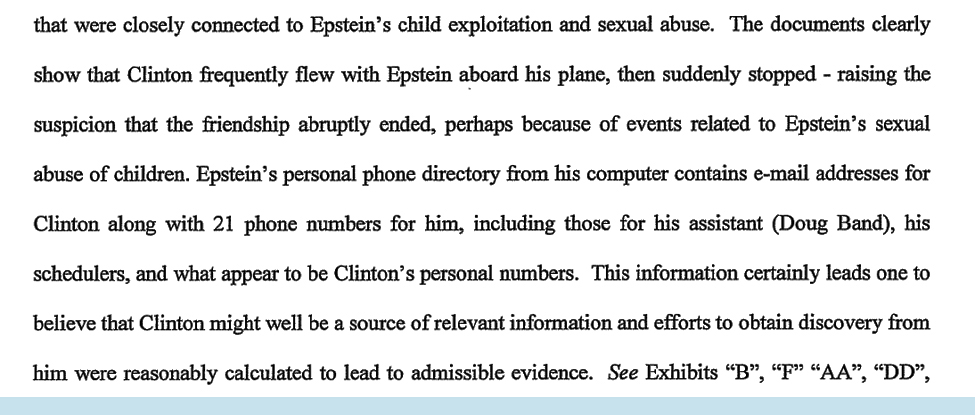
The scandal threatens to re-focus attention on the Epstein case, which raises many important questions about the billionaire’s connections with the rich and powerful. It has since been revealed that Epstein had 21 different phone numbers for contacting his friend Bill Clinton, who,court records allege, “frequently flew” on Epstein’s private jet between 2002 and 2005. The American tabloid press is now reporting that the new claims have created problems for Clinton’s marriage, with Hillary allegedly visibly angry at Bill at a recent public appearance.

Nothing New

Allegations of pedophilia networks amongst the political and entertainment “elite” are of course nothing new. In recent years Britain has been rocked by revelations of repeated, serial sexual abuse of children by popular children’s television entertainers Jimmy Savile and Rolf Harris. These scandals have raised questions about institutional support for these activities at a number of levels, including the BBC, the political classes and even royal participation in the enabling and cover-up of the abuse.

Likewise in America, allegations of political pedophile rings date back decades, with the most notorious being the Franklin scandal in which Lawrence E. King Jr. was accused of running an elite child prostitution ring for Nebraska Republican Party members and high-ranking U.S. politicians. The story involves accusations that link the ring to CIA drug dealing, murder and cover up, including accusations of ritual abuse in the Bohemian Grove. The investigation was championed by former State Senator John De Camp and eventually brought before a grand jury in Douglas County but was eventually thrown out as a “carefully crafted hoax” and two of the alleged victims were themselves convicted of perjury after two other witnesses recanted their supporting testimony. Still, questions still surround the cover up of the case as documented in suppressed documentaries like Conspiracy of Silence.

Cover Ups

The question of whether the London Met will be adequate to the task of properly investigating Mann’s dossier is not an idle one. Just last year reports revealed that the Met had 260 crates of evidence documenting police corruption in the north-east corner of London alone. The evidence relates to Operation Tiberius, a 2002 investigation that concluded there was “endemic corruption” in the Metropolitan Police force and that organized crime networks had been able to infiltrate the Met “at will.” The report that issued from that investigation was 170 pages long, but only six heavily-redacted pages were provided to a parliamentary committee that had requested the information. Only a handful of the scores of then-serving officers and officials identified by the investigation were ever prosecuted.

In the Epstein case, as well, there are numerous questions surrounding the possibility of high-level cover up. In recent weeks it has emerged that Epstein struck a remarkable secret deal with the US Attorney’s Office that barred more than 500 pages of documents detailing negotiations of the deal and a staggering 13,000 documents from the investigation into Epstein’s activities that were shelved as a result of the bargain. Moreover, the victims were not told of the plea bargain until after it had been concluded. All of this resulted from the US Attorney Office’s pledge to avoid turning the case into a “media circus” and disclosing the names of people like Prince Andrew.

Clearing the Smoke, Smashing the Mirrors

As always with ongoing legal investigations, it is important to sort the credible from the incredible, the proven from the unproven, and the mere allegations from the actual findings of fact. Hoaxes, lies and moral panics have erupted in the past that have proven fraudulent in the long run.

So what are the credible sources in investigations like these? How can those with a monetary or other interest in slandering the rich and powerful be separated from those with credible claims of abuse? What bodies or institutions can be relied on to investigate claims of this nature, especially when they involve sitting politicians and others in the highest reaches of political or financial power?

These questions and others like them will be answered in an upcoming edition of The Corbett Report podcast. In the meantime, Corbett Report members are encouraged to sign in and leave their own thoughts on these issues, including sources for further reading on theses topics and discussion of why pedophilia accusations of high-ranking politicians continue to crop up, and what these claims might mean if they are indeed true.

Not a Corbett Report member? Sign up today.

Copyright © Fight for Your Faith