Does your faith need strengthening? Are you confused and wondering if Jesus Christ is really "The Way, the Truth, and the Life?" "Fight for Your Faith" is a blog filled with interesting and thought provoking articles to help you find the answers you are seeking. Jesus said, "Seek and ye shall find." In Jeremiah we read, "Ye shall seek Me, and find Me, when ye shall seek for Me with all your heart." These articles and videos will help you in your search for the Truth.

Wednesday, September 25, 2024

Pope Francis Says All Religions Lead to God; A Strong Bishop Corrects Him (2)

Posted by Daily Citizen Staff | Sep 16, 2024 | Culture


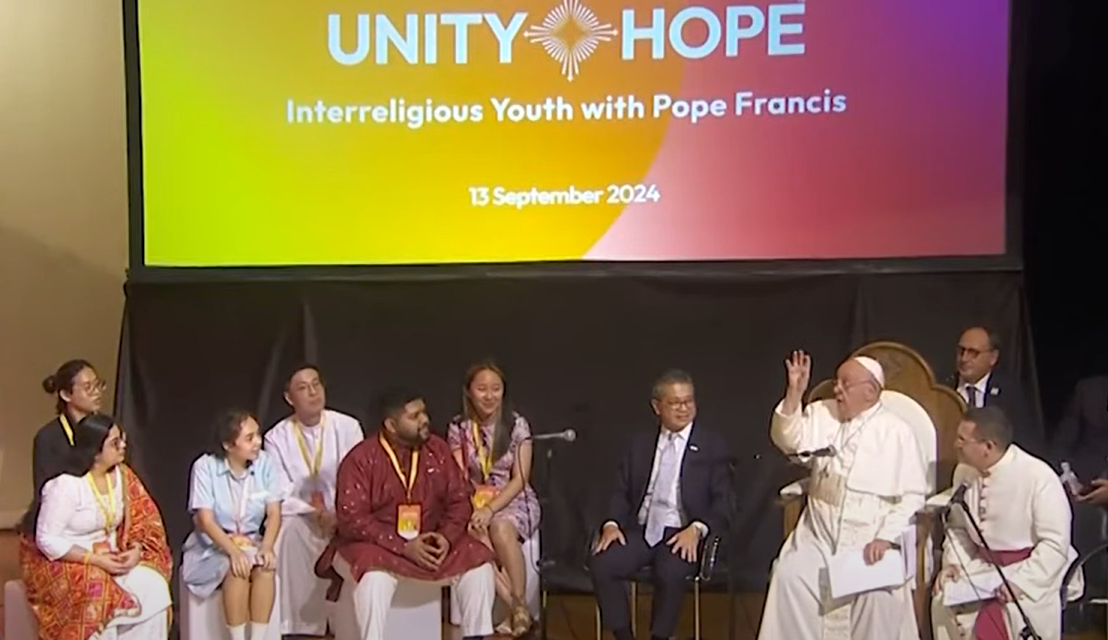
At an interreligious youth meeting in Singapore late last week, Pope Francis made some troubling statements about how people around the world can find God’s salvation.

Departing from his prepared remarks, Francis declared to the gathering that “every religion is a way to arrive at God.” He continued, “Sort of a comparison, an example, would be they’re sort of like different languages in order to arrive at God.”

The leader of the world’s 1.4 billion Catholics continued along this universalist tack: “But God is God for all. And if God is God for all, we are all sons and daughters of God.”

He lamented that some argue, “But my God is more important than your God!” and asked, “Is that true?”

Answering his own question to the young people, the pontiff finished,

There is only one God and each of us has a language, so to speak, in order to arrive at God. Sihk, Muslim, Hindu, Christian. There are different paths. Understand?

And the leaders on stage, representing various religions, happily shook their heads in agreement.

Crux, a Catholic news site, said of these statements from the Pope, “Such rhetoric has stirred controversy … among more conservative Catholics who fear that it calls into question Catholic doctrine on Christ as the lone savior of the world and also undercuts missionary efforts to bring people to the faith.”

They are not wrong.

When Pope Francis made similar statements at an interfaith meeting in Kazakhstan in 2022, Auxiliary Bishop Athanasius Schneider from that country warned such statements risk creating a “supermarket of religions” where people can shop for what suits them.

Of course, such teaching is in direct conflict with Jesus and the Gospel itself.

Jesus was unequivocal when He said, “I am the way, and the truth, and the life. No one comes to the Father except through me.” (John 14:6, ESV)

As C.S. Lewis famously pointed out, either this claim is true, or Jesus is a lunatic or a liar.

The Christian Church has always held, from earliest days, to the exclusivity of salvation in Christ alone.

When Jesus asked the twelve Apostles, “Do you want to go away as well?,” Peter himself, who Catholics believe was the first leader of the Church, responded,

Lord, to whom shall we go? You have the words of eternal life, and we have believed, and have come to know, that you are the Holy One of God. (John 6:68-69, ESV)

And it was this same Peter, speaking of Jesus before the Jerusalem Council in Acts 4, who proclaimed, “And there is salvation in no one else, for there is no other name under heaven given among men by which we must be saved.” (Acts 4:12 ESV)

In First Things, archbishop emeritus Charles J. Chaput, a good friend of Focus on the Family, correctly said of the pontiff’s comments last week.

Pope Francis has the habit, by now well established, of saying things that leave listeners confused and hoping he meant something other than what he actually said.

Chaput adds, “That all religions have equal weight is an extraordinarily flawed idea for the Successor of Peter to appear to support.”

He continues,

As St. Paul preached two thousand years ago, the search for God can take many imperfect forms, but they are each an imperfect search for the one, true, triune God of Sacred Scripture. Paul condemns false religions and preaches Jesus Christ as the reality and fulfillment of the unknown God whom the Greeks worship (Acts 17:22–31).

All Christians must appreciate the clarity with which Archbishop Chaput explains,

We are called Christians because we believe Jesus Christ is God, the second person of the Trinity. From the beginning of our faith, followers of Christ were unique among world religions because they accepted as true Christ’s extraordinary claim that he is God—in part because of his miracles, in part because of his preaching, but ultimately because of his death and bodily resurrection. Christians have also always believed that this reality makes Christianity categorically distinct from all other religions, and in turn requires a total commitment of our lives.

This captures the universal truth of Christianity, the foundation of the Gospel itself. Our Lord alone has the words of eternal life, to whom else shall we go?

Every leader of Christ’s Church must be crystal clear about this fact.

Any who are not, undercut their own calling, contradict the claims of Jesus Himself, and diminish the martyrdom of untold waves of saints through the ages who have given their lives for the sake of our Lord’s matchless Gospel.

Pope Says: “All Religions Are A Path To God” Others Move To Correct Him (1)


by  | Sat, Sep 21 2024

During his recent visit to Singapore, Pope Francis declared that “all religions are a path to God,” sparking a backlash among Christian leaders and believers around the world. Departing from his prepared remarks, Francis, who’ll turn 88 in December, spoke off the cuff, stating that different religions are like “different languages” to reach God.

“If you start to fight: My religion is more important than yours, mine is true and yours isn’t. Where will that lead us?” he asked, according to Catholic news outlet Crux. “There’s only one God, and each of us has a language to arrive at God. Some are Sikh, Muslim, Hindu, Christian, and they are different paths [to God],” he added.

US Christian commentator Billy Hallowell wrote in The Washington Times: “The pontiff tossed petrol on the proverbial flames of concern when he went off-script, delivering a head-scratching monologue seen by some as undermining the Christian Gospel.”

Reacting to the Pope’s comments, Bishop Joseph Strickland, who oversaw the Roman Catholic Diocese of Tyler, Texas, until his dismissal by the Vatican last year, said in a social media post: “Please pray for Pope Francis to clearly state that Jesus Christ is the only Way. To deny this is to deny Him. If we deny Christ, He will deny us, He cannot deny Himself.”

Bishop Strickland was ousted for disagreeing with Francis on the issue of banning pro-abortion Catholic politicians from receiving communion and over the degree to which outreach to the LGBT community is acceptable in the Catholic Church. A petition created in defence of the bishop last year said he was ousted because he “publicly corrected several heterodox statements from Pope Francis.”

Greg Laurie, pastor of Harvest Christian Fellowship in Riverside, California, also took take aim at the Pontiff’s message by quoting: “I am the Way, the Truth and the Life. No man comes to the Father except by Me” (John 14:6).

Outspoken former Anglican and current Old Catholic priest Father Calvin Robinson who has just moved from the UK to the US to take over an Episcopal parish in Michigan, also quoted that verse, adding: “This is a counter-scriptural statement from Pope Francis. The Scriptures teach us the opposite. The gate [to Heaven] is narrow.”

Billy Hallowell wrote: “These concerns from Mr. Strickland, Mr. Laurie and many others aren’t simply minor, dismissable complaints. They’re essential calls to correct a grave spiritual malfeasance and inaccuracy perpetuated by one of the world’s most well-known religious leaders.”

“One of the strongest presentations of this reality is seen in John 3 when Jesus speaks with a Pharisee named Nicodemus. During the exchange, Christ explains that: No one can see the kingdom of God unless they are born again. From there, Christ explains that the Son of Man must be lifted up, that everyone who believes may have eternal life in Him.”

“Thus, it’s impossible to act as though different religions are merely divergent “languages” that all lead to the same God. The entirety of the Biblical message is one of transformation — the need to accept Jesus and allow God to transform our hearts and lives. Christ makes it painstakingly clear that a person can truly access the Lord only through Him,” the Christian commentator continued.

“This is why, via the so-called Great Commission, He implores his disciples to: Go and make disciples of all nations, baptising them in the name of the Father and of the Son and of the Holy Spirit, and teaching them to obey everything I have commanded you (Matthew 28:19-20, NIV).

“Jesus didn’t say: Go out and point people toward any random religion or philosophy, nor did he offer any prompt that affirms: All religions are paths to God. The Pope’s claims simply do not stand up to the Bible’s historical and theological narrative — and even an atheist understands this reality.”

“It’s possible Pope Francis misspoke, is being taken out of context due to translation, or wishes to further clarify his remarks. Considering the gravity of what he’s saying — and especially in light of his position in global Christendom — he owes believers everywhere an immediate and expansive explanation,” Billy Hallowell concluded.

Friday, June 28, 2024

Fmr Vatican Amb Calls Pope Francis A ‘SERVANT OF SATAN'

Dennis Edwards: Love the sinner, not the sin. All have sinned and fall short of the glory of God. The Pope's comments have often led to confusion in the Catholic community. "What is he really saying?" The way the Pope has gone after his critic, various Bishops and Archbishops who he has denoted, has shown his true colors. The Vatican is in the hands of the Jesuits whom Fr. Malachi Martin warned would use the power of the Church to help bring on the One World Government under the Antichrist. The Pope has locked hands with some of the Global agenda of the World Economic Forum and obligated everyone in the Vatican to get the jab. Those are surely indications of whose side he is on. 

Tuesday, August 2, 2016

'Download a Good Heart’, Pope Tells Young as Polish Visit Ends

Reuters, July 31, 2016

KRAKOW, Poland–Pope Francis wrapped up his Polish visit on Sunday with a huge outdoor Mass where he told young people to look beyond the instant gratification afforded by technology, and instead to try to change the world.

Hundreds of thousands of young people, many of whom camped out for the night, waved national flags and cheered as Francis arrived to say the Mass in a large field on the outskirts of Krakow at the end of his five-day trip to Poland where he presided at the Catholic Church’s World Youth Day festivities.

Francis, 79, who has said he is a “disaster” with technology, sprinkled his sermon at the last major event of the trip with social media and technology terms.

He urged the young people to “‘download’ the best ‘link’ of all, that of a heart which sees and transmits goodness without growing weary.”

He said their response to the challenges of life cannot be “texting a few words,” that prayer should be given pride of place over their internet “chats”, and that God’s memory was not a “hard disk” filled with files on everyone, but more of a compassionate heart that wants to help them “erase” evil.

Francis encouraged them to continue “to be dreamers (who) believe in a new humanity, one that rejects hatred between peoples, one that refuses to see borders as barriers”.

Monday, June 27, 2016

In Armenia Visit, Pope Aims For Reconciliation In A Tense Region

Sylvia Poggioli, NPR, June 24, 2016

Pope Francis begins a visit to Armenia on Friday, one of the “peripheries” of the world that are dear to him. He arrived in the capital, Yerevan, on Friday afternoon, and will spend three days in the small country whose geography made it a land of conquest by powerful empires and whose people have greatly suffered for their Christian religion.

The visit will highlight the strong ecumenical ties between the majority Orthodox and smaller Catholic Christian communities, as well as promote reconciliation in a tense region that straddles Europe, the Middle East and Russia.

In his native Argentina, Francis developed close ties with the Armenian community, whose members had fled persecution and massacres.

Last year, Francis marked the centenary of the Ottoman slaughter of Armenians in a solemn ceremony, in which the mournful sounds of the Armenian liturgy echoed through St. Peter’s Basilica. Concealing or denying evil, said the pope, is like allowing a wound to keep bleeding without bandaging it.

“The first genocide of the 20th century,” he said in his homily, “was against you, the Armenian people.”

Those words infuriated Turkey, which accused the pope of spreading hatred, and Ankara recalled its ambassador to the Holy See for a full 10 months.

Historians widely agree that up to 1.5 million Armenians were killed, but Turkey vehemently rejects the accusation of genocide, claiming the number of dead was smaller and that they were victims of civil strife.

The landlocked country in the Caucasus adopted Christianity in the year 301, 12 years before the emperor Constantine legalized it in the Roman Empire.

The Apostolic Armenian Church is part of the oriental Orthodox churches and is seen the custodian of Armenian national identity.

For most of the last century, Armenia was under Soviet rule, suffering religious repression. Today, with the exception of Georgia, Armenia is surrounded by Muslim countries. It shares borders with Turkey, Iran and Azerbaijan, with which it has a long-simmering conflict over the Armenian enclave of Nagorno Karabakh.

Armenia has a population of 3 million, and a diaspora of some 7 million across the world.

During his visit, Francis will also meet Syrian refugees and is expected to speak out again on the modern-day slaughter of Christians and other minorities by Islamist extremists. The pope will also visit a monastery in the foothills of Mount Ararat, which, according to the Bible, is where Noah’s Ark came to rest.

There, near the Turkish border, he will release a flock of doves as a sign of peace and reconciliation in the region.

Massimo Faggioli, a professor of Catholic Church history, says that in visiting Armenia, Pope Francis is also sending a specific message to a geopolitically strategic region–that “religion should not be part of a global, colonial enterprise.”

Faggioli says the pope is very critical of the way both Russia and Turkey mix nationalism with their respective religions, the Orthodox Church and Islam.

“Armenia is in the middle, geographically and historically, between Turkey and Russia,” he says. “So going there, Pope Francis is more or less poking a finger into the eye of the most important nationalist actors in the area.”

The pope is likely to spark further tensions with Turkey when he visits the genocide memorial in Yerevan on Saturday. But in a possible sign of diplomatic compromise in a briefing ahead of the papal trip, the Vatican spokesman declined to use the word “genocide”–preferring the Armenian term Medz Yeghern, which means “the great crime” or “the great evil.”

Monday, November 9, 2015

Pope: It’s sad to see priests, bishops ‘attached to money’

Associated Press, November 6, 2015

VATICAN CITY–Pope Francis says it is “sad” when bishops and priests are “attached to money” and to advancing their careers, in his first public comments following the latest leaked revelations of greedy Vatican prelates resisting his efforts to reform Holy See finances and administration.

With sad eyes, Francis made the impromptu remarks during his homily Friday, apparently inspired by revelations in two new books of leaked documents and conversations.

Francis said: “Even in the church there are these people, who, instead of serving, of thinking of others. … use the church. They are the career-climbers, those attached to money.”

Looking somber, he added: “How many priests, bishops we have seen like this. It’s sad to say it, no?”

Tuesday, October 27, 2015

Pope rebukes Catholic elders at closing of synod on family

By Anthony Faiola, Washington Post, October 25, 2015

VATICAN CITY–Pope Francis on Sunday delivered an extraordinary rebuke to church elders at the closing of a landmark summit on the family here, suggesting they had been too dogmatic and quick to exclude a broader array of people deserving of God’s grace.

In a Mass at St. Peter’s Basilica to mark the end of the three-week summit–known as a synod–Francis took aim at narrowness and false piety, focusing his homily on the biblical story of a blind man named Bartimaeus whom Jesus engages during a journey.

“None of the disciples stopped, as Jesus did,” Francis said in what a times sounded like a scolding tone.

He continued, “if Bartimaeus was blind, they were deaf. His problem was not their problem. This can be a danger for us. In the face of constant problems, it is better to move on, instead of letting ourselves be bothered. In this way, just like the disciples, we are with Jesus but we do not think like him.”

“We can speak about him, work for him, but still live far from his heart which is focused on those who are wounded,” the pontiff said. “This is the temptation of the spirituality of mirage.”

He added, “A faith that does not know how to grow roots into the lives of people stays barren. And instead of an oasis, it creates more deserts.”

Francis’s blunt message came after divided clerics at the synod summit echoed the more inclusive tone of Francis on Saturday, extending a more welcoming hand to divorced and unmarried couples but stopping short of calling for clear alterations in church policies. The synod marked the culmination of a two-year process to recalibrate the faith’s approach to families in the 21st century. Under Francis’s direction, bishops and cardinals set a new precedent by tackling issues once considered taboo in the Roman Catholic Church.

Yet the significant opposition in the synod to rapid changes in rules also suggested how far off Catholics may yet be from seeing Francis’s revolutionary style turned into practice.

The document, in some respects, went further than some thought possible earlier in the week. But even top clerics conceded that liberal Catholics with high expectations of change under Francis might still come away disappointed.

“We have to be always cautious that there aren’t false expectations,” said Cardinal Donald Wuerl, the archbishop of Washington. “One false expectation is that Catholic teachings would be changed. That is not going to happen.”

While a bellwether of the hierarchy’s thinking from its most heated gathering since the reforming Second Vatican Council in the 1960s, the synod’s final communique amounts only to a list of recommendations for Francis. Rather than overhaul church doctrine–or the fundamental truths and teachings of the church–the question largely facing Francis is whether to alter procedures and empower bishops and priests to make more independent decisions on the ground.

In perhaps the most significant pronouncement, clerics sought to find more ways for divorced Catholics to participate in church life. Yet, to assuage the concerns of conservatives, the question of whether a door should be opened for divorced and remarried Catholics–who the church teaches are living in a state of adultery–to take communion at Mass was left vague.

Liberals argued that the language paved the way for Francis to endorse such a shift, while conservatives took heart that it does not explicitly call for one. Such a change, however, would reflect a practice already happening, as some parish priests have decided to offer communion to such couples despite church policy.

Inclusion of the clause came after a breakthrough among the German cardinals. Cardinal Walter Kasper, a liberal lion with the pope’s ear who championed a path to communion for such couples through penance, came to terms on language with Cardinal Gerhard Mueller, an archconservative. The result was wording that could be broadly interpreted without directly mentioning the right to return to communion.

In a speech after receiving a list of 94 recommendations from the synod of bishops and cardinals, Francis acknowledged the rifts among clerics, noting that differences of opinion were freely expressed and “at times, unfortunately, not in entirely well-meaning ways.”

He noted the task ahead as he seeks to find a Solomonesque way to bridge those differences, particularly given the cultural gulfs among the world’s more than 1 billion Catholics. They include those living in the most liberal parishes of Western Europe and the United States as well as far more conservative ones, often based in parts of the developing world where the Catholic Church is growing most.

“We have seen that what is normal for a bishop on one continent is considered strange and almost scandalous for a bishop on another,” Francis said.

Yet the ambiguity of the synod also puts Francis in a highly difficult position. If he fails to change the status quo enough, he risks disappointing liberal Catholics–as well as many non-Catholics–who have heralded him as an agent of change.

But going too far beyond the synod’s recommendations could alienate many in his divided hierarchy, triggering an even stronger backlash among conservatives, some of whom are openly questioning the direction of his papacy.

The synod on family issues marked the Vatican’s second in two years, with a meeting last year touching off the debates on divorce and homosexuality. Unlike last year, when several controversial clauses failed to garner a required two-thirds majority, all the recommendations made this time reached that bar. But some said that was partly because of an attempt to make the language more palatable and ambiguous. Signaling the intensity of the debate, there were more than 1,300 amendments proposed by the more than 260 delegates.

Some conservative bishops argued that the synod was being hijacked by liberals overwhelmingly focused on “Western” or “Eurocentric” issues.

Bishop Joseph Anthony Zziwa, a conservative Ugandan bishop, said there had been far too much talk about homosexuality, which is criminalized in his country, as well as divorce. Bishops even disagreed initially on the definition of a family–which in Africa, he said, often means extended families, compared with nuclear ones in Europe and the United States.

Africans more generally, he said, had far bigger problems.

“You keep asking someone from Nigeria to tell me about homosexuality, to tell me about divorce, when five of his children have been abducted by Boko Haram? You think that person has time to talk about that?” he said.

Monday, October 12, 2015

Is Your Conscience in Good State?

By Dennis Edwards:

Paul admonishes Timothy: 

"that in the latter times some shall depart from the faith, giving heed to seducing spirits, and doctrines of devils; speaking lies in hypocrisy; having their conscience seared with a hot iron."[1]

The television and movies have seared our minds with violence, sex without commitment or love, vulgar language, same-sex marriages, evolution and millions of years, and any anti-God opinions so that we cannot even think properly any more.

We are afraid to take a stand for God and the truth. There is no truth they teach us. It's all relative. Well, it's not relative when you’re going down a busy street and the light is green or red. It could be a life and death call, if you think it's only relative. There are absolutes. If there weren't the universe and life could not function. Society could not function. Our rejection of the absolutes leads to spiritual darkness. Like Nietzsche said in his famous story "The Madman."

"Whither is God?" he cried; "I will tell you. We have killed him- you and I. All of us are his murderers. But how did we do this? How could we drink up the sea? Who gave us the sponge to wipe away the entire horizon? What were we doing when we unchained this earth from its sun? Whither is it moving now? Away from all suns? Are we not plunging continually? Backward, sideward, forward, in all directions? Is there still any up or down? Do we not feel the breath of empty space? Has it not become colder? Is not night continually closing in on us?"

Nietzsche seems to have known that the rejection of God would plummet mankind into an endless abyss of hopelessness. Jesus said the love of many would wax cold as a result of the increase in iniquity in the last days.[2]

"Has it not become colder?"

It certainly seems like in our lifetime that it’s become a bit colder even with all the talk of global warming!

"Is not night continually closing in on us?"

We have chosen darkness rather than light, because our deeds are evil.[3] We have rejected the love and light of God. We have killed Him and have embraced the darkness. That darkness that promised us liberty, the agenda of television and in the movies, was itself the servant of corruption and now we are in bondage to it.[4] We cannot escape.

But there is an escape. God has made a way of escape. Turn around and call out to the Father in Jesus' name and He will hear you. He that confesses and forsakes the way of darkness shall have mercy[5]. Jesus said,

"I am the light of the world: he that follows me shall not walk in darkness, but shall have the light of life."[6]

Are you seeking the truth? Then come to the light, the light of Christ, the true light and He will set you free![7] As Jesus said,

“If ye continue in my words, then are ye my disciples indeed; and ye shall know the truth, and the truth shall make you free.”[8]

Pope Francis, coming from his Jesuit roots, does well in talking about the conscience and the battle that takes place there. The battle is in our minds. Ignatius of Loyola the founder of the Jesuits had made his mental/spiritual disciplines mandatory for all new coming Jesuit disciples. Each one needed to learn to analyze his thoughts in relation to the Word of God, so that he could learn to be totally submitted to God in both thought and action.

Jesus said the first and great commandment was,

"Thou shall love the Lord thy God with all thy heart, and with all thy soul, and with all thy mind."[9]

In Ignatius’ point of view, the Biblical point of view, mankind was living in a spiritual battlefield between the good forces of God and the evil forces of the Devil. These forces were fighting for the heart, soul and mind of mankind. That’s why Paul admonishes us,

“To cast down imaginations and every high thing that exalts itself against the knowledge of God, and bring into captivity every thought to the obedience of Christ.”[10]

Jude warns us to,

“earnestly contend for the faith which was once delivered unto the saints.”[11]

Peter similarly says the same thing,

“But sanctify the Lord in your hearts:” in other words, love the Lord with all your heart, soul and mind; “and be ready always to give and answer to every man that asks you a reason of the hope that is in you with meekness and fear.”[12]

How can we give an answer if we do not even know, nor study God’s Word?

I am happy to hear the Pope talk on the subject of conscience. But let us please reinforce our conscience by reading and studying God’s Word and not just stuffing our heads with the philosophy of

“vain deceit, after the tradition of men, after the rudiments of the world, and not after Christ.”[13]

Footnotes

[1] 1 Timothy 4:2
[2] Matthew 24:12
[3] John 3:19
[4] 2 Peter 2:19
[5] Proverbs 28:13
[6] John 8:12
[7] John 1:9
[8] John 8:31-32
[9] Matthew 22:37
[10] 2 Corinthians 10:5
[11] Jude 1:3
[12] 1 Peter 3:15.
[13] Colossians 2:8

Pope Francis: ‘When the devil numbs your conscience, he has won’

By Thomas D. Williams, Breitbart, 9 Oct 2015

Pope Francis returned to one of his favorite topics Friday morning, telling his hearers that the devil seeks above all to become master of their consciences, so they no longer can tell right from wrong.

The Gospel reading at Mass spoke of Jesus casting out devils, and the Pharisees accusing him of driving out demons by the power of the Beelzebul, the prince of demons. It also spoke of a devil returning after being cast out, bringing other demons with it and setting up shop in the house where it had been before.

In his homily in the chapel at the Saint Martha residence, the Pope said that in the spiritual life “temptations always return, the evil spirit never gets tired.” If he has been kicked out once, he is patient, waiting to return, and “If you let him in, you fall into a worse situation.”

In fact, Francis said, in the gospel story, at first it was clear that it was the devil who was causing problems. But afterward, “The evil one conceals himself, and comes with his very polite friends, knocking at the door, asking permission, but then moves in and spends time with the man and, little by little, starts giving the orders.”

With his “good manners,” Francis said, the devil makes the man fall into moral relativism, calming his conscience.

We start saying things like “This happens everywhere” and “We are all sinners,” Francis said. Yet “When we say everybody, we mean nobody,” he said. “And so we live this worldliness that is the child of the evil spirit.”

“Calming the conscience, numbing the conscience, this is a great evil,” he said.

“When the devil manages to numb your conscience he has won a real victory,” Francis said, because “he has become the master of your conscience.”

The Pope said that the key to combatting the devil is discernment and vigilance. We need to be able to discern situations, he said, to see what comes from God and what comes from the devil who “always tries to deceive” and to “make us choose the wrong path.”

The Christian cannot just accept anything, but must “discern and look well to see where things come from, and what their root is,” he said.

Francis said that the Church “always encourages us to examine our conscience: What happened in my heart today, why? Did this well-mannered devil visit me today with his friends?”

“Where do these comments, these words, these teachings come from, who says this? Discern and keep watch, so as not to let in the one who deceives, seduces and fascinates,” he said.

“We ask the Lord for this grace,” he said.

Wednesday, September 23, 2015

Whoopi Goldberg Says There’s “Nothing in the Bible About Abortion!”

From: Link

The hosts of The View on Tuesday ranted about Catholicism, the Pope and his visit to America. Whoopi Goldberg, offering her thoughts on the faith, complained about Pope Francis discussing abortion: “Well, there’s nothing in the Book that says anything about abortion. Let’s make sure of that. The Ten Commandments are the Ten Commandments. There’s only ten.”

One might argue she forgot the Sixth Commandment: “Thou shall not kill.” Apparently, starring as a nun in Sister Act made Goldberg an expert. The entertainer attempted to explain why some conservatives have issues with the current Pope: “The objection to him, if I may, is that people feel, or some of the staunch Catholics feel that he’s too loose….If you’re gay, God hates you. They want to keep that going.”

Speaking of Pope Francis, Joy Behar sneered, “No matter how compassionate he is, he still follows the rules of the church, anti-choice, anti-birth control, anti-divorce. Women can’t be in the priesthood.”

Follow LifeNews.com on Instragam for pro-life pictures and the latest pro-life news.

It was left to new host — and practicing Christian —- Paula Faris to say of Francis: “He’s still standing by his values because he doesn’t think those change. They don’t change with the wind, like the culture does. He’s doing it with compassion.”

As to Goldberg’s claim about the Bible, there’s also Job 31:15: “Did not he that made me in the womb make him? and did not one fashion us in the womb?” and Jeremiah 1:5: “Before I formed you in the womb I knew you.”

A partial transcript of the September 22 View segment is below:

[Discussing Pope Francis.]

JOY BEHAR: What is the objection to him?

WHOOPI GOLDBERG: The objection to him, if I may, is that people feel, or some of the staunch Catholics feel that he’s too loose. They want to keep it — if you’re a divorced person you can’t get any sacraments. If you’re gay, God hates you. They want to keep that going and I think his feeling is, like, “You’re missing the point. We are a religion that is supposed to be about forgiveness and understanding. If we’re always pointing the figurer and say you don’t matter and you don’t matter, you don’t matter, petty soon won’t nobody matter.

BEHAR: So, when they insinuate religion —

PAULA FARIS: But I still think— I think the overarching word and one word to describe this Pope is compassionate. He still stands about his convictions. He still says the Bible is the same yesterday, today and forever. It does not change and most Christians believe that. The culture can change, our belief system can change. But the one thing that doesn’t change is the word of God. But the way you approach it with Christianity is compassion. And they’ll know your Christians by your love for one another.


BEHAR: No matter how compassionate he is, he still follows the rules of the church, anti-choice, anti-birth control, anti-divorce. Women can’t be in the priesthood.


FARIS: Joy, I want to come back. You said he’s still pro-life and you listed a couple of other things. But don’t you think what makes him so unique? He’s still standing by his values because he doesn’t think those change. They don’t change with the wind like the culture does. He’s doing it with compassion.

GOLDBERG: Well, there’s nothing in the Book that says anything about abortion. Let’s make sure of that. The Ten Commandments are the Ten Commandments. There’s only ten. Only ten.

Wednesday, June 24, 2015

Pope Asks Pardon From Waldensian Protestants for Past Persecution

Reuters, June 22, 2015

TURIN, Italy–Pope Francis asked forgiveness on Monday for the Roman Catholic Church’s “non-Christian and inhumane” treatment in the past of the Waldensians, a tiny Protestant movement the Vatican tried to exterminate in the 15th century.

Francis made his plea during the first ever visit by a pope to a Waldensian temple on the second day of a trip to Italy’s northern Piedmont region, the center of the Waldensian Church, which has only about 30,000 followers worldwide.

While the movement is miniscule compared to the 1.2 billion member Roman Catholic Church, the gesture is part of Francis’ drive to promote Christian unity and it has taken on added significance ahead of the 500th anniversary of the Protestant Reformation in 2017.

“On behalf of the Catholic Church, I ask forgiveness for the un-Christian and even inhumane positions and actions taken against you historically,” he said. “In the name of the Lord Jesus Christ, forgive us!”

The Waldensians, who now live mostly in Italy and Latin America, were founded by Peter Waldo in France in the late 12th century. He gave up his wealth and preached poverty but as the movement grew it came into increasing theological conflict with the papacy.

The movement, an early precursor of the Protestant Reformation in the 16th century, was branded as heretical and in 1487 Pope Innocent VIII ordered its extermination.

Some 1,700 Waldensians were killed in 1655 by Catholic forces commanded by the Duke of Savoy.

Today the Waldensians are part of the World Communion of Reformed Churches and the World Council of Churches. They have only two sacraments–baptism and the Lord’s Supper–as opposed to seven in the Roman Catholic Church, a member of the Italian branch said.

Thursday, January 15, 2015

Pope: I quote the Gospel, they call me a Communist

By Inés San Martín, Crux, January 11, 2015

ROME—Pope Francis is legendary for his passion for the poor, but in a new interview he insists he’s not driven by a Communist-inspired ideology, but by the cornerstones of the Christian faith and the Gospel.

“Caring for our neighbor, for those who are poor, who suffer in body and soul, for those who are in need: this is the touchstone,” the pontiff said.

“Is it pauperism?” he asked, referring to a system of dependence on charitable handouts. “No. It is the Gospel.”

The comments came in an interview with Italian Vatican writers Andrea Tornielli and Giacomo Galeazi for a yet-to-be published book titled “This Economy Kills.” Excerpts were released on Sunday by the Italian newspaper La Stampa.

In the interview, Francis says his economic rhetoric echoes teaching by Church fathers throughout Christian history, citing St. John Chrysostom, St. Francis of Assisi, and a famous line from the Gospel of Matthew: “I was hungry, I was thirsty, I was in prison, I was sick, I was naked, and you helped me, clothed me, visited me, took care of me.”

According to the pontiff, concern for the poor is “not an invention of Communism” but he warned that “it mustn’t be turned into some ideology, as has sometimes happened before in the course of history.”

Once famously blasted by American pundit Rush Limbaugh for advocating “pure Marxism,” Francis complained that he can’t quote the teachings of Church fathers from the first centuries without being accused of giving a Marxist homily.

The pontiff was critical of globalization, saying it’s a system perpetuated by a “throw-away culture” and that, even though global wellness has grown in absolute terms, “so has social disparity and new kinds of poverty have developed.”

“When at the core of the system we don’t have men but money, when money becomes an idol, men and women become nothing more than instruments of a social system dominated by profound unbalances,” he said.

Francis said that the global need to find a solution for poverty is something that can no longer be put on hold, and that without a solution, the other problems of the world won’t be solved, either.

The pope called for a more ethical economic system and more ethics in politics, saying that many of the world politicians who visit him at the Vatican are looking for ethical suggestions from him and other religious leaders.

Friday, November 14, 2014

The Pope on Evolution

http://creation.com/francis?utm_media
by Lita Cosner
Published: 1 November 2014
wikipedia.org

Pope Francis in August 2014

Roman Catholics consider Pope Francis (Jorge Mario Bergoglio, b. 1936) to be the successor to the Apostle Peter, and therefore having authority over Christians worldwide. Protestant creationists today have another reason to be glad that we reject this error.

The Vatican quotes1 Pope Francis:
When we read in Genesis the account of Creation, we risk imagining God as a magus, with a magic wand able to make everything. But that is not so. He created beings and allowed them to develop according to the internal laws that He gave to each one, so that they were able to develop and arrive at their fullness of being. … And so creation continued for centuries and centuries, millennia and millennia, until it became which we know today, precisely because God is not a demiurge or conjurer, but the Creator who gives being to all things. The beginning of the world is not the work of chaos that owes its origin to another, but derives directly from a supreme Origin that creates out of love. The Big Bang, which nowadays is posited as the origin of the world, does not contradict the divine act of creating, but rather requires it. The evolution of nature does not contrast with the notion of Creation, as evolution presupposes the creation of beings that evolve.2
In Peter’s proclamation, we see first of all a complete acceptance of the biblical history of the world.

While his comments were certainly more moderate than other translations of his statement in the press, he clearly accepts evolution and the billions-of-years timescale. This should not be surprising, since the Catholic church has accepted evolution for about 50 years now.

We have noted the theological problems of theistic evolution, or even allowing abillions-of-years timescale. Anyone who reads Scripture seriously can see that the Bible clearly teaches that God created over a period of six normal-length days around 6,000 years ago. Unfortunately for Catholics, their sole authority isn’t Scripture, but the Church, which is the only ‘infallible interpreter’ of Scripture according to their theology.
Peter vs his ‘successor’

When we look to Peter, the ‘first pope’, we see that his attitude toward the biblical account of origins is quite different:
“ … scoffers will come in the last days with scoffing, following their own sinful desires. They will say, ‘Where is the promise of his coming? For ever since the fathers fell asleep, all things are continuing as they were from the beginning of creation.’ For they deliberately overlook this fact, that the heavens existed long ago, and that the earth was formed out of water and through water by the word of God, and that by means of these the world that then existed was deluged with water and then perished. But by the same word the heavens and earth that now exist are stored up for fire, being kept until the day of judgment and the destruction of the ungodly”(2 Peter 3:3–7).

In Peter’s proclamation we see first of all a complete acceptance of the biblical history of the world. And Scripture is his starting point, not other ideas in the culture. Peter is countering what may be called a sort of ‘uniformitarian’ argument: we see things proceeding in the same way that it has for as long as anyone can remember. But Peter points us to Genesis to remind us that things haven’t always been like this, in fact, there are three great discontinuities in history:
Creation of the world from water by the Word of God. The world has not always existed, contrary to the popular philosophy of Peter’s day. Up until the 20th century, an eternally-existing world has been a theory that some scientists have tried to defend. Now they are forced to admit that the universe had a beginning, but thebig bang has several important differences from the biblical account which means that it could not have been the way that God created.
Destruction of the world with water by the decree of God. Peter accepted that there was a global Flood that killed everyone except the eight people on board the Ark (1 Peter 3:20). We know from creation geology models that a catastrophe of this scale would account for the geological layers containing all sorts of fossils (which is why it’s not surprising to us that it has evidence of carnivory, cancer, andthorns—because it’s a record of the post-Fall world). And if a year-long global catastrophe explains the majority of the fossil record, there is no room for millions of years of earth history.
The future destruction of the world with fire by the decree of God. The next great discontinuity in earth history will be the end of the present world. Extrapolating today’s processes, it is clear that the universe is headed towards ‘heat death’ several billion years in the future when the universe is in the state of maximum entropy. But Scripture points to a much sooner demise of the universe, not by natural processes, but with fervent heat which will melt the elements. This will pave the way for the New Heavens and Earth and theresurrection of the dead.

In contrast to Francis, Peter stands on the firm foundation of Scripture and is unafraid to flatly contradict the uniformitarians of his own day.

Was Peter a pope?

Catholics believe that Jesus made Peter the first pope when He said, “You are Peter, and on this rock I will build my church” (Matthew 16:18). The interpretation of this verse is actually important for Catholic theology.

He says, “You are Peter (Πέτρος, Petros), and on this rock (ταύτῃ τῇ πέτρᾳ, tautē tē petra) I will build my church.” ταύτῃ τῇ πέτρᾳ cannot refer to Simon Peter since it’s in the feminine gender; if it was referring to Peter, it would be in the masculine. Also, petros would have referred to a small rock, while petra would have referred to a huge immoveable rock—one suitable for a foundation stone. So Jesus is saying, “You are a small pebble, Simon, but on this boulder I am going to build my church!” So Peter is not the rock—his confession is, according to many Church Fathers—about half of whom spoke Greek as their native language. Many other Church Fathers thought that the rock was Jesus, and even those who thought that the Rock was Peter believed that it was a personal promise to him alone, not to any successors based in Rome.3

We also see that Peter was not treated with unusual deference by the apostles and early church. In Acts 11, the Jerusalem Church makes Peter defend his actions regarding fellowship with Gentiles. This was as it should be, since the apostles had previously sent Peter from Jerusalem (Acts 8:14). And when Peter justifies himself, he does not do so with an ex cathedra statement about the new inclusion of Gentiles, but by recounting Jesus’ instruction through the vision and the Holy Spirit falling on the Gentile converts, signaling divine approval. Then in another debate about what requirements should be placed on gentile Christians in Acts 15, the final decision is made by James, the leader of the Jerusalem church. Later, both Peter and James, as well as John, “seemed to be pillars” of the early Church (Galatians 2:9).

And in Galatians 2, Paul recounts a time when he opposed Peter because he was acting inconsistently with regard to fellowship with Gentiles. Surely if Peter were some sort of divinely ordained leader, an infallible intermediary, Paul would not have been able to do this! Also, Paul wrote an epistle to the Church of Rome, expecting this church to submit to his letter as Scripture, which contradicts the Catholic teaching that the Church is above the Bible.

Scripture itself teaches that Peter was an apostle, hand-picked by Jesus. But outside of his inspired letters, even Peter could err, and there is no hint of the idea that there were successors to Peter’s office (in fact, for a couple of decades, that would result in popes 2–4 having authority over the apostle John, who lived well into the ‘papacy’ of Clement!).
An unnecessary compromise

Perhaps the Pope wanted to gain some intellectual respectability with his pronouncements, but secularists have long noted that not only is evolution by definition a godless process, but a god who would use evolution is certainly not the God of Christianity. No secularist will be particularly impressed that Francis would acknowledge evolution; rather, they would wonder why Francis would cling to a belief in God in light of the ‘fact’ of evolution.
If we trust Scriptures accuracy and sufficiency, we will not be blown off course by every cultural and scientific fad.

In fact, Francis might have done more harm than good, because those who (wrongly) look to him as a spiritual authority might be discouraged by his compromise and lose trust in the Bible.

We would direct Francis to the example of Peter, and past leaders of the Church who strongly affirmed creation, even against competing origin theories. In fact, this includes people that the Catholic Church regards as ‘saints’ and even ‘doctors of the church’, a small prestigious subset of ‘saints’. If we trust Scripture’s accuracy and sufficiency, we will not be blown off course by every cultural and scientific fad. But most of all, we would point the Pope to Christ, the true vicar, and the true Head of the Church, who clearly believed in a literal Adam and Eve, and a recent creation.

Monday, September 8, 2014

Former Israeli President Shimon Peres: Pope Francis is only leader respected enough to end today’s wars

By Carol Glatz, Catholic News Service, Sept. 5, 2014

VATICAN CITY—Former Israeli President Shimon Peres asked Pope Francis to head a parallel United Nations called the “United Religions” to counter religious extremism in the world today.

“In the past, most wars were motivated by the idea of nationhood. Today, however, wars are incited above all using religion as an excuse,” Peres told the Catholic magazine, Famiglia Cristiana, ahead of the papal meeting Sept. 4.

Jesuit Father Federico Lombardi, Vatican spokesman, confirmed that Peres, who ended his presidential term in July, had requested the meeting and told the pope about his idea.

The pope, however, did not commit himself to the proposal.

“The pope listened” to the idea just as he always does with any peace initiative, “showing his interest, his attention and encouragement,” Father Lombardi said.

But “the pope made no personal commitment” and reminded Peres that the Vatican has the Pontifical Councils for Interreligious Dialogue and for Justice and Peace—two offices “that are suitable” for supporting or following such initiatives, Father Lombardi said.

Pope Francis also met later in the day with Jordan’s Prince El Hassan bin Talal, who, for the past four decades, has worked to promote interfaith understanding and dialogue around the world.

Father Lombardi said that, during the 30-minute meeting, the prince talked about the latest activities and “pressing issues” of the various initiatives supported by his Royal Institute for Inter-Faith Studies.

Father Lombardi said the pope’s meeting with Peres lasted an unusually long 45 minutes, reflecting the pope’s “esteem and appreciation” for Peres, whom he earlier praised as a “man of peace.”

The main focus of their talk was Peres’ idea for a “United Religions” organization and did not touch on current “political issues in any depth” the Vatican spokesman said.

In an exclusive interview with Famiglia Cristiana, the 91-year-old former two-term prime minister of Israel said he wanted to establish an international body representing the world’s major religions, as a moral force able to intervene in conflicts.

Peres said Pope Francis would be the best person to head such a world body because “perhaps for the first time in history, the Holy Father is a leader who’s respected, not just by a lot of people, but also by different religions and their representatives.”

“In fact, perhaps he is the only leader who is truly respected” in the world, said Peres, who was jointly awarded the Nobel Peace prize in 1994 with Palestine Liberation Organization Chairman Yasser Arafat and Israeli Premier Yitzak Rabin.

Peres said the United Nations and its peacekeepers “do not have the force or the effectiveness of any one of the pope’s homilies, which can draw half a million people just in St. Peter’s Square alone.”

“So given that the United Nations has run its course, what we need is an organization of United Religions,” Peres said, as “the best way to counteract these terrorists who kill in the name of their faith.”

“What we need is an unquestionable moral authority who says out loud, ‘No. God doesn’t want this and doesn’t allow it,’” he said.

Prayer is also an important part of peacemaking, he said; people should not underestimate “the power of the human spirit.”

“We must not become cynical. The human being is much more than being made up of just flesh and blood,” he said.

Saturday, August 16, 2014

This Pope means business

By Shawn Tully, Fortune, August 14, 2014

The new pope wanted to talk about money. That was the message that went out to a group of seven prominent financiers—major Catholics all—from around the world in the summer of 2013. Barely five months after the shocking resignation of Pope Benedict XVI, Pope Francis had summoned them to assemble at the seat of holy power, the Vatican. They knew their general assignment: to create a plan to restructure the Vatican’s scandal-plagued finances. And like Catholics everywhere, they knew that Francis had already signaled that he was a new kind of pontiff, a “people’s pope” who championed charity and tolerance over dogma. Still, they didn’t know what to expect when they arrived at the Vatican for a meeting with the pope on the first Saturday in August. How interested was he in finance, really? And how serious was he about changing business as usual inside the Vatican?

A major hint came from a change in tradition upon their arrival: The visitors didn’t report to the Apostolic Palace, the Renaissance showplace where for centuries past popes had received visitors in high style. Instead they entered Vatican City on the other side of the colonnade of St. Peter’s Square and took a 150-yard stroll through the hilly enclave to the new pope’s place of business—Casa Santa Marta, a five-story limestone guesthouse that could be mistaken for a newish hotel. There they were ushered into a nondescript meeting room on the first floor with no paintings or religious ornaments and took their seats around a conference table. The members—including Jean-Baptiste de Franssu, ex-chief of asset-management giant Invesco in Europe; Jochen Messemer, a top executive at ERGO, a large German insurer; and George Yeo, former foreign minister of Singapore—chatted nervously as they waited.

After 15 minutes, Pope Francis entered the room—and got right down to business. Attired in a simple white cassock and plain metal cross, he took his place standing at the head of the table. With little preamble, he began outlining his strategic vision, in an approach described by one participant as “highly managerial.” Speaking in fluent Italian and taking frequent pauses while a translator repeated his words in English, the pope explained to the group that for his spiritual message to be credible, the Vatican’s finances must be credible as well. After centuries of secrecy and intrigue, it was time to open the books to the faithful. Strict rules and protocols must be adopted to end the cycle of scandals that had plagued the Vatican in recent years.

Francis declared that sound financial management was a pillar of his greatest mission: aiding the poor and underprivileged. That mission was endangered by volatile, unpredictable budgets that careened from modest surpluses to steep deficits. The Vatican’s inept practices had inhibited giving, he explained, and had to stop. “When the administration is fat, it’s unhealthy,” he said. Francis wanted a leaner, more efficient Vatican administration that would be solidly “self-sustaining.” That, he said, would free up more money for his charities. “You are the experts,” the pope said, “and I trust you. Now I want solutions to these problems, and I want them as soon as possible.” With that, Francis left the group to figure out the details.

As the spiritual shepherd of the world’s 1.2 billion Roman Catholics, Pope Francis, 77, has already done more in 18 months to energize the church and burnish its image than anyone has since the heyday of John Paul II in the mid-1980s. What’s far less appreciated is his intense engagement—and astounding success—in overhauling the Vatican’s finances and pushing the adoption of modern practices it had resisted for decades. “The changes are massive,” says René Brülhart, chief of the AIF, the Vatican equivalent of the Securities and Exchange Commission.

The past 15 years have been a time of turmoil and decline for the church. It has suffered blow after blow to its image, from the pedophilia scandals that have plagued it for over a decade to the recent “Vatileaks” affair, in which Pope Benedict’s butler smuggled letters to the press that warned the pontiff of corruption and cronyism in the Vatican. The church has often promoted issues that tended to divide Catholics more than unite them. And the backlash made Rome look defensive, as many bishops and cardinals viewed their role as defending Catholic doctrines against a hostile culture of secularism.

Before Francis’s arrival, attendance at mass was declining and the recruitment of priests and nuns had plateaued. The difficulties extended to fundraising.

By contrast, Francis’s upbeat, quotable approach and emphasis on charity over doctrine have quickly made him perhaps the most talked-about and admired person on the planet. Francis could be called the first modern pope. His Twitter account, @Pontifex, boasts 4.3 million followers in nine languages. And his message is universally appealing: The paramount duty of the church and its faithful is to aid those in need.

Although it’s too early to make a definitive judgment, the “Francis effect” appears to be reversing the church’s fortunes. Mass attendance is surging in Italy, for instance. The Jesuits, Francis’s religious order, are seeing more inquiries about priestly vocations. And donations are on the rise at dioceses around the world.

What has been less appreciated by outsiders until now is the pope’s elite managerial skill set. Like a great CEO, he has the ability to set a strategic vision, then choose and motivate the right people to make it work. His rapid overhaul of the Vatican’s finances is both one of the most unusual case studies in the annals of business and one of the more instructive.

Francis was elected with a mandate for reform. After Pope Benedict, on Feb. 28, 2013, became the first pontiff in six centuries to resign, the 115 cardinals who assembled to pick his successor held eight days of meetings, or “general congregations,” to discuss the priorities for the next pontiff. Benedict had been considered a brilliant theologian, but he was no manager. Cardinal after cardinal expressed outrage over reports of the overpriced, no-bid contracts handed to officials’ friends in Italy and the criticism of the Vatican bank’s disclosure policies by the Italian government. The feeling was that the next pope should be someone with the leadership skills to bring professional management to a clubby bureaucracy that was expert in blocking change.

As an outsider who had expressed contempt for the Vatican’s status as an insular “royal court,” Jorge Mario Cardinal Bergoglio, then archbishop of Buenos Aires and a native of Argentina, was the overwhelming choice. Pope Francis—the first pontiff to take the name of Saint Francis of Assisi, patron saint of the poor—came in with a plan. His central idea was revolutionary: Money matters are not a core competency of the clergy, as the record shows. So he began replacing the old guard of cardinals and bishops with lay experts who are now largely setting strategy, heading regulatory oversight, and running day-to-day operations.

Indeed, Francis has brought in some of the biggest brand names in the world of business. KPMG is implementing uniform, internationally accepted accounting standards to replace the Vatican’s previous crazy quilt of bookkeeping. EY (the former Ernst & Young) is scrutinizing management of the Vatican’s stores, utilities, and other municipal services. Deloitte & Touche now audits the accounts at the Vatican bank. And Spencer Stuart has recruited top management talent from around the globe. Heading the effort to restructure media operations, assisted by McKinsey & Co., is Lord Christopher Patten, a former head of the BBC and the last British governor of Hong Kong.

When Pope Francis puts a cardinal in charge of something, the choice is typically an outsider. His most important appointment so far, either lay or religious, is Cardinal George Pell, an Australian whom he recruited from the archdiocese of Sydney. Pell now heads the newly formed Secretariat for the Economy, and Pope Francis has granted Pell power over finances that no official has remotely held before. He’s responsible for setting and enforcing all budgets and managing all investments. The son of a heavyweight boxer, Pell, 73, is an imposing figure who is short on niceties and brutally frank about the necessity to radically pare costs.

Pope Francis has a complex but pragmatic view of money. “Money is useful to carry out many things, for works to support humanity,” he has said. “But when your heart is attached to it, it destroys you.” His humble lifestyle follows those precepts. He resides in a one-bedroom, second-floor suite in Casa Santa Marta overlooking the entrance. (Benedict, the former pope, lives nearby in a converted monastery called Mater Ecclesiae and occasionally sends Francis notes with feedback on his interviews.) Visitors say the pope’s lights go on at 4:30 a.m. He’s frequently spotted in the buffet line, tray in hand, at the Santa Marta dining room, where the cuisine isn’t fancy—it offers a choice of two main courses for lunch and dinner, and features Italian specialties such as pasta con pomodoro and pollo arrosto. He takes no holidays, explaining that if the poor can’t take vacations, why should he?

The pontiff does not talk about balance sheets and cash flow. He leaves the numbers to the experts. His forte is leadership. Like any good chief executive, he knows that the culture of an organization is established at the top. And he is always well prepared. “He has five or six sources of information on every subject,” says Austen Ivereigh, author of a forthcoming biography of Francis, The Great Reformer. “It’s impossible to hoodwink him.” By getting the views of many participants—both Vatican officials and lay advisers—in all of his reform initiatives, the pope quickly determines if his instructions are being implemented or blocked by the old guard. If he sees resistance from old-school directors, he’ll quickly make changes, as when he replaced the entire board of the AIF, the financial regulator.

One of his rules is that big donors and companies that do business with the church should get no special treatment. Before he took charge in Buenos Aires, the archdiocese was a large shareholder in Argentine banks, and the banks regularly granted their ecclesiastical investor loans on easy terms. As cardinal, Francis denounced the arrangement as a blatant conflict of interest and sold all the archdiocese’s bank holdings. He also refused to attend fundraising dinners, usually regarded as one of a cardinal’s top jobs. His aversion to catering to the wealthy didn’t stop with his ascension to the papacy. It’s a Vatican tradition that the Secretariat of State, which receives donations from the rich on the pontiff’s behalf, would reward big donors by arranging special audiences and masses with the pope. Pope Francis ended the practice.

Pope Francis is a strong believer in workers’ rights. But that view is highly nuanced. He has famously denounced the excesses of capitalism and firmly believes that the rich get too much from the market economy while regular workers often don’t receive enough. In contrast to his readiness to ax high-ranking officials who block his agenda, he doesn’t believe in firing rank-and-file employees. But he despises waste and inefficiency, and he thinks the Vatican can run better with fewer employees.

The catholic church is highly decentralized financially. In terms of money, the Vatican basically stands on its own. That’s a major reason its finances are far shakier and its wealth is much more modest than its image of sumptuous wealth. The church is divided into three branches: the Vatican, the religious orders, and the dioceses. Each maintains separate finances. In fact, the Vatican has no official claim on or access to the wealth of the two branches that it oversees. The members of the 296 religious orders and congregations are priests, nuns, and brothers who specialize in education (the Jesuits), missionary work (the Missionary Sisters of the Sacred Heart of Jesus), and helping the poor (Franciscans). Frequently, regional units within the orders control their own finances.

The dioceses are where the Catholic Church meets Main Street. The more than 2,800 dioceses, each headed by a bishop or an archbishop, supervise the networks of parishes from Lagos to Manila to Detroit where Catholics attend mass, get married, and send their children to the 95,000 elementary schools. Each diocese is a separate corporation with its own investments and budgets, including the metropolitan archdioceses. The dioceses do send substantial amounts of money to the Vatican each year, but most of it is earmarked for either missionary work or the pope’s charitable giving. The funds sent to support the Vatican’s operations are important but account for around 4.5% of total revenues.

Since the church contributes only modestly to funding its operations, the Vatican must generate substantial income on its own and supplement that income with a steady flow of donations from the faithful. The Vatican serves two functions. First, it is a fully sovereign, independent nation with its own laws, courts, stores, security force of gendarmes, and an “army” of 110 ceremonial Swiss guards. Cloistered behind 40-foot stone walls in the heart of Rome, the Vatican is the smallest nation on the planet. It occupies just 110 acres—or one-eighth the size of Manhattan’s Central Park—and is home to just 837 citizens. The Vatican has no legislature; the pope, the world’s last absolute monarch, can unilaterally announce new laws, create or eliminate departments, and hire and fire as he pleases. Any money the Vatican generates in excess of its expenses can be used at the discretion of its ruler, the pope.

The Vatican’s second and principal function is its role as the hierarchy of the church. The pope heads a large bureaucracy called the curia, which exercises a wide range of power and provides advice and assistance to the church at large. The curia’s most powerful bodies are nine congregations, each headed by a cardinal, that resemble the U.S. government’s cabinet departments. One congregation, for instance, appoints the world’s almost 3,000 bishops. Another does the detective work needed to name new saints.

Through the pope the Vatican establishes and enforces doctrine for all parts of the Catholic Church. But the other branches—the dioceses and religious orders—are financially independent. Each contributes money to the Vatican’s budget.

For financial purposes, the Vatican operates two quasi-independent entities, one for each of its two functions: operating as a nation and serving as the sprawling staff that supports the pope. The city state, or governorate, operates the Vatican’s commercial services. It resembles a medium-size municipal government. The city state has excellent sources of revenue. It garners about $130 million a year, and rising, from the thriving Vatican museums, home of Michelangelo’s Sistine Chapel. And each year tourists purchase around 2.2 million euro-denominated collector coins at its gift shops.

Last year the city state spent around $332 million and collected $377 million, for a “profit” of $45 million. It posts substantial surpluses most years. But that money usually isn’t available to fund the struggling part of the Vatican. The governorate frequently uses its excess cash to bolster the underfunded pension plan and needs to accumulate reserves to expand the museum and refurbish buildings.

The problem resides in the curia, officially known as the Holy See. The Holy See consists of many sections that spend heavily but offer little or no income. Vatican Radio, which broadcasts the pope’s readings and masses, as well as the Vatican’s news, has 330 employees and spends $37 million a year yet collects less than $1 million in advertising. Its deficit is so deep that the city state now covers half the shortfall. Operating the embassies, called apostolic nunciatures, in 113 nations runs over $30 million.

Almost two-thirds of the Holy See’s budget goes to paying salaries, benefits, and pensions for its 2,886 employees. (Including the city state, the Vatican has a workforce of 4,822.) The Vatican pays relatively low wages but offers generous health and retirement benefits. Cardinals and bishops at the congregations and councils often toil for as little as $46,000 a year, though their housing is heavily subsidized. The rank and file, including nuns and priests, are also paid below market, but make it up in benefits. The average salary for lower- to mid-level workers is around $28,000 a year. That’s about 25% less than the $37,800 average for Italian workers with similar private sector jobs. But keep in mind that Vatican employees pay no income taxes. Today around three-quarters of the Vatican’s employees are lay workers, vs. less than half 25 years ago. Vatican lay employees have jobs for life, and virtually no one leaves before retirement age.

For 2013 the Holy See posted revenues of $315 million and expenses of $348 million, for a $33 million deficit. Since 2007 the total shortfalls have totaled $56 million. Those figures actually understate the size of the Holy See’s financial problems. The current spending number is due to rise sharply for a pressing need: taming big pension liabilities. It’s a problem the Vatican shares with virtually every Western economy. The Vatican inaugurated a generous defined-benefit pension plan in the early 1960s but didn’t have an actual pension fund until three decades later.

The Vatican is often assumed to possess great wealth, but if it were a company, its revenue wouldn’t come close to making Fortune 500. Its total operating budget is about $700 million. in 2013 it posted a small overall surplus of $11.5 million. The Vatican’s most valuable assets—some of the world’s great art treasures—are virtually priceless and not for sale. A breakdown of major holdings:

Investments: Portfolio of stocks, bonds, and gold worth $920 million.

Real estate: Holdings have an estimated value of $1.35 billion, including some 2,000 apartments, mostly in Rome.

Vatican Bank: Book value of $972 million.

Art collection: Worth untold billions. The Vatican’s museum brings in $130 million a year in revenue. Treasures include the Sistine Chapel frescoes by Michelangelo (above); “Saint Jerome in the Wilderness,” a painting by Leonardo da Vinci; “Deposition From the Cross,” a painting by Caravaggio; a letter from Marie Antoinette en route to the guillotine; and the papal bull excommunicating Martin Luther.

The pope’s strategy for addressing both spending and pension issues is to gradually shrink the Vatican workforce through attrition and raise more money to maintain the benefits. In February of 2014 he imposed a hiring freeze and also stopped formerly generous overtime payments. The plan is to move existing employees from overstaffed congregations to growth areas, such as financial management, without replacing those who depart.

The Vatican’s pension plan guarantees retirees 80% of their final salaries after 40 years of service, and as noted, few employees leave before retirement. That’s a big premium over the “replacement rate” in Italy of around 72%. But Pope Francis is explicit about providing better pensions than those in Italy. The challenge is filling the huge shortfall in the pension fund. The Vatican is guaranteeing some 1,750 retirees—plus current workers who have paid into the fixed-benefit plan for years—big pensions for decades to come. Right now those future payments far exceed the amount the current fund can possibly generate in income.

According to a Vatican insider, the pension fund is short by “a few hundred million dollars.” The Vatican has been making minimal contributions to the fund for years, and employees kick in just 6% of their salaries. Cardinal Pell says that retirement benefits are safe for now but that the Vatican needs to heavily restock its pension reserves in the years to come. The Vatican could be obligated to contribute another $30 million or $40 million a year for a decade or more to build a fund large enough to pay future pensions from its investment returns.

The other major problem facing the Holy See is that its revenues from investments—almost half of its total—are unpredictable, and returns are far lower than they should be. The Holy See does own one reliable source of profits, the Vatican bank, or IOR. The IOR (for, in Italian, Institute for Religious Works) regularly provides around $70 million toward operating revenues. Perhaps the most surprising feature of the Vatican’s finances is the extremely modest size of its portfolio of stocks, bonds, and real estate. The seed money for the Vatican’s investments came from a $92 million settlement the Italian government provided in 1929, in compensation for its confiscation of the Papal States, covering much of central Italy, 60 years earlier.

Today the Vatican holds some $920 million in stocks, bonds, and gold. Its gold reserves, on deposit at the U.S. Federal Reserve, now amount to just $50 million. The Vatican usually earns between $15 million and $25 million on its holdings, much of it stashed in money-market accounts and short-term government bonds. It also generates low returns on its extensive holdings of real estate, valued on the books at around $1.35 billion. Its principal holding consists of some 2,000 apartments, which are mostly in excellent locations in Rome, including the historic districts surrounding the Vatican and the bohemian-chic neighborhood of Trastevere.

Most of the units, however, are rented to bishops, priests, and lay employees who pay minimal rent. For example, a prominent cardinal and other clergy pay token rent on a building with some 20 apartments on the tony Via Carducci. It would generate over $1 million a year on the open market. Over the past several years the real estate portfolio has returned an average of about $33 million a year.

Catholic foundations around the world actually pay a larger share of the Vatican’s operating budget than do its investments in real estate and securities. This giving is a crucial, unreported bulwark of the Vatican’s finances. Last year, by Fortune’s estimate, foundations donated more than $85 million toward the Holy See. The bounty comes from dozens upon dozens of charities, most of which pledge relatively small amounts. For example, the Legatus organization, a group of prominent Catholic business executives, pledges 10% of its annual dues to the pope, amounting to $500,000 a year.

To turn the Vatican into a consistent profitmaker, the new regime is counting on two institutions with the potential for big growth in earnings: the museums and the Vatican bank. “Those are the two main income sources for the future,” says Zahra, the Maltese adviser to the Vatican.

The museums are the only branch of the Vatican run like a true business. This year the museum is on track to host 5.5 million visitors, or three times the figure 30 years ago. It now ranks as the world’s fifth-most-visited museum, behind only the likes of the Louvre and the British Museum. Traffic this year has risen by 1 million visitors from 2013, largely because of the Francis effect. The Vatican museum famously boasts one of the world’s greatest collections, from its frescoes by Raphael to da Vinci’s painting “Saint Jerome in the Wilderness” to the ultimate trophy attraction, the Sistine Chapel. Cardinal Pell and the reformers want the Vatican to exploit its hidden treasures for additional profit. The goal is to use promotional campaigns and new exhibitions to push museum revenues far above the current $130 million a year.

The Vatican bank is also a potential growth franchise. The IOR resembles a holy savings and loan. The basic purpose of the IOR is simple, and essential. The wealthy dioceses, religious orders, and Catholic charities collect huge sums each year destined for the developing world and deposit the funds in the Vatican bank. That money frequently comes in cash. The Vatican bank wires the funds to all corners of the developing world to build churches and schools, run hospitals, and pay priests and nuns. It’s also the everyday bank for Vatican employees. It has a single branch with eight teller desks, situated in a medieval Gothic prison built by Pope Nicholas V. Its ATMs, all in Vatican City, provide instructions in Latin. The bank’s basic business is highly profitable. Last year the IOR paid around 1% interest on its $3.1 billion in deposits and invested that money in government bonds at over 3.3%. That model generated “spread income” of over $70 million.

Despite its simple mission, the Vatican bank has in the past found itself ensnared in scandal. Perhaps the most decisive transformation under Pope Francis is the remaking of the IOR from a near wreck to the useful institution it should be. Today it is central to the Vatican’s plans for financial growth.

Cardinal Pell has some original ideas on how the IOR can generate more revenue. Pell meets with Pope Francis once every two weeks at Casa Santa Marta to brief him on the progress being made by their handpicked team of financial experts. He describes the pope as a good example of the “old-style Jesuit” who “knows which way is up” and asks the right questions. To serve his higher calling as a pope of the people, Francis knows, he must continue to keep one eye on the bottom line.

Monday, June 9, 2014

Pope's Prayer Meeting for Peace!


Prayer Meeting Shows Pope’s Larger Vision

By Jim Yardley, NY Times, June 6, 2014

VATICAN CITY—From the earliest days of his papacy, when he walked slowly into a grand reception hall in the Apostolic Palace for his first meeting with a curious diplomatic corps, Pope Francis has promoted a fairly conventional foreign policy agenda: fight poverty, pursue peace, bridge ecumenical or interreligious divisions and protect the environment.

What has been unconventional is how Francis has elevated that agenda through adroitly timed gestures and initiatives—none more unexpected than the prayer summit meeting that he is holding on Sunday with the presidents of Israel and the Palestinian Authority. He has placed himself in perhaps the world’s most complex diplomatic dispute—at a moment when American-led negotiations have collapsed—by arguing that dialogue and prayer can help.

If few analysts expect any major breakthroughs, Francis’s summit meeting shows how he is trying to pursue his goals by positioning the Vatican as an independent, global diplomatic player. Analysts also note that Francis’s status as the first Latin American pope has given him credibility in the non-Western world and is helping the Vatican have influence on a broader array of issues and disputes.

Centuries ago, popes dominated global affairs, starting wars or ending them, exercising enormous influence in Europe and adjudicating between European powers as they expanded their colonial empires into Africa and the Americas. Papal influence was much more limited during the last century, with popes trying and failing to end both world wars. The most notable exception was Pope John Paul II, who is credited for his role in the collapse of Communism in Eastern Europe.

Francis is hardly the first pope to speak out against poverty and inequality. Yet his work in the slums of Buenos Aires has lent him extra credibility, as has his status as a product of the developing world.

His first papal trip was to the Italian island of Lampedusa to draw attention to human trafficking and the global indifference to the thousands of refugees trying to reach Europe, with many dying in the Mediterranean. Global headlines also followed when he wrote a mildly scolding letter in January to the political and economic elites of the World Economic Forum in Davos, Switzerland, in which he decried global hunger as “intolerable.”

Francis has spoken often about his concerns over the fate of Christians in the Middle East, and he has used this issue, as well as his broader nonviolence agenda, to insert the Vatican into diplomacy in the region. Last September, he staged a huge prayer vigil at St. Peter’s Square as the United States and other Western powers were contemplating strikes against Syria.

The pope extended his invitation for Sunday’s prayer meeting during a visit last month to Israel, Jordan and the West Bank—and apparently it surprised almost everyone. One of the most resonant moments of his trip came when he made an unscheduled stop to pray beside a security barrier that Israel had erected in Jerusalem.

To some, it is surprising that a Latin American pontiff who has traveled relatively little outside his home region would so assertively involve himself in the Middle East. But others note that the Vatican has played an active role in Latin American politics for decades, including mediating a dispute in the late 1970s between Argentina and Chile over rights to the Beagle Channel.

“In Latin America, the idea of papal intervention is a natural thing to think about,” said Philip Jenkins, a history professor with the Institute for Studies of Religion at Baylor University.

Vatican officials have emphasized that the pope is not planning to try to mediate specific disputes between the two sides on Sunday. Delegations led by Presidents Shimon Peres of Israel and Mahmoud Abbas of the Palestinian Authority will join Francis on Sunday evening in the Vatican gardens for a program of Jewish, Muslim and Christian prayers, as well as music. “No one presumes that peace will break out Monday,” the Rev. Pierbattista Pizzaballa, who is involved in planning for the prayer meeting and is the custodian of Catholic properties in the Holy Land, said at a news conference at the Vatican on Friday. “The intent is to recreate the desire, the possibility, the dream—to reopen a door that had been closed for some time.”

Monday, March 3, 2014

Pope Francis: Scandal kills, and Jesus’ teachings are Christianity, not communism

David Gibson, Religion News Service, Feb 27, 2014

Also: the pope, in his homily at Mass on Thursday morning, says that all the Christian apologetics in the world won’t convince an unbeliever to believe—but living a genuine Christian life can.

In other words, practice what you preach. What a concept!

As he did in decrying the weapons industry earlier this week, Francis used as his first reference point another powerful selection from the New Testament Letter of James, in which the apostle blasts the wealthy, warning them of a terrible judgment to come for exploiting their workers:

You have stored up treasure for the last days.
Behold, the wages you withheld from the workers
who harvested your fields are crying aloud;
and the cries of the harvesters
have reached the ears of the Lord of hosts.

Says Francis:
“The Lord is very strong here. If someone hears this they might think: ‘But a communist said this!’ No, no, the apostle James said this! It is the word of the Lord. It is about inconsistency. When a Christian is not consistent and lives with this inconsistency they create a scandal. And Christians who do not live consistent Christian lives make a scandal.”

Francis then pointed to the Gospel reading from Mark and the well-known passage in which Jesus prophesies all manner of punishments for those lead others astray:

“Whoever causes one of these little ones who believe in me to sin,
it would be better for him if a great millstone
were put around his neck
and he were thrown into the sea.”

“Inconsistent Christians do so much evil,” the pope said. “Scandal kills.” He continued:

“If you find yourself in front of an atheist … and he tells you that he doesn’t believe in God, you can read him an entire library of books that say they prove that God exists, and you can even prove that God exists, and he will not have faith.”

“But if before this atheist you give the witness of a consistent Christian life, something will begin to work in his heart.”

Wednesday, February 26, 2014

New reality in Vatican: Surprise, it’s the pope!

By John L. Allen Jr., Boston Globe, February 24, 2014

ROME—Cardinals are traditionally called “princes of the church,” but Pope Francis insisted on Sunday they’re not part of a “royal court.” Interviews with several cardinals this week suggest the pope backs up those words with his personal example.

As he approaches the one-year anniversary of his election, it’s becoming steadily clearer that Francis is the most laid-back pontiff in recent memory, and perhaps of all time.

Examples abound.

Cardinal Timothy Dolan of New York is a member of a Vatican council that oversees the Synod of Bishops, a summit of Catholic prelates from around the world. The council meets every so often in a building a few blocks from St. Peter’s Basilica, and the practice has been that it passes conclusions to a papal aide without getting face time with the boss.

In October, however, Francis decided to walk down the Via della Conciliazione, the broad Roman street leading away from the basilica, to join one of their meetings. It was an act akin to the President of the United States heading over to Congress to sit in on a meeting of a House committee—i.e., something almost inconceivable to anyone accustomed to the usual protocol.

Francis spent six hours over two days with the council. Aside from his presence, what struck members was the informality of his approach.

“He came over like it was just another day at the office, with his lunch box,” Dolan said. “We couldn’t believe it.”

Dolan said members of the council had been briefed that the pope was coming, but were told that he didn’t want anyone downstairs making a production out of his arrival. He came up by himself, with no aides or security personnel, carrying a briefcase.

“This is a man for whom warmth and informality is very natural,” Dolan said.

That lack of pretense was on display again this past week, when all the cardinals of the world took part in two days of meetings with Francis. In the past the pope arrived for such sessions only after all the cardinals were in place, who would snap to attention when the pope entered the room.

This time, however, Francis showed up early and chatted with cardinals as they arrived, so nobody stood up to greet his entrance.

That wasn’t the only innovation. Cardinal Daniel DiNardo of Houston, Texas, described a surprising run-in.

“We went down for the coffee break in the morning, and I’m in the crowd at the bar,” DiNardo told the Globe. “I turn around, and it’s the pope! He’s in line to get coffee himself, no flunkies surrounding him.”

“You’re both shocked and embarrassed, but this is how he wants things,” DiNardo said. “He’s told people this is what he wants.”

Dolan had a similar encounter the morning the meetings started.

“I turned around when I was checking my coat in, and there was the pope standing in line behind me to check his coat in,” he said. “I have to say, it was kind of stunning.”

Cardinal Gerald Lacroix of Quebec, Canada, said Francis flashes the same informal style at the Domus Santa Marta, the modest bed and breakfast on Vatican grounds where the pontiff has chosen to live.

“I’m staying at the Santa Marta with my parents this week, and one morning at breakfast the pope came in, waved at everybody in the dining room and then went to his table,” the 56-year-old Lacroix said, adding that his parents were thrilled just to be in the same room.

“Then Francis gets up and comes to greet them, at our table,” he said. “He was so relaxed it was unbelievable. Afterwards I almost couldn’t find my mom, because she was floating up on the ceiling!”

Lacroix, who’s never worked in the Vatican, said some members of the old guard must be dumbfounded.

“I’m sure it’s very scary for the people around here,” he said. “They must be saying, what in the world is going on?”

Copyright © Fight for Your Faith