BRICS Write-off $20 billion Debt of Africa and Shocked IMF


All Global Research
articles can be read in 51 languages by activating the Translate Website button below the author’s name.
To receive Global Research’s Daily Newsletter (selected articles), click here.
Click the share button above to email/forward this article to your friends and colleagues. Follow us on Instagram and Twitter and subscribe to our Telegram Channel. Feel free to repost and share widely Global Research articles.
***
Abas La France! Vive le Niger!
Down with France, Down with ECOWAS, Down with the European Union!
Thousands of people demonstrate in the streets of Niamey, the capital of Niger. They do not want an ECOWAS intervention. ECOWAS stands for Economic Community of West African States. And ECOWAS stands for western influence.
Image: Mohamed Bazoum, who was President of Niger from 2021 until the 2023 coup (Licensed under CC BY-SA 4.0)

On 26 July 2023, Niger’s official French-supported President, Mohamed Bazoum, was over-thrown by a military junta, led by General Abdourahamane Tiani.
ECOWAS, France, the European Union (EU) and other western governments may be thinking they are domineering over the sovereignty of other nations. They slammed down sanctions on Niger. Among the “sanctioning” countries was also the United States.
Reuters reported that one participant was seen carrying a sign that read
“Long live Niger, Russia, Mali, and Burkina Faso. Down with France, ECOWAS, and the EU.” “We are demonstrating [against] all the countries of ECOWAS and all who are taking inhumane and unpopular measures toward Niger.”
The creation of ECOWAS in 1975 via the Treaty of Lagos was prompted by Europe and the US, to keep a closer grip on the 15 resources-rich member countries. The official reason was free trade and economic integration. ECOWAS members include, Benin, Burkina Faso, Cabo Verde, Côte d’Ivoire, The Gambia, Ghana, Guinea, Guinea Bissau, Liberia, Mali, Niger, Nigeria, Senegal, Sierra Leone, and Togo.
A little anecdote. When US President Biden threatened to withhold US aid to Niger due to the military coup, the Niger military leader said,
“they should keep their aid money and give it to their millions of homeless people in the US. Charity begins at home.”
This clear vision can only be congratulated.
ECOWAS continues to be strongly influenced by the west, notably France and the EU. It has lost the trust of many members, all those which defy the western impositions and colonial standards.
Image: General Abdourahamane Tiani (Source: WION)
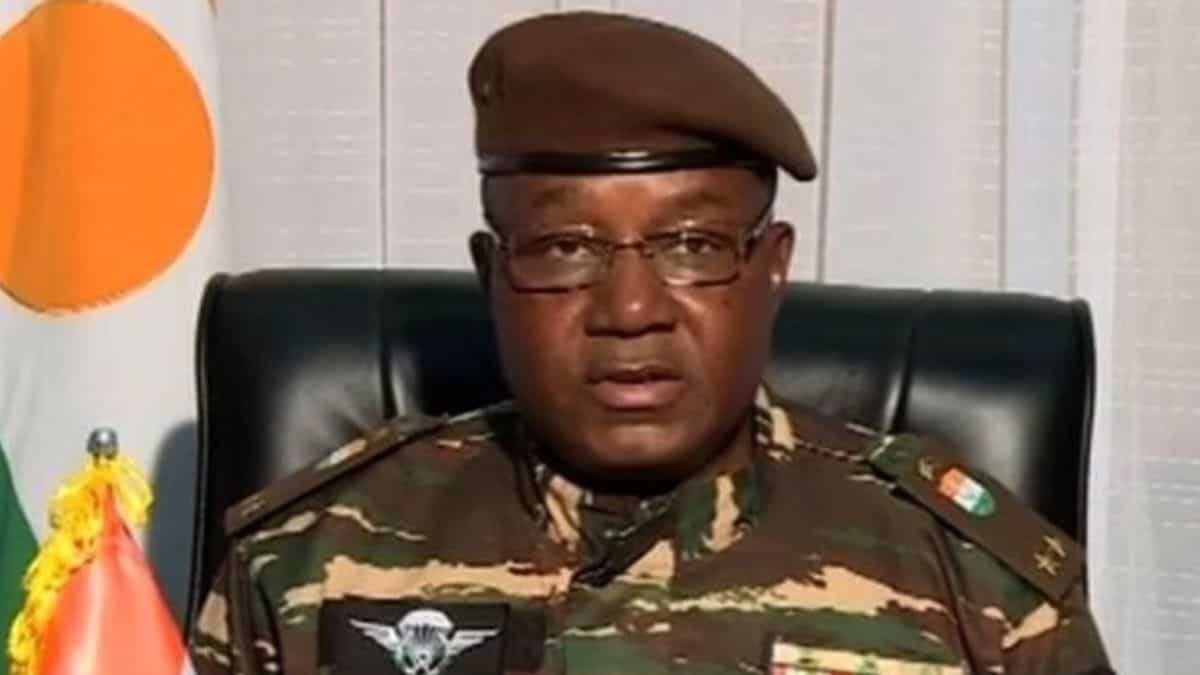
ECOWAS has threatened with military intervention in Niger if the military junta under General Abdourahamane Tiani does not re-instate the “legitimately and democratically” elected President, Mohamed Bazoum, who is apparently detained in the Presidential Palace. They gave the junta a deadline until 6 August 2023.
The country will not submit to threats no matter where they come from, the junta’s president General Tiani has said.
General Tiani insists that the military takeover “remains the safeguard of [the] homeland, Niger.”
An ECOWAS military intervention would never work, unless it was fully driven by the west – God forbid, by NATO. All is possible, since dearly sought-after resources of Niger’s are at stake.
Mr. Putin has already said that non-regional powers interfering in Niger will not help the situation would undoubtedly enlarge the conflict far beyond Niger’s frontiers.
So far, nothing has happened. Most likely nothing will happen. ECOWAS is not united and has no common front. The ECOWAS members of Mali, Nigeria, Burkina Faso, have recently had a military coup, for basically the same reason, the military stood up against western-implanted and western-favoring leaders, to finally free themselves from the chains of western new-colonial slavery.
The only reaction so far, as of 7 August, Niger has closed her airspace and Air France, possibly other airlines, have stopped flying to nearby countries.
General Tiani, the former head of Niger’s presidential guard, the coup’s mastermind, has since created a coalition of different civil society groups. He also has the support of the neighboring military juntas of Mali, Burkina Faso, and Nigeria. They all had recently similar military coups of liberation.
For more details, see this.
When the west talks of “democratically” elected West African leaders, they are lying, the same way they are lying when talking about free and democratic elections in Europe or even the United States for that matter.
These ex-French colonies’ heads of states were all groomed by the west, especially by France, and very likely by the World Economic Forum (WEF). Many of them emanate from the WEF’s academy for Young Global Leaders (YGLs), so that they are in line with western thinking and most notably with the western agendas, i.e., The Great Reset, alias UN Agenda 2030 which are basically identical and in pursuit of the 17 Sustainable Development Goals (SDG).
The real meaning of the 17 SDGs can be found by the proper interpretation behind the colorful SDG insignias. See this.
No wonder that Africans are waking up. In a first go, it appears West Africa has had enough of French usurpation and decided to exit the bond. Others may follow.
Niger preceded her 63rd anniversary of independence on 3 August 2023 by about a week – with a coup to liberate themselves from “Independence” which they never really had, since like most other “former French colonies”, they were never free, economically free, politically free to ally with whom they chose, and free to trade with whomever they desired.
As of this day, France has more than 1,000 military personnel stationed in Niger. General Tiani has said they must go, and France responded that they will be withdrawn. But why were they there in the first place – 63 years after “independence”? And there were many more in earlier years, the same as in other former French colonies.
USAFRICOM operates the Niger Air Base 201 close to Agadez. “It is owned by the Nigerien military but built and paid for by the United States”. Air Base 201 is allegedly designed to fight Islamic insurgents in coordination the the Niger military.
According to USAFRICOM, the US has some 1,100 U.S. special forces in Niger “to carry out military missions and the training of Niger troops”. See this.
The official version is to protect the countries from Islamic terrorists – “terrorists” which ever so often are conveniently engaged to cause upheavals, when anti-French “instability” could be sensed in Niger or other former French colonies. And, foremost, to protect French and European enterprises interests, while exploiting the riches of these former colonies.
Niger is the world’s seventh biggest producer of uranium, according to the World Nuclear Association (WNA).
The radioactive metal is the most widely used fuel for nuclear energy. It is also used in treating cancer, for naval propulsion, and in nuclear weapons.
Niger, which has Africa’s highest-grade uranium ores, produced 2,020 metric tons of uranium in 2022, about 5% of world mining output according to the WNA.
The world’s three biggest producers are Kazakhstan, Canada and Namibia.
Niger has one major mining operation in the north operated by France’s state-owned Orano, another major mine is under development. For more details, see this.
Niger has also other western-coveted economically valuable raw materials, such as crude oil, natural gas, coal, tin, and columbite (an iron-bearing mineral that accompanies tin). Petroleum, first discovered in 1956, is the most important source of government revenue and foreign exchange.
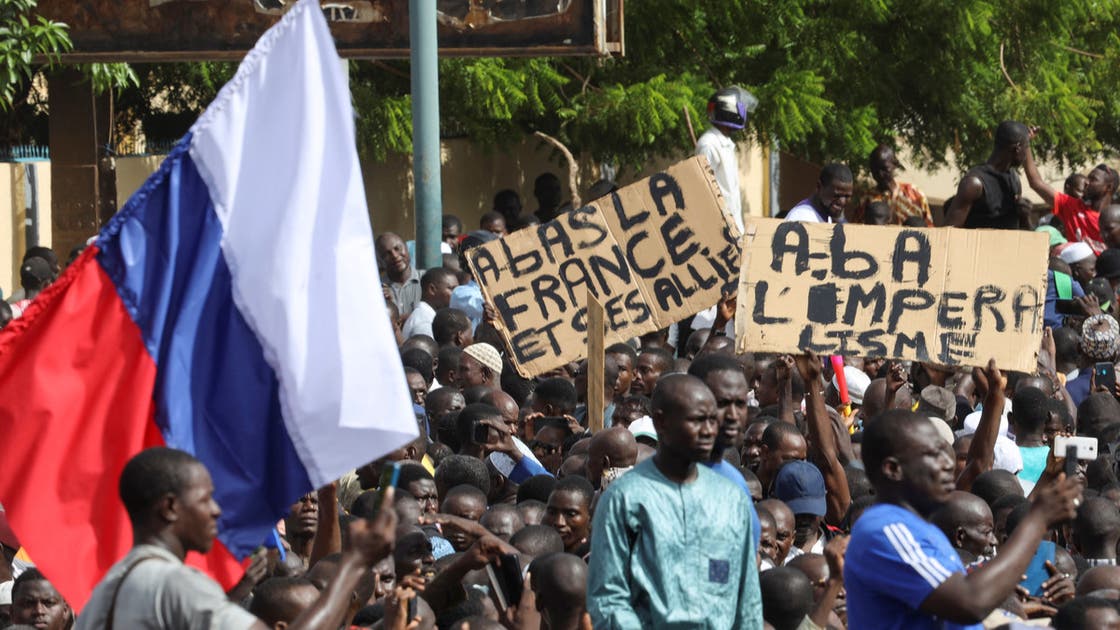
Demonstrators hold a Russian flag and banners during the gathering in support of the putschist soldiers in the capital Niamey, Niger July 30, 2023. The signs read Down with France and its allies, Down with imperialism. (Reuters)
The key to Niger’s true independence – as well as that of the other 13 Central and West African nations — is breaking loose from their dependence on French imperialism, by cutting the chain of their CFA currency to the French Treasury.
Niger and all 14 of the West (8 nations) and Central African (6 countries) sub-Saharan former French colonies remained tied and monetarily enslaved to France through the Franc CFA (CFA = Communauté Financière Africaine or African Financial Community) – which remains guaranteed by the Bank of France without any justification. To get this guarantee they must deposit 50% of their reserves in a special account of the Bank of France. Thereby the CFA-countries are not free of moving CFA currencies as they wish and find advantageous to themselves and their people. They need the Bank of France’s approval to use their own money!
For more flexibility and monetary stability (France’s stability), France created two CFA zones. Each of the 14 countries is affiliated with one of two monetary unions. Benin, Burkina Faso, Côte D’Ivoire, Guinea-Bissau, Mali, Niger, Senegal, and Togo comprise the West African Economic and Monetary Union, or WAEMU, founded in 1994 to build on the foundation of the West African Monetary Union, founded in 1973. The remaining six countries — Cameroon, Central African Republic, Chad, Republic of Congo, Equatorial Guinea, and Gabon — comprise the Central African Economic and Monetary Union, or CAEMU.
These two unions maintain the same currency, the CFA franc. West African CFA countries belong to the West African Monetary Unions (WAMU); and Coopération Financière en Afrique Centrale (Financial Cooperation in Central Africa), or the Central African Economic and Monetary Community (CEMAC). WAMU and CAMAC account for 14 percent of Africa’s population and 12 percent of the Continent’s GDP.
While both CFA francs have the same exchange value against the Euro (CFA 655.74 = 1 Euro – [6 August 2023]). Yet, the two CFA francs are not inter-changeable and the two monetary units have two separate Central Banks, the Central Bank for West African States (BCEAO – French acronym – 8 countries) and the Bank for Central African States (BEAC – French acronym – 6 countries).
If all of this sounds confusing, it is because it is confusing.
The CFA franc was created in December 1945 when the French government ratified the Bretton Woods Agreement; it became the currency of the “French Colonies of Africa”. Today, the French Treasury guarantees the currency under a fixed exchange rate but requires a deposit of 50% of CFA franc reserves into the French central bank. Immediately following independence, this figure stood at 100 per cent (and from 1973 to 2005, at 65 per cent).
Imagine, all their reserves were blocked at the French Central Bank until 1973. They could not use any of their reserves, without the approval of the French Treasury or Central Bank. Today it is down to 50% without any justification. Today, there is absolutely no need for a French guarantee of the West and Central African currencies.
The Frech argue, this arrangement is a quid pro quo for the French ‘guarantee’ of convertibility. The accords stipulate that foreign exchange reserves must exceed money in circulation by a margin of 20 per cent. Before the fall in oil prices, the money supply coverage rate (the ratio of foreign exchange reserves to money in circulation) consistently approached 100 per cent, implying that Africans could dispense with the French ‘guarantee’.
So far, the French do whatever they can to avoid “letting go” of their former colony. It warrants their continued grip on the colonies in terms of controlling trade as well as natural resources. And the former French colonies, through this usurping monetary arrangement, contribute significantly, directly and indirectly, to the French economy. Rough unproven estimates range from 15% to 25% of France’s GDP stems from the former French colonies. Maybe more.
In 2015, Chad’s President Idriss Debby said, he considers the CFA as “pulling African economies down,” and that “time has come to cut the cordon that prevents Africa to develop.” He called for a restructuring of the currency in order to “enable African countries which are still using it to develop.”
French President Macron ignored the statement. Nothing has happened to change, or abandon altogether the CFA arrangement between France and their former West- and Central African colonies.
Earlier this year, Luigi Di Maio, Italy’s former deputy prime minister and current minister of foreign affairs, raised the controversy about the role of the CFA franc on Africa’s development with an even more provocative statement, than the one of Chad’s President in 2015: “France is one of those countries that by printing money for 14 African states prevents their economic development and contributes to the fact that the refugees leave and then die in the [Mediterranean] Sea or arrive on our coasts.”
It is time that the former French colonies take their lives and economic development and prosperity under their own control. Perhaps the recent military coups against French-imposed leaders are the first steps – and may be replicated in other former French colonies. Not that military governments are ideal, they are not. But it is hoped and expected that eventually these military juntas will call for public elections, as democratic as possible, without foreign interference.
Africa, as part of the Global South has a major role to play in the structure of our future world order. To do so, they need economic and political independence.
*
Note to readers: Please click the share button above. Follow us on Instagram and Twitter and subscribe to our Telegram Channel. Feel free to repost and share widely Global Research articles.
Peter Koenig is a geopolitical analyst and a former Senior Economist at the World Bank (30 years). He has worked for eight years in West Africa, Frances former colonies, including in Niger, Mali, and Burkina Faso. He knows about the “CFA-arrangements” which continue making the 14 West and Central African CFA-zones dependent on France.
He lectures at universities in the US, Europe and South America. He writes regularly for online journals and is the author of Implosion – An Economic Thriller about War, Environmental Destruction and Corporate Greed; and co-author of Cynthia McKinney’s book “When China Sneezes: From the Coronavirus Lockdown to the Global Politico-Economic Crisis” (Clarity Press – November 1, 2020).
Peter is a Research Associate of the Centre for Research on Globalization (CRG). He is also a non-resident Senior Fellow of the Chongyang Institute of Renmin University, Beijing.

 The unaccompanied children have little of that aid workers call psychosocial support to help deal with trauma. In one refugee settlement just six case workers are available for 78,000 children, according to the Danish Refugee Council.

By Dennis M. Edwards All Bible verses are from the King James Bible, although I have changed some of the old English. Any similarity ...

Help me in my mission of helping others. Thanks!

Copyright © Fight for Your Faith


