Does your faith need strengthening? Are you confused and wondering if Jesus Christ is really "The Way, the Truth, and the Life?" "Fight for Your Faith" is a blog filled with interesting and thought provoking articles to help you find the answers you are seeking. Jesus said, "Seek and ye shall find." In Jeremiah we read, "Ye shall seek Me, and find Me, when ye shall seek for Me with all your heart." These articles and videos will help you in your search for the Truth.

Monday, June 25, 2018

Air war in post-revolution Libya has left at least 230 civilians dead, report finds

By Missy Ryan, Washington Post, June 19, 2018

At least 230 civilians have died in Libya in the chaotic, multiparty air war that has followed the ouster of dictator Moammar Gaddafi in 2011, a report has found.

The study from Airwars, a London-based watchdog group, and New America, a Washington-based think tank, examined the outcome of 2,158 strikes conducted since September 2012 by at least seven local and international actors, underscoring the fraught and fractured nature of post-revolution Libya.

After a NATO-led air campaign helped Libyans topple Gaddafi in 2011, the country has descended into a simmering civil conflict that included the establishment of rival Libyan governments and the rise of militant groups, including a virulent local branch of the Islamic State, that have taken advantage of ungoverned areas to grow strong.

The report, which The Washington Post obtained ahead of its release this week, is the first comprehensive examination of the death toll caused by air operations in Libya’s post-revolution period.

Using social media accounts and other sources to assess individual incidents, researchers concluded that at least 237 and as many as 387 civilians were killed in those strikes. At least another 324 civilians were wounded in those attacks, the report found.

While the civilian death toll appears to be far smaller than that caused by Western air operations against militants in Iraq and Syria, one important feature of the Libyan conflict has been its murky, mysterious nature.

According to Airwars and New America, strikes have been repeatedly conducted in Libya not only by rival local factions and the United States, but also, with far less transparency, France, the United Arab Emirates and Egypt. But fewer than 50 percent of reported strikes have been publicly declared, leading to questions about responsibility and accountability when civilian deaths do occur.

“Not one belligerent has taken responsibility for a single civilian death in Libya since 2012, and that’s a continuation of what we saw with NATO back in 2011,” said Chris Woods, director of Airwars. “It’s a tragedy for the Libyan people.”

Among Libyan actors, the report found that forces led by Khalifa Hifter, who has emerged as eastern Libya’s most influential power broker, have been responsible for the largest share of civilian deaths since 2012. Backed by outside powers including Russia, Hifter has vowed to clear Libya of extremist militants who have taken root since Gaddafi’s death.

But Hifter has been criticized for harsh tactics and his refusal to support the Western-backed Government of National Accord that seeks, in a rivalry to his own power, to assert authority across Libya.

Hifter’s self-proclaimed Libyan National Army is believed to have conducted about 1,100 strikes resulting in at least 95 civilian deaths, and potentially as many as 247, researchers found. Most of the attacks by Hifter’s forces have taken place in the eastern cities of Benghazi and Derna and in the country’s central oil region.

The GNA, which has fewer air assets, has conducted about 54 strikes, probably resulting in seven to 63 deaths, the researchers said.

Of the outside powers involved in post-revolution Libya, the United States has played the most significant military role. According to Airwars and New America, U.S. aircraft have conducted about 525 strikes on militants in Libya since September 2012.

That included an intense four-and-a-half-month operation in 2016 to push the Islamic State out of Sirte, the coastal city that became the group’s most important stronghold outside of Iraq and Syria.

U.S. Africa Command has said its operations have caused no confirmed civilian casualties in Libya during that period, but Airwars and New America assessed they probably resulted in 11 to 75 noncombatant deaths.

U.S. estimates of civilian casualties have been far lower than those from outside groups, partly because the U.S. military does limited follow-up after strikes occur to assess whether civilian deaths took place.

Often, it has been difficult to determine who has been behind a particular strike in Libya, with no local factions or foreign actors taking responsibility and locals assigning blame to multiple parties.

“This is one of the world’s forgotten wars,” said Peter Bergen, a vice president of New America. “The NATO intervention didn’t end the conflict; it precipitated a new phase and Libya is now an arena for proxy warfare.”

Researchers say the smaller civilian death toll in Libya–compared with over 6,000 in Iraq and Syria–is due to Libya’s lower population density and, perhaps, poorer reporting.

Wednesday, November 16, 2016

US Special Forces In Libya To Fight the ISIS Problem They Created

Corbett
isis-in-libyaby James Corbett
TheInternationalForecaster.com
May 18, 2016
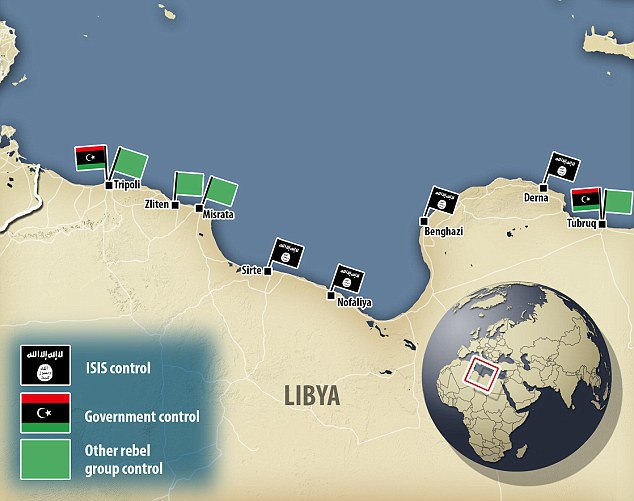
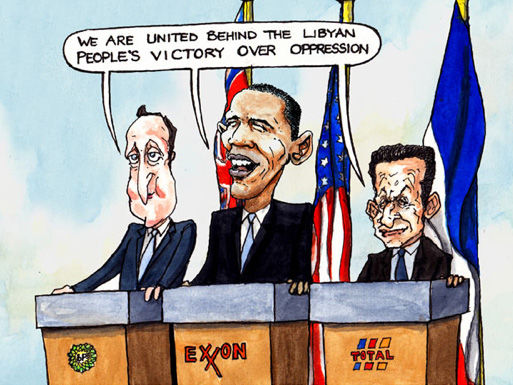
In 2011 NATO rained bombs on Libya to remove the Gaddafi government from power. Openly backing known terrorists in their push to oust Gaddafi, the NATO powers, led by Obama, Cameron and Sarkozy, ended up supporting, fostering and equipping battle-hardened jihadis that they then sent off as a proxy army to begin the destabilization of Syria. But now that proxy army is coming home to roost, with recent reports claiming as many as 6,500 Islamic State fighters operating in Libya.

So of course the US has responded to this mess in the only way it knows how: sending more troops. Well, to be more accurate, the troops have been there for half a year, but the government is just now getting around to announcing their presence…via an anonymous leak in the Washington Post, that is.

That’s right, since late last year a team of US Special Operations commandos have been stationed in Libya in an attempt to “sort through the various factions and identify the potential recipients of American support in the future.” In other words, the same US government that knowingly backed the crazy jihadis in the first place is now there to vet which groups to back in its fight against the crazy jihadis.
Summit-Libya
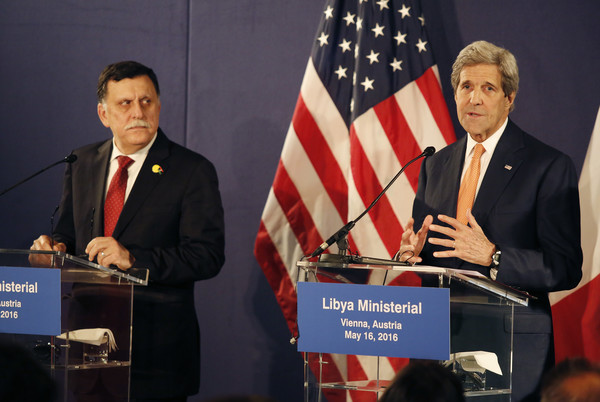
Appalled yet? Well, the worst part isn’t the special forces on the ground at the moment. It’s not even the obligatory “regional powers” conference going on in Vienna, which is likely to see thousands more troops sent to re-invade the country. Nor is it the fact that the US is now planning to break the UN’s own embargo against sending arms to Libya — as long as the Libyans double-dog swear the arms will only be used for fighting ISIS.

No, the worst part is that there is arguably no “Libya” left to save even if the NATO vultures withdrew their talons and flew back to their cave. Since the murder of Gaddafi the country has plunged into utter chaos. The “government” in Tripoli is a “government” in name only. In truth, it barely governs Tripoli, and the areas in the east are for all intents and purposes a separate country. This fundamental divide is perhaps best exemplified by the absolute insanity taking place at the country’s central bank.

vault
You might remember that one of the very first things the NATO-backed terrorists in Libya did after the fighting broke out was to found their own central bank in Benghazi. You might also know that the battle for control of the “legitimate” central bank and its $100 billion dollars in reserves has been one of the main struggles between the many warring factions in post-Gaddafi Libya, with rebel groups having seized the Benghazi branch early last year.

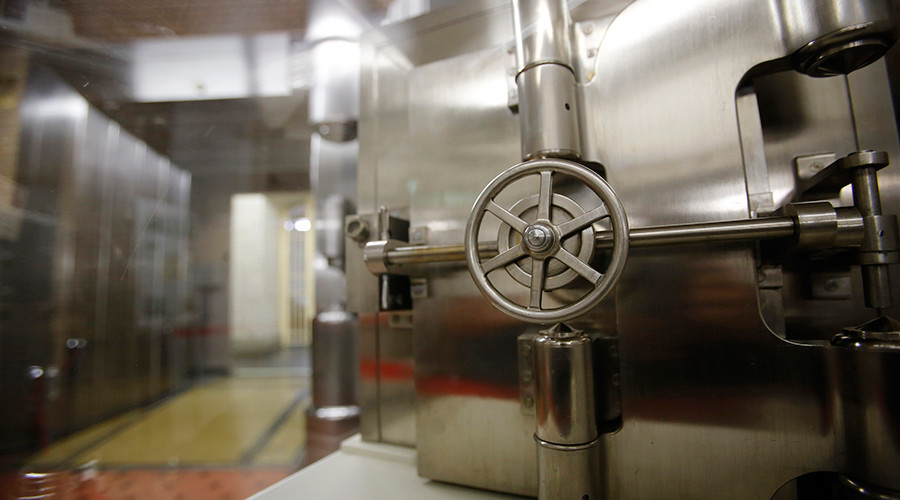
That struggle has descended into a complete farce, with the central bank’s chief not having access to the bank’s funds or even its own vault. The bank, headquartered in the east of the country, is not entirely trusted by the Tripoli-based government, and for good reason: the bank has provided funds to some of the very groups that are waging war with the nominal government. So the government in Tripoli has been sending the central bank a stipend of $23.5 million a month for its operating expenses (a fraction of the $257 million the bank claims to need). The central bank’s vault contains an estimated $187 million in gold and silver, which the bank says it desperately needs. But there’s a catch: there is a five digit access code to enter the vault and the Tripoli government won’t share it with the bank’s own governor. So the bank has taken matters into its own hands by bringing in a pair of safe crackers to help break into the bank’s own vault.

Libya_war_for_oil
This farce is illustrative of the breakdown of Libya as a whole. Any pretense that Libya cohered as a single country was shattered along with the government that was bombed off the face of the earth in 2011. That country may never exist again as anything other than the state-in-name-only that it has become in recent years.

But one thing is for certain: if Libya does survive and its people can once again find a way to live together it won’t be due to the efforts of the US Special Forces or the powers-that-shouldn’t-be and their Vienna conference or an agreement to end the arms embargo on the country. Outside interference caused the problem; it won’t help to fix it.

Dennis Edwards: The Bible does mention Libya as participating in the ultimate invasion of Israel during the Last Days in Ezekiel 38 joining in an alliance with Russia, Turkey, Iran and Ethiopia.. Libya is also mentioned in Daniel 11 which many Bible scholars believe is referencing the same invasion. So Libya well remain a country and at some future date seems to be able to participate in that final battle against Israel predicted in the Bible. 
That's why it's important to know what the Bible says. It tells you the end from the beginning.

Thursday, October 27, 2016

Khadaffi’s Murder

Eric Margolis, October 22, 2016

“We came, we saw … he died” boasted a beaming Secretary of State, Hillary Clinton, speaking of the 2011 western overthrow of Libya’s leader Muammar Khadaffi.

She was, of course, shamelessly paraphrasing Caesar’s famous summary of his campaign around the Black Sea. Mrs. Clinton, who seems ordained to be America’s next president, should have been rather more cautious in admitting to murder.

This week marks the fifth anniversary of Khadaffi’s grisly death. The Libyan leader was fleeing in a motor convoy to reach friendly tribal territory when French warplanes and a US drone attacked and destroyed the vehicles. Wounded, Khadaffi crawled into a culvert where he was captured and killed by French and US-backed rebels.

Thus ended the colorful life of the man who wanted to be the second Nasser and leader of a united Arab world. His death was a warnings to others trying to challenge the Mideast status quo I call the American Raj.

I was invited to interview Khadaffi in 1987 at his Tripoli headquarters in the Bab al-Azizya barracks. This was on the one year anniversary of 1986 US air attacks on the barracks that sought to assassinate Khadaffi, described by US President Ronald Reagan as the “mad dog of the Mideast.” But that night, the ‘Leader,’ as he liked to be called, went to his Bedouin tent in the courtyard and thus escaped death–for a time.

A US 2,000lb bomb came crashing through the roof of the barracks right onto the bed where Khadaffi usually slept, often with his two-year old adopted daughter. The girl died.

Khadaffi led me by the hand through the ruined building, asking me “why Mr. Eric did the Americans try to kill me?” I explained to him: his support of the Palestinians, Nelson Mandela, the Irish Republican Army, and Basque separatists. For Khadaffi, they were all legitimate freedom fighters.

Khadaffi or at least his intelligence chief, the sinister Abdullah Senussi, was accused of being involved in the downing of a French UTA and US Pan Am airliner. Libya financed anti-French movements in Paris-dominated West Africa and the Sahel.

Chad became a flash-point between Paris and Tripoli. The former head of French intelligence, Count Alexandre de Marenches, told me France’s president, Francois Mitterand, ordered him to bomb Khadaffi’s personal jet, then changed his mind. The British also tried to kill Khadaffi by means of a large car bomb in Benghazi.

Eventually, Libya managed to bury the hatchet with its western foes, though Khadaffi remained highly annoying to the former colonial powers and a fierce critic of the Saudis whom he denounced as thieves of Arab resources and betrayers of the Palestinians.

I’ve often been asked what Khadaffi was like. He was a simple Bedouin born in a tent. Khadaffi was disgusted by the poverty and corruption of the Arab world, and its domination and exploitation by the Americans, French and British. He saw himself as a champion of Palestinian rights, and Libya, with only 6 million people, as the leader of modernized Africa.

But he was also a dreamer who often had fanciful schemes, like the Great Manmade River to draw artesian water from the Sahara. He loved to insult his fellow Arab leaders, branding them cowards, thieves and liars. Khadaffi was theatrical and flamboyant and loved to show off.

After spending an evening with Khadaffi in his Bedouin tent, I told him, tongue in cheek, “Leader, we may bomb you but I must confess our women think you are the most handsome and dashing Arab leader.” He beamed and showed me some of his Italian-tailored faux combat wear and kid-skin jump boots. At times he seemed like a kid in a toy store–zany but also serious and determined. According to his many critics, Khadaffi was a dangerous, anti-western megalomaniac.

He was also vilified and demonized by the western media, a process that happened to all third world leaders who refuse to accept western dictates.

Khadaffi was quietly cooperating with the US when the Arab Spring erupted in Tunisia. Secretary Hillary Clinton and her neocon advisors decided to seize advantage of Mideast turmoil and overthrow Khadaffi.

A new ‘color revolution’ was unleashed by the western powers. Protests were organized in Benghazi, always an anti-Khadaffi stronghold, by CIA, French intelligence and Britain’s MI6. Western special forces attacked Libyan military positions. The UN was gulled into calling for ‘humanitarian intervention to supposedly save civilian lives.’

France led the military intervention. Khadaffi’s son, Seif, had claimed that his father had helped finance French president Nicholas Sarkozy’s election. The vindictive Sarkozy intended to shut up the Khadaffis.

Western special forces intervened behind the cover of a popular uprising. Khadaffi’s ragtag forces quickly collapsed and rebel groups seized power, murdering Khadaffi in the process.

The west got Libya’s high grade oil and was rid of a thorn in its side. Khadaffi told me that if he were overthrown, Libya would splinter into its tribal mosaic–which is just what has happened. Chaos reigns as warlords backed by the US, France, Britain, Italy and Egypt–and a small ISIS contingent–fight over bleeding Libya. Decades of development that made Libya Africa’s leader in health care and education were wiped away.

Interestingly, the template for the western overthrow of Khadaffi–aka “regime change”–was next employed in Syria, with vastly more destructive results but less success. Expect to see more color revolutions when Mrs. Clinton takes over the White House.

Thursday, September 15, 2016

Militia Seizes Libyan Oil Terminals in Challenge to Government

By Suliman Ali Zway and Declan Walsh, NY Times, Sept. 11, 2016

BERLIN–Fighting erupted in Libya’s oil crescent on Sunday when forces loyal to the dominant militia commander in eastern Libya attacked and seized as many as three major oil terminals, military and civilian officials said.

The sudden offensive from the commander, Gen. Khalifa Hifter, adds a new layer to Libya’s multifaceted civil war, and presents a fresh challenge to the authority of the already weak unity government backed by the United Nations.

General Hifter’s forces attacked the oil ports of Ras Lanuf, Es Sider and Zueitina early Sunday, said Ahmed al-Mismari, a spokesman for General Hifter’s Libyan National Army. Since 2013, the ports have been held by a smaller militia known as the Petroleum Facilities Guard, led by Ibrahim Jathran.

In July, Mr. Jathran signed an agreement with the unity government to resume oil exports from Libya, ending a three-year-old embargo. But on Sunday, his soldiers had been expelled from Ras Lanuf and Es Sider, though there were reports of continuing fighting at Zueitina.

General Hifter’s military gambit puts him on a collision course with the unity government even as international scrutiny of Libya intensifies. The contested oil region lies 50 miles east of Surt, the coastal city where Western-allied militias backed by American airstrikes are laying siege to the main Islamic State base in Libya.

Oil, Libya’s main source of wealth, has always been a central factor in the complex civil conflict that erupted after the ouster of Col. Muammar el-Qaddafi in 2011.

The country’s central bank reserves, drawn from oil income, have rapidly been depleted this year, causing a plunge in the Libyan currency and economic pain. But political and factional rivalries have thwarted efforts to resume oil production.

General Hifter, who is based in the eastern city of Benghazi, has long resisted joining the unity government that established itself in Tripoli in March. He has also opposed efforts by other groups to resume oil exports.

Tuesday, September 6, 2016

Libya: Unified Against ISIS, Fragmented After

By Rod Nordland and Nour Youssef, NY Times, Sept. 3, 2016

CAIRO–Martin Kobler, the United Nations envoy to Libya, used to regularly joke that the only functioning government in Libya was the Islamic State. Unlike the country’s other three governments, it not only held territory but ran the courts, provided services to the public and ensured security–however harsh its rule.

Fortunately, Mr. Kobler said recently, his joke is now out of date, with the Islamic State reduced to three neighborhoods in the coastal city of Surt, and its headquarters in the hands of militias supporting the new United Nations-backed government. “This is over now,” he said.

The problems of governing Libya, however, are far from over, particularly as its many remaining factions try to figure out what comes next at a potential second round of talks this month, presided over by the United Nations. Surt’s future will loom large in the discussions.

Ever since Libya’s longtime ruler, Col. Muammar el-Qaddafi, was deposed and killed in Surt in 2011, the country has been divided by tribal and militia rivalries. With a population slightly larger than that of Miami, Libya has no clear central government and scant possibility of exploiting its enormous oil reserves, the ninth largest in the world.

That a United Nations-backed government in Tripoli was able to dispatch a militia force to subdue the Islamic State in Surt was the first piece of good governance news in five years of vicious internecine fighting.

But even victory in Surt remains worrisome. First of all, the militias have to finish clearing out remnants of the Islamic State from the three city neighborhoods. The militias are reported to be close to accomplishing that, which will then raise the question of what they will do next.

They are from Misurata, a coastal city seen as a rival of Surt. While they were nominally doing the bidding of the new, United Nations-backed Government of National Accord, or G.N.A., it is not at all clear that they will continue to accept its authority.

Then there are Libya’s other factions. The government in the eastern city of Bayda, with its Parliament in Tobruk, once enjoyed international support but now relies mostly on Egypt and some Persian Gulf allies. It is also suspicious of the intentions of the Misuratans, and angry about United Nations backing of the G.N.A.

The country’s most powerful military leader, Gen. Khalifa Hifter, based in Benghazi, has almost entirely cleared that city, the east’s biggest, of the Islamic extremists who once held sway there. But he, too, is deeply suspicious of the Misurata militias, because they are dominated by Islamists. While General Hifter has been named the Libyan National Army commander, politically he operates independently.

That is true as well of the third faction claiming to rule Libya, a Tripoli-based Islamist militia grouping that has a Parliament separate from that of the G.N.A.

“The government has to implement state authority over who dominates this area,” Mr. Kobler said. That the Misurata militias were acting on behalf of the G.N.A. when they ousted the Islamic State from Surt was a very positive sign, he said.

“It shows the strength of the G.N.A.,” he added. “The other two governments do not exist. A government should provide security, basic services. That is not the case from those two governments.”

It is important as well, he said, that an international consensus is building to support the G.N.A., with the Arab League and the African Union calling on their members not to back other factions’ claims to legitimacy; the success in Surt bolstered that consensus.

The same consensus does not seem to exist in many parts of Libya. The government based in Bayda has denounced the G.N.A. In Benghazi, General Hifter has boycotted the meetings that the United Nations has convened to bring all of the factions together, and he is by far the strongest military player.

When Surt finally falls, said Ahmed el-Mesmari, the spokesman for the Libyan military in the east, the militias there will abandon the new Tripoli government.

“We don’t think anyone can control these forces,” Mr. Mesmari said. “They are anarchists and extremists. They are closer to Qaeda than they are to anyone else. They would be very hard to tame.”

Even internationally, the picture can be confusing. Special Forces troops from the United States and Britain were advising the militias in Misurata in the fight against the Islamic State, and American air power was decisive in their advances against the extremists. Italy sent its own secret service operatives to Tripoli to work with the G.N.A., according to Italian news reports.

Tripoli itself is fragmented by numerous militias with shifting alliances, not all of them supporting the United Nations-backed government.

“By our count, there are 40 militias and gangs in Tripoli,” Mr. Mesmari said. “The city is a barrel bomb waiting to drop.”

His criticism is common among Libyan politicians in the east.

“It is a stillborn government bound to fail,” said Abu Bakr Buera, a member of the Tobruk Parliament. The problem would be easy to solve, he added. “We just need to put everyone in one room, and it would take just a few hours,” he said. “The problem is getting everyone in one room.”

Mr. Kobler said the confused state of Libya’s military and political factions was not surprising, but was a legacy of its history.

“This country never had strong institutions, even during the time of Qaddafi,” he said. “It’s tough to do this because it’s being done for the first time, and it’s a long and protracted process. “

If what is happening in Libya is hard to follow, Mr. Kobler said, there is a simple explanation underlying everything: “It’s all about power and oil and money. That’s all you have to know.”

Wednesday, August 10, 2016

Even with U.S. airstrikes, a struggle to oust ISIS from Libyan stronghold

By Sudarsan Raghavan, Washington Post, August 7, 2016

SIRTE, LIBYA–The black flag of the Islamic State flutters above a two-story house that serves as a sniper’s nest. The deserted street is under its control, as are all the nearby buildings. The banner and the occasional crack of the marksman’s bullet are the only signs of the militants on this afternoon.

Two blocks north, less than a football field away, Libyan militiamen are gathered with handheld rocket launchers and Mad Max-style pickup trucks mounted with large machine guns. Since last Monday, U.S. airstrikes have pounded Islamic State targets in this battered seaside city, the stronghold of the Middle Eastern militants’ Libyan affiliate. Yet the pro-government militia forces have not crossed this front line.

“If we move forward, their snipers will be firing at us like hell,” said Suleiman Shwairf, a pro-government fighter, peering at the flag from behind a wall Friday.

The American air intervention has altered the military equation on the ground and given a much-needed boost to the morale of the fighters battling the Islamic State, also known as ISIS or ISIL. But in a densely packed urban environment, where territory is seized street by street and house by house, eradicating the militants from Sirte remains a formidable struggle, illuminating the limits of the U.S. air campaign.

The fall of Sirte could be a major setback to the ambitions of the Islamic State. But since May, when the campaign to liberate Sirte began, the militias have been confronted with a sophisticated and coordinated strategy used by Islamic State fighters to protect their bastion in Sirte’s urban center. Hundreds of pro-government fighters have been killed or wounded by buried mines, explosive-laden doors, tripwire bombs, suicide attackers and snipers. The Islamic State remains in control of roughly 70 percent of the city’s urban area over a stretch of four miles.

In their first week, U.S. airstrikes mostly targeted Islamic State tanks and armored personnel carriers, as well as mobile ammunition depots and rocket launchers. Now, the Islamist fighters are altering their tactics to counter the air assault, hiding their military vehicles, moving command posts frequently, and staying out of sight during the day, according to pro-government commanders.

“The armored personnel carriers, the tanks are not their strongest weapons, anyway,” said Mohamed Darat, 45, the top commander for the largest front line in the city. “Their strongest weapons are the land mines, booby-traps and the snipers. Those are the biggest problems we face.”

Still, of the several thousand Islamic State militants initially in the city, most have either fled or been killed. Only an estimated 500 to 1,000 remain, and they are surrounded–by pro-government forces on land and by Libyan vessels patrolling the sea. Add the American air support, and a long-term hold on Sirte by the militants seems implausible.

The questions many Libyans ask: When will the city fall? And at what human cost?

In early 2015, the Islamic State seized parts of this sprawling metropolis in the heart of Libya’s oil crescent, home to most of its petrochemical resources. The birthplace of Libyan dictator Moammar Gaddafi, the city was the last major stronghold of his loyalists during the revolution five years ago that toppled his regime. Gaddafi was killed here by rebel fighters in October 2011.

The Islamic State within a few months swiftly consolidated its grip on Sirte, using it as a base to stage attacks on oil facilities and other targets. With pressure growing on the militants’ parent body in Syria and Iraq from U.S. airstrikes and attacks by Iraqi forces, Sirte was viewed as a possible fallback capital of the Islamic State’s self-declared caliphate.

It was those ambitions that triggered the current fighting here. When Islamic State fighters advanced west up the coast in May, militia brigades from the nearby city of Misurata counterattacked. Within days, they had pushed the militants back inside Sirte, retaken the outer suburbs of the city and moved into the urban zones. Small groups of American and British elite troops helped target Islamic State positions with surveillance drones and other technology.

Then their advance into the city center slowed.

The Islamic State forces, a mix of foreigners and Libyans, were pummeling the brigades with tank and artillery fire. The land mines and snipers were planted on streets and at hospitals, universities and other large complexes. The militants had cached weapons, as well as supplies of food and water, in different parts of their territory.

The militants also are using creative ways to kill. They have jury-rigged refrigerators to blow up when militia fighters search houses. Bombs are planted inside bags of bread and left in visible places for their enemy to pick up. They have transformed baby monitors into voice-activated bomb triggers, and used paper clips touched together to ignite explosives.

“They are using the most devious and inhuman ways to kill our fighters,” said Darat, a former civil engineer.

In the past three months, some 400 militiamen have died, with more than 2,000 injured, according to doctors at a military field hospital outside the city. There was also anger and frustration among the fighters, who had felt that the United States and the West had abandoned them by not taking stronger actions to help them combat the Islamic State.

The mounting casualties and military stalemate in the city prompted Libya’s Western-backed national unity government to request the U.S. airstrikes last week.

But on the front lines, the U.S. intervention, while welcome, remains bittersweet.

“It’s a little late,” Darat said. “If the Americans started supporting us from the beginning, we would have saved so many lives.”

The road into Sirte from the west is littered with the debris of war. Charred cars from a suicide bombing. Aging Soviet-made tanks, some stalled in the sand. Walls covered with the graffiti of myriad militias.

Inside, Sirte is a ghost city.

Nearly its entire population of 80,000 has fled. Buildings are pocked with grapefruit- size holes from artillery rounds. Houses have been shattered by crossfire. Locked-up shops and businesses have black stamps on their walls reading in English and Arabic: “Office of General Services.”

The stamps are from the Islamic State tax collection department.

In one neighborhood, pro-government fighters took down a large iron frame at a traffic circle where the militants used to execute residents, hanging them up as in a crucifixion and then shooting them. In another enclave, they found an Islamic State prison where detainees were tortured and a grave that contained nine bodies, Darat said.

The militants are now entrenched in several large urban neighborhoods and in the Ouagadougou conference center, which Gaddafi once used to host African Union meetings and other international summits.

Al-Dollar, a residential enclave so named because of its opulent mansions, has become the primary front line. Militia fighters have taken over the empty houses, moving in mattresses and supplies, and setting up rooftop firing positions.

Roads are blocked by stacked shipping containers that mark the boundaries between the Islamic State and the militiamen. Signs read: “Danger. There are snipers.” And two days before the U.S. airstrikes began, a suicide bomber blew himself up in front of a house, steps from Darat’s command center. On Friday, pieces of the assailant’s body were still on the ground.

The U.S. airstrikes have helped Darat’s men to some degree. He said that last Monday, he coordinated with the Misurata military operations room working with the U.S. forces to call in a strike on an Islamic State sniper’s nest in a house. And on Wednesday, he asked for an attack on an antitank gun. In both cases, he said, “our American friends” struck the targets.

Only 10 mortar rounds have landed in al-Dollar since the U.S. campaign began. The week before, the enclave was regularly struck by tank fire, rockets and other artillery. Now that has all disappeared. The Islamic State fighters are keeping a low profile, apparently waiting out the air campaign, Darat said.

Still, on Thursday, a militant sniper killed a militia fighter here. And on Friday, a bullet from an Islamic State position hit a nearby mosque, prompting the militia fighters to return fire with heavy machine guns.

What Darat wants most is to cross the main road, less than 200 feet from his command center, and push farther into Islamic State territory. On the other side of the road, the militants control a hospital complex and a hospitality center once used by Gaddafi to host dignitaries.

But the area is sown with land mines and booby traps.

And Darat is running out of mine specialists. His best engineer was killed recently when he tried to move a corpse. Islamic State fighters had planted a bomb under the body. Many of Darat’s remaining mine specialists are either traumatized or unwilling to push forward into Islamic State territory.

He recently considered sending 1,000 sheep across the road to get blown up by the mines–and clear the way. But he decided that would be too brutal, he said.

And as U.S. airstrikes keep targeting Islamic State weaponry, there could be an unexpected consequence. Darat’s intelligence operatives have noticed more militant fighters moving at night. And that, he fears, could make his goal of crossing the road more complicated.

“Now, Daesh knows they can’t use so many heavy weapons against us without the Americans attacking them,” Darat said, using the Arabic acronym for the group. “They will plant even more land mines. They are running out of options.”

Monday, August 8, 2016

Stay Out of Libya

By Justin Raimondo, Antiwar.com, August 4, 2016

We’re back in Libya, with US warplanes bombing targets in the city of Sirte, on a mission that, according to the Pentagon, has “no endpoint at this particular moment.” And that statement sums up perfectly the Sisyphean task that presented itself to US policymakers when the Terrible Triumvirate–Hillary Clinton, national security honchette Susan Rice, and UN ambassadress Samantha Power–prevailed on President Obama to overthrow the regime of Libyan despot Moammar Ghaddafi.

Take a look at what we’re getting ourselves into: with no less than three governments, lawless Libya is a perfect example of Ronald Reagan’s famous dictum that “government is the problem, not the solution.” Yes, that’s right, the former domain of Ghaddafi has three rival “governments.” Go ahead and count ‘em:
The General National Congress (GNC), headquartered in Tripoli, is controlled by Islamist militias and backed by Turkey, Qatar, and Sudan.

The Council of Deputies, located in Tobruk, is basically the instrument of Gen. Khalifa Hiftar, a known CIA asset who used to live a few miles from the Agency’s headquarters.

The UN-appointed “government of national unity,” which was never elected by anyone and had to be shipped into the country by boat because the Tripoli authorities wouldn’t let their plane land.

While the ostensible reason for the US air strikes is the elimination of ISIS from the country, there is no escaping the “nation-building” aspect of Washington’s mission. For the logic of the mission means ISIS must be replaced with something, and that something is bound to be the UN-approved “government.” Yet this is likely to provoke further conflict, as the Islamists in Tripoli and the followers of Gen. Hiftar in the east are not likely to be pushed aside so easily.

The divisions that ensure a future of perpetual conflict are rooted in the history of a country that isn’t really a country at all.

The fiction that is the nation-state of “Libya” was only maintained by the brute force of Ghaddafi’s military: when that was defeated and dissolved, the “Libyans” rallied around what have always been their authentic allegiances: tribe and faith. Indeed, “Libya” has only existed since the end of World War II, when the UN moved in and forcibly joined together three regions that had no common history or culture: Tripolitania in the west, Cyrenaica in the east, and the southern Fezzan area, a desert mostly inhabited by Tuareg and Tebu tribes. The UN was merely replicating the plan carried out by Mussolini, and his Italian predecessors, who colonized the region and sought to abolish tribal boundaries. When King Idris I, installed by the UN, protested that he didn’t want to rule over Tripolitania, and preferred to extend his domain only over Cyrenaica, he was ignored. With the fall of Ghaddafi, the country has reverted to its natural state–and now, once again, the UN is coming in the “fix” the ‘problem.”

The age-old scam of governments creating problems that they then use as an excuse to increase their powers so they can “solve” them is on full display in Libya–and Syria, and Iraq. All these countries had secular governments where not a trace of Islamist radicalism could be found. Their “liberation” by the Western powers, who launched regime change operations in the name of “democracy,” gave rise to ISIS–and created the rationale for yet more destructive intervention.

All three disasters can be properly laid at Hillary Clinton’s doorstep, but GOP presidential candidate Donald Trump is no rational alternative. While rightly averring that Western meddling created the Libyan miasma in the first place, he wrongly says “We have no choice” but to intervene once again. This is arrant nonsense: we are sliding down a slippery slope in Libya, and soon will be faced with the problem of how to prevent ISIS from popping up once again. Trump says he’s against “nation-building” but you can’t just drop bombs and then fly away–once you intervene, then you own the country, like it or not.

Do we want to own Libya?

Here Trump is faced with the inevitable contradiction at the heart of his foreign policy views: he wants to appear “tough” without getting his hands dirty. This marriage of rhetorical bellicosity and instinctual anti-interventionism can only end in divorce. Instincts aren’t enough: what’s required are principles–a concept entirely alien to Trump.

Hillary, on the other hand, does have principles–the wrong ones. She’s a liberal internationalist and serial regime-changer who, once in power, will take us into conflicts ranging from North Africa to Eastern Europe and into the steppes of Central Asia. Trump may stumble into trouble–she’ll take us there by the express route.

The only candidates for President who want us to stay out of Libya are the Green Party’s Jill Stein and the Libertarian nominee, Gary Johnson. But since neither of them are going to wind up in the White House, it’s certain we’ll be sinking into the Libyan quagmire no matter which major party wins in November.

This is a recipe for disaster. As the Russians continue to pound ISIS in Syria with air strikes, and the government of Bashar al-Assad makes gains on the battlefield, the international jihadist movement will increasingly transfer its attention to Libya, where they have a real chance of establishing a “caliphate” in alliance with the very forces Mrs. Clinton enabled by overthrowing Ghaddafi. When she visited Libya to celebrate her “victory,” she infamously declared: “We came, we saw, he died”–and, with those words, sealed the fate of a nation.

We can follow the Islamists around the globe, playing whack-a-mole unto eternity: our interventions only make them stronger, and us weaker. This is what Osama bin Laden gleefully predicted when he said:

“All that we have mentioned has made it easy for us to provoke and bait this administration. All that we have to do is to send two mujahidin to the furthest point east to raise a piece of cloth on which is written al-Qaida, in order to make the generals race there to cause America to suffer human, economic, and political losses without their achieving for it anything of note other than some benefits for their private companies. All Praise is due to Allah. So we are continuing this policy in bleeding America to the point of bankruptcy.”

Terrorism is like scabies–the more you scratch it, the more it spreads. We are seeing this truism play out as terrorist attacks are now becoming a weekly occurrence in Europe. How long before the same condition afflicts us in North America?

When we invaded Iraq we opened Pandora’s box–as I warned so long ago. Now the same people who brought us that disaster have the nerve to counsel patience when the demons they unleashed are harrying us at every turn.

As the playwright Tennessee Williams put it in Cat on a Hot Tin Roof:

“There’s nothing more powerful than the odor of mendacity.”

Monday, July 4, 2016

The 5 most serious accusations from Republicans’ Benghazi report

By Amber Phillips, Washington Post, June 28, 2016

Remember that heated hearing in the fall when Hillary Clinton sat in front of Congress for 11 hours and defended her handling of the Benghazi terrorist attacks? Well, a report from that investigation (of which Clinton’s testimony was just one part) is out, capping the two-year process that is the ninth overall investigation into the Benghazi, Libya, incident.

There is no smoking gun, but the report does conclude that Clinton and the Obama administration more broadly should have realized how endangered U.S. outposts in Libya were at the time of the 2012 attacks and done more to protect them and the four Americans–including Ambassador J. Christopher Stevens–who were killed.

Or, more accurately, the Republicans on the special Benghazi committee concluded that. Democrats on the committee called this whole thing a partisan witch hunt to bring down Clinton’s presidential run and released their own, much softer report on Monday. But those two reports aren’t even the sum total of the committee’s work; two of the committee’s most conservative lawmakers released a more critical report, which was not signed off on by the rest of the GOP members.

For our purposes, we’re going to focus exclusively on Republicans’ main report, since Republicans are the ones in control of the committee and Congress, and this is the report a majority of the committee members signed off on. It’s also the one that will be at issue in the 2016 presidential race.

Clinton said Tuesday she’d “leave it to others to characterize this report but I think it is pretty clear it is time to move on.” Her campaign had no trouble characterizing it for her, calling it “a partisan sham” and full of “discredited, conspiracy theories.” Clinton has rebutted many of the report’s key findings in the past.

This one brings several new details about that night that Rep. Trey Gowdy (R-S.C.), the Benghazi committee chairman, says should “fundamentally change the way you view Benghazi.” The State Department disagrees there’s anything new in this report, and The Washington Post’s Karoun Demirjian writes “there’s no significantly new information” about the U.S. response to the attacks.

Still, the report is big news in the political world. Here are the five most serious findings from it, according to reviews of the report from The Washington Post’s Karen DeYoung and Adam Goldman, NBC News’s Andrea Mitchell, Politico’s Rachael Bade, CNN’s Stephen Collinson and a news conference House Republicans on the committee gave Tuesday:

1. The State Department failed to protect U.S. diplomats in Libya.

This is the report’s bottom line. It doesn’t necessarily lay the blame at Clinton’s feet–Gowdy had said he wanted to keep the report focused on the facts, not personalities–but the conclusion is clear: Clinton and the Obama administration should have realized the risks.

To back up this conclusion, CNN’s Collinson reports that requests for more security in Benghazi leading up to the attacks went unheard or were refused.

Even House Democrats’ version of their report acknowledges that “security measures in Benghazi were woefully inadequate,” pointing the finger at the security and law enforcement arm of the State Department rather than Clinton. Ambassador Stevens was at the diplomatic compound in Benghazi with only two official bodyguards even after other Western diplomats had left the country.

NBC’s Mitchell notes the report finds that the then-vice chairman of the Joint Chiefs of Staff, a pretty big player in national security crises, did not join an emergency video conference because “he had left to return to his residence to host a dinner party for foreign dignitaries.” Mitchell reports he received one update on the attacks during the dinner.

2. The CIA missed warning signs.

The report says the agency misread how dangerous Libya, in the midst of a revolution after overthrowing its longtime dictator a year earlier, was at the time. Recall the attacks took place on Sept. 11 and 12, 2012.

“One section of the report seems to allege that U.S. officials fundamentally misunderstood who their allies were at the time,” writes NBC’s Mitchell.

To illustrate that point, the report details how there was confusion in U.S. intelligence circles about who ultimately came to the Americans’ rescue. Previous reports concluded it was a “quasi-government militia.” This report says it was a military unit loyal to the country’s former dictator.

3. The Defense Department failed to rescue Americans in time.

Or at least, it was late in deploying help, waiting until well after the initial attack had begun even though President Obama had authorized the military to do whatever it needed to hours earlier. U.S. military forces didn’t reach Benghazi until 2 p.m. the day after the initial attack on the diplomatic compound. The report blames a breakdown in the chain of command for this, including a debate among U.S. Marines about whether they should wear their military uniforms or civilian attire.

4. The Obama administration “stonewalled” the investigation.

The administration engaged in what Gowdy described as “intentional,” “coordinated” and “shameful” stonewalling of his investigation. The report says the State Department, Pentagon and CIA refused to turn over all of the agencies’ records and delayed getting others to Congress, a process that Republicans said delayed their investigation by months.

At the heart of this accusation is Clinton’s use of a private email server exclusively while she was secretary of state. A hacker had revealed a year before this investigation that Clinton used a private email account to conduct some of her business, but it wasn’t until the Benghazi committee asked the State Department for some of her emails in 2014 that everyone realized just how much she used her private account: The State Department realized there were no records of emails sent or received on an official State Department email account set up for Clinton.

Since then, of course, thousands of her emails have been released, but Clinton was first allowed to delete emails on her server she considered private.

The report blasts that, saying it “makes it impossible to ever represent to those killed in Benghazi that the record is whole.”

5. A Clinton aide influenced the State Department’s review.

As noted above, Congress isn’t the only branch of government that reviewed what happened in Benghazi. The State Department did its own inquiry, which was intended to be internal but independent.

But according to a section of the Benghazi investigation that Politico’s Bade obtained, the report “was consistently influenced by” Cheryl Mills, Clinton’s former chief of staff. Mills has said she offered suggestions on drafts, but they were merely that: suggestions.

What the report doesn’t answer.

Among the most prominent areas the report doesn’t shed light on are allegations that the United States was helping get weapons to Libyan rebels. Any such operation, which Bade reports Clinton herself supported but the administration never confirmed or denied, would have been top-level secret. (Recall the 2012 attacks happened a year after a successful uprising against Libya’s longtime dictator, Moammar Gaddafi.)

Apparently the government still refuses to answer questions about whether the operation existed; the report says the administration refused to let anyone who might have knowledge of such a program testify.

Monday, March 7, 2016

Libya: How Hillary Clinton Destroyed a Country

By Justin Raimondo, Antiwar.com, March 3, 2016:

“We came, we saw, he died,” exclaimed an ebullient Hillary Clinton, as she exulted over the horrific death of Libyan leader Moammar Gaddafi. Visiting Tripoli, the Libyan capital, the American Secretary of State was eager to take credit for the “liberation” of yet another Muslim country by Western powers acting in concert. 

An extensive and quite revealing New York Times investigation reports on “a ‘ticktock’ that described her starring role in the events that had led to this moment. The timeline, her top policy aide, Jake Sullivan, wrote, demonstrated Mrs. Clinton’s ‘leadership/ownership/stewardship of this country’s Libya policy from start to finish.’ The memo’s language put her at the center of everything: ‘HRC announces … HRC directs … HRC travels … HRC engages,’ it read.”

These days, however, out on the campaign trail, Mrs. Clinton is not quite so eager to take ownership of what can only be characterized as an unmitigated disaster, a case history dramatizing the perils of “liberal” interventionism from inception to bloody denouement.

Mrs. Clinton was easily won over by the Libyan rebels who presented a utopian view of what the post-revolutionary era would look like: there would be free elections, a free media, women would be able to “do it all,” and everyone would get a pony. They “‘said all the right things about supporting democracy and inclusivity and building Libyan institutions, providing some hope that we might be able to pull this off,’ said Philip H. Gordon, one of her assistant secretaries. ‘They gave us what we wanted to hear. And you do want to believe.’”

Confirmation bias in a writer or reporter is fatal, but only to his/her own career: in a Secretary of State it is a death sentence for thousands. And that’s exactly how it turned out in Hillary’s case.

To this day, Clinton avers that “it’s too soon to tell” whether the Libya intervention qualifies as an unmitigated failure–even in the face of marauding militias, no less than two self-declared governments, the horrific death of an American ambassador at the hands of the very militias we empowered, and the incursion of the Islamic State, al Qaeda, and other terrorist outfits. She refused to be interviewed for the Times article.

While Defense Secretary Robert Gates and Vice President Joe Biden opposed regime change, Clinton took the side of the younger “back-benchers,” as the Times calls them, who wanted to go in there and “get on the right side of history.” The misnamed “Arab Spring” was in full bloom, and the media was pushing the idea that this was a great awakening of “democracy.”

Hillary, who had hesitated at first to jump on the bandwagon during the Egyptian events, made up for lost time in Libya. She “pressed for a secret American program that supplied arms to rebel militias, an effort never before confirmed,” the Times reports. Those arms would be used to attack a CIA outpost in Benghazi, where Ambassador Stevens would fall at the hands of these very militiamen.

While initially the US was purportedly acting only to prevent civilian deaths at the hands of Gaddafi–a “humanitarian disaster” that turned out to be nothing but media-driven war propaganda–Hillary and her staff soon fell down the slippery slope to actively aiding the rebels. The ‘responsibility to protect” soon became another regime change operation, as in Iraq.

“‘We don’t want another war,’ she told [Russian Foreign Minister Sergey] Lavrov, stressing that the mission was limited to protecting civilians. ‘I take your point about not seeking another war,’ she recalled him responding. ‘But that doesn’t mean that you won’t get one.’”

The French were pushing particularly hard for a more muscular Western response, and in a meeting with French and British officials the frogs played their “trump card,” as the Times describes it. Although the meeting was convened to decide whether to act, Clinton was informed that “French fighter jets were already in the air”–but, added the French official, “this is a collective decision and I will recall them if you want me to.”

This certainly gives new meaning to the phrase “leading from behind” that administration officials used to describe our role. Clinton was supposedly “irritated,” but she capitulated readily enough.

“‘I’m not going to be the one to recall the planes and create the massacre in Benghazi,’ she grumbled to an aide. And the bombing began.”

The Libyan leader, who had ruled his country for more than 40 years, knew what the outcome would be. His regime, “he railed to anyone who would listen,” was Libya’s sole defense against Islamist crazies who would overrun the country if not for him. But no one in the West was listening.

Clinton was jazzed that this was supposedly a model of “multilateralism,” with the Arab League as well as the Europeans in on the deal. But that proved to be the original mission’s undoing as Qatar–a little pesthole of an oil-rich country long dependent on the US military for its existence–starting funneling weapons to Islamist militias with dubious credentials. This is how we were pressured into going from “humanitarian intervention” to regime change. If we didn’t arm the “good” militias, Clinton argued, the bad ones being empowered by Qatar would prevail. Yet military officials were not convinced:

“NATO’s supreme allied commander, Adm. James G. Stavridis, had told Congress of “flickers” of Al Qaeda within the opposition. Mr. [Tom] Donilon, Mr. Obama’s national security adviser, argued that the administration could not ensure that weapons intended for ‘the so-called good guys,’ as one State Department official put it, did not fall into the hands of Islamist extremists.”

As the Times makes all too clear, Clinton has a bias in favor of action, as well as relying on what can only be called a woman’s intuition. Her aides, the Times says, “described her as feeling her way through a problem without being certain of the outcome.” Another word for this is recklessness.

Clinton eventually succeeded in persuading President Obama, who signed a presidential finding authorizing a covert action to overthrow Gaddafi. US weapons poured into the country. The militias were unleashed, while Clinton hailed the elections that were staged shortly after the “liberation.” Yet as it turned out the elected officials had no real power: the guns were in the hands of the militias, who extorted government officials for more weapons in return for not being killed. The country went to pieces rather quickly, but our Secretary of State and would-be President had already moved on: she was too busy plotting regime change in Syria to be bothered with the unraveling of Libya.

Clinton wanted to make a deal with the Qataris that we would arm their favored radical Islamists in Syria if they would lay off aiding al-Qaeda-type crazies in Libya. But when the President vetoed her Syrian regime change plan, the proposed deal was off–and Libya continued to deteriorate into the Mad Max scenario we see today.

She quit the State Department after losing the internal debate over Syria, and is now campaigning for the highest office in the land on a platform of “love and kindness.”

Not that there’s much “love and kindness” in the country she destroyed almost single-handedly.

This Times story dropped like a stone: although normally one would expect such a damning account of a presidential candidate’s tenure as Secretary of State to be grist for the media mill, there wasn’t so much as a peep about it from anywhere else–including from the Republican candidates, never mind from Bernie Sanders.

A woman who could very well occupy the highest office in the land, with near total control of US foreign policy, basically committed an entire nation to perdition. Where’s the outrage? The liberal media, which is clearly rooting for Hillary, isn’t about to point to this horrific example of incompetence and hubris.

Wednesday, December 9, 2015

Mourning the death of the ‘messiah of Africa’

BBC, 6 December 2015

When Muammar Gaddafi was toppled in 2011, there were scenes of jubilation in Libya. But Jake Wallis Simons didn’t have to go far in Ghana to find those who have fond memories of the executed Libyan leader, and are still mourning his loss.

One recent Sunday afternoon, amid the yellow dust, sunshine and traffic fumes of Accra, I met a man who told me that Colonel Gaddafi was the messiah.

The man’s name was Karim Mohamed, an ebullient 45-year-old tailor who had spent three years living and working in Libya before the fall of Gaddafi.

He was married with three children, and lived in a six-bedroom house that he had built himself using the money he had earned in Libya.

“In Libya, everybody was happy,” he told me. “In America, there are people sleeping under bridges. In Libya, never. There was no discrimination, no problems, nothing. The work was good and so was the money. My life is all thanks to Gaddafi. He was the messiah of Africa.”

Karim was far from unusual in this part of Ghana. As we talked, two other men sauntered over to join the conversation, and turned out to share his passion for the late Libyan dictator.

“Gaddafi was a nice guy,” said Mustafa Abdel Momin, a cheerful, 35-year-old construction worker who had worked in Libya for seven years. “He never cheated anybody. He was perfect. The best.”

“What was the point of killing him?” added Eliyas Yahya, the local imam. “You kill someone to solve the problem and now the problem is worse. Why kill Gaddafi?”

Gaddafi may have been a ruthless autocrat, but for years the relative affluence and stability of his rule was a godsend to migrants desperate for work. My new friends were among the tens of thousands of Africans who had used money earned in Libya to break themselves from the cycle of poverty at home.

As we talked in the shade of a small grocery shop, the evidence was all around us. This was a district in the north of the city known locally as the Libyan Quarter, home to a community of Ghanaians who had made their money under the Gaddafi regime.

The ramshackle houses that characterise many parts of Accra were nowhere to be seen here. Instead there were modern, spacious residences lining the orange dirt road, stretching into the distance.

Karim pointed out what I had thought was a municipal building on the corner. As it turned out, it was actually a mansion belonging to a man called Sheikh Swala, who had started several successful businesses using money he had earned in Libya. The house had 30 bedrooms. And without Gaddafi, it would never have been built.

Indeed, new construction was now a rarity in this neighbourhood. Here and there, some houses were even lying unfinished–when Gaddafi was deposed, the Libyan Quarter became frozen in time.

A diffident, 36-year-old man called Amadu joined our group. Nobody noticed him at first, as he seemed so withdrawn. But eventually, he told his story.

Amadu had been among those unable to afford a proper Libyan visa. In 2010, he and several friends made the dangerous journey there overland, through the Sahara desert. They ran out of water and many of his group died, but he made it to Libya and found work as a tiler.

By the time war broke out in 2011, he had saved $3,500 (£2,300). He remembers standing on the docks in Tripoli when the first shots were fired, forcing him to run for cover. He was confined to his room for several days before he managed to escape back to Ghana, but he was unable to bring his hard-earned money with him. And that was how his dreams had died.

“There is nothing for the youth here in Ghana,” said Mustafa. “After Gaddafi, we are full of crisis. Youth unemployment is sky-high and there is nothing for us to do. Either we end up living a life of crime because it is the only way to make money, or we try and make it to Europe.”

The others agreed. “Now it is Europe, Europe, Europe, wherever on earth you go,” said Eliyas loudly. “Some people are going to Brazil, if they can afford it. But for everyone else, it’s Europe.”

Before Gaddafi was ousted, he officially warned the European Union that if his regime were to collapse, as many as two million migrants would arrive on Europe’s shores, creating chaos.

He may have been more a dictator than a messiah. But he seems to have been right about that.

Friday, January 23, 2015

Monday, September 29, 2014

The Wild Man Prophecy and Its Affect on the Middle East!

By Dennis Edwards --

Most everyone knows that Abraham is the father of both the Jewish and Arab nations. However, most people do not realize that both Jews and Arabs are descendants of Shem. In fact, according to Bible chronology, Shem and Abraham’s lives overlap by about 100 years. So Abraham could have known Shem. The point I am trying to make here is that both Jews and Arabs are Shemites or as we say today Semites, that is, descendents of Shem.

The word anti-Semitism comes from Shem’s name. Since both Arabs and Jews are Shemites- Semites, the word anti-Semitism should mean those who are prejudice to both Arabs and Jews. Instead it is used to designate hatred or prejudice toward the Jewish people. According to Wikipedia the word was first“coined in the late 19th century in Germany as a more scientific-sounding term for Judenhass or Jew-hatred."[1]

In any event, Abraham is the father of the Jewish people through Isaac the son of Abraham’s wife Sarah. But Abraham is also the father of the Arab nations through Ishmael, his son through his wife’s handmaiden Hagar. Ishmael was actually older than Isaac. Because of the jealousy which was arising between Hagar and Sarah and ultimately between their descendants, Sarah asks Abraham to put away both Hagar and her son Ishmael.

Abraham laments, but God tells him to yield to his wife’s request. Hagar and her son are put out of the camp and wander in the desert. In her desperation she calls out to the Lord for help and he helps her. The angel responsible for her rescue prophesizes over Ishmael saying,

And he will be a wild man; his hand will be against every man, and every man’s hand against him; and he shall dwell in the presence of all his brethren.[2]

The Lord also says, “For I will make him a great nation.”[3]

And later:

These are the sons of Ishmael, and these are their names, by their towns, and by their castles (or encampments); twelve princes according to their nations.[4]

Have the Arab nations been traditionally “a wild man?” Surely there manner of gaining converts during some of their reign over the Middle East since the time of Mohammed has been by force. Also, since they are a tribal people, each tribe tends to keep to themselves and have strong tribal preferences. Therefore, even though they are brothers, they find it hard to agree and have through history been in constant squabbles among themselves, which we even see today in the Sunni- Shiite division. The disunity of the Arabs was brought out in the old film "Lawrence of Arabia" about a WW1 British soldier who helped the Arabs in their fight for liberty from the Turks. We see it within the “liberated” nations of Iraq and Libya. Without a strong man dictator to force the different tribal areas to work together, the country soon falls into chaos which every man’s hand against each other.

The Israelis realizing that the Arabs are often against each other, have used the fact to their advantage in the Middle East conflict. Because of their knowledge of the Arab weakness, they have been able to prevent some attempted unions by Arab leaders which could have proved dangerous to Israel’s national security. Secret documents have shown that the Mossad have used the philosophy of divide and conquer as their foreign policy using their expert intelligence to foment division among the Arab nations. As long as the Arab nations are fighting among themselves Israel’s security is safe and Israel becomes the most dominant military power in the area.

On June 25, 2014 blogger Brandon Martinez wrote the following on his blog commenting on the fighting in Iraq between the different Muslim groups confirming Israel’s policy:[5]

On the June 22 edition of NBC’s Meet the Press, Israel’s Prime Minister Benjamin Netanyahu let slip his government’s intention to divide and conquer the Middle East. Remarking on the latest ISIS (Islamic State of Iraq and Syria) incursions into Iraq, Netanyahu expressed the desire of his regime to promote internal strife in Israel’s neighboring states. “We must weaken both [Sunni and Shia Muslims],” Netanyahu said, implying that it is in Israel’s interests to have Muslims fighting and squabbling amongst themselves.
“When your enemies are fighting each other, don’t strengthen either one of them, weaken both,” said the Israeli leader.

Martinez continues,

That is what ISIS was created to do. The terrorist militia’s American, Israeli and Saudi backers are content to see these roving bands of malcontents and marauders behead their way to Damascus and Baghdad. What better way to solidify Israel’s position as the sole hegemon in the region?

Fragmenting, weakening and Balkanizing the Middle East has been part and parcel of the Israeli impulse from the very beginnings of the Jewish state.

Martinez brings to our attention that oddly enough, back in 1982, Israeli military strategist Oded Yinon had written a paper called, “A Strategy for Israel in the 1980s.” At the time Iraq was Israel’s most powerful and potential adversary and Israel’s greatest threat. Yinon, therefore, advocated the territorial dissection of Iraq into three states. Each state would be based on ethnic and confessional roots, namely Kurds, Shiites and Sunnis. Yinon promoted the same scenario for the other Arab/Muslim states surrounding Israel, including Syria, Egypt, Lebanon and Iran. Some experts claim the idea of a Middle East divided along Arab tribal lines goes back as far as the 1920s.

According to Martinez, Yinon believed that fractured and divided Arab/Muslim countries could not pose any challenge to Israeli dominance. He insisted,

Every kind of inter-Arab confrontation will assist us in the short run and will shorten the way to the more important aim of breaking up Iraq into denominations as in Syria and in Lebanon. 

Martinez concludes,

Yinon’s geopolitical blueprint is still very relevant today. His vision of a crippled and prostrate Arab/Muslim world is playing out before our very eyes.

Will Iraq be divided into three sectarian parts in the near future in fulfillment to Yinon’s suggested strategy?

Footnotes:
[2]Genesis 16:12
[3] Genesis 21:18
[4] Genesis 25:16

Wednesday, September 17, 2014

Mideast complexities confound US coalition effort

By Dan Perry, AP, Sep 15, 2014

The Middle East has confounded outsiders for years, so it is no surprise that another U.S.-led project with a straightforward goal—destroying a marauding organization of extremists—is bumping up against age-old rivalries and a nod-and-a-wink-style political culture.

U.S. secretary of state John Kerry has received backing for the principle of reversing the territorial gains of the Islamic State group in Iraq. But getting concrete assistance is another matter, and there is a whiff of lip service about the proceedings.

Much of the problem lies in the Muslim region’s Sunni-Shiite divide, which outsiders tend to underestimate again and again—only to see it emerging as the dominant factor once more. Here’s a look at the landscape:

SUNNIS AREN’T INCLINED TO HELP SHIITE REGIMES. Saudi Arabia’s King Abdullah has come out against the Islamic State group and its acts of barbarism in Syria and Iraq. Egyptian President Abdel-Fattah al-Sissi clearly reviles political Islam and its militant extension, the jihadis who are tearing up Libya, Yemen, Syria, Iraq, and Egypt’s own Sinai Peninsula. Yet they still have reservations about making a direct move that would be seen as aligning with the Shiite leaderships in Baghdad and Damascus. The issue pops up everywhere: secular Sunnis in northern Iraq actually felt so alienated from the Shiite government of Nouri al-Maliki and its anti-Sunni machinations that—at least for a time earlier this year—they genuinely supported the Islamic State group because it was Sunni. Iran factors into this equation as well: although its Persian majority is not ethnically Arab, it is a Shiite nation, and as such supports the Shiite-dominated government in Baghdad. Several days of U.S. lobbying, and a new leader in Iraq more amenable to reaching out to non-Shiites, will not change this. Nor will the U.S. sway Turkey, another Sunni power that has not been pleased with the Islamic State group but is still eager to see the overthrow of its enemy, Syrian President Bashar Assad. The issue has no fix; what is needed is finesse.

U.S. CREDIBILITY HAS WANED. U.S. credibility has suffered in the Middle East since Sept. 11, 2001, which doesn’t help the recruitment effort. The arguments for invading Iraq have been discredited, and the Iraqi and Afghan campaigns—which went on years beyond the original plan—are not looking successful. Smaller fights against terrorists in Pakistan and Yemen seem destined to continue without end. The Obama administration’s swift abandonment of Hosni Mubarak in 2011 shocked allies in the region, most of whom were hardly more democratic than the ousted Egyptian leader. U.S. attempts to work with Islamists, during the brief rule of Egypt’s Muslim Brotherhood, left many concluding that American leadership was naive and its diplomacy inept. In an echo of colonial-era animosities, many in the region see Western leaders who are stirred to action by the beheading of a few Westerners—but not by hundreds of thousands of Arab deaths. Washington also has proven unable to influence its close ally Israel to slow down Jewish settlement construction in the West Bank—one of the few things that can unite virtually all Sunnis and Shiites in angry opposition.

POLITICAL ISLAM IS UNPOPULAR WITH THE GOVERNMENTS. Two years ago, it looked like political Islam was not only ascendant but destined to dominate. The Muslim Brotherhood and its allies seemed to have an automatic majority in Egypt, did very well in elections in Libya, Tunisia, Morocco and elsewhere, and were becoming dominant even in the Syrian opposition. But the tables have turned dramatically, largely because of the success of the Egyptian military in conflating the Muslim Brotherhood with jihadi radicalism, and by the horrifying actions of Islamic extremists who have harmed the Islamist project as a whole. Today, most governments in the region are working to undermine political Islam, leaving mainly Qatar, which supports the Brotherhood financially and has granted refuge to many of the group’s leaders from Egypt as well as Hamas leader Khaled Mashal. Yet even Qatar, under pressure from other Gulf nations, appears to be backtracking, announcing this weekend that several key Brotherhood leaders would be leaving. All this aids the coalition-building effort and helps explain why Kerry is not shown the door.

DEMOCRACY IS NOT SO POPULAR, EITHER. A key slice of the regional elite—educated and globalized, but not starry-eyed—considers the Western obsession with free elections to be naive and destructive. The argument says that societies with high illiteracy, little democratic history or infrastructure, and tribal culture shot through with radical Islamic influences are simply not ready for the responsibility of majority rule. It is better, they reason, to enable a type of managed democracy—like in Egypt where the previously elected Islamist party has been outlawed and decapitated—or a lengthy transition or the kind that is offered by King Abdullah in Jordan. For the United States’ current coalition project, this means getting into bed with less-than-democratic countries that, after the frustrations of the Arab Spring, do not welcome meddling in their political systems.

THE LEAST BAD OPTION. The jihadis are aiming for a form of utopia, from their perspective. But most people in the Middle East have grown accustomed to compromise—to accepting and even embracing the least bad option. In this way, secular Palestinians accept Hamas, preferring Islamist oppression to the corruption of secular rulers like Yasser Arafat. Many Libyans are surely nostalgic for their stability and reasonable prosperity under Moammar Gadhafi. There was no political freedom and even the hint of insanity at the top. But it could be seen as less bad than the current situation with two competing governments, neither in control, violent Islamist militias holding Tripoli and Benghazi, and foreign workers fleeing for their lives. Many Syrians are concluding that the Assad regime may be the least bad option as well, if the likely replacement is a coalition of jihadis. Western leaders fret that hitting the Islamic State group may help Assad, but many in the region find that a palatable outcome, even if they won’t say so publicly. Others hope for an optimal solution: Hit the jihadis, and also finally support in earnest the rapidly disintegrating Free Syrian Army—the so-called “moderate” Syrian rebels who have almost been forgotten as so much of the region has gone up in flames.

Copyright © Fight for Your Faith