Does your faith need strengthening? Are you confused and wondering if Jesus Christ is really "The Way, the Truth, and the Life?" "Fight for Your Faith" is a blog filled with interesting and thought provoking articles to help you find the answers you are seeking. Jesus said, "Seek and ye shall find." In Jeremiah we read, "Ye shall seek Me, and find Me, when ye shall seek for Me with all your heart." These articles and videos will help you in your search for the Truth.

Sunday, August 3, 2025

Israeli minister sparks anger by praying at sensitive Jerusalem holy site

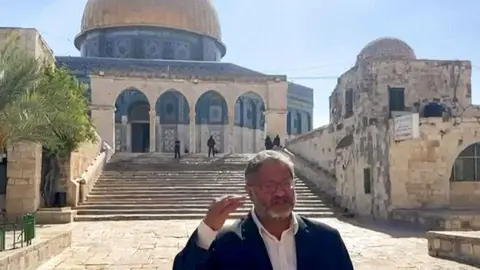
 Itamar Ben-Gvir X account Itamar Ben-Gvir stands wearing a white dress shirt and black suit jacket, motioning with one hand and speaking, in front of the blue-tiled and gold-domed al-Aqsa mosque.


Israel's far-right National Security Minister Itamar Ben-Gvir has visited the al-Aqsa Mosque compound in Jerusalem and prayed there, violating a decades-old arrangement covering one of the most sensitive sites in the Middle East.

Photos and videos of his visit show Ben-Gvir leading Jewish prayers at the compound, which is known by Jews as the Temple Mount, in occupied East Jerusalem.

Praying at the site breaks a long-time arrangement that allows Jews to visit the site but not pray.

The Israeli prime minister's office released a statement saying there had been no change to Israel's policy of maintaining the status quo agreement that allows only Muslim worship there.

Jordan, custodian of the site, called Ben-Gvir's latest visit "an unacceptable provocation".

Hamas called it "a deepening of the ongoing aggressions against our Palestinian people", while a spokesperson for Palestinian Authority President Mahmoud Abbas said the visit "crossed all red lines".

The site is the holiest place for Jews because it was the site of two Biblical temples. It is the third holiest place for Muslims, who believe it was where the Prophet Muhammad ascended to heaven.

It was captured by Israel from Jordan in the 1967 Middle East war. Under the status quo, Jordan was allowed to continue its historical role as custodian of the site, while Israel assumed control of security and access.

Palestinians accuse Israel of taking steps to undermine the arrangements and complain that in recent years Jewish visitors have often been seen praying without being stopped by Israeli police.

The Waqf, the Islamic endowment which runs the site, said Ben-Gvir was among 1,250 Jews who ascended the compound on Sunday morning.

Ben-Gvir, an ultra-nationalist who as national security minister oversees the police, has visited the site before, but the Times of Israel reported this was the first time that he openly prayed at the site.

He was flanked by police officers while entering and touring the compound.

In a statement at the site, Ben-Gvir said "horror" video of hostages recently released by Hamas, in which they appear emaciated, were aimed at putting pressure on Israel, and called for the hostages' return.

The minister also repeated his call for Israel to occupy the whole of the Gaza Strip and to encourage what he described as "voluntary emigration" of Palestinians from the territory.

Experts say this would amount to the forced displacement of civilians, and a possible war crime.

He has been sanctioned by the UK for "repeated incitements of violence against Palestinian communities" in the occupied West Bank.

Thursday, February 20, 2025

Jesus, the Book of Daniel and the Temple Institute - Chapter 13


Jesus, the Book of Daniel and the Temple Institute 

The book of Daniel not only contains many specific prophecies about the latter days, but also one that even Jesus Himself mentions to His disciples when talking about the end of the world:

When you therefore shall see the abomination of desolation spoken of by Daniel the prophet, stand in the holy place, (whoso reads, let him understand) then let them which be in Judah flee into the mountains: … For then shall be great tribulation, such as was not since the beginning of the world to this time, no, nor ever shall be.[1]

The fact that Jesus quotes from Daniel should motivate us to do a bit of study on the subject. Some eschatologists believe “the holy place” that Jesus was talking about could be a rebuilt Jewish temple on the Temple Mount. Presently in Jerusalem there exists an organization called the Temple Institute which is preparing for the eventual rebuilding of a Jewish Temple on the Temple Mount in Jerusalem, where today stands the Muslim’s Mosque of Omar. Read the following introduction to their site: 


SHALOM AND WELCOME to the official website of the TEMPLE INSTITUTE in Jerusalem, Israel. The Temple Institute is dedicated to every aspect of the Holy Temple of Jerusalem, and the central role it fulfilled, and will once again fulfill, in the spiritual well being of both Israel and all the nations of the world. The Institute's work touches upon the history of the Holy Temple's past, an understanding of the present day, and the Divine promise of Israel's future. The Institute's activities include education, research, and development. The Temple Institute's ultimate goal is to see Israel rebuild the Holy Temple on Mount Moriah in Jerusalem, in accord with the Biblical commandments.[2]

Following the Six-Day War of 1967, Christianity Today published an article saying, 

Israeli government representatives have ordered 60,000 tons of the finest Bedford stone from Bedford, Indiana to be used in the erection of the Jerusalem Temple….The cornerstones for the Third Temple are already in Israel. Materials for this Temple have been secretly in preparations for seven years.[3]

The Temple Institute argues that the above report is false. They say that the abundance of stones available in Israel makes the report highly unlikely. However, they do not deny the possibility of the stones having been already cut and prepared. If true, the stones necessary for the rebuilding of the Temple could be present in Israel at this very moment and could be assembled in a short period of time. All the various Temple ornaments have been carefully created in conformity with the instructions given by Moses for the original items.[4]

In a recent news article The Temple Institute has announced the opening of a training school for Levitical priests necessary to the services in the new Temple.[5] Another news article, "Preparing for the Third Temple," reinforces the ideas of the Temple Institute.

The author of the article, Daniel Ben Simon, goes on a visit to the Jewish Quarter of Old Jerusalem to see what preparations are being made for the building of the new Temple. For many Israelis the building of the Third Temple has become an all-consuming passion and work. They believe that the time may be just right for its establishment and want to do all they can to hasten the day when it will stand where the First and Second Temples once stood. 
One of the elite soldiers of the Temple who has dedicated his life to the Third Temple’s construction is Yehuda Glick. Since moving from New York to Israel, Glick has been preparing for the great day when the building will be constructed. The Temple will be the Jewish people’s most holy place on earth. Until then, he spends his time as a Temple Mount activist and serves as a 
tour guide to foreign visitors.

To Glick, there is no greater sensation in life than walking on the ground of the Temple Mount where Abraham offered sacrifice to God. Glick believes that the state of Israel is a Divine move, and the culminating manifestation of that Divine move will be the construction of the Third Temple on the Temple Mount.[6]

In similar fashion, the Jewish community of Shiloh, where the original Tabernacle stood before the building of the First Temple, is carefully sewing the veil of the Temple. The veil will be needed to enclose the “Holy of Holies.” The “Holy of Holies” is the area of the Temple where only the High Priest is able to enter, and only on one specific day of the year. Here’s a section of an article from May 2014 found in the magazine Israel Today called "Jewish Women Recreating Temple Veil."
If the Jewish Temple is ever to be rebuilt in Jerusalem, the massive curtain—66 feet high by 33 feet wide and 2 inches thick—that once hung in the Second Temple and was consumed by fire in A.D. 70, will need to be recreated. That task is already underway in the Jewish community of Shiloh, located in Biblical Samaria about 40 minutes north of Jerusalem, reports Israel Today. For more than two years women from the community have been working to assemble the materials and learn the techniques needed to weave the veil that will hang between, and separate, the Holy Place and the Holy of Holies.[7]

The Orthodox Jews who are preparing for the Temple’s reconstruction obviously take prophecy seriously. Many Christian Bible scholars agree that the reconstruction of the Third Temple is one of the main end-time events which ushers in the last three and half year period of world history known as the Great Tribulation. Are you aware of the prophecies concerning the rebuilding of the Temple and the beginning of animal sacrifices by the Jews on the Temple Mount? Are you aware of the Holy Covenant which seems to bring about the peace agreement in the Middle East? Do you know what the breaking of the covenant signifies, or in other words, who will break the covenant and what will happen afterwards? If you took Bible prophecy seriously, you would not be answer-less and empty-headed when asked these questions. 

Here is an update from June 2020. The Temple Institute announced that two red heifers have been produced that could serve as a sacrifice in the Temple according to Levitical laws. Watch the two minute video. 

[To go to the chapters 14-19 inclusive click on link.]
To go to the next chapter click HERE
Notes: First published in August 2020 online. Written in 2016.

[1] Matthew 24:15,16 & 21
[2] https://www.templeinstitute.org/ (accessed 03/2016)
[3] http://www.biblebelievers.org.au/temple.htm (accessed 03/2016)
[4] http://www.templemount.org/tempprep.html (accessed 03/2016)
[5] http://www.israelnationalnews.com/News/News.aspx/215910 (08/2016)
[6] Daniel Ben Simon, "Preparing For The Third Temple," Al-Monitor Israel Pulse, June 7, 2013 (accessed 03/2016)
[7] Israel Today, "Jewish Woman Recreating Temple Veil," May 28, 2014.

Thursday, December 26, 2024

Tuesday, December 15, 2020

Monday, August 1, 2016

Jesus, the Book of Daniel and the Temple Institute

Chapter 13 from Where is America in Bible Prophecy by Dennis Edwards

The book of Daniel not only contains many specific prophecies about the latter days, but also one that even Jesus Himself mentions to His disciples when talking about the end of the world:

When you therefore shall see the abomination of desolation spoken of by Daniel the prophet, stand in the holy place, (whoso reads, let him understand) then let them which be in Judah flee into the mountains: … For then shall be great tribulation, such as was not since the beginning of the world to this time, no, nor ever shall be.[1]

The fact that Jesus quotes from Daniel should motivate us to do a bit of study on the subject. Some eschatologists believe “the holy place” that Jesus was talking about could be a rebuilt Jewish temple on the Temple Mount. Presently in Jerusalem there exists an organization called the Temple Institute which is preparing for the eventual rebuilding of a Jewish Temple on the Temple Mount in Jerusalem, where today stands the Muslim’s Mosque of Omar. Read the following introduction to their site: 

SHALOM AND WELCOME to the official website of the TEMPLE INSTITUTE in Jerusalem, Israel. The Temple Institute is dedicated to every aspect of the Holy Temple of Jerusalem, and the central role it fulfilled, and will once again fulfill, in the spiritual well being of both Israel and all the nations of the world. The Institute's work touches upon the history of the Holy Temple's past, an understanding of the present day, and the Divine promise of Israel's future. The Institute's activities include education, research, and development. The Temple Institute's ultimate goal is to see Israel rebuild the Holy Temple on Mount Moriah in Jerusalem, in accord with the Biblical commandments.[2]

Following the Six-Day War of 1967, Christianity Today published an article saying, 

Israeli government representatives have ordered 60,000 tons of the finest Bedford stone from Bedford, Indiana to be used in the erection of the Jerusalem Temple….The cornerstones for the Third Temple are already in Israel. Materials for this Temple have been secretly in preparations for seven years.[3]

The Temple Institute argues that the above report is false. They say that the abundance of stones available in Israel makes the report highly unlikely. However, they do not deny the possibility of the stones having been already cut and prepared. If true, the stones necessary for the rebuilding of the Temple could be present in Israel at this very moment and could be assembled in a short period of time. All the various Temple ornaments have been carefully created in conformity with the instructions given by Moses for the original items.[4]

The news article Preparing for the Third Temple by Daniel Ben Simon reinforces the ideas of the Temple Institute.

The author of the article goes on a visit to the Jewish Quarter of Old Jerusalem to see what preparations are being made for the building of the new Temple. For many Israelis the building of the Third Temple has become an all-consuming passion and work. They believe that the time may be just right for its establishment and want to do all they can to hasten the day when it will stand where the First and Second Temples once stood. 

One of the elite soldiers of the Temple who has dedicated his life to the Third Temple’s construction is Yehuda Glick. Since moving from New York to Israel, Glick has been preparing for the great day when the building will be constructed. The Temple will be the Jewish people’s most holy place on earth. Until then, he spends his time as a Temple Mount activist and serves as a 
tourist guide to foreign visitors.

To Glick, there is no greater sensation in life than walking on the ground of the Temple Mount where Abraham offered sacrifice to God. Glick believes that the state of Israel is a Divine move, and the culminating manifestation of that Divine move will be the construction of the Third Temple on the Temple Mount.[5]

In similar fashion, the Jewish community of Shiloh, where the original Tabernacle stood before the building of the First Temple, is carefully sewing the veil of the Temple. The veil will be needed to enclose the “Holy of Holies.” The “Holy of Holies” is the area of the Temple where only the High Priest is able to enter, and only on one specific day of the year. Here’s a section of an article from May 2014 found in the magazine Israel Today called Jewish Women Recreating Temple Veil.

If the Jewish Temple is ever to be rebuilt in Jerusalem, the massive curtain—66 feet high by 33 feet wide and 2 inches thick—that once hung in the Second Temple and was consumed by fire in A.D. 70, will need to be recreated. That task is already underway in the Jewish community of Shiloh, located in biblical Samaria about 40 minutes north of Jerusalem, reports Israel Today. For more than two years women from the community have been working to assemble the materials and learn the techniques needed to weave the veil that will hang between, and separate, the Holy Place and the Holy of Holies.[6]

The Orthodox Jews who are preparing for the Temple’s reconstruction obviously take prophecy seriously. Many Christian Bible scholars agree that the reconstruction of the Third Temple is one of the main end-time events which ushers in the last three and half year period of world history known as the Great Tribulation. Are you aware of the prophecies concerning the rebuilding of the Temple and the beginning of animal sacrifices by the Jews on the Temple Mount? Are you aware of the Holy Covenant which seems to bring about the peace agreement in the Middle East? Do you know what the breaking of the covenant signifies, or in other words, who will break the covenant and what will happen afterwards? If you took Bible prophecy seriously, you would not be answerless and empty-headed when asked these questions.

Notes:

[1] Matthew 24:15,16 & 21
[2] https://www.templeinstitute.org/ (accessed 03/2016)
[3] http://www.biblebelievers.org.au/temple.htm (accessed 03/2016)
[4] http://www.templemount.org/tempprep.html (accessed 03/2016)
[5] Daniel Ben Simon, "Preparing For The Third Temple," Al-Monitor Israel Pulse, June 7, 2013 (accessed 03/2016)
[6] Israel Today, "Jewish Woman Recreating Temple Veil," May 28, 2014.

Saturday, June 6, 2015

Prayers Inflame Tensions Over Jerusalem Holy Site

Reuters, June 4, 2015

JERUSALEM–Every morning at 7.30, Murad Hamad sets up a flimsy plastic chair in the shade of the Moroccans’ Gate entrance to Al-Aqsa Mosque compound in Jerusalem and waits for the tourists to arrive.

Hamad’s job is to help keep the peace at one of the world’s holiest places, a site sacred to both Muslims, who call the compound the Noble Sanctuary, and to Jews, who refer to it as the Temple Mount because of the building that once stood there. The guard is not much concerned with the sun-creamed tourists. But he pays close attention to the groups of devout Jews and Israeli nationalists who try most days to enter the site and pray.

Those groups are at the centre of a creeping shift in Jerusalem: After 900 years, Jews are chipping away at Muslims’ exclusive control of the site, the third holiest in Islam. The shift, which has provoked violence in the past, threatens to open a dangerous new front in the Israel-Palestinian conflict, adding religious enmity to a political struggle in the very heart of the disputed city.

Al-Aqsa has banned non-Muslim prayer since 1187. Like Muslims across the region, Hamad and the other 70 or so guards employed by the Waqf, the Islamic trust that oversees the mosque, see Jews praying there as a serious insult.

The risk of confrontation remained small as long as the groups pushing for the right to pray remained at the fringes of Judaism. A decade or so ago, a handful of Jewish faithful would enter the compound each day. Attempts at prayer were rare. The Chief Rabbinate of Israel declared in 2007 that Jews should not visit the site because it was too holy.

But in recent years the radical fringe has become increasingly mainstream, drawing in nationalist, secular supporters and backing from high-profile politicians. A hundred or more Jews can arrive at the mosque some days, in large, organised groups. Last year Yossi Farenti, then Jerusalem District Police Chief, told the Israeli parliament’s Internal Affairs committee that the number of Jews visiting the site had increased 27 percent in the first half of 2014. “There is indeed a worsening in the past few years as to what happens at Temple Mount,” he said. “This is a fact. No one disagrees. You can see it in the numbers.”

A growing number of rabbis have contradicted the Chief Rabbinate, saying visits should be encouraged precisely because the Temple Mount is divine. Jewish visitors mumble prayers under their breath and walk barefoot on the ancient stones in a sign of obeisance.

A range of groups, some of them well financed by the Jewish diaspora, are campaigning for open access to Temple Mount, which Jews believe is the point from where God created the world and was the site of the second Jewish temple until 70 AD. They want the right for Jews to pray alongside Muslims. Some even want to build a new temple and have crafted sacred gold-and-silver vessels and hand-stitched priestly vestments ready for the day it is sanctified. Other supporters are breeding red heifers, hoping for one without a white blemish that can be sacrificially slaughtered at the temple, as described in the Book of Numbers.

Palestinian Muslims and others across the region fear their control is slipping.

“They want to change the rules,” said Hamad, the Waqf guard.

Perched on an esplanade at the eastern edge of Jerusalem’s Old City–the Mount of Olives and the Garden of Gethsemane behind–there are few patches of land more contested than this 35 acres.

The critical moment in the modern era was Israel’s capture of the Old City in the six-day war of 1967. For Israeli Jews, control of the Old City tied together politics, religion and nationhood. Following the victory, tens of thousands flocked to the Western Wall, believed to have been a retaining support for the second Jewish temple built 2,500 years ago. It was the first mass Jewish pilgrimage to the site since the temple’s destruction.

But days later, with the approval of the prime minister, Defence Minister Moshe Dayan went to see the imams of the Islamic Waqf and handed them back the keys to the mosque.

“I said that Israeli troops would be removed from the site and stationed outside the compound,” Dayan wrote in his autobiography. “The Israeli authorities were responsible for overall security, but we would not interfere in the private affairs of the Muslims responsible for their own sanctuaries.

“We had no intention of controlling Muslim holy places or of interfering in their religious life.”

Over time, a status quo evolved under which Jews have been allowed to enter and tour the area but forbidden to pray. Israeli police and some military help provide security, but the Waqf administers the compound.

There were some early attempts to change that. In the 1980s, a messianic terrorist group called the Jewish Underground plotted to blow up the Dome of the Rock and replace it with a temple. That plan was foiled by the Shin Bet, Israel’s domestic intelligence agency.

In 1990, another group calling itself the Temple Mount Faithful tried to lay a cornerstone for a new Jewish temple, provoking riots that killed 22 Palestinians.

The Waqf says things really began to shift from September 2000, when Ariel Sharon, then Israel’s opposition leader, visited Temple Mount with a large delegation just before an election. Many Palestinians saw the move as a provocation. It led to a violent uprising called the Second Intifada, also known as the Al-Aqsa Intifada, which continued for five years and left about 3,000 Palestinians and 1,000 Israelis dead. Access to Al-Aqsa for both Muslims and non-Muslims was greatly restricted.

In recent years the groups committed to overturning the status quo have shifted strategy, becoming more organised and gaining donors and influence.

While there are still radical elements, and frequent verbal and physical confrontations with Muslims at Al-Aqsa, the groups try to cast the issue as one of religious freedom, arguing that Jews should enjoy the same prayer rights as Muslims.

The most visible proponent of the new approach is Yehuda Glick, a red-bearded, American-born rabbi who set up the Temple Mount Heritage Foundation in 2007 and now acts as a spokesman for several Temple Mount organisations.

A 49-year-old father of eight, Glick has become a rallying figure for the movement, frequently photographed with supporters such as an outspoken politician from Netanyahu’s right-wing Likud party, or studying pictures of a possible new temple.

In 2013 and again in 2014 he was arrested by police after confrontations at Al-Aqsa and banned from visiting. He sued and won a court ruling allowing him to return once a month under tight supervision.

Last October, as Muslim anger at the presence of Jewish worshippers triggered clashes, Glick was shot four times by a Palestinian when he left a conference in central Jerusalem. After 10 days in a coma, and life-saving operations by a Muslim surgeon, Glick came around.

“I respect the Muslims’ right to pray,” he told Reuters as he recovered from his injuries. “But there is no reason in the world that at the only holy place for the Jewish people, a Jew should not have the right to pray.

“The Temple Mount is the holiest place in the world according to the Bible and there should be freedom to pray for all believers–Jews, Christians and Muslims.”

That is not how Mohammad Ahmed Hussein, the Grand Mufti of Jerusalem and the head of the Waqf, sees it.

As the inheritor of a job handed down almost without break since the 12th century, Hussein is the overriding religious authority at Al-Aqsa and holds the keys to the mosque. He believes the precedent created by more than 800 years of religious practice is incontrovertible.

“No one but Muslims are allowed to perform any kind of prayers at Al-Aqsa,” he told Reuters, referring to the compound rather than just the mosque itself.

“Jewish prayer at Al-Aqsa is not so much an insult as it is an aggression. If Jews try to pray at Al-Aqsa, it will only create more tensions in the region.”

For Israeli Prime Minister Benjamin Netanyahu, that is potentially a big problem.

Netanyahu has repeatedly said the arrangement that has governed Al-Aqsa since 1967 should not change. But after Glick was shot, Israeli authorities temporarily shut all access, including for Muslims. In protest, Jordan withdrew its ambassador to Tel Aviv, the first time it had taken such a step since signing a peace deal with Israel in 1994. Jordan has had special responsibility for Al-Aqsa since the 1967 war. The Hashemite Kingdom has financed the Waqf and paid for renovations to the mosque and the Dome of the Rock. Its anger was echoed in Egypt, Saudi Arabia and beyond, leaving Netanyahu worried about regional stability.

He beefed up Israeli security around the Old City, a move that many Palestinians saw as proof that change was coming.

Six months on, the situation appears calmer, though tensions remain.

Five days a week–there is no access on Fridays or Saturdays–religious-nationalist Jews join foreign tourists to walk up the covered wooden ramp, through the Moroccans’ Gate, the only one of the 11 ancient gates non-Muslims can use, and into the holy compound.

Israeli guards assemble the Jews into groups of 10, confiscate their religious and prayer accoutrements for the length of the visit, and then assign them Israeli police escorts.

At the top of the ramp, where Israeli forces keep dozens of riot shields and other security equipment, Waqf guards join the Jewish groups. The Israeli police lead the visitors around, while the Waqf guards maintain more distance.

On one recent visit, a pious Jewish teenager, yarmulke on his head and long curls hanging either side of his face, fell to the ground in the act of prayer. Police quickly hoisted him to his feet and warned that he would be thrown out if he tried to pray again.

As the group passed in front of Al-Aqsa mosque, the police urged them not to get too close. Several ignored the warnings and stepped towards the portico, where Muslim men and women enter via separate doorways.

A group of women in headscarves and veils began shouting “Allahu Akbar” (“God is Greatest”) at the top of their voices, protesting the group’s presence.

As the Jewish group moved away from the mosque into a grove of trees on the eastern edge of the plaza, it was left alone, allowing surreptitious prayer to begin.

Efrem Goldberg, an American rabbi, wrote an account of a visit he made to the Temple Mount last year, in which he described feeling intimidated by Muslims there. “In a small gesture of defiance,” he wrote, “we continuously prayed in our hearts and when we paused opposite the Kodesh Ha’ Kadashim”–the Holy of Holies, where Jews believe the Ark of the Convenant once stood–“we even had Daniel Katz,” a rabbi, “give us the priestly blessing.”

Netanyahu said in a speech that “only under Israeli rule will there be freedom of worship for all religions in Jerusalem. Believers pray at their holy sites not in spite of our rule in the city, but precisely because of it.”

Some Palestinians think it is a matter of time before Temple Mount supporters in the Israeli government propose dividing up prayer times, giving Muslims certain hours to worship and Jews others.

Glick said the momentum is all in one direction.

“The Third Temple, which will be a house of prayer for all nations, will be built very soon,” he said, repeating a mantra of the Temple Mount faithful.

Hamad, who said he has seen a steady change during his 10 years as a Waqf guard, is convinced a crisis is coming.

“It’s going to blow up,” said the 36-year-old. “It’s certain.”

Tuesday, September 24, 2013

Jews Challenge Rules to Claim Heart of Jerusalem

By Jodi Rudoren, NY Times, September 21, 2013

JERUSALEM—Small groups of Jews are increasingly ascending the Temple Mount in Jerusalem’s Old City, a sacred site controlled for centuries by Muslims, who see the visits as a provocation that could undermine the fragile peace talks started this summer.

For decades the Israelis drawn to the site were mainly a fringe of hard-core zealots, but now more mainstream Jews are lining up to enter, as a widening group of Israeli politicians and rabbis challenge the longstanding rules constraining Jewish access and conduct. Brides go on their wedding days, synagogue and religious-school groups make regular outings, and many surreptitiously skirt the ban on non-Muslim prayer, like a Russian immigrant who daily recites the morning liturgy in his mind, as he did decades ago in the Soviet Union.

Palestinian leaders say the new activity has created the worst tension in memory around the landmark Al Aksa Mosque and Dome of the Rock, and have called on Muslims to defend the site from “incursions.” A spate of stone-throwing clashes erupted this month: on Wednesday, three Muslims were arrested and an Israeli police officer wounded in the face. And on Friday thousands of Arab citizens of Israel rallied in the north, warning that Al Aksa is in danger.

"We reject these religious visits," Sheik Ekrima Sa’eed Sabri, who oversees Muslim affairs in Jerusalem, said in an interview. "Our duty is to warn," he added. "If they want to make peace in this region, they should stay away from Al Aksa."

The 37-acre site is perhaps the most religiously contested place on earth. Jews revere it as the home of the First and Second Temples more than 2,000 years ago. For Muslims, who call the site the Noble Sanctuary, it is the world’s third holiest spot, from which Muhammad is believed to have ascended to heaven. More than 300,000 foreign tourists also flock there annually, many of them Christians drawn to the ruins of the temple Jesus attended.

Politically, the competing claims to the area are the nut around which the Israeli-Palestinian conflict revolves, the symbolic heart of each side’s religious and historical attachment to Jerusalem that has made its governance one of the thorniest issues in peace negotiations.

Israel captured the site along with the rest of East Jerusalem and the West Bank in 1967, with a general declaring dramatically, “The Temple Mount is in our hands!” But the government immediately returned control to the Muslim authorities, and ever since, a de facto accommodation has prevailed in which Muslims worship at Al Aksa above and Jews at the Western Wall below, a remnant of the retaining wall around the ancient Second Temple.

There have been flare-ups before. In 2000, a visit by Ariel Sharon, then Israel’s opposition leader, accompanied by 1,000 police officers, prompted a violent outbreak and, many argue, set off the second intifada.

Over the last few years, a cause long taken up by only a fringe group of far right-wingers has increasingly been embraced by the modern Orthodox—known here as religious Zionists—who have also gained political power. At three recent Parliament hearings, religious lawmakers and cabinet ministers questioned the status quo, in which non-Muslims can enter the site only for a few hours five days a week, and those identified by the police as Jews are separated, escorted by police officers and admonished not to dance, sing, bow down or even move their lips in prayer.

"The Temple Mount is in our hands—but is it really?" asked Michael Freund, a Jerusalem Post columnist who visited the site as a child in 1977 and returned for the first time last year, with 50 members of his synagogue. "It particularly offends me that the Israeli government puts into place restrictions which prevent Jews from fulfilling their basic right to freedom of worship."

Jack Stroh, a cardiologist from East Brunswick, N.J., who visited on Wednesday, has been bringing friends for five years before the holidays of Sukkot and Passover—two of three pilgrimage festivals when ancient Jews were required to pray at the temples.

"My cousin said that if Jews don’t go up to the mountain there is an increased chance that the government will say Jews are not interested and will give it away," he said as his group waited to enter. "I’m taking them up. Someone took me up. They’ll take other people up; it’s a growing phenomenon."

Amid the religious pilgrims on Wednesday was Michal Berdugo, 25, a secular Israeli who said it had been her “dream for three years” to visit. “It’s part of who we are,” she said.

The recent shift has many roots. For years, most authorities on Jewish law said Jews should not enter the complex for fear of treading on the ancient temple’s holiest spots, but recent archaeological work has led some moderate and even liberal Orthodox rabbis to lift those bans. At the same time, activists have stepped up their campaign for access and prayer at the Temple Mount, part of a broader push to cement Jewish control of all of Jerusalem.

Experts who have observed the phenomenon also see it as a reaction to Israel’s evacuation of Jews from the Gaza Strip in 2005, a redirection of Messianic energy once devoted to West Bank settlements that many fear could soon succumb to the same fate to make way for a Palestinian state.

"The war for the land of Israel is not just political, but essentially spiritual," said Yossi Klein Halevi, author of a new book that traces the lives of paratroopers who seized the Mount in 1967. "Given that the Temple Mount is the focal point of holiness in the Holy Land, the thinking is that we need to go to the source in order to prevent the further partition of the land."

Israel Police statistics show visits by people identified as Jews rose to 8,247 in 2011 from 5,792 in 2010, then dipped slightly last year. The figure is on track to top 2011’s total this year, with 5,609 Israelis coming through July. Crowds—and clashes—are expected Sunday and Monday for Sukkot.

While the numbers remain tiny compared with the 10 million annual visitors to the Western Wall below, Palestinian officials say what used to be a trickle of individuals has given way to groups of 40, 60, 90. They were particularly alarmed that the Israeli police commissioner told a newspaper this month that “every Jew who wishes to pray at the Temple Mount can pray on the Temple Mount,” though his subordinates said afterward that did not change the police policy on the ground preventing non-Muslim prayer. A recent visit by the right-wing housing minister also stirred outrage.

"Before, it was some settlers from here, some extremists from there; now we start to hear it from the real officials," said Adnan Husseini, the Palestinian governor of Jerusalem. "When they get inside with this big number, it’s sure that they will make some kind of religious activities and there will be more friction between them and the people inside the mosque."

The Palestinians have complained to the United Nations, the Arab League and Secretary of State John Kerry, most recently after Wednesday’s clash, when the chief Palestinian negotiator wrote to Mr. Kerry saying the issue “could inflame the situation and undermine the current opportunity to move toward peace.”

Israel’s chief rabbinate still maintains the Mount is off limits to Jews—a sign saying so is posted at the gate. But a senior Israeli official, speaking on the condition of anonymity, said the government supports “in principle” Jews’ rights to pray there, adding, “we’ve got to do it in a measured way, a sensitive way.”

As visiting the Mount has become more mainstream—one Israeli newspaper has since December 2011 devoted a full page weekly to news and columns about the site—the original hard core has been emboldened. A group formed last year calls for building a small synagogue on the plaza. Yehuda Etzion, who was arrested in 1984 for plotting to blow up the Dome of the Rock, and a team of architects are designing a “future Jerusalem” plan with a new temple at its heart. An activist group’s Web site devoted to the Mount unveiled a virtual tour this summer with a Third Temple where the Dome stands.

"We’re talking about something much deeper than visiting the place, we’re talking about a movement that wants to change the status quo from its roots," said Yedidia Z. Stern, a vice president of the Israel Democracy Institute, an Orthodox Jew with liberal leanings who has watched the change with concern. "You’re dealing with the ultimate TNT in our national existence here."

For Max Freidzon, the Russian immigrant, visiting the site has become a daily ritual: he stands still several times on his stroll around the Mount, and goes through the morning prayers—including a plea to rebuild the temple—without moving his lips.

"The situation is the same like it was in the Soviet Union," said Mr. Freidzon, 46, citing the police escorts, the identification checks, and the ban on religious texts and on a minyan, the 10-person quorum required for public communal prayer. "Step by step, the situation will change. It’s necessary to pray here, and to make here minyan, and to build here temple."

Copyright © Fight for Your Faith