Thursday, April 23, 2026
Sunday, August 3, 2025
Israeli minister sparks anger by praying at sensitive Jerusalem holy site

Photos and videos of his visit show Ben-Gvir leading Jewish prayers at the compound, which is known by Jews as the Temple Mount, in occupied East Jerusalem.
Praying at the site breaks a long-time arrangement that allows Jews to visit the site but not pray.
The Israeli prime minister's office released a statement saying there had been no change to Israel's policy of maintaining the status quo agreement that allows only Muslim worship there.
Jordan, custodian of the site, called Ben-Gvir's latest visit "an unacceptable provocation".
Hamas called it "a deepening of the ongoing aggressions against our Palestinian people", while a spokesperson for Palestinian Authority President Mahmoud Abbas said the visit "crossed all red lines".
The site is the holiest place for Jews because it was the site of two Biblical temples. It is the third holiest place for Muslims, who believe it was where the Prophet Muhammad ascended to heaven.
It was captured by Israel from Jordan in the 1967 Middle East war. Under the status quo, Jordan was allowed to continue its historical role as custodian of the site, while Israel assumed control of security and access.
Palestinians accuse Israel of taking steps to undermine the arrangements and complain that in recent years Jewish visitors have often been seen praying without being stopped by Israeli police.
The Waqf, the Islamic endowment which runs the site, said Ben-Gvir was among 1,250 Jews who ascended the compound on Sunday morning.
Ben-Gvir, an ultra-nationalist who as national security minister oversees the police, has visited the site before, but the Times of Israel reported this was the first time that he openly prayed at the site.
He was flanked by police officers while entering and touring the compound.
In a statement at the site, Ben-Gvir said "horror" video of hostages recently released by Hamas, in which they appear emaciated, were aimed at putting pressure on Israel, and called for the hostages' return.
The minister also repeated his call for Israel to occupy the whole of the Gaza Strip and to encourage what he described as "voluntary emigration" of Palestinians from the territory.
Experts say this would amount to the forced displacement of civilians, and a possible war crime.
He has been sanctioned by the UK for "repeated incitements of violence against Palestinian communities" in the occupied West Bank.
Tuesday, March 18, 2025
Monday, February 10, 2025
Musk Says DOGE, Treasury Agree on New Anti-Fraud Measures
Seeking to Claw Back $50 Billion in Payment Fraud

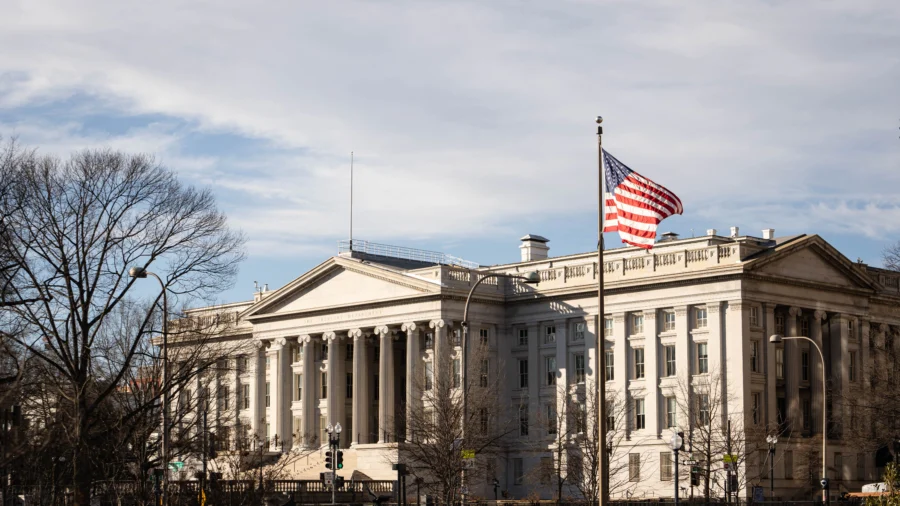
Elon Musk said Saturday that the Department of Government Efficiency (DOGE) and the U.S. Treasury Department have agreed on new anti-fraud measures aimed at preventing tens of billions of dollars in fraudulent government entitlement payments each year.
In a Feb. 8 statement shared on social media, Musk described the scale of the problem as “utterly insane,” citing estimates that at least $50 billion annually is being lost due to improper payments, including funds going to individuals without Social Security Numbers or even temporary ID numbers.
Musk, who leads DOGE and has been designated a “special government employee” by President Donald Trump, revealed in the post that Treasury officials estimated that $100 billion in annual entitlement payments may be going to individuals without verifiable identification.
In a discussion with Treasury personnel, Musk said he asked for an estimate of how much of that is “obvious and unequivocal” fraud, and the consensus was that at least half—$50 billion per year, or around $1 billion per week—is fraudulent.
“This is utterly insane and must be addressed immediately,” Musk wrote, adding that the DOGE team and Treasury have jointly agreed to a series of reforms.
One of the most significant changes will be the requirement that all outgoing government payments include a payment categorization code. According to Musk, these codes are essential for financial audits, yet they are frequently left blank, making it nearly impossible to track where taxpayer dollars are going.
Under the new rules, every payment will also need to include a rationale in the comment field. Currently, many government payments lack any explanation, making it difficult to assess their legitimacy, Musk said. While he emphasized that no judgment will be applied to these rationales at this stage, requiring at least some justification for payments is expected to serve as a deterrent against waste and fraud.
Another reform involves more effective implementation of Treasury’s Do-Not-Pay list, which is meant to prevent payments to fraudulent entities, deceased individuals, suspected terrorist fronts, and other entities or people who should not be paid by federal agencies. Musk said that this list has not been strictly enforced, with some payments still being made to flagged entities. He also pointed out that it can take up to a year for names to be added to the list, calling for weekly or even daily updates to prevent ongoing fraud.
Musk said that the above “super obvious and necessary” changes will be implemented by existing, long-time career Treasury employees; not anyone from the DOGE. His remarks in this regard align with Treasury Department Scott Bessent’s insistence that DOGE members have read-only access to Treasury data and that they have not been “tinkering” with sensitive payment systems at the department.
The development comes as DOGE focuses its cost-cutting and efficiency-enhancing efforts at multiple federal agencies, including Treasury, as part of the Trump administration’s broader aim of reducing deficits and eliminating fraud, waste, and abuse from government.
Republicans have praised DOGE’s efforts to identify government waste, while Democrats have denounced the body’s actions as an abuse of power and its operations as skirting congressional oversight. There have been protests over DOGE by members of Congress, federal employee unions, and privacy advocates, along with a number of lawsuits targeting its activities. Recently, a judge blocked DOGE’s access to the personal financial data of millions of Americans at the Treasury Department.
Bessent recently defended DOGE’s actions at Treasury. He said in an interview with Bloomberg that the DOGE team is made up of highly trained professionals and “not some roving band running around doing things,” possibly in reference to claims by critics that DOGE has embraced and is applying the adage “move fast and break things,” which is part of the Silicon Valley start-up culture of being innovative, nimble, and disruptive.
“This is methodical and it’s going to yield big savings,” Bessent said of DOGE’s work at Treasury.
In a follow-up post on Saturday, Musk said that the reason no action was taken under prior Treasury leadership to tackle the $50 billion or more in fraudulent government payments is complacency.
“Nobody in Treasury management cared enough before,” Musk wrote. “I do want to credit the working level people in Treasury who have wanted to do this for many years, but have been stopped by prior management. Everything at Treasury was geared towards complain minimization.”
The Epoch Times has reached out to the Treasury Department with a request for comment.
From The Epoch Times
Sunday, January 14, 2024
Tuesday, January 9, 2024
Tuesday, August 15, 2023
Wednesday, June 2, 2021
Why Are Progressives Obsessed with the Transgender Policies at the College of the Ozarks?
https://mises.org/wire/why-are-progressives-obsessed-transgender-policies-college-ozarks
TAGS Bureaucracy and RegulationU.S. History
Earlier this year I argued that the state is necessarily hostile to Christianity due to it being not only a rival pole of power in society, but because the state itself promotes its own religion in the form of progressivism. I noted at the time that legislation like the Equality Act is an attempt to force progressive dogma onto the rest of society and to further undermine and supplant the remaining vestiges of independence in society. A recent lawsuit regarding housing policy on college campuses serves as another reminder of what this process looks like in action.
On his first day in office, Joe Biden signed the Executive Order on Preventing and Combating Discrimination on the Basis of Gender Identity or Sexual Orientation, which expanded the definition of sexual discrimination to include, as the name suggests, discrimination on the basis of gender identity and sexual orientation. It then directed the executive agencies to review their policies and to change them in accordance with this guidance. On February 11 the Department of Housing and Urban Development (HUD) released its updated guidance to reflect that discrimination on the basis of gender identity or sexual orientation would be considered a violation of the Fair Housing Act.
The College of the Ozarks is a unique conservative Christian school located in Missouri, and as one might expect of a conservative Christian school, it has long prohibited biological males and females from sharing the same dorms, bathrooms, and showers regardless of their sexual and gender identity. In response to this new HUD policy, the school, working with the public interest law firm Alliance Defending Freedom, sued the government in April, seeking to have the rule overturned because its implementation did not follow proper procedure and also seeking a temporary restraining order and preliminary injunction because the college is in the middle of organizing the housing for the incoming freshmen in the fall and the new rule has caused “immediate upheaval” for the school administration.
So far, the school’s legal efforts have come to naught. At the time of writing, district judge Roseann Ketchmark, who was appointed by Obama and confirmed with no Republican opposition, has yet to release her written ruling, but she has announced that she will not issue the injunction. Without the written ruling it is not exactly clear where the case will go from here, but Fox News reports that the school’s lawyers plan to challenge the dismissal.
The College of the Ozarks is very small, with only around fifteen hundred students, and its policies make clear that such a school is not for everyone. In contrast to the stereotypical “party hardy” attitude at many colleges, College of the Ozarks is a dry campus and forbids students from partaking in alcohol even off campus. The school also has a curfew, and forbids sexual relations with anyone of the same sex, sex outside of marriage, gender expression inconsistent with sex assigned at birth, and gender transitioning. Students are required to attend religious services at least five times a semester and there is a campus dress code. All full-time students are required to work on campus to fund at least part of the costs of admission.
All that is to say that College of the Ozarks is a different kind of college than most and that unless a prospective student is completely clueless, they know what they are getting themselves into when they apply and choose to attend. Such a school may not be my or your cup of tea, but its continued existence demonstrates that it does provide value for those students who do attend.
This case once again demonstrates the Borg-like attitude that is at the heart of the progressive movement and its inability to brook any dissent, no matter how small. All of society must heel before the progressive dogma of the day and any deviation, no matter how small and insignificant, must be crushed. No one is going to go to College of the Ozarks expecting to go to a party school like the University of West Virginia. It is not clear why someone who identifies as transgendered would ever want to go to College of the Ozarks in the first place other than to troll them and try to sue them into oblivion. The only reason the school cannot be left in peace is because progressivism is a religion of zealots who will never stop as long as they have the power to enforce their will upon others.
Mises stated in Liberalism that “A free man must be able to endure it when his fellow men act and live otherwise than he considers proper. He must free himself from the habit, just as soon as something does not please him, of calling for the police.” In a truly liberal society there is room for people and institutions of many different faiths and world views to live in relative peace and harmony. We are fortunate to live in a country that has such a diverse array of people and places. Even before the founding of the United States, America had been a refuge for people who do things differently. It is without a doubt ironic that the land founded upon nonconformity and relative peaceful coexistence is slowly and seemingly inexorably being crushed into a homogenous cube by the grinding machinery of the state and its zealot pilots under a banner of diversity and tolerance.
Zachary Yost is a freelance writer and Mises U alum. You can subscribe to his newsletter here.
Friday, October 23, 2020
Friday, January 31, 2020
Israel could clash with international court on settlements! (AP)
Wednesday, July 1, 2015
Thursday, May 14, 2015
How moms set children’s spiritual compass and why it matters
Religious identity used to be “inherited.” “Cradle Catholic” is shorthand for born into the faith; within Judaism, the faith is passed through a Jewish mother to her children unless they grow up to proclaim a different religion.
But children don’t just inherit parents’ spirituality, says psychologist Lisa Miller in her new book, “The Spiritual Child.” She writes that the essential sense of a transcendent power in the world–one that will love, guide and accept them and wrap them in a protective layer of self-worth–has to be nurtured.
And for that, call (and thank) your mom or grandmom.
Miller, professor and director of clinical psychology at the Teachers College of Columbia University, scrupulously uses the neutral reference to “parents” throughout “The Spiritual Child.” But sorry, fellas, her research and narrative examples are replete with women in a book released just in time for Mother’s Day.
“Science shows women are central to the spiritual development of children and that their sense of connection to a God or higher power is the cornerstone of psychological thriving and resilience across their life span,” Miller said in an interview.
“Children get plenty of good things from dad, but it’s the mother whose spiritual practices and observances really impact both daughters and sons, particularly daughters,” she said. Miller’s studies found children with a spiritual connection at a young age were “90 percent less likely to be depressed” as teens or young adults.
This does not necessarily mean a forced march to a house of worship–which can be a complicated command for many interfaith couples who often compromise by making no religious choice at all. Miller sees no advantages in organized, branded religions–particularly ones that minimize women’s roles, which her research showed “gave no benefit” to women’s spiritual and psychological well-being.
The key is to “figure out how you pray,” said Miller, with an emphasis on the personal.
“It’s less important which religious tradition you observe if your children hear you speak authentically about spirituality and your own relationship to the creator and you let them know the spiritual life is as real as the earth under our feet: We stand on it and we count on it,” said Miller.
Miller, 48, who is Jewish, said she grew up in the Midwest in a community where, she said, “spirituality was in the water. We knew we were born spiritual. It was based on love and on relationships.”
Wednesday, July 11, 2012
Why is walking in the woods is good for you?
Alex Hutchinson, The Globe and Mail, May. 27 2012
In Japan, they call it shinrin-yoku—literally, “forest bathing.” Here, we might just call it a walk in the park. Either way, people around the world have an intuitive sense of the restorative power of natural environments. The question is: Why?
Scientists have advanced a wide range of theories about the specific physical and mental benefits nature can provide, ranging from clean air and lack of noise pollution to the apparent immune-boosting effects of a fine mist of “wood essential oils.” But the most powerful benefits, a new study suggests, may result from the way trees and birds and sunsets gently tug—but never grab—at our attention.
The study, which will appear in a forthcoming issue of the Journal of Affective Disorders, found that volunteers suffering from depression who took a 50-minute walk in a woodland park improved their cognition, as measured by the ability to remember a random string of digits and repeat them in reverse order, compared to those who took a walk through city streets. An earlier study found similar results in subjects who weren’t depressed.
The explanation, according to lead author Marc Berman, a research fellow at the Rotman Research Institute at Baycrest in Toronto, lies in the distinction between two types of attention: “voluntary,” in which we consciously focus on something; and “involuntary,” in which something grabs our attention.
The ability to direct voluntary attention is crucial in daily life (and for cognitive tasks like remembering random digits), but it’s easily fatigued. Dr. Berman and his colleagues believe that going for a walk in the park gives voluntary attention a break, since your mind has a chance to wander aimlessly and be engaged—involuntarily but gently—by your surroundings.
“In a lot of natural areas, you’re away from loud noises and distractions,” Dr. Berman explains. “It tends to be less crowded so you don’t have to worry about bumping into people, and it also has interesting stimulation to look at, which captures your attention automatically.”
In contrast, honking horns and traffic lights and crowded sidewalks—and pretty much every other ingredient of modern life in a big city—constantly force you to exert your voluntary attention to react or block them out, leaving you more cognitively depleted.
All this makes it sound as if the benefits of nature are mostly in your head. It’s true that simply looking out a window at nature or, to a slightly lesser extent, looking at pictures of nature scenes can produce some of the same effects. But the physical environment itself may also play a role, Dr. Berman notes.
One obvious candidate is air quality: A single exposure to polluted air can trigger lung and heart problems, and chronic exposure has been linked to cognitive decline. Even downtown parks and riverside bike paths are likely to have significantly better air quality than busy city streets, and trees offer an additional protective effect. The level of vehicle emissions just 200 metres away from a road is already four times lower than it is on the sidewalk next to the road.
A more unusual suggestion, proposed by researchers at Japan’s Nippon Medical School, is that trees emit a fine mist of health-giving “wood essential oils.” In a series of shinrin-yoku studies, the researchers have reported that walking for two hours in a forest enhances immune function (as measured by levels of “natural killer cells”), reduces levels of stress hormones and lowers blood pressure, compared to similar walks in downtown Tokyo.
(Before you rush out to buy a case of wood essential oils, it’s worth noting that this research was funded in part by Japan’s Forestry and Forest Products Research Institute.)
Still, the fact that pictures of nature can produce cognitive benefits suggests that at least part of the effect is mediated by what we see. One simple hypothesis is colour: Nature scenes tend to feature more green than urban scenes. A more subtle possibility is that natural landscapes have more fractal patterns—a mathematical classification that describes the complex shapes of phenomena like coastlines, mountain ranges and broccoli florets—compared to the simple straight lines that characterize man-made environments.
“Maybe looking at these fractal patterns captures attention automatically, which leads to this more restorative process,” Dr. Berman says.
Teasing out the key variables will take time—and ultimately, it seems unlikely that there’s a single magical quality or essential oil that fully explains the call of the semi-wild. For now, it’s enough to know that the benefits of exposure to nature are real and measurable. And in an increasingly distracting and distracted world, they’re more important than ever.
Friday, July 6, 2012
How to Make Optimism Work for You!
My recent column on optimism drew hundreds of comments from readers who testified to the value of living life as a glass half full. But one in particular—from a 90-year-old man living in Calabasas, Calif.—was especially telling. The reader, William Richmond, wrote that a phrase in the column, “Fake it until you make it,” summed up his long and very successful life.
His approach to life could serve as a battle plan for the millions of recent college graduates now searching for work in an unforgiving job market, as well as for older adults trying to re-enter the workplace after a long hiatus and those who lost jobs and must now reinvent themselves.
In 1946, after serving nearly four years as a fighter pilot in the Marine Corps, Mr. Richmond said he returned to civilian life “certain I could conquer anything I went after.”
After all, he’d managed to fly solo and safely land a Piper Cub after just six hours of training, then spent the next year learning to be a pilot. “Do it, then learn how—I guess if it’s good enough for the Marines…,” he wrote.
Mr. Richmond loved jazz and, having been handed a drum to play in his middle school band in Rockford, Ill., he decided to go to Los Angeles to become a professional musician.
“I wasn’t very good, but I could keep pretty good time and could look like I knew what I was doing,” he wrote. “In a few months I actually got a job in a downtown bar and in due time was playing in a big band.”
But recognizing his musical limitations, he then enrolled in a music college to learn how to be a professional drummer, after which he worked almost nonstop for 15 years in big-name bands, playing for singers like Peggy Lee, Ella Fitzgerald and Frank Sinatra—and finally for Jerry Lewis.
Noting Mr. Richmond’s ability to make people laugh, Mr. Lewis asked him up to write jokes, then a movie, “The Ladies Man” (1961), which was a success even though his collaborator, Mel Brooks, quit early on, leaving Mr. Richmond, a complete novice, to write it. After taking a class in screenwriting, Mr. Richmond wrote six more movies for Mr. Lewis, and followed that with 30 years as a professional comedy writer on countless TV shows before retiring at age 73.
“The important thing,” Mr. Richmond said in an interview, “is to visualize what you want and go after it. Be ready for an opening—serendipity—all the time.”
Elaine Fox, a psychologist at the University of Essex in England and author of an informative new book on the science of optimism, “Rainy Brain, Sunny Brain,” says positive thinking is not the main thing about optimism.
“What really makes the difference is action,” she told me. “If you sit back passively, you won’t get the job you want.”
Her book includes the story of Madam C. J. Walker (1867-1919), born to former slaves, orphaned by age 7, married at 14 and divorced at 20. Undeterred by racism and sexism, she became perhaps America’s first black millionaire by founding a company that made hair-care products.
“Madam Walker’s rags-to-riches story was fueled primarily by her irrepressible can-do attitude,” Dr. Fox wrote. “Setbacks were tackled head on with tireless energy.”
After Thomas Edison unsuccessfully tried more than 10,000 different ways to develop an electric lamp, Dr. Fox wrote, “he famously proclaimed: ‘I have not failed. I’ve just found 10,000 ways that won’t work.’ “
In an interview, Dr. Fox said: “The important thing is having a sense of control over your life, your destiny. When you have a setback, you feel you can do something about it.”
Or, as she wrote: “Optimism is not so much about feeling happy, nor necessarily a belief that everything will be fine, but about how we respond when times get tough. Optimists tend to keep going, even when it seems as if the whole world is against them.”
Sometimes a little bluffing helps. Mr. Richmond said he got his first professional break by telling other musicians he was a great drummer. One thing led to another, until he got a job with a band that was to play one-nighters on the road for nine months.
“After the first night, I was fired—I just wasn’t good enough,” he recalled. “But they had to keep me until they found a replacement, and gradually I started to play better and better, so I kept the job.”
Many people trying to enter (or re-enter) the job market have found that it helps to put yourself where you want to be, even if it involves a monetary sacrifice.
Robin Seligman-Schmidt of Manhattan was 52 when she decided look for work in the fields she had studied in school: art and interior design.
She started by volunteering at the Leo Baeck Institute, a research library in New York that houses German-Jewish archives and art. “I worked with an art curator cataloging and doing odds and ends,” she said, and that led to a paid position as consultant for “Destination Shanghai”—an exhibition of work by and about German and Austrian Jews who escaped to China during World War II, now on display at the institute.
“Through volunteering you might find something totally different that you’d never done before or even thought of before,” was Ms. Seligman-Schmidt’s advice to job seekers of all ages. “Do something to keep your mind going, and you might find something that really interests you.”
Dr. Fox has shown that while brain circuits vary from person to person, it is possible to strengthen what she calls the “sunny” brain and weaken the “rainy” brain.
Among the science-based “retraining” methods she describes in her book are these:
* Face your fears head on. Step outside your comfort zone to help eliminate fear, anxiety and negative thoughts that can stand in the way of success.
* Re-evaluate events in your everyday life. Tell yourself that maybe things aren’t so bad.
* Practice mindful meditation. Allow feelings and thoughts to pass through your mind without judging or reacting to them; that helps create a sense of detachment from negative experiences.
* Take control over how you feel instead of letting feelings control you. A sense that you control your destiny can help you bounce back from setbacks and maximize your enjoyment of life.
* Laugh. Use positive feelings to counter negative ones.
* Be fully engaged. Get involved in activities that are meaningful to you, whether it’s a career, hobby, sport or volunteering. Do it, as Bill Richmond says. Then learn how.
Monday, July 2, 2012
Ten Habits of Grateful People- Even In Tough Times!
Stepcase Lifehack, 28 Jun 2012