Does your faith need strengthening? Are you confused and wondering if Jesus Christ is really "The Way, the Truth, and the Life?" "Fight for Your Faith" is a blog filled with interesting and thought provoking articles to help you find the answers you are seeking. Jesus said, "Seek and ye shall find." In Jeremiah we read, "Ye shall seek Me, and find Me, when ye shall seek for Me with all your heart." These articles and videos will help you in your search for the Truth.

Wednesday, December 13, 2017

Trump Risks Uniting the Entire Arab World Against the US

Patrick Cockburn, The Independent, December 9, 2017

President Trump and the Israeli government will have foreseen and discounted a Palestinian “day of rage” and protests among Muslims everywhere in the wake of the US recognition of Jerusalem as the capital of Israel and plans to move its embassy there. They assume that this will all blow over because US allies such as the rulers of Saudi Arabia, UAE and Egypt will be satisfied with pro-forma protests, and the Palestinians are too weak to do anything except demonstrate ineffectively.

The US and Israel could be miscalculating: when I lived in Jerusalem I came to believe that many dramatic events in Israel, such as shootings and bombings, often had less effect than the outside world expected. But anything involving Jerusalem itself, and above all its Muslim holy sites, had a much bigger impact than anybody had imagined.

The immediate consequence of Trump’s action is that the US becomes weaker because it has carried out another initiative of which the rest of the world disapproves. A superpower at the height of its strength might get away with such a demarche, but not a politically divided US, its influence already ebbing because of failures in Iraq and Afghanistan. The move is so obviously against US foreign policy interests that it will further persuade other world leaders that Trump is an impossible ally.

The move could have other dangerous consequences. There is a myth that the Israeli-Palestinian struggle was not an issue that concerned Osama bin Laden or played a role in the rise of al-Qaeda. In fact, bin Laden’s speeches and writings are full of references to the Palestinians–and his first public utterances in the 1980s were calls for a boycott of American goods because of its backing for Israel.

The connection between the Palestinian question and 9/11 was played down at the time, particularly by neocon pundits and think tanks who claimed that the US could safely ignore the issue while pursuing an aggressive policy in Iraq. It is true that 9/11 damaged the Palestinians because they were marginalised as the US and its allies began a series of wars during which they largely disappeared from the news agenda.

But as the wars in Iraq and Syria come to an end, focus will shift back to Israel and the Palestinians. Isis and al-Qaeda have been defeated in their efforts to change regimes in Baghdad and Damascus. If they are going to survive and get support in the Muslim world, they will need to find a new enemy. Battered they may be, but they have far more activists and resources than bin Laden at the time of 9/11. The declaration on Jerusalem throws al-Qaeda-type movements a lifeline, just as they are facing complete defeat.

Trump inherited the war to eliminate the self-declared Caliphate from President Obama and has continued it unchanged. Most decisions about the conflict have in any case been taken by the Pentagon and not by the White House. Up to now the biggest change in US policy in the region has been the effort to end Obama’s détente with Iran and build up an anti-Iranian coalition. This will now become a more difficult job.

In October, Trump de-certified the nuclear deal with Iran, demonising the Iranians as the source of all instability in the region. He and his administration tend to conflate Iranians and Shias in much the same way as do Saudi Arabia and the Sunni monarchs of the Gulf. His National Security Adviser H R McMaster said in late October that “what is most important, not just for the United States but for all nations, is to confront the scourge of Hezbollah and to confront the scourge of the Iranians and the IRGC [Islamic Revolutionary Guard Corps].”

It is unclear how far this belligerent rhetoric is going to turn into real military action. If Trump does want to confront Iran and the axis of states and paramilitary organisations it leads, then he has left it a bit late. The Iranian Shia side has triumphed in the war in Syria and Iraq against predominantly Sunni resistance, which was once backed by Saudi Arabia, Qatar and Turkey. The role of Hezbollah and the Shia paramilitary, Hashd al-Shaabi, will naturally diminish because there is no longer a war to fight and the central governments in Baghdad and Damascus are becoming stronger.

The recognition of Jerusalem as Israel’s capital will make it easier for Tehran to call for all Muslims, Shia and Sunni, to stand together in defence of the Palestinians and the holy sites. It will make it more difficult, though not impossible, for Saudi Arabia and its Gulf allies to act with the US, move closer to Israel and portray Iran as the greatest threat in the region.

There is a broader consequence of the switch in US policy: there are some 1.5 billion Muslims in the world who are the majority in some 50 states and make up 22 per cent of the world’s population. None of them will be pleased by Trump’s latest action. The population of many of these countries, including some of the largest such as Turkey (80 million) and Pakistan (193 million), were already very anti-American before the Trump presidency. In 2012, polls showed that 74 per cent of Pakistanis considered the US as an enemy. Even this high figure is surpassed by Turkey where 82 per cent said this summer that they had an unfavourable view of the US. Divided about everything else, Turks agree on their dislike of the US, which will again make it more difficult for the US to act against Iran.

President Putin is to visit Istanbul on Monday to speak to President Erdogan about Jerusalem and Syria, a sign that it may be difficult to isolate the issue of the Israeli capital from other conflicts.

All these important developments are happening, though nothing has really changed on the ground: Israel already treated Jerusalem as its capital, and the so-called peace process with the Palestinians has been a sham for years. The US can no longer pretend to be an even-handed mediator, but then it never was one in the first place.

By recognising Jerusalem as Israel’s capital, Trump and Israel may have broken a political rule which says it is dangerous to mess with de facto situations others have informally come to accept. Doing so can have unexpectedly disastrous consequences. A good example of this happened less than three months ago when President Masoud Barzani held a referendum demanding Iraqi Kurdish formal independence, though the Iraqi Kurds had enjoyed de facto near independence since 2003. The Iraqi, Turkish and Iranian governments, who had accepted the previous situation for years, reacted furiously and within three weeks the Kurds lost control of Kirkuk and much of their territory. It may be that President Trump and Israel will likewise find that they risked more than they imagined and will pay a heavier price than expected for formalising Israeli rule in Jerusalem.
Monday, December 11, 2017

Jerusalem: Netanyahu expects EU to follow US recognition

BBC News 11/12/17


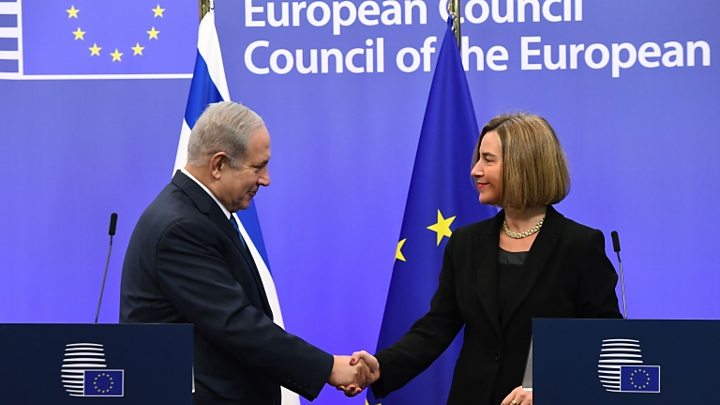
Benjamin Netanyahu and Federuca Mogherini
The pair greeted each other warmly but had different things to say on Jerusalem

Israeli PM Benjamin Netanyahu says he expects European countries to follow the US in recognising Jerusalem as his country's capital.

He is in Brussels for talks - the first time an Israeli prime minister has visited the city in more than 20 years.

But the EU's foreign policy chief, Federica Mogherini says the bloc's stance on the matter is unchanged.

Donald Trump's move has left the US isolated on a highly sensitive issue between Israel and the Palestinians.

Arriving in Brussels, Mr Netanyahu again welcomed the announcement, saying Jerusalem had been the capital of the Jewish people for 3,000 years and Mr Trump had put "facts squarely on the table".

"I believe that all, or most, European countries will move their embassies to Jerusalem, recognise Jerusalem as Israel's capital and engage robustly with us for security, prosperity and peace," he added.

As well as recognising Jerusalem, President Trump also said he was directing the US state department to begin preparations to move the US embassy from Tel Aviv to Jerusalem.

But Ms Mogherini said the EU would continue to recognise the "international consensus" on Jerusalem.

"We believe that the only realistic solution to the conflict between Israel and Palestine is based on two states with Jerusalem as the capital of both."

She also condemned "all attacks on Jews everywhere in the world".

Before heading to Brussels, Mr Netanyahu met French President Emmanuel Macron in Paris, who urged him to freeze settlement building and to re-engage with Palestinians.
Why Trump's move was controversial

Israel regards Jerusalem as its "eternal and undivided" capital, while the Palestinians claim East Jerusalem - occupied by Israel in the 1967 Middle East war - as the capital of a future Palestinian state.

Israeli sovereignty over Jerusalem has never been recognised internationally, and all countries maintain their embassies in Tel Aviv.


Why the city of Jerusalem matters

According to the 1993 Israel-Palestinian peace accords, the final status of Jerusalem is meant to be discussed in the latter stages of peace talks.

Since 1967, Israel has built a dozen settlements, home to about 200,000 Jews, in East Jerusalem. These are considered illegal under international law, though Israel disputes this.

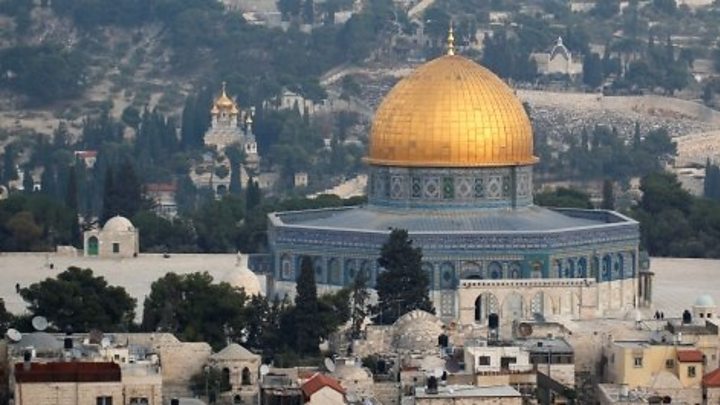
Jerusalem is also home to key religious sites sacred to Judaism, Islam and Christianity, especially in East Jerusalem.

How the world reacted

Mr Trump's announcement drew worldwide condemnation and sparked protests which continued for a fifth day on Monday.

In the West Bank city of Ramallah, Palestinians lobbed stones at Israeli security forces while Lebanese people have been taking to the streets of Beirut.

Dennis Edwards:

Here we see the difference in the American and European point of view. Much of Europe is dependent on Arab oil and perhaps has therefore been more concerned with the Palestinian's wishes in regards to Jerusalem. Or the apparent division between America and Europe on the Palestinian problem may give rise to a Hegelian solution, i.e., you create the problem to later come in with the solution you desire. Bible prophecy indicates, if we are understanding the prophecies correctly, that there will be a Holy Covenant or agreement for a seven year period. Some eschatologists, or people who study Bible prophecy, believe that the the Covenant will be some sort of peace pact between Israel and the Palestinians offering concessions to both sides. Palestine wants autonomy and Israel wants Jerusalem and a Holy Temple. Could the Covenant be a accord that placates both sides. It remains to be seen. But we should be attentive to the developments in Israel because the Holy Covenant is one of the major signs of the times as it ushers in the last seven years before the supernatural return of Christ.

Friday, December 8, 2017

Trump recognizes Jerusalem as capital of Israel in reversal of longtime U.S. policy

By David Nakamura, Washington Post, December 6, 2017

President Trump on Wednesday formally recognized Jerusalem as Israel’s capital, defying warnings from other Middle East countries and some U.S. allies in a politically risky move that he insisted would not derail efforts to broker a peace deal.

But in a sign that the move could backfire, Palestinian President Mahmoud Abbas slammed Trump’s announcement as a “declaration of withdraw” by the United States from the peace process, according to the Associated Press.

In a midday speech at the White House, Trump defended his decision as “long overdue” recognition of reality given that Jerusalem is the seat of Israel’s parliament, supreme court and prime minister’s office. He argued that an agreement between the Israelis and Palestinians has remained elusive for more than two decades even as his predecessors declined to recognize the contested Holy City as Israel’s capital.

“Some say they lacked courage, but they made the best judgment based on the facts as they understood them,” Trump said, speaking in the Diplomatic Reception Room. “Nevertheless, the record is in. After more than two decades, we’re no closer to a lasting peace agreement.”

Trump added that “it’s folly to assume that repeating the exact same formula will produce a different or better result.”
The announcement came a day after senior White House aides previewed Trump’s decision, and the president also ordered the State Department to begin planning to move the U.S. Embassy from Tel Aviv to Jerusalem, a process that administration officials said would take several years. After his remarks, Trump signed another six-month waiver to maintain the embassy compound in Tel Aviv, which senior aides said was meant to ensure funding was not eliminated under a 1995 law even as planning for a new embassy would commence.

Trump emphasized that despite his decision he remained committed to helping broker a peace agreement.

The announcement set off a flurry of reactions in Washington, Europe and the Middle East. Trump spoke with Abbas on Tuesday to inform him of the decision and Abbas told him his government would not accept the move.

Image result for Prime Minister Benjamin Netanyahu on trump 
In Israel, Prime Minister Benjamin Netanyahu hailed the president’s announcement, calling it “a historic day” and stating that his nation is “profoundly grateful for the president for his courageous and just decision.”

Trump campaigned on a promise to move the embassy to Jerusalem, a move popular among evangelicals. A slew of evangelical leaders, including former Arkansas Gov. Mike Huckabee and Robert Jeffress, senior pastor at First Baptist Church in Dallas, released statements of praise on Wednesday.
Dennis Edwards: Here's my analysis of the situation.
Like I explained yesterday the decision by the Trump administration to recognize Jerusalem as Israel's capital  could indeed be a monumental one. Many Bible prophecy eschatologists believe the Antichrist will be involved in confirming a peace pact in the Middle East.[1] This pact is called in Scriptures "the Holy Covenant."[2] The covenant will be confirmed by many for a seven year period.[3] Some have speculated that the Covenant could be the long awaited peace agreement between Israel and the Palestinian people and the rebuilding of the Third Temple in Jerusalem. If we are understanding Scripture correctly the Antichrist is the author or presenter of the Holy Covenant.[4] However, the Antichrist later breaks the Covenant half way through the seven year period.[5] At this point he places something called by Scriptures "the Abomination of Desolation" in the Temple in Jerusalem.[6]
The proclamation by Trump at this present moment seems to push us closer to the point of confirming a Covenant for the rebuilding of the much desired Jewish Temple. The present situation with the Arab nations divided as they are among themselves makes any sort of united retaliation against Israel less likely. Israeli military strategy has been since the 1980s to sow discord among the Arab as confirmed in their own writings. The American military has also been used as an instrument in defeating Israel's enemies as in the case of Iraq and Libya. The American military intelligence that indicated that Saddam Hussein had weapons of mass destruction could easily have been supplied by Israeli secret Mossad agents. The whole "Arab Spring" event may have been instigated by American/Israeli intelligence operatives to bring down Qaddafi and the Syrian leader Assad.
Therefore, with the election of Trump the powers that be behind the scenes saw that it was time to move forward with Jerusalem as capital of Israel. They could give the American evangelicals some leeway in regards to abortion in exchange for their support concerning Israel. Even the recent documentary called "Christ Revealed" promoted a very strongly positive image of Israel and the need for Christians to support the "Promised Land" and its people. 
I believe that this American/Israeli relationship will eventually pit America and Israel against the world led by the Antichrist world leader as seen in the Biblical invasion of Israel as found in Ezekiel 38 and 39 in the Old Testament, or the Battle of Armageddon in the New Testament.[7] Therefore, the announcement of America recognizing Jerusalem as Israel's capital could very well move us further down the road to the Holy Covenant, that seven year agreement of peace which may involve the Jewish nation and the Palestinians. When the Holy Covenant is confirmed, it is broken some three and a half years later.[8] The breaking of the Covenant starts the terrible Great Tribulation period mentioned by Jesus in Matthew 24 in the New Testament.[9]
Stay attentive to these developments. We all have that anxious feeling in our stomachs that the world is headed for disaster. But we deserve it. We have abandoned our Christian principles and embraced vain theories of man, rejecting Biblical instruction and guidelines. Daniel Webster, Secretary of State for three different Presidents warned: 
"If we abide by the principles taught in the Bible, our country will go prospering and to prosper, but if we or our posterity neglect its instruction and authority, no man can tell how sudden a catastrophe may overwhelm us and bury all our glory in profound obscurity."
Notes
[1] Daniel 9:27
[2] Daniel 11:30
[3] Daniel 9:27
[4] Daniel 11:22; 9:27
[5] Daniel 9:27
[6] Daniel 11:31; Daniel 9:27; Matthew 24:15  
[7] Revelation 16:16; Revelation 19:17-21
[8] Daniel 9:27
[9] Matthew 24:15, 21

Thursday, December 7, 2017

Arab warnings mount as U.S. suggests move to declare Jerusalem the capital of Israel

By Loveday Morris, Washington Post, December 4, 2017

JERUSALEM–Arab nations and Palestinian officials have warned of dire consequences if the United States recognises Jerusalem as Israel’s capital, including potential unrest and an end to the peace process, amid last-minute lobbying to prevent President Trump from making the move.

In a late-night call Sunday, Jordan’s foreign minister, Ayman Safadi, warned Secretary of State Rex Tillerson that such a decision could “trigger anger across the Arab and Muslim world, fuel tension and jeopardize peace efforts,” according to Jordan’s state news agency.

Egypt’s foreign minister, Sameh Shoukry, also discussed with Tillerson the “possible negative impacts” on peace, according to a ministry spokesman. He asked that Tillerson avoid taking decisions that could “stir tensions in the region.”

Turkey said a change in policy would be a “major catastrophe.” Palestinian Foreign Minister Riad Malki, meanwhile, called for an emergency meeting of the 22 members of the Arab League, which is expected to take place Tuesday.

“Any U.S. announcement on the status of Jerusalem prior to a final settlement would have a detrimental impact on the peace process and would heighten tensions in the region,” the Saudi ambassador to Washington, Prince Khalid bin Salman, said in a statement, the Reuters news agency reported. “The kingdom’s policy has been and remains in support of the Palestinian people, and this has been communicated to the U.S. administration.”

For more than two decades, successive U.S. presidents have signed a waiver every six months that allows them to delay a move of the embassy from Tel Aviv to Jerusalem on national security grounds. During his campaign, Trump vowed to relocate the U.S. Embassy but reluctantly signed the waiver six months ago as his administration attempts to broker a peace process.

The White House was expected to let Monday’s deadline for the next signing pass unmentioned, a signal that a shift is likely to be in the works. Trump is likely to outline a new policy on Jerusalem and the embassy in a speech Wednesday, an administration official said.
Israel claims Jerusalem in its entirety as its eternal and undivided capital, but Palestinians want East Jerusalem to be the capital of a future Palestinian state.

Despite the critical statements by Jordan and Egypt, Palestinians may find it hard to coordinate genuinely robust opposition at a time when Arab states increasingly see their security interests aligned with Israel’s against their shared enemy, Iran.

In the Knesset on Monday, Israeli Prime Minister Benjamin Netanyahu hailed an “unprecedented” shift in the Arab states’ attitude to Israel.

Jared Kushner, President Trump’s son-in-law and senior adviser, said Sunday that Trump is “close” to making a decision on Jerusalem but is “still looking at a lot of facts.” Israel captured the eastern part of the city from Jordan in 1967 in the Six-Day War, later annexing it in a move considered illegal by the United Nations.

Palestinian officials have warned that recognition of the city as Israel’s capital will end U.S.-brokered peace efforts, which they have already complained appear biased toward Israel. Calling it Israel’s “undivided” capital would mark an even more dramatic step, effectively recognizing Israel’s annexation of East Jerusalem.

Palestinian President Mahmoud Abbas last month expressed surprise after the United States threatened to shutter the Palestine Liberation Organization’s Washington office unless the Palestinians engaged in meaningful peace talks.

Recognizing Jerusalem as Israel’s capital “is offensive and contrary to the role of the U.S. administration as a mediator and sponsor of the peace process,” the Palestinian deputy premier, Ziad Abu Amr, told the U.S. consul general for Jerusalem, Donald Blome, in a meeting in Ramallah on Monday, according to the Palestinian news agency Wafa. It “closes every door to the continuation of a serious peace process, and pushes the entire region into more tension and instability.”

“The status of Jerusalem and Temple Mount have been determined by international agreements,” Turkish Deputy Prime Minister Bekir Bozdag said after a cabinet meeting on Monday, according to Reuters. “It is important to preserve Jerusalem’s status for the sake of protecting peace in the region.”

The State Department has warned embassies of potential unrest and anti-American protests this week related to an announcement, according to U.S. officials.

[Dennis Edwards: The possibility of the United States moving their embassy to Jerusalem could be an instrumental step in pushing the world toward the "Holy Covenant" mentioned in the Bible in the ancient prophecies of Daniel written about 600 BC. These prophecies foretell of a 7 year agreement in the last days which is later broken by the Antichrist's invasion of Israel and his proclaiming Jerusalem as his world capital. Some eschatology scholars have speculated that some sort of Holy agreement about Jerusalem that would permit Israel to build the Third Temple somewhere on or near to the Holy Mount could involve some sort of compromise about the Palestinian problem. It remains to be seen what exactly will happen if America goes ahead with this announcement's proposal and what will develop. Nevertheless, we need to be attentive to these events because they could very well be pushing us down the road toward world government and the rise of the Antichrist to power, and eventually on to Armageddon. Stay alert. Some 80% of Biblical prophecy has already met it's mate in fulfilment. The last 20% will also some day be fulfilled. Are you ready for the prophetic events that may soon overwhelm us? Read my book Where is America in Bible Prophecy? found by clicking on the link. Thanks]

Copyright © Fight for Your Faith