Does your faith need strengthening? Are you confused and wondering if Jesus Christ is really "The Way, the Truth, and the Life?" "Fight for Your Faith" is a blog filled with interesting and thought provoking articles to help you find the answers you are seeking. Jesus said, "Seek and ye shall find." In Jeremiah we read, "Ye shall seek Me, and find Me, when ye shall seek for Me with all your heart." These articles and videos will help you in your search for the Truth.

Thursday, September 14, 2017

9/11 first responders face illness, uncertain future

By Chau Lam, Newsday, September 10, 2017

The day after terrorists attacked the World Trade Center on Sept. 11, 2001, then-New York City police officer Tom Wilson joined thousands of first responders and rescue workers at the Lower Manhattan site searching for survivors.

He spent weeks digging through the ruins at Ground Zero and sorting debris at the Fresh Kill landfill on Staten Island. Now he’s sick, diagnosed with cancer in 2008.

“I had half my tongue cut out,” Wilson said in a recent interview.

The 48-year-old from Bellport is one of thousands of first responders and rescue workers who, a decade and half after the Twin Towers fell, are battling diseases that doctors with the World Trade Center Health Program have associated with exposure to toxic fumes and dust at Ground Zero.

Many are living lives of disability and facing an uncertain future. Others know their fate all too well. Soon, they will join a burgeoning roll call of those whose dedicated service in the days after the nation’s worst terror attacks will likely cost them their lives.

This week, 156 names will be added to the memorial walls in a Nesconset park, bringing the total number of first responders who died from illnesses linked to their work at Ground Zero to more than 850, according to John Feal, a 9/11 first responder and president of the FealGood Foundation.

The three walls inside the 9/11 Responders Remembered Park were erected to honor their service.

“I find solace that those names are etched and they’ll be there forever,” Wilson said. “But at the same time, I find it disturbing that it’s just growing and growing.”

Here are the stories of two of the first responders from Long Island whose lives and the lives of their loved ones have been forever altered by their work in the days after 9/11.

Robert Tilearcio. These days, Tina Tilearcio rarely leaves her husband’s bedside. She times her errands and breaks to coincide with his naps.

“I ran to the beach twice when I knew he was sleeping and he wasn’t going to get up,” said Tilearcio, of Massapequa Park.

In the finite amount of time she has remaining with her husband Robert Tilearcio–be it a day, a week, or a month–Tina Tilearcio wants to spend every minute of it with the man she fell in love with more than three decades ago.

Robert Tilearcio, 58, a New York City firefighter, is dying of brain cancer, a disease connected to his work turning over debris searching for survivors and remains in the days and weeks after the attacks on the World Trade Center.

Rounds of radiation and chemotherapy after surgery to remove the tumor kept the disease at bay for more than two years. But on July 11, doctors at Memorial Sloan Kettering Cancer Institute in Manhattan told Robert Tilearcio there was nothing else they could do to treat his cancer–glioblastoma, a fast-spreading malignancy.

“We started crying,” said Tina Tilearcio, 53.

On the Tuesday when terrorists crashed two commercial planes into the Twin Towers, Robert Tilearcio and fellow firefighters at Engine 266 in Far Rockaway drove toward the Lower Manhattan site. He spent two days looking for survivors and searching for remains of fellow firefighters and the men and women who perished when the buildings collapsed.

“He didn’t have any masks, nothing,” said Tina Tilearcio.

For at least a month after that, Tina Tilearcio said her husband worked 24-hour shifts, came home for about eight hours, and returned to Ground Zero.

“Just enough time to sleep, shower, and go back,” she said.

For more than a decade, Robert Tilearcio continued to work, switching to light duty whenever symptoms of his growing list of ailments, including gastroesophageal acid reflux, or GERD, and difficulty breathing, prevented him from fighting fires.

Then, on April 29, 2015, Robert Tilearcio came home from work, mowed the lawn and showered. He and his wife, a real-estate agent, were about to leave to show houses to prospective buyers.

“And, all of a sudden he screamed from the top of his lungs, and threw his hands up in the air, ‘Oh my God. Oh my God’, as loud as he could,” Tina Tilearcio recalled. “He did like a ballerina turn. I managed to grab him by his pants and eased him down so his head wouldn’t hit the ceramic tiles.”

At St. Joseph’s Hospital in Bethpage, doctors found a tumor the size of a chestnut on his brain. The official diagnosis came on May 8, 2015.

“They said he had 18 months,” Tina Tilearcio said.

“I wish that somebody out there could find a cure, and a miracle could happen,” Tina Tilearcio said.

Tom Wilson. When Tom Wilson learned he had cancer in 2008, the father of four young boys had just welcomed a newborn daughter into the world.

He was only 39.

“I said I could die from this,” said Wilson, a former New York City Police officer who is now working for the Suffolk County Police Department.

Although currently cancer-free, Wilson continues to struggle with the side effects of the radiation used to treat his cancer and the occasional scare that the disease might return.

“One year, my tongue blew up to the size of a lemon. I couldn’t breathe,” Wilson said. “Over the years, I get these flare-ups. I can’t swallow.”

One such episode in December 2016 was so bad he couldn’t open his mouth or move his jaw, Wilson said.

Less than six months later, doctors at the Stony Brook WTC Wellness Program diagnosed Wilson with osteoradionecrosis or dead bone.

“Radiation not only kills the cancer cells, but it kills the good stuff around it,” said Wilson. “Basically, certain areas of my jaw [are] turning into sawdust.”

Wilson is taking medication that helps change the viscosity of his blood.

“Hopefully that slows it down,” Wilson said. “But I got to be careful with the jaw. It’s very fragile.”

So, wrestling with his four rambunctious sons and daughter, which he used to love to do, is out of the question.

“I got to limit my physical activity. That takes a toll,” said Wilson. “I try to put up a front because you don’t want to bring your kids down.”

Wilson’s teeth are beginning to fall out, but implants are not possible because he said the blood vessels in the jawbone don’t regenerate. His fear, Wilson said, is the day when the jawbone cracks.

“So, when my jaw does fracture, I’d have to take a piece of (bone from) my leg area and rebuild it,” he said.

For right now, Wilson is thankful to be alive and around to watch his children, ages 9 to 16, grow up.

Israel Endorses Independent Kurdish State

(Reuters) Israel supports the establishment of a Kurdish state, Prime Minister Benjamin Netanyahu said on Wednesday, as Kurds in Iraq gear up for a referendum on independence that lawmakers in Baghdad oppose.

Here's an excerpt from the Wikipedia article about Oden Yinon's plan for greater Israel.

Oded Yinon's 1982 "Zionist Plan for the Middle East"

The term Yinon Plan refers to an article published in February 1982 in the Hebrew journal Kivunim ("Directions") entitled 'A Strategy for Israel in the 1980s'.[1] Kivunim was a quarterly periodical[2] dedicated to the study of Judaism and Zionism which appeared between 1978 and 1987,[3] and was published by the World Zionist Organization's department of Information in Jerusalem.[4] The article was penned by Oded Yinon, reputedly a former advisor to Ariel Sharon,[5], a former senior official with the Israeli Foreign Ministry[6][7][8][9] and journalist for the Jerusalem Post.[10]It is cited as an early example of characterizing political projects in the Middle East in terms of a logic of sectarian divisions.[11] Otherwise, it was mentioned in conspiracy theories according to which the article either predicted or planned major political events in the Middle East since the 1980s, including the 2003 invasion of Iraq and the overthrowing of Saddam Hussein, the Syrian Civil War and the rise of the Islamic State. Some conspiracy theories claim the article was adopted by members of the Institute for Zionist Strategies in the American administration until it was adopted by the Bush administration as a way to further American interests in the Middle East, as well as achieving the Jewish dream of a state "from the brook of Egypt to the Euphrates", encompassing the majority of the Middle East, as written in the Hebrew Bible.[12]

In his article Yinon proceeds to analyze the weaknesses of Arab countries, by citing what he perceives to be flaws in their national and social structures, concluding that Israel should aim to bring about the fragmentation of the Arab world into a mosaic of ethnic and confessional groupings.[8] 'Every kind of inter-Arab confrontation,' he argued, would prove to be advantageous to Israel in the short term.

[18]Iraq

Yinon considered Iraq, with its oil wealth, to be Israel's greatest threat. He believed that the Iran-Iraq war would split up Iraq, whose dissolution should be a strategic Israeli aim, and he envisaged the emergence of three ethnic centres, of Shiites governing from Basra, the Sunni from Baghdad, and the Kurds with a capital in Mosul, each area run along the lines of the administrative divisions of the former Ottoman Empire.[18]

Linda S. Heard, writing for CounterPunch in 2006, reviewed recent policies under George W. Bush such as the war on terror, and events in the Middle East from the Iran-Iraq war to the Invasion of Iraq in 2003, and concluded:

There is one thing that we do know. Oded Yinon's 1982 "Zionist Plan for the Middle East" is in large part taking shape. Is this pure coincidence? Was Yinon a gifted psychic? Perhaps! Alternatively, we in the West are victims of a long-held agenda not of our making and without doubt not in our interests.[18] https://en.wikipedia.org/wiki/Yinon_Plan

Tuesday, September 12, 2017

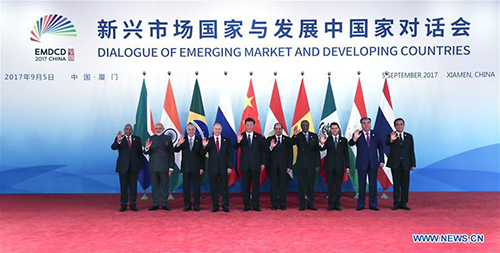
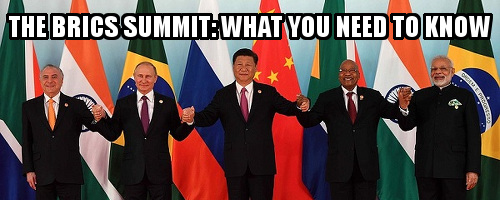
The BRICS Summit: What You Need to Know


by James Corbett
corbettreport.com
September 9, 2017

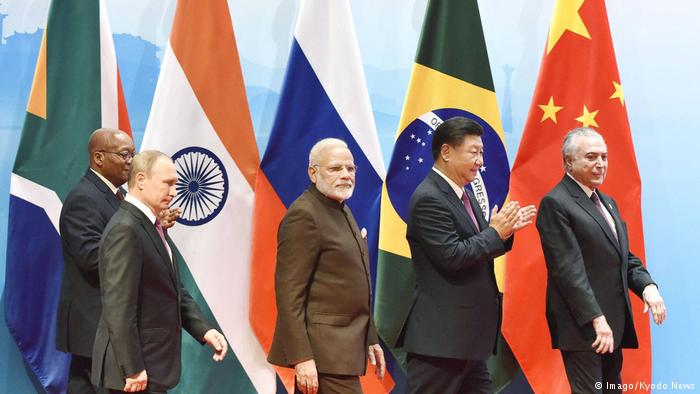
The leaders of the so-called "BRICS" nations converged on Xiamen in Southeast China this week to convene the Ninth BRICS Summit, the annual get-together for the association. And to the surprise of absolutely no one, the event kicked off with a joint declaration full of the usual mealymouthed dipolomatic gobbledygook that was immediately hailed by the members' state-run media mouthpieces as the start of the group's second "golden decade" and (say it with me) "paving the way for a new world order."

Yay.

But, buried in among all the feelgood diplobabble were a few nuggets of significance, as predictably undigestible as those nuggets may be.

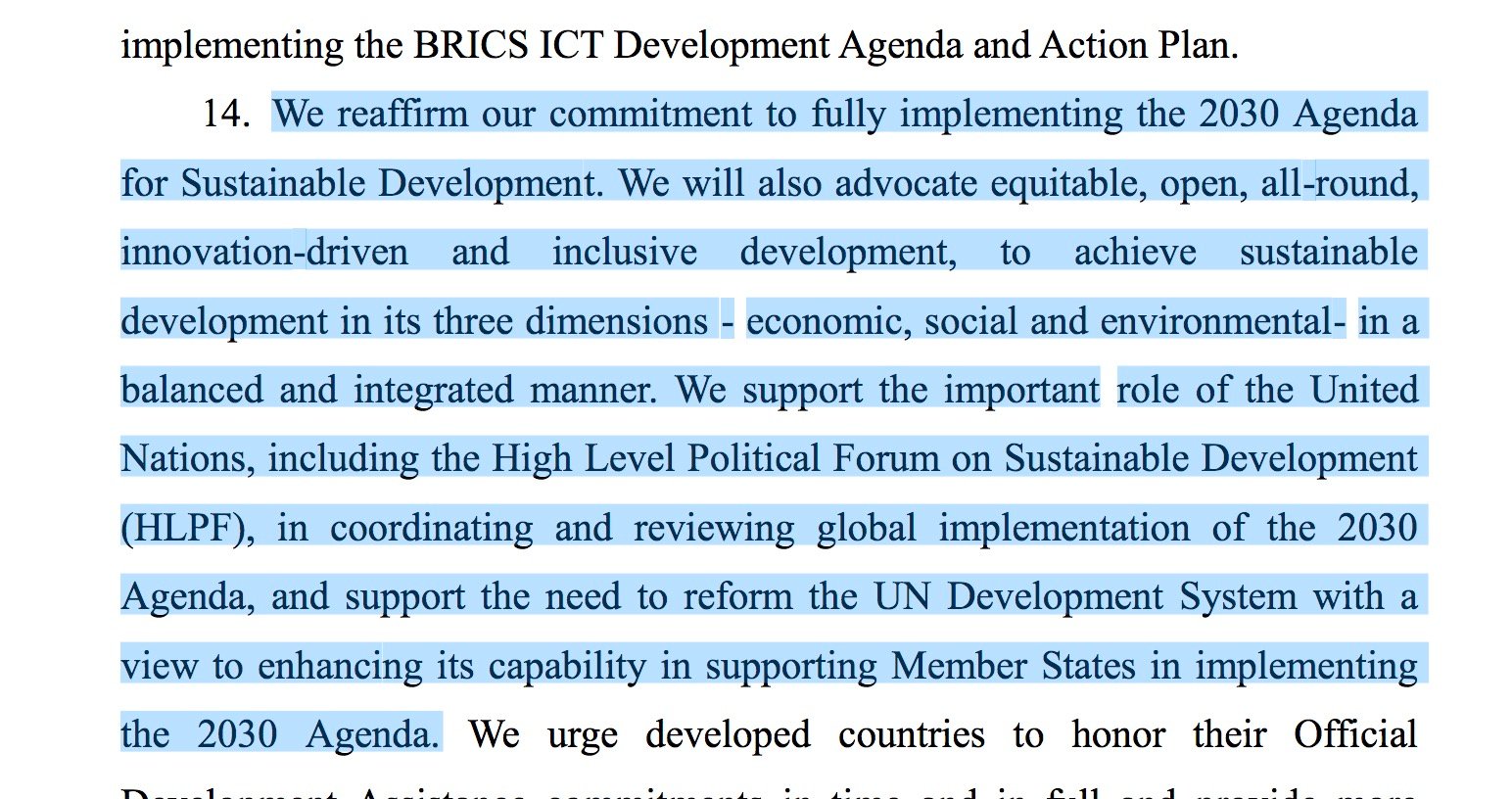
Like the BRICS' reaffirmation of commitment to the UN and their "sustainable development" scam, Agenda 21/2030:


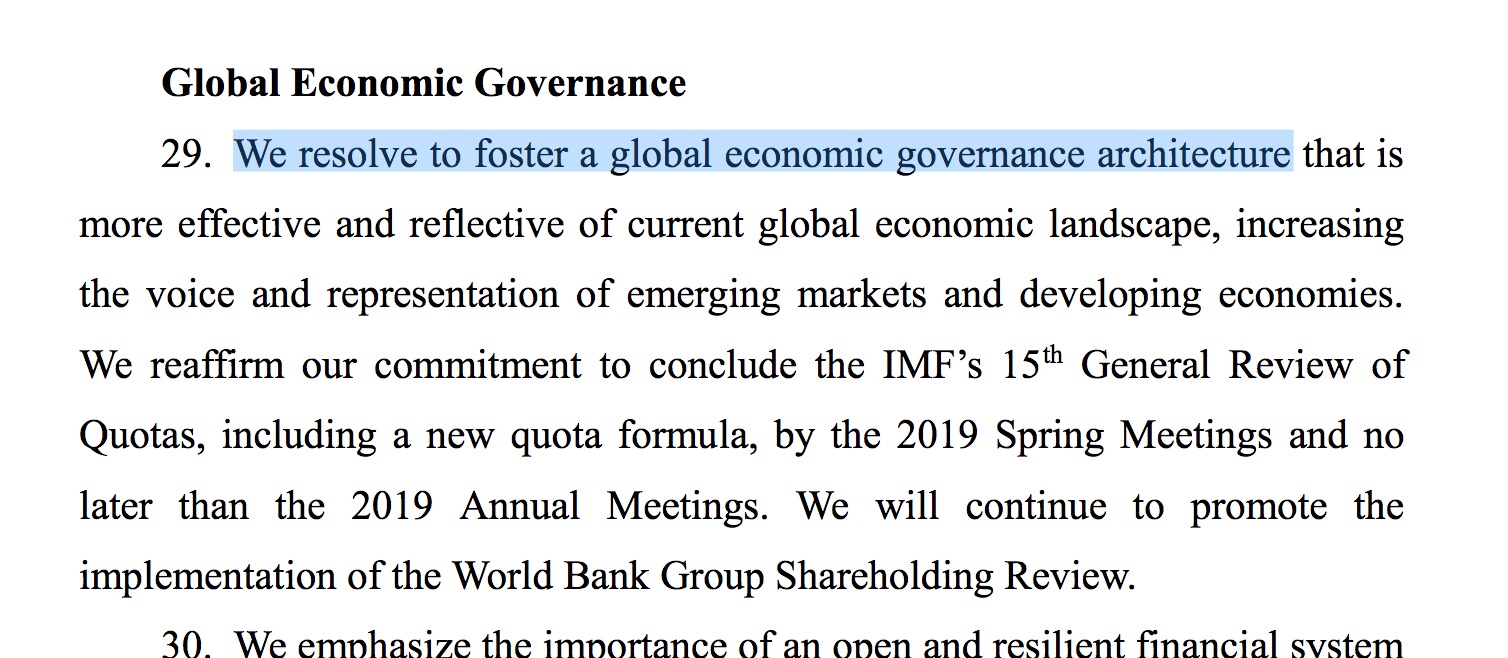
And their resolve to foster a "global economic governance architecture," complete with an obligatory curtsy and ring-kissing of their IMF/World Bank masters:


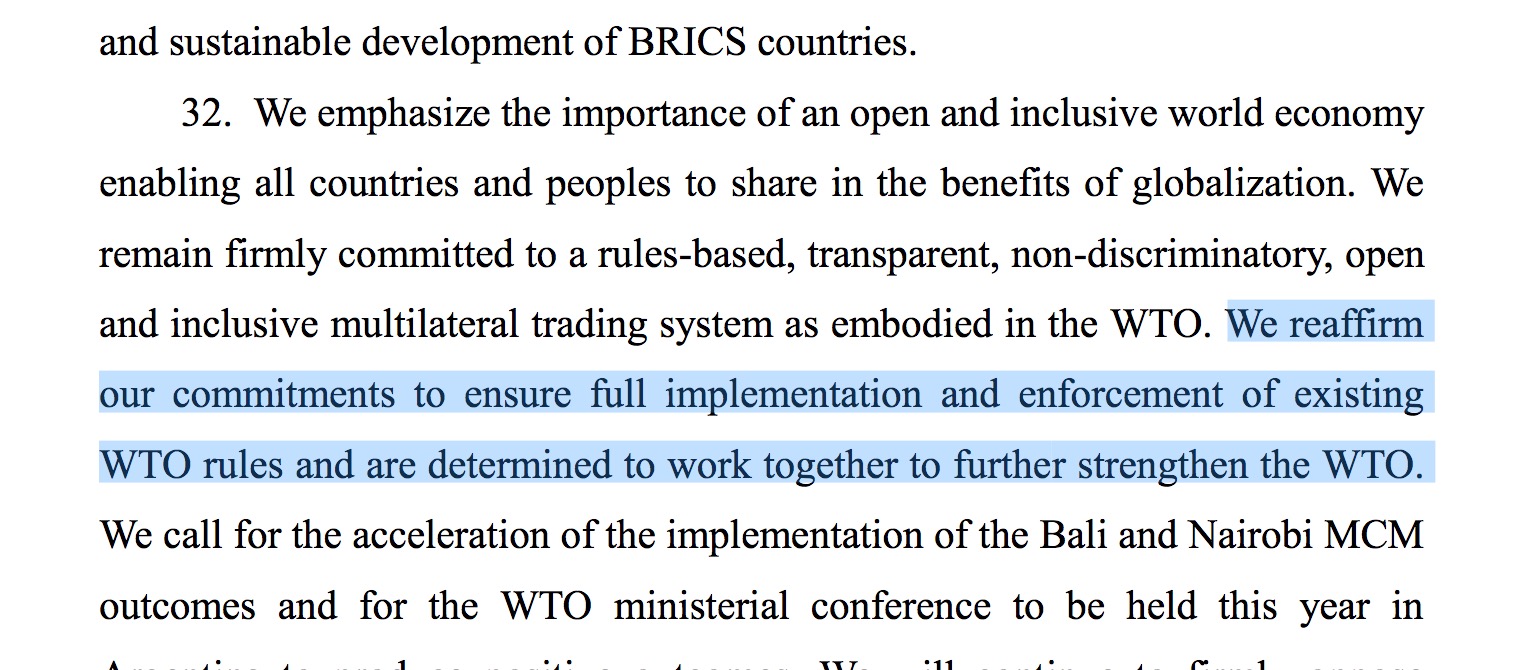
And their genuflection to the World Trade Organization:


Barf.

But, like it or not, the summit did generate some actual news worthy of some scrutiny, so in the interest of keeping you informed, here are the most important stories to emerge from this year's BRICS Summit.

Beijing Betrays Belt-and-Road Buddies?


One item from the joint declaration of actual news significance was buried halfway through the lengthy document, right after a discussion of the (in)security situation in Afghanistan. Blink and you'd miss it, but there in paragraph 48 is a little diplomatic bombshell alternately described as a "breakthrough" and a "betrayal."


"We, in this regard, express concern on the security situation in the region and violence caused by the Taliban, ISIL/DAISH, Al-Qaida and its affiliates including Eastern Turkistan Islamic Movement, Islamic Movement of Uzbekistan, the Haqqani network, Lashkar-e-Taiba, Jaish-e-Mohammad, TTP and Hizb ut-Tahrir."

For those unfamiliar with the groups named in this sentence and their affiliations, this otherwise innocuous clause condemning terrorism is a "breakthrough" for India, because they have tried (and failed) to get the BRICS to condemn Pakistani terror groups like the Haqqani network and Lashkar-e-Taiba (LeT) for some time now. Just the naming of these names as threats to the security of the region is a huge boost for India's position relative to its arch-nemesis, Pakistan, and is widely seen as diplomatic coup for New Delhi.

The sentence is seen as a "betrayal" by Pakistan, however, because that country had every reason to believe until now that it was in a blossoming relationship with China. They are partners in the highly lucrative China-Pakistan Economic Corridor (CPEC), after all, and Islamabad has been using Beijing as a diplomatic shield against Washington as Trump does his Obama Surge 2.0.

Indeed, it's hard not to see this clause as a clear win for India. Just a few months ago India was boycotting the Belt and Road Forum in protest of the CPEC and coming close to military confrontation with China over a seemingly insignificant mountain pass in Doklam, and now China has publicly chewed out their arch-rivals on the global stage. Don't expect China to completely abandon Pakistan politically, but this does indicate that Beijing is willing to use the stick as well as the carrot in their international dealings.

The Sidelines At Center Stage


At any major international summit, the bilateral meetings taking place on the sidelines of the main conference are where a lot of the real action can be found.

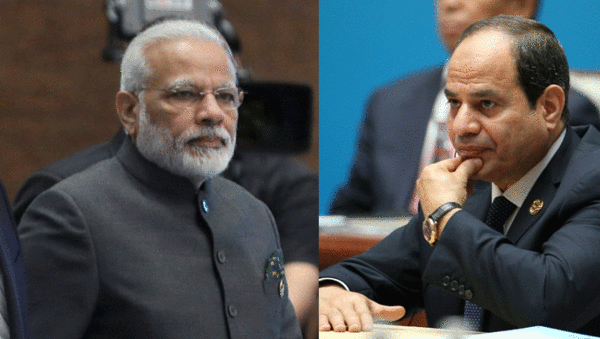
Once again the big winner of the sideline events appears to be Prime Minister Narendra Modi and the Indian people he claims to represent. After much "will they, won't they?" speculation it was finally confirmed that, yes, indeed, Chinese President Xi Jinping would meet with Modi for the two leaders' first substantive bilateral talks. Details of the deliberations were, as always, maddeningly vague, but at the very least indicated that the two powers are not on the edge of all-out warfare, as seemed possible during the Doklam standoff mere weeks ago.

One non-BRICS member getting in on the action was Egypt, with Egyptian President Abdel-Fattah al-Sisi meeting Russian President Vladimir Putin on the sidelines of the summit on Monday. The two discussed "boosting bilateral cooperation and other issues of mutual interest," including, understandably, the security situation at Cairo airport, scene of the October 2015 Russian plane crash that killed over 200 people, mostly Russians. Sisi also got to burnish his diplomatic credentials with a sideline meeting with Modi where the two, predictably, vowed to "strengthen ties."

BRICS Plus?


So what was Egypt doing at the BRICS Summit anyway? Or Mexico, Guinea, Thailand and Tajikistan, for that matter? Well, it's called "BRICS Plus," and it's a concept put forward by Chinese Foreign Minister Wang Yi last March. Employing the universal language of diplospeak, Wang explained that China wanted to "explore modalities" of an expanded BRICS grouping, adding: "We hope to establish extensive partnerships and widen our circle of friends to turn it into the most impactful platform for South-South cooperation."

That vision took shape at the Xiamen summit with China's invitation for "dialogue" with Mexico, Egypt, Guinea, Thailand and Tajikistan. The idea is to expand the BRICS' reach and bring more of the developing world into the fold.

The plan may have already hit a road bump, however. The idea has been heavily criticized by "existing members" (read: India) and China has reportedly backed off the idea to make these dialogue partnerships an ongoing part of the BRICS Summit. Of course, this by no means signals an end to China's interest in expanding the global reach of its diplomatic and economic ties, and India should tread carefully on ideas that expand the scope (and thus the relevance) of the BRICS. If the BRICS becomes an impediment to China's global ambitions it may just be left to wither on the vine.

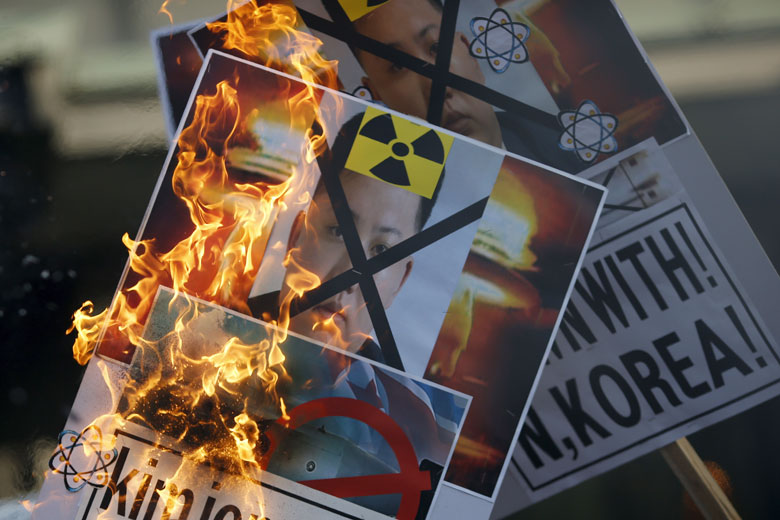
No Nuking NK!


The real determinants of what happens on the Korean peninsula remain (much to the detriment of the Korean people) powers other than North or South Korea. Namely China and the US (and to some extent Russia and Japan). Given the Russian and Chinese backbone of the BRICS, it's no surprise, then, that the North Korean situation was one of the topics that was front and center at the shindig.

As the joint declaration put it:


"We strongly deplore the nuclear test conducted by the DPRK. We express deep concern over the ongoing tension and prolonged nuclear issue on the Korean Peninsula, and emphasize that it should only be settled through peaceful means and direct dialogue of all the parties concerned."

This remains the line in the sand for both Russia and China: There is no military solution to the Korean crisis.

Putin has floated an idea for a gas pipeline to Korea and the connection of the North and South Korean energy grid and railway systems (an idea that, incidentally, was first floated by Maurice Strong over a decade ago). Meanwhile, Xi is calling on France to get involved and give the whole situation a diplomatic restart. But both Xi and Putin are adamant: no military solution.

As Pepe Escobar puts it in his article on "The real BRICS bombshell:"


"Beijing has imposed a definitive veto on war – of which the Pentagon is very much aware.

"Pyongyang’s sixth nuclear test, although planned way in advance, happened only three days after two nuclear-capable US B-1B strategic bombers conducted their own 'test' alongside four F-35Bs and a few Japanese F-15s.

"Everyone familiar with the Korean peninsula chessboard knew there would be a DPRK response to these barely disguised 'decapitation' tests.

"So it’s back to the only sound proposition on the table: the RC 'double freeze.' Freeze on US/Japan/South Korea military drills; freeze on North Korea’s nuclear program; diplomacy takes over."

And Last but not Least...


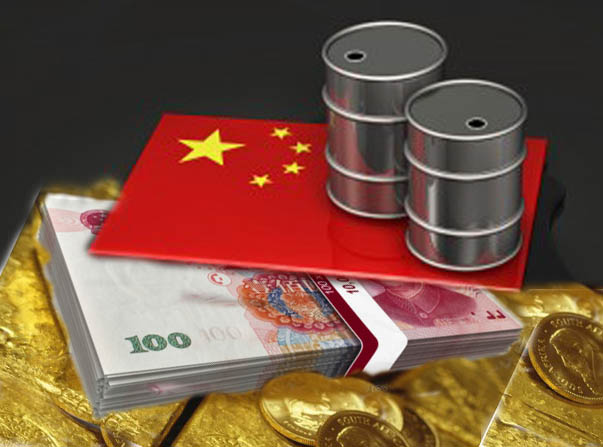
The biggest news to emerge during the summit was not directly part of the summit at all, but in some way is a reflection of the topsy-turvy period of global geo-economic reorientation we are living through. I am referring, of course, to the yuan/oil/gold earthquake that is about to shake the monetary world.

If you saw my recent video on the subject you already know the story, but in a nutshell China is about to ring in a (say it with me) "new world order" with their Shanghai International Energy Exchange. The exchange will offer crude oil contracts denominated in yuan, which "will be fully convertible into gold on exchanges in Shanghai and Hong Kong." As Grant Williams points out in his important overview of the story (h/t Corbett Report user Ukdavec), the ability for a country like, oh, let's say, Russia, to sell oil to China directly for yuan (no dollars involved) and convert that yuan to gold effectively completely severs all the links to the US government, US banking system, US treasuries and US dollar that has underpinned the unipolar world of the post-Bretton petrodollar. It is difficult to overstate the significance of this event...

But, having said that, this story is beyond the bounds of this BRICS update. Suffice it to say, if the BRICS want to become the real beginning of an actually multipolar alternative to the US hegemony, something like the yuan/oil/gold triangle would have to be in place. And here it is. Fancy that.

Now, as always, I have to re-re-restate the ground level truth: The BRICS are a phoney opposition literally created by Goldman Sachs whose pseudo-alternative institutions are run by the very same bankers and bureaucrats they pretend to oppose. The cold war of the 21st century is being engineered in the exact same way that the cold war of the 20th was. And, as always, whichever "side" wins this "fight," the oligarchs and their systems of control will come out on top.

But make no mistake: the cold war, engineered as it is, is here. And meetings like the BRICS Summit are where we catch the first glimpses of it.

Friday, September 8, 2017

Wednesday, September 6, 2017

Tuesday, September 5, 2017

Albert Einstein's belief in Intelligent Design!

Dennis Edwards

Albert Einstein rejected Judaism and traditional Christian churchianity, but he was serious scientist willing to accept where the evidence led and change his mind when he was wrong. At one point, he was a believer in the "Steady State Universe" developed by Fredrick Hoyle the British mathematician and astronomer. This idea started with the assumption that the universe was static and had always existed, that it had no beginning. However, after a famous solar eclipse in the beginning of the 20th century, scientists were able to prove through observation that light was effected by gravity. This fact led to the development of the "Big Bang" theory, so named by Fred Hoyle whose theory it overthrew. Einstein stated that it would have been a bigger error to cling to an idea that was shown to be wrong, than to have believed the idea in the first place. 

However, Einstein's work in the mathematics and physics led him to a deep conviction that the universe was not the result of random processes. He said, "We are in the position of a little child entering a huge library filled with books in many different languages. [Here he is alluding to the different scientific equations that we use to describe the various forces of nature that we find, such as: gravity, the strong and weak nuclear forces, the speed of light, the chemical equations of the elements, etc. Einstein continues.] The child knows someone must have written these books. It does not know how. [In other words, Someone must have written the various laws of science - which, following his line of thought, should have led him to a personal Divine Being. But his prejudice against Judaism and organised Churchianity, led him to reject that hypothesis and procure belief in a type of impersonal universal force. He goes on to continue his thought.] It (the child) does not understand the languages in which they (the books) are written. The child dimly suspects a mysterious order in the arrangement of the books, but doesn't know what it is. That it seems to me, is the attitude of even the most intelligent being toward God. We see a universe marvellously arranged and obeying certain laws, but only dimly understand those laws. Our limited minds cannot grasp the mysterious force that moves the constellations."[1]


Werner Von Braun, the German Aerospace Engineer which helped the USA develop the rockets that enabled the launching of America into space, said something very similar to Einstein. He said, "For me, the idea of a creation is not conceivable without invoking the necessity of design. One cannot be exposed to the law and order of the universe without concluding that there must be design and purpose behind it all...My experience with science led me to God. They challenge science to prove the existence of God. But must we light a candle to see the sun?"[2]

Of course these men were not the first to come to this conclusion. Isaac Newton who discovered the law of gravity and is considered by many as the greatest of the early scientists said, "This most beautiful system of the sun, planets, and comets, could only proceed from the counsel and dominion of an intelligent and powerful Being. [Here we see Newton coming to the conclusion of a personal God. However, he did not embrace churchianity of his day.] This Being governs all things, not as the soul of the world,[Here we see Newton refuting the Greek and Eastern concept of "God" being the impersonal force of the natural world.], but as Lord over all; and on account of His dominion He is wont to be called Lord God, or Universal Ruler."[3]

Following Newton, we can read from the writings of Thomas Jefferson on his thoughts relating to this topic. Again, Jefferson was not a traditional believer in the "God" of the Bible and rejected the miracles recorded therein. However, he comes to the same conclusion as Newton. He wrote, "So irresistible are these evidences of an intelligent and powerful Agent [He could have been reading Newton.] that, of the infinite numbers of men who have existed through all time, they have believed, in the proportion of a million to one, in the hypothesis of an eternal pre-existence of a Creator, rather than in that of a self-existent universe."[4]

Sometime later, Abraham Lincoln made the following declaration: "I can see how it is possible for a man to look down upon the earth and be an atheist, but I cannot conceive how he could look up into the heaven and say, 'There is no God.'"[5]

Some 2,800 earlier than Lincoln, in the Book of Psalms found in the Hebrew Bible, we find these words in a Jewish hymn. "The heavens declare the glory of God and the firmament shows His handiwork. Day unto day they speak, night unto night they reveal knowledge. There is no land or language where their voice is not heard."[6] The psalmist is eluding to the magnificent celestial bodies that cause us to stand in awe and ponder our significance in lieu of their awesomeness.

Einstein would draw the same conclusion. He wrote, "Scientist's religious feelings take the form of rapturous amazement at the harmony of natural law, which reveals an intelligence of such superiority that, compared with all systematic thinking and acting of human beings is an utterly insignificant reflection."[7] He also said,"Everyone who is seriously interested in the pursuit of science becomes convinced that a spirit is manifest in the laws of the universe - a spirit vastly superior to man, and one in the face of which our modest powers must feel humble."[8] 


Have you come to the right conclusions? Are your biases against the organised religious system of today causing you to reject the intelligent and powerful Being who created the universe? Maybe you need to have another think. When asked to criticize the validity of the New Testament and agree with the conclusions of a skeptic regarding Christianity, Einstein surprisingly responded: "I am enthralled by the luminous figure of the Nazarene....No one can read the Gospels [found in the New Testament] without feeling the actual presence of Jesus. His personality pulsates in every word. No myth is filled with such life."[9]

Have you given the real Jesus, found in the pages of the Gospels a fair chance? Or have you rejected him because of the religious system of today and of the past? Please, take another look. Put aside your prejudice against Christianity and read Jesus for himself. Read his own words found in the writings of Matthew, Mark, Luke and John. I assure you, if you take the time to investigate Jesus with an open and honest heart, you will be surprised at what you find.

Notes

[1] Einstein, Albert; 
[2] Von Braun, Werner; 
[3] Newton, Isaac; The Principles; 
[4] Jefferson, Thomas;
[5] Lincoln, Abraham;
[6] Psalm 19, Hebrew and Christian Bible
[7] Einstein, Albert; The World as I See It.
[8] Einstein, Albert;                                                            [9] Einstein, Albert;


Monday, September 4, 2017

Copyright © Fight for Your Faith